-Hanoman raises prospect of murder charge in Fagundes case
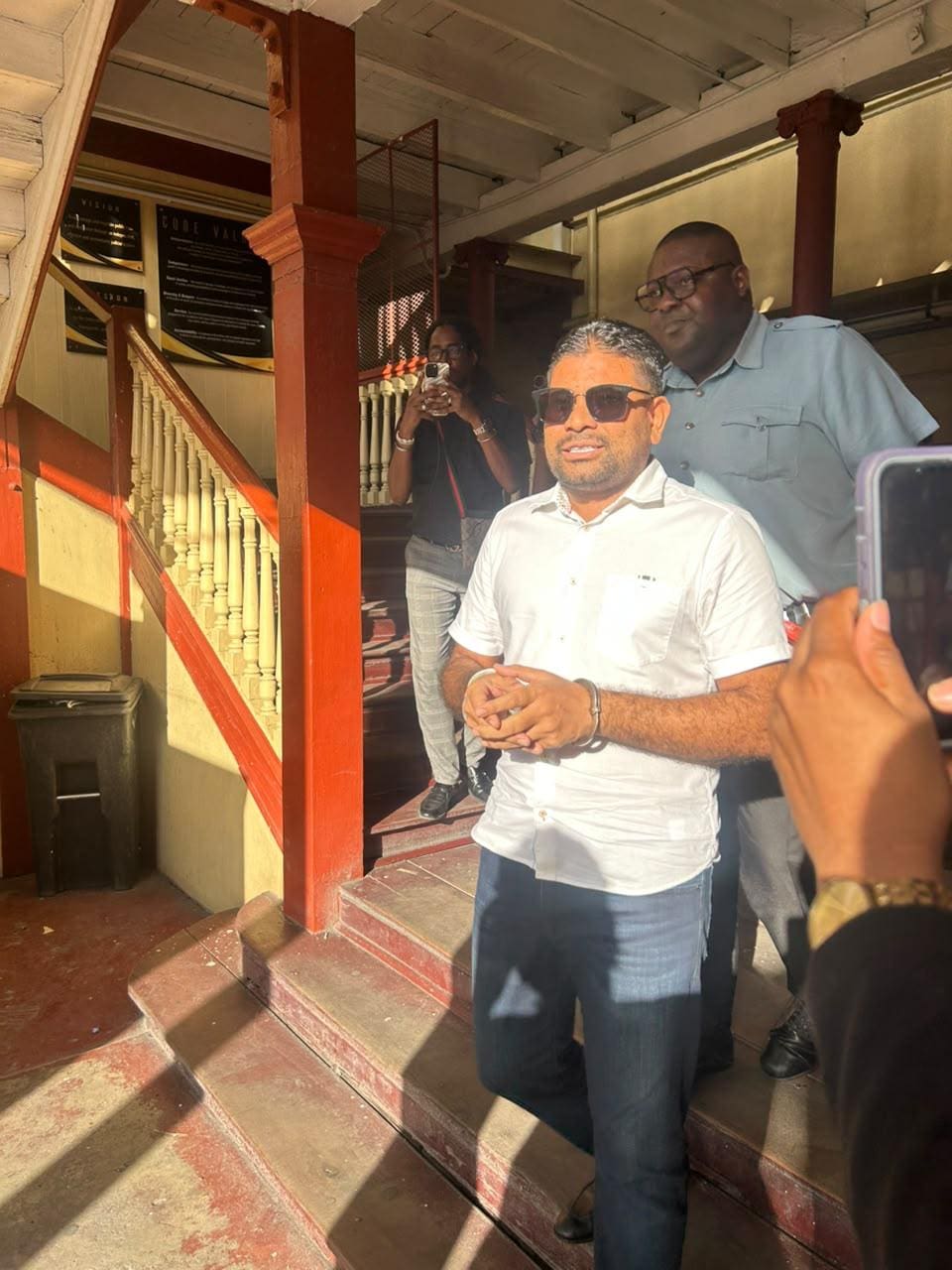
Following strong opposition from defence lawyers to prosecution arguments that included the prospect of further criminal charges, Chief Magistrate Judy Latchman on Tuesday declined for a second consecutive day to revoke Opposition Leader Azruddin Mohamed’s bail in his extradition proceedings.
Magistrate Latchman ruled that breaches of his bail conditions had not been established and that there were no substantial grounds to justify revocation. She also found no evidence that Mohamed was a flight risk or had supplied the court with an incorrect address.
The hearing at the Georgetown Magistrate’s Court featured sharp exchanges between prosecutor Glen Hanoman and defence attorneys Siand Dhurjon and Roysdale Forde over allegations of witness interference, evidence tampering and political victimisation.
As the prosecution presented its arguments, Mohamed’s father and co-defendant, Nazar Mohamed, broke into tears. At one point, he called out in defence of his son: “He is being victimized, he is innocent of all these charges!”
Magistrate Latchman asked the elder Mohamed to try to control himself during the proceedings.
Hanoman, seeking to have the magistrate revisit her decision of the previous day, argued that Azruddin Mohamed had committed further offences while on bail and subject to conditions.
He alleged that within hours of conditions being imposed, Mohamed had appeared outside the United States Embassy and described prosecution witness Senior Superintendent Prem Narine as a murderer and an assassin. He also referred to calls for Narine’s visa to be revoked and for his deportation, characterising the conduct as witness tampering.
Hanoman contended that Mohamed had repeatedly been afforded bail and suggested that this had encouraged a belief that he was above the law.
He told the court that further charges were being contemplated in connection with the 2021 Main Street murder of Ricardo Fagundes, witness tampering, obstruction of justice and cybercrime-related offences. He said persons he described as co-conspirators had already given statements to police.
Those assertions were challenged by the defence. Dhurjon said Mohamed had never been arrested or contacted by police in relation to a murder investigation. If investigators had uncovered serious evidence, he argued, Mohamed was already in custody and available to be questioned.
Dhurjon maintained that there must be proper grounds for revisiting bail and that Hanoman’s assertions could not be treated as the equivalent of sworn affidavit evidence. He also questioned whether the prosecutor was involved in the investigations to which he referred.
Accusing Hanoman of malicious intent, Dhurjon argued that the prosecutor was making allegations as the hearing progressed.
Hanoman also alleged that Mohamed had tampered with evidence by releasing footage of the shooting incident outside Narine’s residence with a false narration and by cropping the video to misrepresent what had occurred.
Dhurjon disputed that characterisation, questioning how the cropping of footage, by itself, amounted to evidence tampering.
“Must Mr Mohamed show the entire 24 hour footage?” he asked.
Hanoman clarified that the prosecution was seeking revocation of Azruddin Mohamed’s bail alone, rather than that of his father. He argued that the cumulative effect of charges brought since bail was granted justified revocation, even if individual charges were not considered serious.
Dhurjon urged the court to take account of what he described as extraordinary allegations by the prosecutor.
Hanoman maintained that the charges had been thoroughly investigated and alleged that Mohamed’s conduct involved bribery and corruption. He further alleged that the Mohameds had bribed governments over decades and argued that the proceedings reflected the loss of protection rather than victimisation.
It was during these submissions that Nazar Mohamed interjected in defence of his son.
Befall
Responding to the allegations concerning Narine, Dhurjon said Mohamed had attended a protest days after the court proceedings relating to the shooting incident. Those present had demanded justice, he said, and had not called for harm to befall Narine.
Dhurjon also alleged that Narine had assaulted Mohamed on the road and said photographs showed his client’s injuries. He argued that the matter illustrated institutional failures.
“Our institutions do not function as they should,” he told the court.
Forde similarly argued that the charges were politically motivated and accused Hanoman of diverting attention from the issues the court had to determine.
He pointed to Mohamed’s position as Opposition Leader and the police’s placement under the Ministry of Home Affairs, questioning whether an ordinary citizen would have been repeatedly charged in similar circumstances.
Addressing the firearm-related allegations, Forde said Mohamed had been recording the use of state resources at Narine’s property and had driven past without stopping.
Hanoman also questioned the address Mohamed had supplied to the court, alleging that police had found him hiding at a relative’s residence.
Magistrate Latchman asked whether a person who gave an address to the court was thereby prohibited from visiting another address.
Dhurjon said no wanted bulletin had been issued for Mohamed and questioned how he was to know police were seeking him. He added that police had not visited Mohamed’s Republic Park address between October 12 and 14.
Hanoman further argued that Mohamed posed a flight risk because he had access to fast helicopters and speedboats.
After hearing the submissions, Magistrate Latchman ruled that the existence of charges did not, by itself, satisfy the court that Mohamed had committed or was likely to commit an offence. Breaches of his bail conditions had to be established, she said.
She found no evidence supporting the allegations that he was a flight risk or had given an incorrect address.
The ruling leaves Mohamed’s bail in the extradition proceedings intact, subject to the existing conditions. It does not determine his custody status in separate criminal proceedings.
Mohamed and his father are contesting extradition to the United States. Their extradition proceedings are scheduled to resume before Magistrate Latchman on November 23.
Meanwhile, a bail application filed by Mohamed’s mother, Bonita Mohamed, is expected to be heard before Justice Priscilla Chandra-Hanif at 9 am today. The application seeks to quash Magistrate Abigail Gibbs’ October 30 decision refusing bail in the surveillance footage case and secure his release on reasonable terms. It alleges apparent bias arising from a connection between Gibbs and an officer involved in investigating the underlying shooting incident, challenges the length of remand and argues that insufficient weight was given to Mohamed’s previous compliance with bail conditions, family responsibilities and established ties to Guyana.
Source: Kiskadee Watch