Home Blog Page 59

Higher operating costs widen gov’t deficit as productive-sector lending falls

0

— BoG report details spending pressures, food-price increases and weaker reserves

The Central Government’s deficit nearly tripled to $105.6 billion during the first half of this year, with the Bank of Guyana’s 2026 Half-Year Report showing sharply higher operating costs alongside declining credit to agriculture, manufacturing and mining.

The assessment adds detail to the fiscal deterioration previously reported by Kiskadee Watch from the Ministry of Finance’s Mid-Year Report. The first-half deficit increased from $35.9 billion in 2025, while the projected annual deficit widened from $448.9 billion to approximately $503.8 billion.

The report attributed higher current expenditure to “higher spending on transfer payments, employment costs, purchases of other goods and services, and interest charges.”

Interest costs rose by 52.7% to $13.77 billion. Goods and services spending increased by 22.5% to $107.26 billion, employment costs by 18.8% to $77.83 billion and transfers by 18.2% to $152.10 billion.

Current expenditure grew by 20.7%, against a 0.8% increase in capital spending. Revenue declined by 0.7%, despite stronger tax collections, as Natural Resource Fund transfers fell.

Borrowing and debt

The government’s borrowing requirements have expanded alongside those costs. Kiskadee Watch reported in September that net external borrowing during the first half increased from $19.1 billion to $71.4 billion, while net domestic borrowing rose from $16.8 billion to $34.3 billion.

APNU, responding to the Finance Ministry’s assessment, called for an explanation of the widening financing gap and disclosure of the measurable returns expected from additional borrowing.

Public and publicly guaranteed debt increased by US$830.2 million during January–June to US$8.573 billion. The projected year-end debt stock of US$10.329 billion would represent an increase of approximately one-third over the end-2025 level, Kiskadee Watch reported

The domestic portfolio is heavily dependent on short-term securities. Treasury bills accounted for 84.4% of domestic debt, and the Finance Ministry’s report said the entire domestic portfolio was subject to interest-rate refixing within one year.

First-half debt-service payments amounted to US$145.7 million, comprising US$101.5 million on external obligations and US$44.2 million on domestic debt.

The Finance Ministry has maintained that borrowing remains within prudent cost and risk limits, pointing to a debt-to-GDP ratio of 28.6% at the end of 2025. The International Monetary Fund has assessed Guyana’s debt-distress risk as low, citing rapid growth, concessional borrowing and relatively low debt-service costs.

Writing in Stabroek News in February, former Auditor General Anand Goolsarran had questioned continued borrowing despite petroleum revenues and urged a medium-term framework for spending. He had also challenged the classification of Natural Resource Fund withdrawals as current revenue, arguing that it presented a more favourable operating position and weakened accountability over the use of oil funds.

Uneven lending

Private-sector credit rose by 11.5% to $592.83 billion, but agriculture credit declined by 3.1%, manufacturing by 4.4% and mining by 16.5%. Mortgage and personal lending expanded by 21.2% and 14.5% respectively.

The lending figures provide another measure of the uneven performance outside of petroleum. Earlier reporting on the Finance Ministry’s assessment recorded construction growth of 24.7%, services growth of 7.2% and manufacturing growth of 3%. Agriculture, forestry and fishing contracted by 0.5%, with other crops declining by 6.4% following prolonged rainfall.

APNU subsequently highlighted the reduction in the full-year non-oil growth forecast from 10.8% to 10.2% and the agriculture forecast from 7.6% to 2.9%. It argued that weather-related losses required greater investment in drainage, irrigation and protection against flooding and drought.

Household costs

Vegetable prices increased by 26.8% between December and June, fruit prices by 13.1% and oils and fats by 6.3%.

Those increases sit within the broader 6.7% rise in food prices previously reported by Kiskadee Watch. Overall consumer prices increased by 4.4% over the six months, with vegetables and vegetable products contributing 2.5 percentage points.

President Irfaan Ali nevertheless defended the government’s inflation management, pointing to the 12-month inflation rate of 4% as at June and increases in international fuel prices. The 12-month rate compares June with June last year; the 4.4% measure records the increase since December.

Gross international reserves fell by US$293.9 million to US$1.062 billion, providing approximately one month of import cover.

The decline comes amid persistent difficulties obtaining foreign currency. Ali acknowledged in September that unmet demand in the banking system exceeded US$200 million, with requests carried forward because banks could not satisfy them all.

He projected demand of US$1.575 billion between September 10 and year-end and identified credit-card settlements, profit repatriation and business expansion as sources of pressure.

Such access problems predate the latest report. Stabroek News had reported in July 2025 that visits to four commercial banks found no US-dollar notes available for sale. Bank of Guyana Governor Dr Gobind Ganga maintained then that aggregate holdings showed no overall shortage, but said banks should provide small amounts for legitimate customer needs.

State enterprises

GUYOIL’s deficit widened from $12 million to $3.02 billion. GPL and GuySuCo recorded deficits of $1.97 billion and $897 million respectively.

The government has presented its spending programme as an investment in long-term transformation. And Stabroek News had reported that the $1.558 trillion budget presented in January was 12.7% larger than the previous year’s, with Finance Minister Dr Ashni Singh citing infrastructure investment and continued economic expansion.

The latest figures, however, put renewed attention on the balance between operating costs, borrowing and productive investment. APNU has called for the government to demonstrate how larger budgets and increased debt will translate into stronger productive sectors and better living standards.


Source: Kiskadee Watch

Linden student, 17, killed in suspected murder-suicide

0

A 17-year-old Linden Technical Institute student was shot dead, allegedly by her boyfriend, who then fatally shot himself at Block 22 Squatting Area, Wismar, Linden, this afternoon.

According to police reports, the deceased have been identified as Toisha Andrew, of Block 22 Squatting Area, and Anthony Kellon Malachi Cato, 21, a worker under the government’s ten-day employment programme, of Phase Three, Murphy Street, Amelia’s Ward, Linden.

Kellon Malachi Cato

According to preliminary information, Andrew had just returned home from school at around 4.30 pm when Cato approached her armed with a handgun. He allegedly discharged a round, striking her in the forehead and causing her to fall to the ground. Cato then reportedly shot himself and fell to the ground, where he remained motionless.

Andrew was taken to the Linden Hospital Complex, where she was pronounced dead on arrival. Cato’s body remained at the scene, with a handgun lying nearby.

Police were processing the scene as investigations continued.


Source: Kiskadee Watch

Mohamed says vehicle searched, damaged after clamping; police cite dangerous driving probe

0

Opposition Leader Azruddin Mohamed yesterday complained that his vehicle was damaged after being clamped at Parika on Saturday and was subsequently searched by police, while the Guyana Police Force said the clamping was part of a dangerous driving investigation.

In a statement which did not name Mohamed, the force said motor vehicle PAB 4000 was clamped near the Parika Stelling on October 10 following reports from commuters that it had been driven dangerously along the Cornelia Ida Public Road, West Coast Demerara.

“The clamping of the vehicle was therefore undertaken to facilitate the investigation and was not based on the identity or status of the vehicle’s occupant,” police said.

Mohamed, however, questioned the police action and alleged that a traffic matter had escalated into a search of his vehicle for illegal firearms and ammunition. In posts on his Facebook page yesterday, he also alleged that the vehicle had been stoned while it remained clamped at Parika.

According to his account, the driver, identified only as Mr Macpherson, had been travelling to Parika to collect him and his team following a visit to Essequibo. Mohamed said the driver was charged with dangerous driving, held for approximately seven hours and released on $50,000 station bail. He is expected to appear in court on Wednesday, Mohamed added.

While Mohamed’s post described the alleged traffic offence as overtaking, police said the reports concerned undertaking several vehicles.

The force said it had reviewed footage from the Safe Country Camera network which corroborated the commuters’ reports. According to police, the footage showed PAB 4000 being driven dangerously at approximately 3.15 pm on Saturday while travelling west along the Cornelia Ida Public Road.

Police said the driver was being investigated for dangerous driving under Section 36(1) of the Motor Vehicles and Road Traffic Act. Their statement did not identify the driver or announce a charge, bail or a court date.

In a separate post, Mohamed said that when he returned to collect the vehicle on Monday, its bonnet was visibly dented and a sizeable stone was lying nearby. His post said eyewitnesses had reported seeing police patrolling the area on Sunday.

“A vehicle in police custody should be secured and protected, not returned damaged,” the post stated, asking how the damage had occurred and who would be held accountable.

Mohamed further reported that nearly a dozen officers subsequently searched the vehicle before the wheel clamps were removed. An officer speaking in the video posted by Mohamed said they had received reports that the vehicle had an illegal firearm and that they were going to search for it. The officers then conducted a search of the vehicle.  In the video, Mohamed later said the search had been completed and nothing was found.

He said the same vehicle had previously spent more than 30 days in police custody, after he was detained along with members of his staff at the Leonora Police Station, and alleged that his vehicles had been searched repeatedly for illegal firearms and ammunition.

Accusing President Irfaan Ali of using the force against him, Mohamed questioned the deployment of police resources to search the vehicle following a traffic complaint.

“Traffic enforcement must not become a pretext for disproportionate police action, and law enforcement resources must serve the public fairly and impartially,” his post stated.

The police release addressed the dangerous driving investigation and the reason for clamping the vehicle but did not address Mohamed’s allegations about the subsequent search or damage.

The force maintained that it was enforcing traffic laws impartially and said all road users were required to comply with the law.


Source: Kiskadee Watch

Ali announces preferential agricultural loans initiative at Farmers Conference

0

President Irfaan Ali yesterday shared that Republic Bank has committed to setting aside funding for agricultural loans and that preferential rates were being negotiated, as the government seeks to expand local food production, attract investment and reduce dependence on imports.

Ali made the announcement while delivering the feature address at the Ministry of Agriculture’s Farmers’ Conference 2026 at the Arthur Chung Conference Centre, Liliendaal, Greater Georgetown.

The President said the government was negotiating with commercial banks to introduce incentives, which would allow farmers seeking to establish medium and large-scale operations to access financing at more affordable rates.

“We have currently brought all of the commercial banks together and we are currently negotiating with them to offer the same type of incentive… [offered] for low-income housing… for loans to agriculture,” Ali said.

He added that Republic Bank had already committed to allocating resources for agricultural loans, although the preferential interest rate was still being negotiated. The recently launched Guyana Development Bank, he said, was already attracting interest from the agricultural sector, with almost 30 percent of applications received coming from agriculture-related businesses.

He said the level of interest reflected growing confidence in agriculture as a viable investment opportunity, adding that it contrasted with the situation in 2020, when some farmers and poultry producers were scaling back operations or leaving the sector.

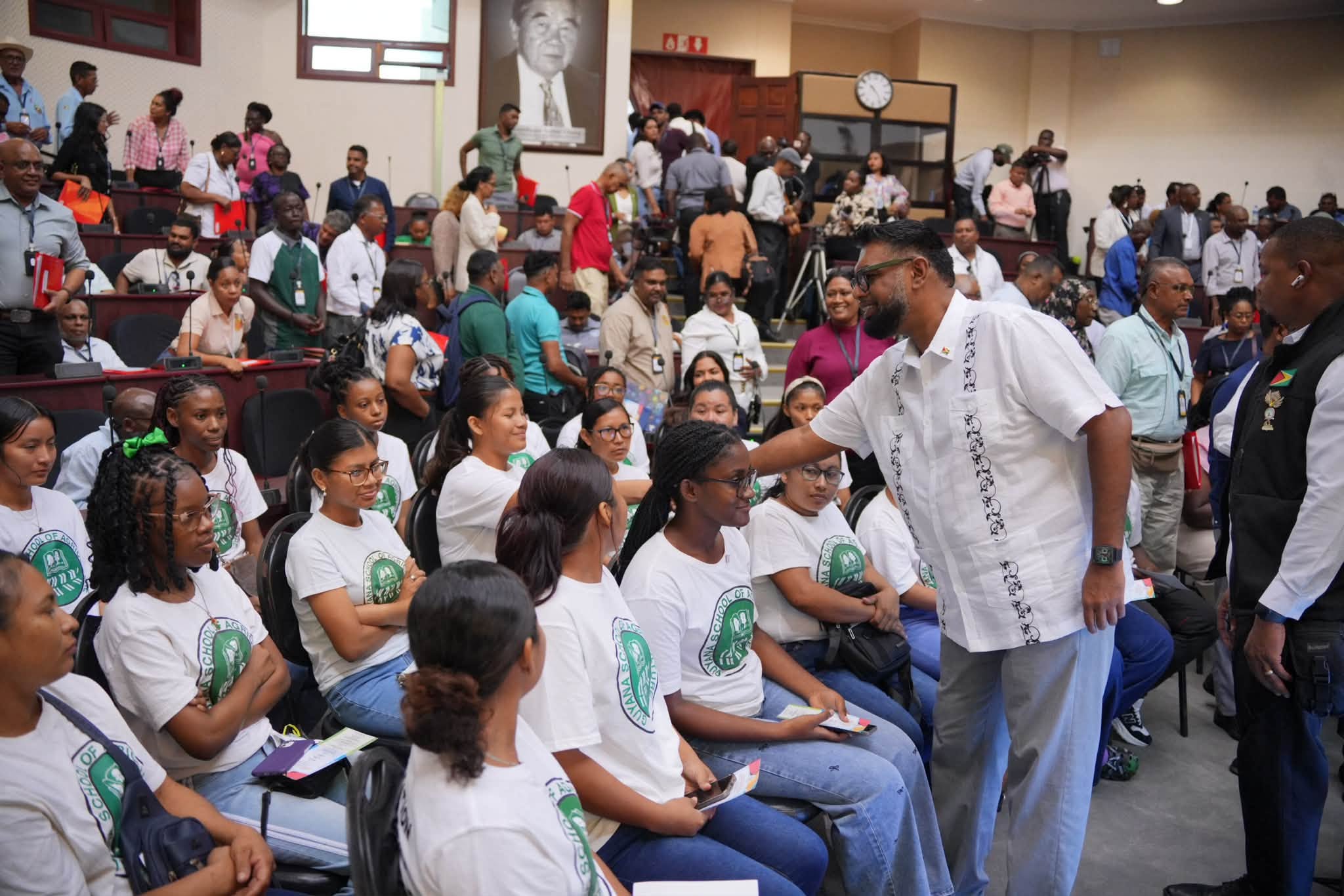
President Irfaan Ali greeting attendees at yesterday’s Farmers Conference

On poultry production, Ali said Guyana’s target was to have 50 percent of its hatching egg requirements by the end of 2027, with the aim of moving closer to full domestic production by the end of 2028. He said some imports would still be necessary to maintain resilience and protect against disruptions to supply.

The President further disclosed that a private poultry investor was preparing to commission a processing plant that would triple processing capacity, strengthening the country’s ability to handle increased local production.

He also announced that domestic production of onions would fulfil local requirements for the first quarter of 2027 and production was expected to begin in Region Nine in January 2027, provided the initiative proceeds as planned.

Ali said the International Monetary Fund’s 2026 country assessment had identified agriculture as an important contributor to economic resilience and diversification. The report, he said, indicated that agriculture had expanded by an average of 10 percent annually since 2022 and accounted for six percent of gross domestic product (GDP) and one-fifth of non-oil GDP.

He said productivity plans would be developed alongside farm-to-market roads and drainage and irrigation projects, with farmers receiving support to determine how land and infrastructure could be used to increase production and connect products to markets. He also advocated for long-term purchasing agreements between farmers and buyers to provide more stable prices and reduce the risks associated with market fluctuations.

The inaugural conference brought together farmers, agricultural stakeholders, policymakers and industry representatives to discuss modernising livestock production, agro-processing, market access, food systems and farmer competitiveness.

Agriculture Minister Zulfikar Mustapha said the forum was established following concerns raised by farmers about the absence of a national platform where they could exchange ideas and discuss common challenges.

Mustapha said the discussions were intended to help shape agricultural policies and programmes, noting that farmers’ experience and participation were essential to the sector’s continued development.

The conference forms part of Agriculture Month 2026, being observed under the theme ‘Innovate, Nourish, Grow: Building a Strong and Sustainable Guyana’.


Source: Kiskadee Watch

Fire Service hopes to install 2,000 more hydrants next year — Wickham

0

Chief Fire Officer Gregory Wickham says the Guyana Fire Service hopes to install approximately 2,000 additional fire hydrants across the country next year, with another 120 expected to be installed before the end of this year.

Speaking to the media following the service’s 69th anniversary parade in Georgetown yesterday, in a video posted on the Ministry of Home Affairs’ Facebook page, Wickham said there were already at least 5,000 hydrants across Guyana’s ten administrative regions.

“And by next year, we are hoping to plant about 2,000 hydrants throughout Guyana,” he said, adding that the programme was intended to ensure a ready supply of water for firefighting.

Wickham said the service was pursuing a strategy of installing hydrants across communities to improve access to water when firefighters respond to emergencies.

Water access has remained a concern during major fires. During the September 9 blaze which devastated Regent Household Plus on Regent Street, Kiskadee Watch reported that a nearby hydrant appeared not to have been used and firefighters relied on open water sources.

Deputy Chief Fire Officer Dwayne Scotland said during that operation that firefighters arrived within three minutes of receiving the report and contained the blaze to the affected building.

Home Affairs Minister Oneidge Walrond, who also spoke to reporters following yesterday’s parade, said the government was pursuing an “aggressive fire hydrant programme”, involving the restoration of existing hydrants and additional installations as communities expand.

Asked about firefighters’ ability to prevent fires from spreading between closely situated commercial buildings, Walrond attributed improvements to the availability of equipment, water and other resources.

She recalled that fires on Regent Street previously threatened entire blocks and commended the work done to contain the recent Regent Household blaze.

Hydrant installations have also featured in the government’s community development proposals. Kiskadee Watch reported in August that plans for Melanie Damishana and Non Pareil included increasing the number of hydrants from three to 43, while a separate presentation at Charity identified 64 proposed hydrant locations.

Wickham also said the Fire Service had recently acquired another fireboat, bringing its complement to two. He highlighted investments in new equipment, including breathing apparatus for firefighters, and credited government support with strengthening the service’s response capacity.

Walrond said the acquisition of fire tenders, trucks and a fireboat was intended to improve emergency response.

“It’s not just so we could have a glorious parade,” she said.

She cited the recent fire at the children’s home in Sophia, saying firefighters from the new Campbellville Fire Station responded in under two minutes. According to the ministry’s accompanying statement, the swift response helped avert potentially catastrophic consequences, with no injuries reported.

The anniversary parade began at the Square of the Revolution and proceeded along Brickdam, where ranks gave the traditional “Eyes Right” salute to Walrond, before concluding at Ashmin’s Building on High Street.

The minister praised firefighters’ discipline, professionalism and resilience, saying their willingness to risk their lives to protect others deserved recognition beyond the anniversary observance.

“The government has made tremendous investments in the assets, but our greatest investments have been in our young people and in the training,” she said.

Wickham said the service’s work extended beyond firefighting to emergency medical assistance provided by its Emergency Medical Technicians.

He further stated that there had been fewer fires to date than during the corresponding period last year, although he did not provide figures.

Urging citizens to report fires promptly, Wickham warned that grass fires could spread to buildings and said early notification was essential to limiting damage.

“Let us get a call because time is of essence,” he said, urging persons to contact the Fire Service on 912.

He added that firefighters were continuing house-to-house and community outreach on fire safety and prevention.


Source: Kiskadee Watch

Restructuring at GuySuCo under review, Mustapha says

0

– unaware of plans for relocation  

Agriculture Minister Zulfikar Mustapha yesterday said restructuring is being considered at the Guyana Sugar Corporation (GuySuCo), but he is unaware of any proposal regarding relocation of the corporation’s head office.

Speaking to Kiskadee Watch on the sidelines of the Ministry of Agriculture’s Farmers Conference at the Arthur Chung Conference Centre, Liliendaal, he said, “GuySuco is going on. I met with the management; we had some changes the other day. There are some movements.” He added that he was not aware of plans to relocate the head office from La Bonne Intention (LBI).

Mustapha added that restructuring was being considered, although he could not say when recommendations would be made public. “Not to my knowledge yet. But they are looking at some restructuring to be done,” he responded when asked about the relocation. 

Reports are that GuySuCo is exploring the possibility of relocating its head office to Berbice, where most of its sugar operations are concentrated.

A senior staff member told Kiskadee Watch over the weekend that management had engaged head office employees to gather information about their family arrangements, personal circumstances and other obligations as it explores the feasibility of relocating the office.

“Nothing, nobody has been officially informed that the head office is being relocated,” the source said, adding that employees had not yet been formally notified of any decision to move.

The source said the corporation’s employment and labour obligations would have to be considered if relocation proceeds, particularly if employees are required to move to a location more than 10 miles from their current workplace.

The source, who said they were also affected by the proposed move, said they were not involved in the assessment of employees’ circumstances and could not comment on the findings of the ongoing engagements.

However, the senior staff member said that while moving the head office closer to the corporation’s sugar-producing operations in Berbice could have strategic advantages, they saw no financial benefit to the move.

“Strategic-wise, it might be a good idea,” the source said, noting that approximately 75 percent of GuySuCo’s operations are in Berbice, while the remaining 25 percent are in Demerara.

The source added that some head office functions would still need to remain in Demerara because of the corporation’s international operations and its dealings with port authorities.

Further, the source said the more pressing concern for 258 non-unionised senior GuySuCo employees was approximately $145 million in outstanding retroactive salary payments for January to August 2025 and the removal of a salary increase from their pay in January 2026.

In letters dated August 20 and September 8, 2026, the employees appealed to Chief Executive Officer Paul Cheong, arguing that they were unfairly excluded from retroactive payments received by unionised workers, which totalled approximately $900 million.

The employees said their salary adjustments took effect in September 2025, but they never received the retroactive payments for the first eight months of that year. They also said the increase was removed from their salaries in January 2026. “There is some payment that GuySuCo is contractually obligated to pay senior staff, [an] increase in salary that was unilaterally removed from us from January 2026,” the source said.

The employees contended that the decision contradicted salary arrangements communicated to them in September 2025 and created unequal treatment among staff. They asked management to include the outstanding payments in their September 2026 salaries.

The correspondence was copied to Mustapha, GuySuCo’s Board Chairman Jairam Petam, Vice-President Bharrat Jagdeo, Labour Minister Keoma Griffith and Chief Labour Officer Aslim Singh. The employees had warned that they could pursue further formal action if the matter remained unresolved.


Source: Kiskadee Watch

Ministry welcomes Tier 1 trafficking ranking; report flags decline in victim support

0

The Ministry of Home Affairs yesterday welcomed Guyana’s retention of Tier 1 status in the United States’ 2026 Trafficking in Persons Report for a tenth consecutive year, although the assessment also recorded fewer investigations and a sharp decline in referrals of identified victims to care.

In its October 12 release, the ministry said Guyana had held the highest ranking since 2017 and that the report recognised serious and sustained efforts to meet the minimum standards for eliminating trafficking.

However, Kiskadee Watch reported on October 10 that authorities identified 390 victims in 2025 but referred only 25 to care, compared with 416 victims identified and referred in 2024. Investigations fell from 31 to 16, while prosecutions increased from three suspects to four. One trafficker was convicted in each year.

The assessment also identified inadequate oversight of recruitment agencies, unresolved safeguards against recruitment fees and continuing trafficking risks at China-affiliated worksites. Tier 1 measures government compliance with minimum standards and does not mean that a country is free of trafficking.

Home Affairs Minister Oneidge Walrond, who co-chairs the Ministerial Taskforce on Trafficking in Persons, said the ranking recognised sustained work across the national response.

“Our responsibility is to ensure that this work reaches people at risk of exploitation, and that victims and survivors can access protection and support. We will continue working with law enforcement, service providers and communities to prevent trafficking and bring offenders to justice,” she stated.

The ministry highlighted the prosecution of suspected sex and labour traffickers, the detention of a trafficker previously convicted in absentia and training for police officers, judges, immigration officers and other officials.

It also pointed to the completion of a 30-person transition home in July 2025, where victims receive a voluntary ten-day reflection period without law enforcement interviews.

Other measures included a QR code reporting system, three dedicated hotlines, including a Spanish-language service, and awareness activities involving Toshaos, miners, hotel operators and schools.

According to the ministry, the report found that penalties under the Combating Trafficking of Persons Act 2023, ranging from five years to life imprisonment, were sufficiently stringent.

Alongside those advances, the assessment recorded reductions in funding for victim services and prevention, continuing trial delays and weaknesses in recruitment oversight and enforcement in the interior, Kiskadee Watch reported. :chatgpt-content-reference{index=”2″}

The ministry said the report’s recommendations would inform further work to strengthen interior enforcement, identify victims among vulnerable groups and modernise labour recruitment oversight.

The national response is guided by the 2026–2030 National Action Plan for the Prevention and Response to Trafficking in Persons, built around prevention, protection, prosecution and partnership.

The ministry said the plan was developed through consultations with government agencies, civil society organisations, survivors and other stakeholders, and is being implemented through the ministerial taskforce and its thematic subcommittees.

Persons with information about suspected trafficking can report to the nearest police station or call the 24-hour hotlines on 623-5030, 227-4083 or 624-0079.


Source: Kiskadee Watch

GPL presses contractors on project deadlines

0

Guyana Power and Light Inc (GPL) has urged contractors working on major electricity projects to meet their agreed deadlines, following a meeting to review progress across its infrastructure programme.

However, the company’s statement did not identify the projects reviewed, their completion dates or how far works have advanced.

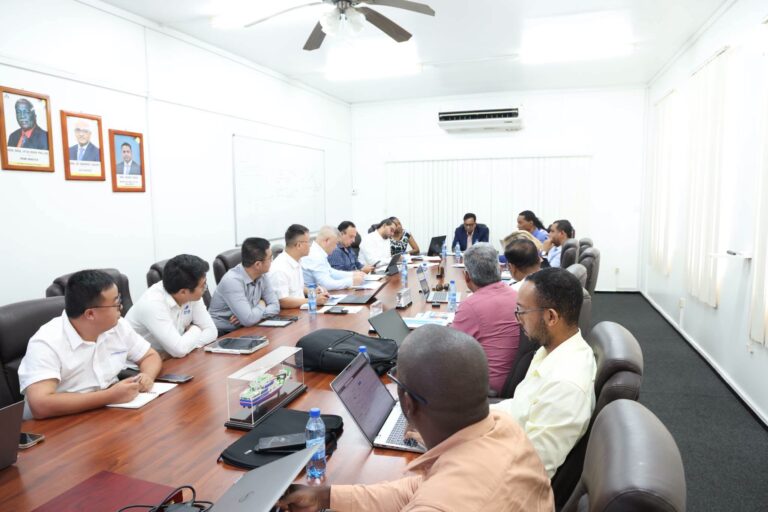
The meeting was led by Kesh Nandlall, Team Leader of GPL’s Executive Management Committee, and attended by director Ryan Ross and other company representatives. Representatives of InterEnergy, PowerChina, China Machinery Engineering Corporation and Kalpataru Projects International Limited also participated.

According to GPL, the contractors provided updates on ongoing works, implementation schedules and upcoming milestones. The company said it reviewed progress against agreed schedules, identified matters requiring attention and emphasised the need to meet deadlines.

GPL said the projects are intended to increase capacity, modernise the electricity network and improve reliability as demand grows. It did not disclose the matters requiring attention or whether any projects were behind schedule.

The meeting follows a similar review involving the Ministry of Public Utilities and Aviation, GPL and the same companies in September. Kiskadee Watch reported on September 22 that the statement issued after that meeting also omitted project completion dates and details of construction progress.

The infrastructure programme involves substantial investment in transmission and distribution. Stabroek News reported in April 2025 that GPL signed contracts worth US$422.2 million, approximately $90 billion, with PowerChina and Kalpataru to extend its transmission network. The works were intended to facilitate the delivery of additional electricity, including power from the gas-to-energy project.

In November 2025, GPL announced a further US$199 million contract with Kalpataru and a US$35.93 million contract with China National Machinery Import and Export Corporation for network improvements. The company said those investments would reduce outages and improve power quality across several service areas.

InterEnergy’s role includes supervisory, engineering and project management consultancy services under a US$15.6 million agreement signed in October 2025, Stabroek News reported.

Progress on the works comes amid continuing pressure on electricity supply. At a September 7 press conference, GPL officials said available generation was only just sufficient to meet demand, leaving inadequate reserve capacity to respond to disruptions. The company reported 265.6 megawatts of available generation, while peak demand had reached 257 megawatts on September 1. :

GPL also identified overloaded feeders and transformers as contributors to outages, underscoring the need for network improvements alongside additional generating capacity.

GPL has been struggling to maintain a reliable electricity supply, with repeated outages affecting households and businesses across the Demerara-Berbice Interconnected System. In September, company officials acknowledged that available generation was barely keeping pace with demand, leaving insufficient reserve capacity to cushion unexpected disruptions. Overloaded feeders and transformers have also contributed to outages, while major transmission and substation works remain underway. The difficulties have persisted despite substantial government spending on additional generation and network upgrades.


Source: Kiskadee Watch

Credit to agriculture, manufacturing falls as mortgage lending expands

0

Credit to agriculture, manufacturing and mining declined during the first half of this year, despite overall private-sector credit growth of 11.5%, according to the Bank of Guyana’s 2026 Half-Year Report.

Agricultural credit fell by 3.1%, manufacturing by 4.4% and mining by 16.5%, while mortgage lending expanded by 21.2%.

The uneven lending pattern comes as the government promotes diversification and greater access to financing for businesses outside the petroleum industry.

Stabroek News had reported in January that Budget 2026 allocated US$100 million for the Guyana Development Bank. The announced measures also included a co-investment arrangement intended to help small and medium-sized enterprises access up to an additional $7 million at preferential rates through participating commercial banks.

Meanwhile, commercial banks have expanded housing finance. In February, Demerara Bank had announced that its residential lending ceiling would increase from $30 million to $40 million while retaining a 5% annual interest rate. Republic Bank subsequently announced mortgages of up to $60 million at 5%.

The credit figures also accompany weaker performance in some productive sectors. Kiskadee Watch’s reporting on the Finance Ministry’s mid-year assessment recorded manufacturing growth of 3% and a 0.5% contraction in agriculture, forestry and fishing. Other crops declined by 6.4% following prolonged rainfall.

In its September response to that assessment, APNU highlighted declining agricultural credit and called for greater investment in drainage, irrigation and protection against flooding and drought. It also questioned the downward revisions to the government’s non-oil and agricultural growth forecasts.

The outstanding credit figures measure lending balances and do not, by themselves, establish whether the declines resulted from reduced borrowing, repayments or tighter lending conditions.

Meanwhile, prices for vegetables and vegetable products increased by 26.8% between December and June, while fruit prices rose by 13.1%, according to the report. The bank attributed the increases mainly to reduced supplies following heavy rainfall and flooding.

The figures provide further context for complaints from shoppers and vendors about the cost of everyday foods.

Kiskadee Watch reported in July that Georgetown market vendors were reducing purchases and shrinking their businesses as wholesale prices increased, while households were changing meals to stretch their budgets.

Bourda vendor Mohanram Singh said a bag of boulanger that previously cost between $6,000 and $8,000 had risen to approximately $13,000. He also reported higher cabbage, eschallot and celery prices.

Shopper Sureya Howard said her household was combining greens with potatoes, eddoes and other foods to make meals go further. At Kitty Market, vendor Annette Singh said she had reduced the size of her stand because both she and her customers were buying less.

The Finance Ministry’s mid-year assessment, previously reported by Kiskadee Watch, recorded an overall food-price increase of 6.7% during January–June. Vegetables and vegetable products contributed 2.5 percentage points to the 4.4% increase in overall consumer prices.

President Irfaan Ali defended the government’s management of inflation, citing the 12-month rate of 4% as at June and higher international fuel prices. That measure compares prices with June last year, whereas the six-month figures measure changes since December.

Budget 2026 had set aside $9 billion for additional measures to ease cost-of-living pressures. The government said interventions would be developed through continued consultations.


Source: Kiskadee Watch

Auditor General should get involved now given the many operational concerns raised about development bank

0

Dear Editor,

It was recently announced that the Government of Guyana opened the Guyana Development Bank (GDB). What was abnormal with this opening was that only Members of the Board of Directors were identified, but no mention was made of a General Manager,  nor was there an organization chart identifying the various bank departments. In fact, no  project appraisal, loan supervision, credit, and accounting departments, among others, were identified. As a result, will these critical departments be managed on a daily basis by the Board of Directors? Are the Board Members full-time staff members of the GDB?  This must be clarified as trained credit analysts, capable of evaluating, supervising, and recovering development loans in a decentralized system across Guyana’s ten administrative regions, are required to professionally manage the GDB. No other arrangement will be efficient. 

Equally strange is the fact that the loan applications are expected to be submitted using an online address: (gdb.gov.gy](https://gdb.gov.gy/). Really?  Can you imagine  a farmer in a rural community in Region 8 having access to the technology to engage in this loan application process? Just a reminder, GAIBANK had branch offices in the regions, since being close to the economic activity reduces transaction costs for applicants and borrowers; and  it enhances project supervision, and strengthens cooperation and coordination with the regional administration, along with the supporting services organized in the community.  Furthermore, when consideration is given to the fact that the supply of fish and other crops is decreasing (Bank of Guyana 2026 Half Year Report: https://bankofguyana.org.gy/bog3/images/research/Reports/HalfYear2026.pdf); that the demand for food is increasing (immigrants entering Guyana, among others); that none of the Board Members have any qualifications in agriculture; and that the Minister of Agriculture was excluded from the opening of the GDB,  these deficiencies are indeed  clear signals  that serious policy considerations are not being undertaken.

One other interesting observation of the GDB is that loan disbursements for approved loans to borrowers will be paid into the commercial bank accounts of approved GDB clients. This is a very worrisome event, because the project disbursements of funds must be paid directly to the suppliers of the inputs, the equipment, or project services financed with the GDB loans. Regrettably, paying the money into the borrower’s account at the commercial bank will increase the probability for misuse, due to the GDB’s lack of oversight and the obvious setbacks due to asymmetric information concerns. Additionally, without a defined credit policy, this will add further complications to the GDB operations.   

It has also been reported that successful clients who would have repaid their loans and advanced their business can then move their economic activities to the commercial banks, where they can obtain larger loans. This development cannot be a serious expectation, simply  because commercial banks will require collateral that have market valuations that are no less than the value of the disbursed loan plus interest. Can the GDB borrowers meet these requirements? This would be an important event to monitor; and the data collected should be examined to determine the success or failure of this credit operation.

It was reported also that no interest will be collected on the loans provided by the GDB;  and therefore, the question is: where will the money come from to pay the Board of Directors and the other expenses of the  GDB? Will it be a proportion of the money approved for the Bank? How will the financial viability of the GDB be measured, given that there will not be available the traditional financial statements? Moreover,  will the financial sustainability of the GDB  be a line item in the National Budget in a manner no different than that of a Ministry?  These issues must be clarified. 

In view of all these operational concerns raised about the GDB, it is extremely important to have the Auditor General be immediately involved in auditing the GDB transactions; for the Auditor General must not wait until “de boat gaan ah falls” to step in. That will be too late for Guyana. Consequently, the time is now for the Auditor General to move into audit action. Wake up Guyana!

Sincerely,

Dr. C. Kenrick Hunte

Professor and Former Ambassador


Source: Kiskadee Watch