Home Blog Page 60

Hoyte was ahead of his time and will be acknowledged as one of the handful of sincere patriots who served this nation

0

Dear Editor,

I refer to a letter dated October 11, 2026, from Mr. Khemraj Harryram, and I wish to thank him for researching this piece of our history that the PPP has tried to erase: the role many played in preparing the ground for the 1992 elections and the handing over of political power to Dr. Cheddi Jagan upon his victory.

I wish to speak of one man who was ahead of his time—Hugh Desmond Hoyte.

Hoyte was one of the most incorruptible and dignified figures ever to serve in Guyana’s history. His only real competitors for that distinction would be Jagan and his wife, Mrs. Janet Jagan. When the true history of this country is written, the name Hoyte, like the Jagans, will be acknowledged as one of the small handful of sincere patriots that had the privilege of serving this nation at the highest level.

Hoyte served as Guyana’s Home Affairs Minister from 1969 to 1970, Finance (1970 to 1972), Works and Communications (1972 to 1974), and Economic Development (1974 to 1980). After the rigged 1980 elections, he was appointed one of five vice-presidents to Burnham, responsible for economic planning, finance, and regional development, particularly the State Planning Secretariat. In August 1984, Hoyte became Prime Minister and First Vice President, continuing to oversee the State Planning Secretariat. In 1985, he became President until he lost power in 1992. He continued to pay keen attention to the State Planning Secretariat and to a department called the Department of International Economic Cooperation during his Presidency.

The 1985 elections, in which Hoyte was the Presidential Candidate, were rigged. However, he was part of a machinery over which he had limited control, just after the death of Burnham. He was the Candidate on paper, while the real political bosses at the time were operators out of Congress Place. In short, he was a casualty of a system that included Hamilton Green and Robert Corbin.

Guyana is fortunate that he stayed his hand and carefully managed these hardliners, for had he rocked the boat, he would have lost political power to them, since they were much stronger than him politically in 1985. Without a moderate voice like Hoyte’s in office after 1985, there would have been no Jagan presidency. The hardliners in the PNC in 1992 had a plan to keep power and were willing to work that plan by whatever means necessary. It took Hoyte to stop them in 1992.

The real history of Guyana will show that the General Secretary of the PNC from 1985 to 1992 was Corbin, and the Deputy Leader from 1985 to 1992 was “Hammie”. Use that information to work out the arithmetic.

Throughout his entire period in public service, the only tangible asset of any substance the Hoyte family owned was a house on North Road, after serving at the highest level of Government in the Cabinet for 23 years. He had no 60-acre farm on the Linden Highway, no mansion at Leonora. Nor did he have any 10% stake in the assets owned by members of the selected cricketers’ clan (more than 10% of the prime properties in parts of Providence and on the Ogle to Eccles Road, certain malls both in Guyana and abroad).

His significant achievement was what he did after 1985. He had taken over a country from Burnham in 1985 that was in severe fiscal crisis, where it took 102% of total government revenue to service the national debt. After paying the debt, there was no money to pay even wages and salaries for public servants. By 1986, Hoyte knew with clarity that time was no longer on Guyana’s side.

He therefore quietly committed to the IMF in 1986 to a comprehensive programme to reduce the debt, rebalance the economy and open it to private investors under a comprehensive Economic Recovery Programme (ERP), strong enough to “elicit the appropriate external financing and debt restructuring.”

Just ask Mr. Carl Greenidge, who was at the table with Hoyte when they spoke to the IMF in 1986, in a meeting in which Mr. Alexandre Kafka (1917–2007) was the lead spokesperson. Kafka was a prominent Czech-born economist and naturalized Brazilian citizen who served as an Executive Director of the IMF for 32 years (1966 to 1998).

Also in the room was Mr. Dara McCormack (1943–1996), an Irishman who represented the Caribbean as Executive Director at the IMF at the time. It was Mr. McCormack who said the policy response before 1986 was “ad hoc and in retrospect, clearly inadequate.” That was because of Burnham’s medically unfit executive instructions. Some say that in his final days, Burnham was borderline delusional.

As the graph below reveals, by 1989 Hoyte had reduced the external debt by 13%, which paved the way for vital new inflows to be injected into the economy in 1990 and 1991. It was Hoyte who first created the economic impetus to start paying the debt on a predictable basis thereafter, until Asgar Ally and Bharrat Jagdeo came.
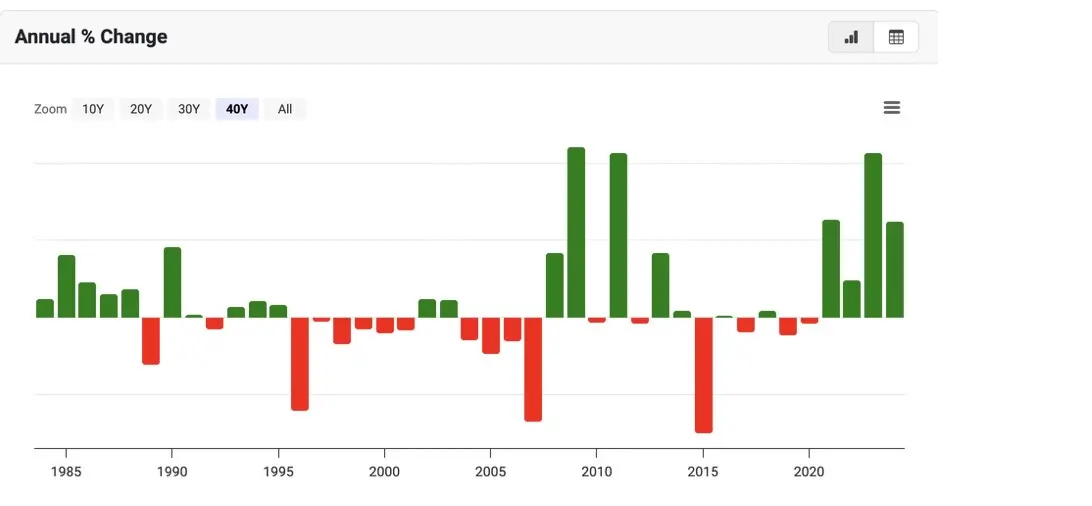
By 1991, the revenue it took to service the debt had stabilized to 105%, as part of a medium-term plan that created the economic momentum to reduce this drain on the revenue used to service the debt to 59% by 1993, mere months after the PPP secured power. Asgar Ally and Jagdeo continued the ERP and HIPC Programme conceived with the IMF by a team that was formed under Hoyte, and that strategy bore fruit since by 1996 it took only 42% of the revenues to service the debt, leaving more cash for human development projects.

Hoyte knew that a continuation of the Burnham policy would lead to more scarcity of food, accelerated inflation, and a rejection of Guyana by the international community. As President, it was his patriotic duty to do something for his people, and fast, but within an environment that balanced the political mannerisms of the PNC Central Committee with the terms of the ERP that was being formulated with talent like Carl Greenidge, Haslyn Parris, Cecil Rajana, Michael DaCosta, and others, in conjunction with the IMF.

Guyana can learn much from the Hoyte era.

Yours faithfully,

Surujdai Juglall


Source: Kiskadee Watch

Farewell to a political icon

0

Dear Editor,

The last political icon of the 40’s, the veteran Eusi Kwayana passed on after nearly eight decades of service.

Eusi Kwayana, a veteran political activist, an elder statesman, cultural and political musician and prolific writer died quietly in the United States last Saturday. His was a marathon life of over one hundred years and he will be remembered as a militant grassroot activist. He changed his name from Sydney King to a Swahili name Eusi Kwayana in the late 60’s and was responsible for the creation of ASRE and ASCRIA and was a strong admirer of the independence struggle in India and Ghana.

Kwayana writing in the Daylight after the demise of Dr Jagan in 1997 stated that as a young school teacher his entrance into politics was fired by listening to a charismatic young Cheddi Jagan speaking at a public meeting in Plaisance; what motivated him was Dr Jagan’s speech that ended with the slogan “workers unite you have nothing to lose but your chains”. When the Political Affairs Committee (PAC) was formed in 1946, Kwayana set a PAC group in Buxton that was visited by Jan Carew. There was also a PAC group formed in Kitty led by the late Boysie Ramkarran another political stalwart. The PAC group in Buxton passed a resolution to form a political party that resulted in the formation of the PPP in 1950.

The elections of 1953 that were contested under universal adult suffrage under limited self-government saw a massive victory for the PPP. This led to a six-member cabinet with Sydney King as the Minister of Communication and Works. However, before the government could have started Burnham demanded leadership or nothing that led to what was known as crisis week. I was told that when the cabinet members voted for a leader they were split evenly with Sydney supporting Dr Jagan. Dr Jagan would eventually be elevated as the Chief Minister. Mr. King’s famous “confounded nonsense” remark to the British Governor showed that he was no pushover. The constitution was suspended after 133 days in office. This would lay the foundation for the split of the PPP in 1955.

Sydney King parted company with the PPP over two issues first the suspension of Martin Carter and Rory Westmaas and the West Indian Federation. He decided to stand as an independent candidate in the 1957 election however, Dr Jagan approached him to go on the PPP list. When he refused Balram Singh Rai went as the candidate and won the East Coast constituency. The late Paul O’ Hara nee Persaud, himself a Buxtonion, told me that racism hit the roof after that. This led one senior PPP leader to conclude that a good strategy would have been to allow Sydney King to run as an independent candidate. From the 60’s to the 70’s he was in and out of the PNC but from 1973 he stood strongly against rigged election, the shooting of Dr Josh Ramsammy, and the refusal to employ world renowned historian Dr Walter Rodney at UG and later his political assassination. Apart from his political activism he was also a prolific writer. He coined the revolutionary songs for the two major political parties the PPP and PNC.

Farewell to a fallen political icon Eusi Kwayana. May his soul rest in peace.

Yours faithfully,
Rajendra Rampersaud


Source: Kiskadee Watch

Guyana’s tourism authorities should examine implications of this interCaribbean move

0

Dear Editor,

I refer to the article published by Kiskadee Watch titled “interCaribbean to fly between Barbados and Ogle daily.” While the introduction of daily flights between Barbados and Ogle Airport may be welcomed as a positive development for regional connectivity, it also raises an important question that deserves public scrutiny: Is Barbados pursuing a quiet strategy to expand its already well-developed tourism sector by positioning itself to siphon off a portion of Guyana’s potential tourist traffic?
Barbados has long established itself as a major Caribbean tourism destination, supported by an internationally recognised tourism brand, established hospitality infrastructure, and decades of experience in attracting visitors. Guyana, by contrast, is seeking to develop its tourism industry, with its unique rainforest ecosystems, abundant wildlife, rivers, waterfalls, and distinctive cultural heritage offering considerable potential for growth.

The introduction of daily air service between Barbados and Ogle could serve legitimate purposes, including facilitating business travel, strengthening regional ties, and making it easier for Guyanese to travel abroad. However, it is also worth examining whether this new connection could enable Barbados to position itself as a gateway through which international visitors access Guyana, while encouraging them to spend a greater portion of their travel budget in Barbados, where tourism infrastructure and services are already well established.

If visitors can conveniently combine Guyana with a stay in Barbados, which destination ultimately captures the greater economic benefit? Will Guyana gain from increased visitor arrivals, hotel occupancy, employment, and spending in local communities, or could a substantial share of the tourism value generated by these travel connections accrue to Barbados?

These are not accusations against Barbados or interCaribbean Airways. Rather, they are legitimate questions about regional competition, tourism development, and the need for Guyana to protect and advance its own economic interests. Improved air connectivity can be mutually beneficial, but the benefits should not be assumed; they must be assessed.

Guyana’s policymakers and tourism authorities should therefore examine the likely implications of this route, including its potential impact on visitor flows, travel packages, airline connections, and the distribution of tourism revenue. They should also consider whether Guyana has a clear strategy to ensure that increased accessibility translates into greater local investment, stronger domestic tourism businesses, and sustainable employment for Guyanese.

As Guyana invests in developing its tourism industry, it must remain alert to the possibility that better-connected regional competitors could benefit disproportionately from the very tourism growth Guyana hopes to achieve.
The central question is simple: Is this daily Barbados–Ogle service merely an expansion of regional connectivity, or could it also form part of a broader commercial strategy that allows Barbados to capture a greater share of the tourism market that Guyana is working to develop?

The travelling public and the relevant authorities deserve a clear, evidence-based answer.

Sincerely,
Keith Bernard


Source: Kiskadee Watch

Croal inspects Leonora road, 498-acre housing development

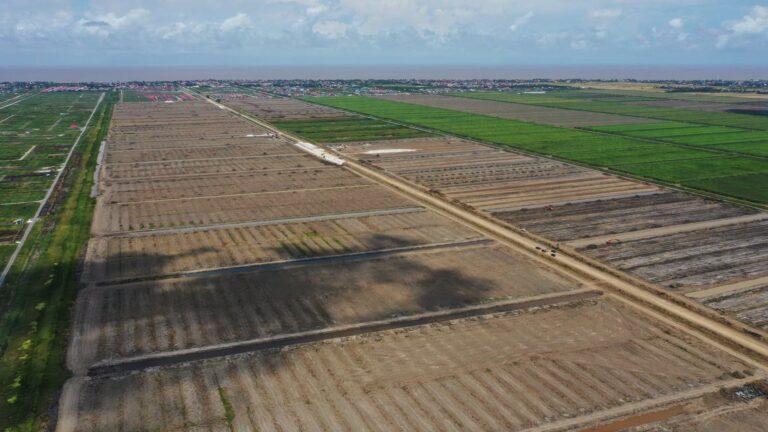
Housing Minister Collin Croal on Friday inspected construction of a four-lane interconnecting road and the development of approximately 498 acres of residential land in Leonora and Groenveldt, Region Three.

According to a Ministry of Housing update, the works are intended to improve access, open additional lands for housing and meet demand for house lots and housing units in the region.

Croal visited the sites on October 9. The update did not state the percentage of works completed, the contract costs or the completion dates.

The ministry had earlier announced a 7.7-kilometre asphaltic roadway at Leonora to connect with the Versailles–Parika Highway. Stabroek News had reported on March 5 that the road was described as the first phase of a transport network which would eventually link to the proposed Leonora–Canal Number One Highway.

At that time, Croal said the road would improve access to more than 300 homes under construction in the Leonora/Groenveldt area, reduce travel time and support commercial activity along the corridor.

Housing construction in the area includes three-bedroom concrete houses, young professional homes and modular units. DPI reported on February 28 that 115 three-bedroom houses being built by 19 Region Three contractors were approximately 65% complete. Each was described as measuring 1,013 square feet, with living, kitchen and dining areas, one bathroom and front and rear patios.

Croal had urged the contractors to maintain construction standards and meet their deadlines for persons awaiting their homes. He also identified Regions Three and Four as areas earmarked for some of the largest investments under the government’s housing programme.


Source: Kiskadee Watch

National Insurance Board should move immediately to remedy minimum pension issue

0

Dear Editor,
 
Mr. Christopher Ram and others have raised the matter that the National Insurance Board has failed to pay the minimum old-age pension in accordance with the “NIS Benefit Regulations.” As it happens, I am one of those pensioners.
 
The Regulations require that the minimum pension paid must not be less than half (50%) of the Public Service minimum wage. However, the Public Service minimum wage has increased since 2021 but the minimum old-age pension has not accordingly increased as required with the Regulations.
 
For me, it seems a simple enough matter to fix, and the National Insurance Board should take immediate steps to do so. It should not have been necessary for this matter to have gone to Court.
 
Yours sincerely,
Kit Nascimento


Source: Kiskadee Watch

Mustapha denies chicken shortage, says demand rising with production

0

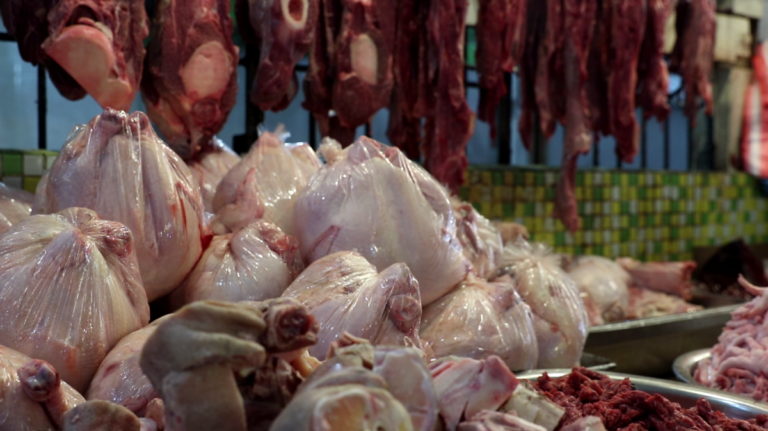
Agriculture Minister Zulfikar Mustapha has denied that Guyana is experiencing a chicken shortage, while acknowledging that available supplies are insufficient to meet all demand.

Speaking to Kiskadee Watch during a break at the Ministry of Agriculture’s Farmers Conference at the Arthur Chung Conference Centre, Liliendaal yesterday, Mustapha said production was expanding but consumption was also increasing.

“We don’t have a chicken shortage in the country. As the production increases the demand increases,” he said.

Mustapha said six tunnel-ventilated poultry pens were operating, each producing between 30,000 and 40,000 birds every six weeks. He also said chicken imports were being handled through the New Guyana Marketing Corporation (GMC), which distributes supplies to other parties. “We don’t have any private imports. All chickens come under GMC,” he stated.

His comments follow the government’s announcement in August that it had arranged for approximately 330,000 pounds of chicken to be imported weekly to address temporary gaps in local supply. The announcement did not identify the source countries, companies authorised to import or the expected duration of the arrangement.

The Guyana Poultry Producers Association had requested temporary imports during a July meeting with Mustapha, citing declining domestic production and increased demand. The association said imports would help meet demand and stabilise prices, and would no longer be needed once local output returned to normal.

David Fernandes, managing director of Bounty Farm Limited and president of the Caribbean Poultry Association, subsequently told Kiskadee Watch that reduced production and rising consumption had contributed to the shortage. He had expressed hope that consistent production would be restored by September.

Fernandes identified inadequate processing and cold-storage capacity as a weakness. During periods of oversupply, farmers unable to sell their birds cannot clear poultry houses for new chicks, leading hatcheries to reduce output. That cycle can leave the industry unable to respond quickly when demand increases, he explained. He also cited the effects of Inclusion Body Hepatitis, which had disrupted poultry operations and forced some farmers out of production.

Mustapha had told the National Assembly in June that Guyana was already self-sufficient in poultry production, with limited imports permitted to meet demand from the expanding tourism and hospitality sectors. His statement was made in a written response to a question from APNU parliamentarian Terrence Campbell.

The government has also invested in tunnel-ventilated poultry facilities to increase production. At the commissioning of the project at Mon Repos in July, the Agriculture Ministry said the initiative cost more than $1 billion and comprised five facilities at Mon Repos, Cornelia Ida and Onverwagt. Mustapha’s latest account puts the number operating at six.

Mustapha’s comments also follow an October 9 statement in which the Agriculture Ministry rejected claims attributed to Vigilant Political Action Committee co-founder Dorwain Bess that approximately one million pounds of potentially contaminated chicken could be on the local market. The ministry said there was no supporting evidence and maintained that poultry imported through the GMC must satisfy sanitary, veterinary and food-safety requirements, including certification in the country of origin and inspection upon arrival in Guyana.


Source: Kiskadee Watch

Parika stelling 15% complete, Ramraj says

0

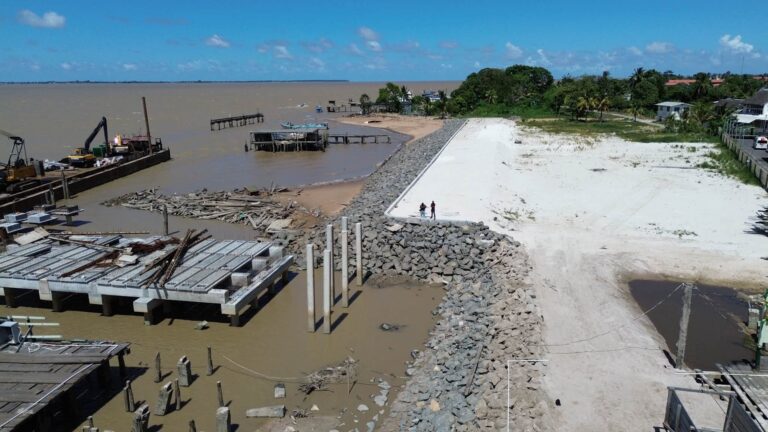
Construction of the new Parika Ferry Stelling is approximately 15% complete, while a diversion route has been completed to allow cargo exceeding 20 tonnes to again pass through the facility, Minister within the Ministry of Public Works Madanlall Ramraj has reported.

In a Facebook post following an inspection, Ramraj said river defence work had advanced significantly and the area had been sealed to protect against flooding. Pile cap work was  underway ahead of the installation of precast beams. He was accompanied on the visit by Minister within the Ministry of Agriculture Vickash Ramkissoon.

The completion of the diversion follows restrictions on heavy vehicles using the Parika–Supenaam ferry service, which drew protests from truck operators in August.

Kiskadee Watch reported on August 8 that the Transport and Harbours Department (T&HD) had imposed a maximum gross vehicle weight of 20 tonnes on July 9, before further reducing it to 15 tonnes. The restrictions were linked to a damaged drawbridge at Supenaam and construction at Parika, where several beams had shifted from concrete-encased piles during piling works.

Truckers complained that the lower limit, which included both vehicle and cargo weight, made their operations unprofitable. Ramraj subsequently met truckers and businessmen and reprimanded T&HD over the lack of consultation. His latest post did not specify the maximum gross vehicle weight now permitted on the service.

Stabroek News had reported in July 2025 that the first phase of the new Parika port facility and waterfront development was valued at $5 billion. The announced work included land reclamation and sea defence north and south of the existing stelling, together with construction of the main concrete stelling. Gaico Construction, Toolsie Persaud and A&S General Contractors were identified as the contractors.

The 2026 budget allocated $2.2 billion to advance the stelling and waterfront project, with completion slated for 2028. The government’s stated plan is to develop the facility into an international port of entry and a regional hub for tourism, agriculture and shipping.


Source: Kiskadee Watch

Corbin demonstrated one could hold firm convictions without surrendering basic principles of respect and decency

0

Dear Editor,
 
 
Much has been said, and will continue to be said, about Robert Corbin since his passing on October 4. Today, I take the opportunity to reflect on the man I knew – a man who, despite political differences and disagreements, remained civil, respectful and willing to engage others without hostility.
 
In a political culture where disagreement is increasingly treated as disloyalty, where independent thought can invite personal attacks, and where too many confuse power with authority, Corbin demonstrated that one could hold firm convictions without surrendering the basic principles of respect and decency.
 
I first met Robert Corbin in 1968 in Linden, while he was campaigning to become General Secretary of the youth arm of his party, the People’s National Congress (PNC). We discussed several issues, agreeing on some and disagreeing on others. Yet, our differences did not prevent the development of a relationship that continued over the years.
 
On our second occasion of meeting in Kwakwani, Corbin had already secured his position in the Young Socialist Movement. Our engagement continued for a number of years, and I had reason to telephone him on several occasions during his time in the PNC Government and later as Leader of the Opposition.
 
One of Corbin’s strengths was his willingness to listen. Regardless of our differences, he would sit, listen intently to what was being said, and, when the appropriate time came, offer his response. He was a keen and intense listener, so much so that some might have mistaken his silence for disengagement. Those who knew him understood otherwise.
 
I listened to Corbin’s responses to presentations made in his capacity as Leader of the Opposition. On occasions when he visited me at the Guyana Trades Union Congress (GTUC) to discuss issues of common nature he would suggest that we continue our discussions in an informal and cordial setting. He understood that meaningful engagement did not always require a public platform, a confrontation or an audience.
 
Although Corbin and I, and at times leaders of the trade union movement, disagreed on issues, he was never discourteous in his dealings with us. He did not appear to carry grudges simply because another person held an independent position. That is a quality worth remembering, particularly in a society where too many public engagements have deteriorated into personal attacks and political hostility.
 
I want to believe that Corbin’s disposition was shaped not only by the family that raised him with what we call “grace and manners,” but also by the political culture in which he was nurtured.
 
Those of us who have been active in national life since the 1980s can recount countless instances of public disagreement with the political establishment, whether in government or opposition. Differences were not absent then, nor were political struggles without their difficulties. But the degree of personalised hostility that increasingly characterises political engagement today was not accepted by all as an honourable or necessary feature of public service.
 
There was an understanding that one could disagree with the government, challenge the opposition, defend workers’ interests or advance an independent position without automatically becoming a personal enemy. Political office did not relieve anyone of the obligation to respect others, and disagreement did not have to destroy the possibility of dialogue.
 
Corbin belonged to that tradition, and those characteristics remained evident in his conduct until the end.
 
During my last telephone conversation with Robert, we discussed our concerns about the declining conditions in our country and the growing intolerance in our national life. As was his nature, he listened attentively, interjected where necessary and offered his perspective. He impressed upon me that the circumstances confronting us represented challenges associated with Guyana’s politics, while encouraging me to stay the course and continue the fight.
 
Those words resonated with me because the struggle for workers’ rights, social justice, dignity and accountability does not end when the political circumstances become difficult. The trade union movement has a responsibility to continue speaking out, defending the rights of workers and challenging conditions that undermine the welfare of our people. That responsibility cannot be abandoned simply because the road ahead is difficult.
 
Corbin was a man, with the shortcomings that come with being human. I do not pretend that we agreed on everything or that he was without imperfections. But I can speak to my experience: he was civil and cordial in his engagements with me and with the trade union movement. He understood that disagreement was part of public life and that respect for another person’s right to hold a different view was essential.
 
Today, Robert Corbin’s work on earth is done. His passing provides an opportunity not merely to remember the political offices he held, but to reflect on the personal qualities he demonstrated and the value of preserving civility in our national discourse.
 
May his soul rest in eternal peace.
 
I extend my condolences to his wife, Carol, his children, other family members, and the People’s National Congress, the party he led and called his political home.
 
Farewell, warrior. May your contribution to Guyana’s political life, and the memory of the man who could disagree without disrespect, endure.

Yours faithfully,

Lincoln Lewis


Source: Kiskadee Watch

Food vendor arrested, gun and $500,000 recovered in East Canje robbery probe

0

-video shows masked men confronting persons at depot

Police have arrested a 27-year-old food vendor and recovered $500,000, a firearm and a car suspected to have been used in Saturday night’s $10 million robbery at an East Canje beverage depot.

Video footage of the incident seen by this publication shows masked men arriving in a car and confronting a man on a motorcycle before entering the building, where they put what appeared to be cash into a bag.

In an update, police said the suspect, of Vryman’s Erven, New Amsterdam, was arrested at about 2 pm on Sunday in connection with the robbery at No. 2 Village, East Canje, Berbice.

Acting on information received, investigators subsequently recovered the cash and motor car. A search of the vehicle unearthed a .32 revolver containing two rounds of ammunition.

The firearm, ammunition, cash and vehicle were lodged pending investigations. Police said the suspect remains in custody while efforts are being made to locate others believed to have been involved.

The robbery occurred at about 7.35 pm on Saturday at the beverage depot operated by Jagnarine Persaud, called “Balram,” 57, on the lower flat of his premises at Lot 180, No. 2 Village.

Police had reported that three masked men, armed with a handgun, a baseball bat and a cutlass, confronted Persaud and stole $10 million, representing approximately three days’ sales.

The footage shows a car reversing onto the bridge leading to the property. A man was preparing to leave on a motorcycle while a young boy sat on a chair in the yard.

As two masked men emerged from the car brandishing what appeared to be cutlasses, the child got up and ran away. The men confronted the motorcyclist, forced him off the motorcycle and took him into the building.

A subsequent sequence shows three masked men entering a room which appeared to be the cashier area, where a man and a woman were present. The man appeared to speak to the intruders, although his words were inaudible, while the woman moved into a corner.

The man then stood watching as the intruders placed what appeared to be cash into a bag.

During the robbery, another man could be seen beyond the glass enclosure picking up an item from the store and approaching an opening in the glass, apparently to pay. On noticing the intruders, he quickly backed away.

The masked men subsequently hurried out of the room, followed by the man who had been inside. They were then seen running to the parked car and driving away. The man rushed towards the entrance before turning back as the footage ended.

In their initial account, police said Persaud was in the cashier area with his wife while their five-year-old son was seated outside. Persaud told investigators that he heard the child screaming and, as he attempted to leave the cashier area, was confronted by the men, who demanded his money.

Police said the men took approximately $200,000 from one drawer and a further $9.8 million from another before fleeing west along the No. 2 Public Road in a dark-grey car bearing no registration number.

No shots were fired and no one was injured. Investigators processed the scene and extracted CCTV footage from cameras attached to the building.


Source: Kiskadee Watch

President shrugs off questions about pardoning Daniel Seeram

0

Last Updated on Monday, 12 October 2026, 21:42 by Writer

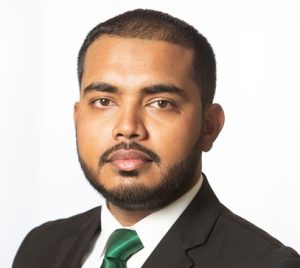
Mr Daniel Seeram

President Irfaan Ali shrugged off questions about whether he would consider pardoning the coordinator of the border patrol unit (BPU), Daniel Seeram, after he is sentenced early next month for assaulting his ex-wife causing actual bodily harm.

“I’m not even in that space as yet,” he said when asked by Demerara Waves Online News.

In response to the fact that Guyana’s Constitution provides for clemency, Dr Ali added that “this is a President that has always acted within the confines of the law; I believe in that.”

The president did not respond to the question on whether he would ask Mr Seeram to step down as BPU coordinator, a post to which he was appointed in April 2026.

Mr Seeram, who is remanded to prison pending sentencing on November 2, has since appealed the magistrate’s conviction and a High Court ruling that there was no scope for a judicial review of the magistrate’s decision. Mr Seeram also wants the Guyana Court of Appeal to grant him bail.

He was found guilty of committing the offence on September 11, 2023.

Mr Seeram is a former Guyana Defence Force (GDF) captain and a former Region Four chairman from 2020–2025 on A Partnership for National Unity+Alliance For Change (APNU+AFC) ticket.


Source: Demerara Waves