Home Blog Page 264

Guy Expo 2026 launches, positioning investment at heart of future opportunities

0

Guy Expo 2026 is positioning investment, innovation and enterprise at the centre of Guyana’s next phase of economic opportunity, as the four-day exhibition prepares to bring businesses, customers, investors and partners together at the National Exhibition Centre, Sophia, from November 12 to 15.

Minister of Tourism, Industry and Commerce, Susan Rodrigues, officially launched Guy Expo 2026 at the National Exhibition Centre, describing the longstanding exhibition as an important platform for showcasing Guyanese talent, creativity and enterprise while creating opportunities for businesses to expand and build new partnerships.

“The future is shaped by the investments we make today,” Minister Rodrigues said, underscoring the central message of this year’s Expo, which is being held under the theme, “Creating Tomorrow’s Opportunities Through Today’s Investments.”

Guy Expo, which began in 1995, has grown from a local exhibition into a major business platform where enterprises can showcase their products and services, connect with customers, build partnerships and explore new markets.

The 30th anniversary edition held last year was the largest in the Expo’s history at the time.

Minister Rodrigues said the 2026 theme reflects the direction in which Guyana is moving, noting that future opportunities depend on investments being made today in businesses, skills, technology, infrastructure and ideas.

She pointed out that investment is not limited to large scale capital, but also includes a small business owner purchasing new equipment, an entrepreneur investing in training, a manufacturer improving product quality or a young person developing a new skill.
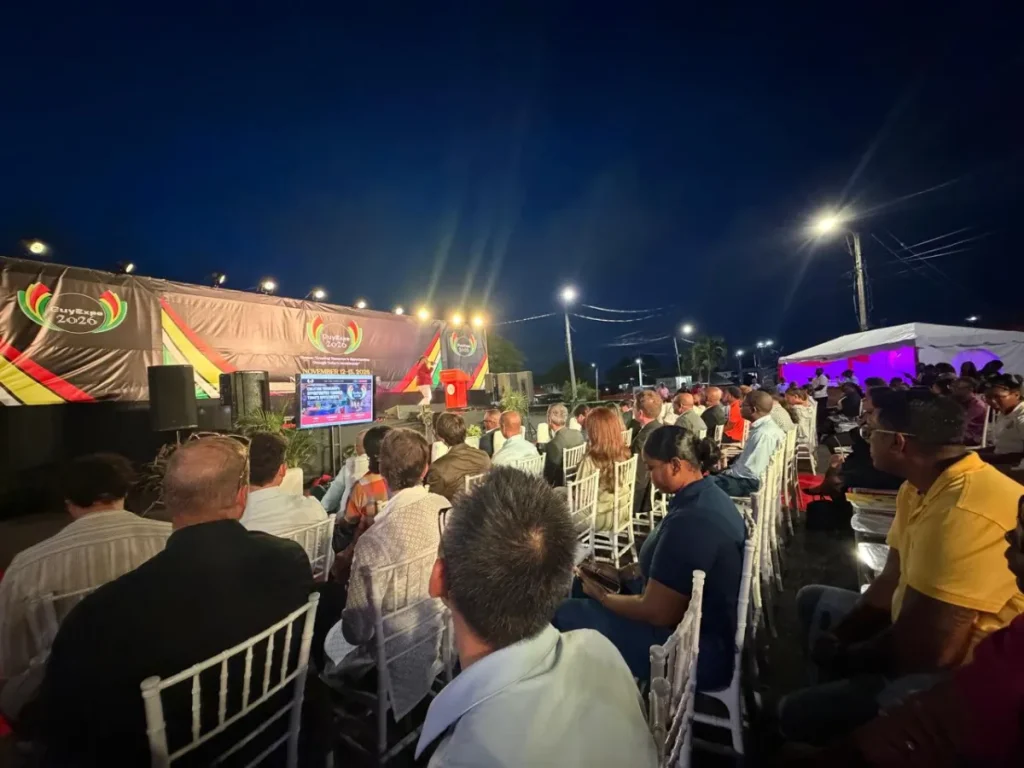
Persons in attendance

“These decisions may seem small on their own but collectively they build stronger businesses, create employment and expand the opportunities available to our people,” she said.

The minister said Guy Expo will continue to provide businesses with opportunities for business to business engagement, allowing exhibitors to meet potential customers, partners, investors and suppliers while exploring avenues to enter new markets.

The growing tourism sector is also creating new opportunities for Guyanese businesses.

She noted that Guyana welcomed 453,489 visitors in 2025, while 320,174 visitors had already arrived by the end of August 2026. August recorded 48,582 arrivals, the highest August on record.

With visitor arrivals projected to exceed 500,000 by year end and an ambition of reaching one million visitors by 2030, Rodrigues said the growth presents opportunities for hotels, restaurants, tour operators, transportation providers, artisans, farmers, entertainers and community businesses.

At the same time, access to finance remains an important component of business development, with the Guyana Development Bank providing another avenue for entrepreneurs to access financing of up to $3 million, alongside technical assistance and business development support.

Through its agencies and programmes, the Ministry of Tourism, Industry and Commerce is also supporting entrepreneurs through training, business development, standards, market access and other forms of assistance.

“Our objective is to see more Guyanese businesses growing, employing more people, producing more locally and becoming competitive in regional and international markets,” Minister Rodrigues said.

Guy Expo 2026 will provide exhibitors with opportunities to forge connections, identify new customers, develop partnerships and explore avenues for growth.

As Guy Expo moves beyond its first 30 years, the focus is now turning towards the businesses, products, markets and opportunities that will shape its next chapter and contribute to a more dynamic Guyanese economy.

DPI


Source: Village Voice News

27th Interpol Americas Conference Opens In Guyana Amid Growing Threats To National Security – HGPTV – Guyana’s Nightly News and Entertainment Channel

0

By Marvin Cato | HGP Nightly News |

GEORGETOWN, GUYANA — Senior law enforcement commanders, intelligence chiefs, and security delegates from across the Western Hemisphere have convened in Georgetown for the 27th INTERPOL Americas Regional Conference, a high-level summit focused on dismantling transnational organized crime networks, interdicting cross-border contraband, and curbing an alarming surge in global financial fraud.

The two-day conference, which officially opened on Wednesday, September 23, 2026, provides a collaborative operational platform for member states to assess emerging criminal trends, harmonize investigative methods, and deploy practical law enforcement tools to protect vulnerable populations throughout the Americas and the Caribbean.

Guyana’s hosting of the biennial security conference coincides with significant milestones in its institutional participation within the global policing architecture, having formally joined INTERPOL on October 1, 1968. The nation’s National Central Bureau (NCB) in Georgetown, embedded directly within the Criminal Investigation Department (CID) of the Guyana Police Force (GPF), serves as the 24/7 communications and intelligence pipeline linking local detectives to 196 member countries worldwide.

Border Vulnerabilities and Proactive Defense

Delivering the keynote address to open the assembly, Prime Minister Brigadier (Ret’d) Mark Phillips stressed that Guyana’s unique geographic position—serving as the physical bridge connecting continental South America with the Caribbean archipelago—places the country at a strategic yet vulnerable crossroads for illicit trafficking:

  • Contraband Corridors: Prime Minister Phillips pointed out that expansive, porous land boundaries, shared river basins, and vast Atlantic maritime waters create operational challenges that international cartels actively exploit.
  • Human Exploitation: The Prime Minister condemned human trafficking syndicates and gunrunning rings that feed on displaced migrants and marginalized communities.

“Narcotics and illegal firearms travel through illegal channels while traffickers and smugglers profit from people already placed in desperate circumstances,” Prime Minister Phillips stated.

Minister of Home Affairs Oneidge Walrond echoed those security imperatives, emphasizing the multi-billion-dollar modernization investments channeled into Guyana’s domestic defense and surveillance systems. She argued that traditional reactive policing is obsolete in an era dominated by asymmetric, digitally enabled criminal enterprises.

“Security can no longer be understood as responding to crime after it occurs; it requires us to protect our people, our borders, our institutions,” Minister Walrond affirmed.

Fraud Alerts Jump 40%: Cryptocurrency and Asset Recovery High on Agenda

A central pillar of the Georgetown deliberations centers on combating sophisticated economic crimes, following findings published in INTERPOL’s Second Global Financial Fraud Assessment Report:

  • Spike in Global Fraud: The assessment revealed that between 2024 and 2025, fraud-related international notices and red alerts issued across the Americas and the Caribbean escalated by 40 percent, driven by cyber-enabled scams, illicit call centers, and fraudulent investment schemes.
  • Cryptocurrency Misuse: Delegates are examining operational methodologies to trace, freeze, and seize cryptocurrency wallets exploited by organized crime cartels to launder extortion proceeds and finance narcotics consignments.
  • Asset Forfeiture Pipelines: Discussions are focusing on practical mechanics for mutual legal assistance, tracking illicit cross-border wire transfers, and accelerating the repatriation of confiscated criminal assets back to victim jurisdictions.

Addressing the assembly, INTERPOL President Lucas Philippe urged security chiefs to cut through bureaucratic complexities and maximize the operational efficiency of existing shared systems:

“Ultimately, we all want the same thing: to help officers prevent crime, investigate it and bring criminals to justice. Our structures should make that work easier rather than add complexity. That means clear channels, standard procedures, tools that work together and making the best possible use of what already exists. That is why having all the key stakeholders around the table today matters.”

Deploying the Operational Task Force (OTF) Model

To move beyond policy rhetoric and achieve concrete takedowns, the conference highlighted the rollout of INTERPOL’s Operational Task Force (OTF) Model:

  • Targeted Multilateral Action: The OTF framework provides member countries with specialized, agile coordination cells designed to target specific high-value targets, transnational syndicates, or emerging criminal threats that overwhelm single jurisdictions.
  • Closing Intelligence Gaps: By facilitating real-time biometric and forensic data sharing, direct access to INTERPOL’s global databases (including the I-24/7 network), and joint operational commands, the model eliminates blind spots between regional police forces.

The 27th INTERPOL Americas Regional Conference continues its closed-door working sessions in Georgetown, with delegates slated to conclude proceedings with joint operational recommendations for hemispheric policing cooperation.


  • Source: HGP Nightly News / HGPTV

    Heritage Games 2026 officially opens, bringing Indigenous athletes together

    0

    The 2026 Amerindian Heritage Games officially got underway on Thursday evening at the Everest Sports Ground, Georgetown, bringing together athletes from across Guyana’s ten regions for four days of sports competition, while making way for talent development.

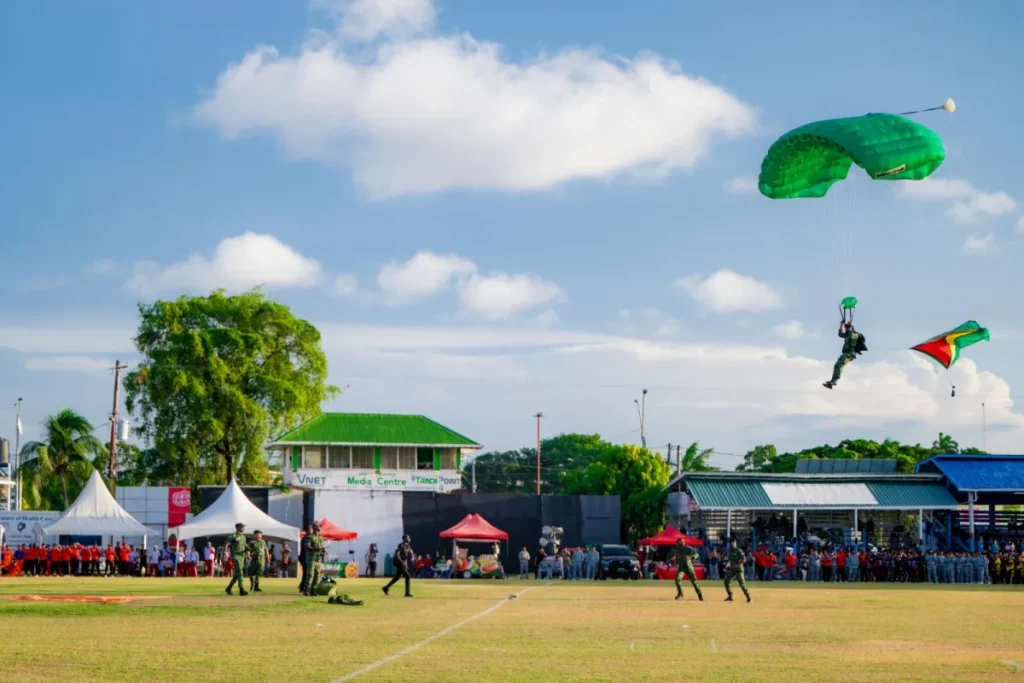
    The ceremony, held under the theme “Observing Our Cultural Heritage During Our Diamond Jubilee,” featured a march past by the participating teams, cultural performances, and a parachuting display by the Guyana Defence Force.

    A parachuting display by the Guyana Defence Force on Thursday

    Prime Minister, performing the duties of president, Brigadier (Ret’d) Mark Phillips officially declared the Games open.

    He highlighted the importance of such an event in advancing the government’s One Guyana development approach and expanding opportunities for young people across the country.

    “No longer must development be centred only on the coastline. Development must reach the communities in the hinterland,” the prime minister said.

    He noted that the government has invested in sports infrastructure, equipment, trainers and coaches across hinterland communities, which has helped to strengthen sporting opportunities for young people.

    The prime minister noted that the participation of hundreds of indigenous athletes is a demonstration of the government’s efforts to bridge the development divide.

    “You have a government that is connected to the people. A government that will continue to support the development of sports in all your communities, in every region, every part of Guyana,” he said.

    Also attending the opening ceremony was Minister of Amerindian Affairs Sarah Brown-Shadeek who also welcomed the athletes and highlighted the importance of sports in creating opportunities for young people from hinterland communities.

    She said sports can serve as a stepping stone to wider opportunities, noting that several athletes who participated in previous editions of the games have gone on to represent Guyana at different levels.

    Minister Brown-Shadeek said the 2026 Games will feature football, cricket, volleyball, archery and novelty events, while also welcoming the participation of new teams and defending champions.

    Meanwhile, Minister of Culture, Youth and Sport Charles Ramson Jr. added that the Heritage Games represent more than a sports competition, describing them as a platform to recognise the talent that exists throughout Guyana.

    “The games started as an idea, an idea that represents a belief in talent that exists in every single one of us as Guyanese people,” Minister Ramson said.

    He pointed to continued investment in community grounds, noting that more than $1 billion has been invested in hinterland community grounds over the past five years.

    Meanwhile, Minister within the Ministry of Culture, Youth and Sport, Steven Jacobs, during his brief remarks noted that the games also provide athletes with opportunities to be identified by national sporting associations.

    “This is not only about competition, it’s about opportunities,” Minister Jacobs said, noting that representatives from football, cricket, volleyball and archery will be present to scout emerging talent.

    The first night of competition continued with football, with Mahdia facing Paramakatoi, as the participating teams began their quest for honours in this year’s Games.

    The 2026 Amerindian Heritage Games continue through Sunday, providing a platform for just over 700 male and female Indigenous athletes to compete, showcase their abilities and celebrate their heritage through sport and culture.


    Source: Village Voice News

    Ali, Rodríguez Offer Rival Paths on Settling Border Controversy

    0

    President Irfaan Ali and Venezuela’s acting President Delcy Rodríguez used the United Nations General Assembly this week to advance sharply different approaches to settling the Guyana-Venezuela border controversy, with Rodríguez calling for a return to bilateral negotiations and Ali insisting that the International Court of Justice (ICJ) process should be respected.

    Rodríguez made Venezuela’s position first, addressing the 81st session of the UN General Assembly on Wednesday, September 23, 2026, in New York. She reaffirmed Caracas’ claim to the Essequibo region and appealed to Guyana to return to negotiations under the 1966 Geneva Agreement.

    “Here, I appeal to the Cooperative Republic of Guyana to resolve the issue and to return to negotiations, as stipulated by the Geneva Agreement.”

    Rodríguez argued that direct negotiations offered a more durable basis for settlement than decisions imposed by external institutions.

    “Agreements which last the longest are those that emerge from bilateral negotiations. They last longer and function better than those imposed by external bodies.”

    Her intervention came as the ICJ prepares to rule on Guyana’s case concerning the validity of the 1899 Arbitral Award, which Guyana maintains established the final international boundary between the two countries.

    Less than 24 hours later, Ali addressed the General Assembly on Thursday, September 24, presenting Guyana’s position that the controversy has already entered the judicial phase after decades of efforts to resolve it through bilateral and United Nations-supported mechanisms.

    Ali urged Venezuela to accept the forthcoming ICJ ruling, saying Guyana would do the same.

    “Now that we have both participated in the hearings which were completed in May 2026, we urge Venezuela to abide by the forthcoming ruling in accordance with their obligation under the UN Charter, as Guyana will do.”

    Ali stressed that Guyana’s resort to the World Court was not its first choice.

    “Recourse to the ICJ came after decades of efforts to resolve the controversy bilaterally, including through a mixed commission and the Good Offices of the UN Secretary General.”

    He also reiterated Guyana’s position that the 1899 Arbitral Award itself described the settlement of the land boundary as “full, perfect, and final.”

    The contrasting presentations highlight the fundamental divide between Georgetown and Caracas.

    Guyana’s position is that previous efforts to settle the controversy failed, the matter was referred to the ICJ under the framework of the Geneva Agreement, and both countries have participated in the court proceedings. The substantive hearings concluded in May 2026, leaving the parties awaiting the court’s judgment.

    Venezuela’s position is that the Geneva Agreement remains the basis for a negotiated settlement and that the controversy should be resolved through direct talks rather than an external judicial determination.

    The ICJ has already ruled that it has jurisdiction to hear Guyana’s case, which was filed after the UN Secretary-General referred the controversy to the court under the Geneva Agreement.

    Ali nevertheless used his UN address to look beyond the legal proceedings, saying Guyana wants a new relationship with its neighbour once the controversy is settled.

    “We look forward to a new era of neighbourly relations in the interest of our peoples, the development of our countries and the stability and prosperity of our region.”

    The two UN addresses therefore underscored rather than narrowed the diplomatic divide: Rodríguez called Guyana back to the negotiating table on September 23, while Ali, speaking on September 24, called for Venezuela to respect the forthcoming judgment of the World Court.


    Source: Village Voice News

    Pres Ali tells UN: Guyana went to ICJ after decades of bilateral efforts, urges Venezuela to abide by ruling

    0

    President Irfaan Ali told the 81st United Nations General Assembly (UNGA) that Guyana turned to the International Court of Justice (ICJ) only after decades of bilateral efforts to resolve the border dispute with Venezuela. He urged Venezuela to abide by the court’s forthcoming ruling, as Guyana will do.

    The president was speaking at the general debate of the Assembly’s 81st Session in New York.

    The debate is the annual gathering where leaders of the UN’s 193 member states set out their positions to the world.

    His address came less than a day after Venezuela’s acting President, Delcy Rodríguez, used the same podium to urge Guyana to return to negotiations under the Geneva Agreement.

    It was also his first address to the Assembly since the ICJ completed hearings in the case in May 2026. That placed Guyana’s commitment to the rule of law on record before the full membership of the United Nations, with a ruling still pending.

    “Recourse to the ICJ came after decades of efforts to resolve the controversy bilaterally, including through a mixed commission and the good offices of the UN Secretary-General,” President Ali said.

    He noted that the 1899 Arbitral Award was “the full, perfect, and final settlement” of the border.

    Despite this, he said, Guyana had “endured long and repeated provocations and aggression.”

    “Guyana has always advanced the peaceful settlement of the controversy in relation to our border with Venezuela,” the president said.

    He recalled that the Secretary-General referred the matter to the court under the Geneva Agreement.

    The court has since twice pronounced on its jurisdiction to hear the case. President Ali said Guyana took part in the proceedings in full respect for international law and encouraged Venezuela to do the same.

    “Now that we have both participated in the hearings, which were completed in May 2026, we urge Venezuela to abide by the forthcoming ruling in accordance with their obligation under the UN Charter, as Guyana will do,” he said.

    He said Guyana hopes the ruling will open a new chapter between the two neighbours.

    “We look forward to a new era of neighbourly relations in the interests of our peoples, the development of our countries, and the stability and prosperity of our region,” he said.

    The case, filed by Guyana in 2018, seeks the Court’s confirmation that the 1899 Award and the boundary it established between then-British Guiana and Venezuela are valid and binding under international law.

    The ICJ has twice affirmed its jurisdiction, ruling in 2020 that it had authority over the case and dismissing a further Venezuelan objection in 2023. The Court has also twice granted Guyana’s requests for provisional measures, most recently ordering Venezuela in 2025 not to proceed with elections in the disputed Essequibo region.

    This year, world leaders have gathered under the theme “Restoring trust, managing transformation: a United Nations that delivers for all.” (DPI)


    Source: Village Voice News

    Pres Ali presses for UN overhaul

    0

    President Dr Mohamed Irfaan Ali used Guyana’s address to the United Nations General Assembly (UNGA) to push for a Security Council that gives Africa, Latin America and the Caribbean permanent representation.

    He argued that a body designed at the end of the Second World War can no longer claim to speak for the world as it is presently.

    “We need a Security Council that reflects the geopolitical realities of the 21st century, not the power structures of 1945,” the Guyanese leader told the 81st UNGA Session in New York on Wednesday.

    The call carries added weight coming from Guyana, which completed a two-year term as a non-permanent member of the Council in 2025, giving it first-hand experience of how the body works.

    President Ali framed reform as the answer to a deeper problem that he identified as the declining confidence in multilateralism itself.

    He listed weakening of cooperation between nations among the most troubling challenges of the age, alongside war, climate change and rising inequality. He argued that the UN’s credibility now depends on its willingness to change.

    “The United Nations must not be a monument to the past. It must become an instrument for the future,” he declared.

    In his message, the president also called for the UN to become more transparent, accountable and responsive.

    He also wants a stronger General Assembly with greater weight given to its deliberative and representative authority, since that is the one body where every member state has an equal voice. He pointed to a system too often divided by institutional rivalries and competing mandates.

    He also pointed to resources that fall short of the responsibilities member states have handed the organisation.

    “This is not the hour to retreat from multilateralism. This is the hour to reclaim and to renew it,” he called on world leaders.

    President Ali tied the reform agenda directly to this year’s race for UN Secretary-General. He argued that institutions do not reform themselves and need leadership capable of change.

    Guyana has put forward Ambassador Carolyn Rodrigues-Birkett for the post, and CARICOM nations have endorsed her candidacy.

    The UNGA is the annual gathering where leaders of the UN’s 193 member states set out their positions to the world. This year, world leaders have gathered under the theme “Restoring trust, managing transformation: a United Nations that delivers for all.”

    DPI


    Source: Village Voice News

    Murder Allegations: Is the PPP Govt Still “Democracy at Its Finest” in U.S. Eyes?- Lall

    0

    By GHK Lall- Is American Ambassador to Guyana, Excellency Nicole D. Theriot, still touting the PPP Govt as democracy as its finest?  Is Secretary of State, Mr. Marco Rubio, still hailing the special relationship between the U.S. government and Guyana’s PPP Govt?  Is CEO Darren Woods and Country Head, Alistair Routledge, Exxon’s cardinals, still selling the PPP Govt as the best partners that anyone can want?

    They should read the media reports of the Guyana’s Snr Supt, Prem Narine, and his expressive, explosive, testimony about six execution-style murders.  Allegedly by a close friend of the same PPP Govt that went nowhere.  Nowhere despite the evidence.  Nowhere, most likely because of the millions donated.  Never for that evidence that pointed to one PPP insider to see the light of day until now when the PPP Govt and its friend have a parting of the ways.

    Truth be told, the U.S. Ambassador doesn’t need the Guyana media to publish what its own intelligence network already confirmed.  Further, U.S. ambassadors are the best expert witnesses on how Guyana Governments own and control, dominate and decide for, the Guyana Police Force, on major developments of this nature.  This is not a 2026 development, but one that goes back at least six decades.

    Now with the senior superintendent overnight confessions about the way that things went down (concealed and condemned to close confinement) with those six murders, will Ambassador Theriot still be waxing brightly about democracy in relation to the PPP Govt?  Will Excellency Rubio still be selling his special relationship with those who coddle an alleged serial murderer, Guyana’s equivalent of America’s Green River killer?

    Will CEO Woods and Exxon Guyana Country Chief, Mr. Alistair Routledge, still be making a huge production of the Exxon-PPP Govt partnership?  Will they, when the PPP Govt covers over Guyana’s alleged equivalent of Charles Whitman, the Texas University Tower mass murderer from back in 1966?  I would hope not.  I trust that easy access to Guyana’s oil doesn’t mean so much that partners in heinous crimes are given a free pass.  Without a word said.  Without a visa restricted.  Without some sanctions applied, if only to save face.

    Wakeup call and reality check for Guyanese.  Don’t hold breath.  If the U.S. could have dealt with Chile’s Pinochet (a 10,000-man mass murderer), then Guyana’s PPP Govt and its itsy-bitsy-teeny-weeny half dozen murders isn’t anything to get carried away over, or cry about.  Collateral damage.  Just like how arms of the U.S. Government used Panamanian strongman Manuel Noriega to flood Black American communities in California with mind altering substances and send those already poor, depressed communities back into the Stone Age.  With those backgrounds, why should the murders of six meaningless nonwhite Guyanese matter that much to America?  Why should Americans care?

    If the PPP Govt wasn’t such a groveling flunky (sanctity of contract) to Exxon and wider American interests, then maybe the six murders could have been a tipping point.  A point of damnation and no return for the PPP.  But not when it is how it is.  The PPP Govt sold itself.  The American Govt bought into the bargain.  Now the Americans have to swallow hard, and position these murder exposures as a domestic matter.

    Like hell it is!  The man that the U.S. wants is the alleged mass murderer.  The U.S. wants him as a gold smuggler, a tax evader, and a money launderer, as charged.  So, don’t tell Guyanese that the same quarry, now an alleged murderer isn’t of interest.  Nor those who covered over his crimes a nonissue. What does not rise to the level of urgent concern.

    Inarguably, the PPP Govt had much involvement in the suppression of murder evidence.  The police environment is built that way, under PPP Govt instructions.  U.S. Government agents know this.  They should avoid being a party to crimes, covering up crimes.


    Source: Village Voice News

    The UN is facing a crisis of trust and possible bankruptcy. Its new leader will have an enormous challenge

    0

    Last Updated on Friday, 25 September 2026, 7:55 by Written By Denis Chabrol

    Reproduced from The Conversation

    The United Nations is deep into the process of looking for its next Secretary General as Portugal’s Antonio Guterres steps down in December after a decade.

    The leadership change comes as the 81-year-old organisation faces many serious challenges. Who will step in and tackle them with the skills and courage they demand remains an open question.

    There is no legislated date for UN member countries to decide on the new Secretary General; it depends on when the Security Council agrees on its preferred candidate. Ultimately, the decision has to be made before December 31.

    Turbulent times at the UN

    The campaign to take over from Guterres is unfolding against the background of a crisis of trust in the international system generally, and in the UN in particular.

    International cooperation between some countries is in the process of unravelling. Many are turning away from international dialogue, despite cyclical conflict in hot spots in Africa and the Middle East continuing, and global threats like climate change, health pandemics and competition in newly contested areas like the Arctic, cyberspace, outer space and the oceans.

    The UN reports many countries are alarmingly disrespecting international law and withdrawing from international treaties. The rules of war are being shredded by combatants with virtually no accountability in Ukraine, Gaza and elsewhere.

    Beset by faltering economies, growing social welfare costs, rising military expenditures and right-wing populism, countries are defending their sovereignty against what they see as the threat of invasive multilateral bodies.

    The United States has been a particularly staunch critic. According to US Secretary of State Marco Rubio: “the post-war global order is not just obsolete, it is now a weapon being used against us”. President Donald Trump said the UN’s response to global conflicts is little more than to “write a really strongly worded letter, and then never follow that letter up”.

    Ukrainian President Volodymyr Zelensky would seem to agree. In 2025 he observed:

    Nations can speak about their pain from stages like this but even during bloodshed, there isn’t a single international institution that can truly stop it. That’s how weak these institutions have become.

    One flow-on from these developments is the UN’s funding crisis. Guterres has talked ominously of bankruptcy looming and predicted the UN would likely need to cut US$500 million from its 2026 regular budget and lose 20% of its staff.

    The budget crisis has been driven partly by the US’ highly publicised cutbacks in its funding of UN bodies, traditionally the organisation’s major donor.

    The US is not alone. Many states, including Germany, France and the United Kingdom, are cutting back on foreign aid as priority is accorded to defence spending.

    This could have major ramifications. Australia’s Foreign Minister Penny Wong gloomily predicted the slashing of UN agency programs could lead to “shell” or “zombie” agencies, doomed to fail because they can’t deliver basic functions.

    The challenges don’t end there

    Against this background, some are arguing a major overhaul of the UN as we know it is overdue.

    The UN was created when the world was coming out of the second world war, colonialism was rife and many countries lacked the capacity and the governance structures to go it alone.

    It is a new world order now. Some of the more strident critics argue the UN needs a much more limited, less interventionist mandate.

    The UN is not perfect. It is beset by serious structural problems, not least of which is the power still in the hands of five countries (the US, UK, Russia, France and China) to veto decisions of its main peace body, the Security Council. Its bureaucracy has grown exponentially over the years, with a proliferation of mandates, agencies, funds and programs.

    But it is the only truly global organisation where all countries – big and wealthy, tiny and struggling – can meet and exercise a voice, with decision-making capacity more-or-less on par. There is no obvious better alternative.

    It also administers diverse programs in health, water and sanitation, weather, food, the environment, cultural preservation, trade, telecommunications, atomic energy, drugs, crime and human rights and refugees.

    We need the UN for all of this. And we need its advocacy and monitoring and accountability mechanisms. As Wong put it:

    We do not want a dysfunctional UN that can be manipulated by those who mean to dismantle it or to take it over for their own national or often autocratic, aspirations.

    Who will step up?

    There are currently seven candidates formally in contention for the Secretary General position. The process is complicated and drawn out and does not preclude last-minute additions.

    There is a principle of geographic rotation that alternates the position among five geographic regional blocs. This time it favours the Latin American and Caribbean bloc. There are five candidates from the Latin American region, four of whom are women (there has never been a woman Secretary General):

    • Maria Fernanda Espinosa, from Ecuador, a past president of the General Assembly
    • Ecuadorian diplomat Ivonne A-Baki
    • the former foreign minister of Guyana, Caroyn Rodrigues-Birkett
    • Rebeca Grynspan, former vice-president of Costa Rica and currently the Secretary General of UNCTAD (the UN’s Conference on Trade and Development)
    • the sole male candidate from the region is Rafael Grossi from Argentina, director of the International Atomic Energy Agency.

    Each candidate has identified restoring trust in the multilateral system and returning peacekeeping to the forefront of the UN’s activities as priorities.

    A massive challenge awaits

    The Secretary General is chief administrator of an organisation with thousands of staff, many very disgruntled about recent cuts, a budget in the billions and multiple different organs and agencies as part of its structure.

    She or he must also play simultaneously the roles of global mediator, defender of the rights of people around the world, and generally be chief advocate for the principles on which the UN is built: the pursuit of peace, human security and rule of law.

    This is a big ask at the best of times, which today is not.


    Discover more from Demerara Waves Online News- Guyana

    Subscribe to get the latest posts sent to your email.


    Source: Demerara Waves

    President Fully Endorses Rodrigues-Birkett For Un Job At General Assembly As Reports Surface That Us Intends To Veto Nomination – HGPTV – Guyana’s Nightly News and Entertainment Channel

    0

    By Marvin Cato | HGP Nightly News |

    UNITED NATIONS, NEW YORK — Facing widespread diplomatic reports that the United States intends to exercise its permanent veto to block Guyana’s candidate, President Dr. Irfaan Ali used his address before the United Nations General Assembly on Thursday to deliver an impassioned defense of Ambassador Carolyn Rodrigues-Birkett’s candidacy for UN Secretary-General.

    Addressing more than 130 world leaders gathered at the UN Headquarters for the general debate of the 81st session of the General Assembly, President Ali argued that the global body stands at an unprecedented crossroads that demands fearless, bridge-building leadership capable of restoring international confidence and upholding the UN Charter impartially.

    The high-stakes endorsement comes amid revelations that Washington opposes Rodrigues-Birkett’s bid over Guyana’s principled and outspoken stance inside the UN Security Council regarding Israel’s military operations in Gaza.

    ‘Leadership This Moment Demands’: President Ali Makes the Case

    President Ali urged the General Assembly to support a candidate who understands global divisions and possesses the moral authority to unite fragmented institutions:

    • Unity of Purpose: The President argued that the United Nations requires executive leadership capable of aligning its disparate organs, agencies, and regional bodies into a shared sense of mission.
    • Charter Defense Without Fear or Favor: Ali emphasized that the next Secretary-General must defend international law and the UN Charter not merely when it is politically expedient, but precisely when its foundational principles face immense geopolitical pressure.
    • Defying the Odds: Highlighting her unique life trajectory, President Ali framed Rodrigues-Birkett as an Indigenous woman from a remote riverine village who shattered structural barriers against poverty, gender, and minority exclusion to attain global diplomatic prominence.

    “We believe that her experience, conviction, her record of service speak directly to the kind of leadership this moment demands,” President Ali declared to world leaders.

    “The United Nations need its next General Secretary to work with all member states to restore confidence in the organization.”

    The Diplomatic Fault Line: The Gaza ‘Genocide’ Statements

    The friction between Washington and Georgetown centers directly on statements delivered by Ambassador Rodrigues-Birkett during Guyana’s tenure as an elected member of the United Nations Security Council:

    • Calling Out Actions in Gaza: During formal debate in 2024, Ambassador Rodrigues-Birkett delivered an official statement on behalf of the Government of Guyana characterizing Israel’s military campaign in the Gaza Strip as a “veritable genocide.”
    • ICJ Compliance Demands: In that address, Rodrigues-Birkett cited the provisional orders issued by the International Court of Justice (ICJ) mandating that Israel take immediate measures to prevent genocidal acts in accordance with international obligations. She criticized Israel for what she described as a blatant disregard of those binding judicial rulings.
    • Call for Council Action: Delivering an urgent appeal to the Security Council, the Ambassador had warned: “The floodgates have already opened in Gaza, and this Council must agree to pull the plug and stand up for Palestinians.”

    Washington, as Israel’s primary strategic ally on the Security Council, has reportedly viewed those positions as an insurmountable obstacle to supporting Rodrigues-Birkett’s ascension to the UN’s top executive office.

    The Reality of the P5 Veto

    Under the United Nations Charter, the appointment of the Secretary-General is made by the General Assembly upon the formal recommendation of the 15-member Security Council.

    Because the recommendation requires the concurring votes of the Council’s five permanent members (P5)—the United States, the United Kingdom, France, China, and Russia—a negative vote from any single permanent member constitutes an absolute veto.

    If the United States executes its threatened veto during Security Council straw polls or formal balloting, it will effectively terminate Ambassador Rodrigues-Birkett’s historic bid, despite substantial support among Caribbean, African, and non-aligned nations.

    Nevertheless, Guyana’s diplomatic delegation signaled that it will continue pressing her qualifications on the international stage as the selection process unfolds.


  • Source: HGP Nightly News / HGPTV

    OPINION: Visa -PPP Govt denies; who believes, trusts?

    0

    Last Updated on Friday, 25 September 2026, 7:08 by Written By Denis Chabrol

    by GHK Lall

    The PPP Govt denies involvement in the Justice Gino Persaud “visa review.”  A government that honors its word, has a record of being trustworthy, can have that accepted at face value.  No arguments.  No pushback.  By its hand, however, the PPP Govt has condemned itself into the row of the untrustworthy.  Too little done to earn the confidence of Guyanese.

    The PPP gave its word: it was going to address all contracts.  Then, what did it do?  Like some cheap tinhorn operator, the government reneged on its commitment, welshed on its promise.  Should it be believed in its visa denial assertions?  I want to; how can I?

    The same government said that there will be an untainted, impeccable, Commission of Inquiry (COI) into the MV Barima tragedy.  It swore, it committed, it promised.  Then, what did it do?  A secret swearing in, the media barred.  A flawed beginning; the stage set: a farce for a COI in the making.  This is the government that says to the people ‘believe us, trust us.’  But it wraps the COI in layers intended to mislead.  There was misrepresentation from the inception.  Deviousness will continue to the termination.

    When a government is characterized by secrets, only drunks, fools, and knaves would trust anything it says.  Secrets with oil money.  Secrets with housing money.  Secrets with the deportee deal.  Secrets relative to a leader’s whereabouts during the first hours of the Barima horror.  Secrets and stealth in its dealings with MV Barima family members longing for relief.  Secret missions spearheaded by exploiters and fearmongers from the PPP Govt who cross the doorstep of survivors, pressure them.  If at the beginning, in the middle, and in the aftermath of a harrowing national tragedy, one of Guyana’s biggest, the PPP Govt could work energetically at pulling the wool over the eyes of Guyanese then, by all that’s reasonable, how can these people be believed?  Be trusted?  With anything?

    The government denies that it had a hand in what is lining up to be the Gino Persaud Visa Papers.  I wish to give it the benefit of the doubt, accept its word.  But on what basis?  On what history?

    The PPP Govt said that it is about unity.  Go back to 2020.  It has delivered the kind of unity that would please Israel’s Benjamin Netanyahu, South Africa’s PW Botha, and America’s Donald Trump.  A nod for unity, followed by a wink.  The PPP has divided this country, so that its One Guyana supremacy program could gain energy and acceleration.  Mocha.  Linden.  Teachers.  Public Service.  Where’s the promised unity?  How to believe?

    The PPP Govt insists in all its speeches, all its propaganda films, that it’s about democracy.  Parliamentary doors locked for months.  There’s democracy.  The Speaker has blocked the free flow of motions and conversations.  Democracy, again.  For his crowning achievement, the Hon Speaker has his own dictionary, with certain revealing words banned.  Howzat for parliamentary democracy!  I must ask the Hon Speaker of the House where he stands on the burning of books found offensive by the PPP Govt.  Taking a risk, I want to ask him what should be the fate of writers of such books, but am too scared.  Democracy claimed, parliamentary proceedings stonewalled, and it required the white people to save the little brown people from their foolishness, weakness, sickness, and tawdriness.  The man did say that stupidity took over this country.

    Guyanese are free to take the risk and trust what the government says about its noninvolvement in the U.S. Gino Persaud “visa review” development.  Exclude me.  I have had it enough of PPP shaded truths, PPP Govt guileful misrepresentations, and PPP leadership sly deceptions.  This government has misled the Guyanese people so frequently, one more to its record is nothing.  Mislead one time, mislead a million times afterwards.  The irony is that (like the boy who cried wolf), this time might be the one time that the PPP Govt should be believed, trusted, except that it’s too late in time.


    Discover more from Demerara Waves Online News- Guyana

    Subscribe to get the latest posts sent to your email.


    Source: Demerara Waves