Home Blog Page 238

‘Guyana’s Great Lament: Poverty Amid Plenty’

0

Even before the extraction of one barrel of oil from its offshore discovery that is said to set the country on course to become ‘a regional energy powerhouse’, the former President of Suriname, Chandrika Persad Santokhi, announced ‘Royalties for Everyone’, a programme to distribute the country’s oil wealth directly into the hands of its people.

Every Surinamese is to be given an annual US$750 savings note and paid an annual interest rate of 7%. According to President Santokhi, the aim of the programme is to transform Suriname’s oil wealth into tangible benefits for its people while encouraging individual civic and economic participation, and of course development of generational wealth.

Suriname at present has a population of about 645,256 and a 2026 estimated GNI per capita of US$6,140 (Gross National Income is used as an attempt to identify the value of annual national production actually going to Suriname).  The country found oil internally in the early 1980s but its first offshore discovery occurred in 2020 and recoverable oil resources are at present estimated at 2.4 billion barrels. Guyana has a population of 797,000 and a 2026 estimated GNI per capita of US$33,167. It found oil in 2015 with recoverable resources estimated at 11 billion barrels.

Both Guyana and Suriname are signatories to the 2016 United Nations Sustainable Development Goals that commit governments to implement nationally appropriate social protection systems and measures for all, including floors that are a kind of universal of basic income (UBI) – ‘a basic set of essential social rights and transfers in cash and kind to provide a minimum income and livelihood security for all and to facilitate effective demand for and access to essential goods and services.’

In 2017, I noted that ‘The discovery of oil has made it possible for us to look at development and citizenship differently and begin to work towards a UBI for every citizen of Guyana. …. [and] depending on where the poverty floor is set, by permanently maintaining 10% of revenue for this purpose, this small initial grant will gradually grow and could expand towards a UBI’ (‘A universal basic income for all Guyanese’, Future Notes SN 30/08/2017).

The government of the People’s Progressive Party (PPP) rejected this approach, and some have argued that Santokhi was merely attempting to win votes, but that is just the point, for at one level that is what political accountability demands. Instead, at about the same time the President of Suriname, a country that is poorer than Guyana, was making a transformative commitment, the government of Guyana was distributing one of its haphazard US$500 grants that do little to improve the economic position of the poor and thus Guyana’s great lament of poverty amid plenty.

Recently, in relation to government’s attempt to subvert the Guyana Teachers Union, the Working People Alliance (WPA) exclaimed, ‘This matter is a WPA line in the sand … You cannot ask African Guyanese for their votes while simultaneously seeking to crush organisations they belong to.’

I am surprised that the WPA has not noticed that this is precisely what the PPP believes it needs to do to compel Africans to vote for it.  It has little interest in improving their general welfare but seeks instead to enhance its capacity to stay in government by impoverishing and politically demobilising the African people.

Last Monday, I encountered a similar kind of contribution from the leader of the PNC in the National Assembly, Dr. Terrence Campbell. He was complaining about the level of public servants income and was calling on the PPP government to double the minimum wages of public servants to G$200,000 per month, noting that during the period from 2015 to 2020, when the PNC was in government, they received a 77% increase in salaries (https://kiskadeewatch.com 22/09/2026).

Dr. Campbell, your kind of genteel political statement, while suitable for a democratic polity like Suriname, where votes are constitutionally and democratically properly aligned and governments are thus accountable, will get no traction under the PPP.

During the PPP’s previous term in office the United States government had to put its foot on the the party’s neck to get it to improve on its usual increases for public servants that hardly even covered the annual rate of inflation. This was despite Cheddi Jagan’s tenet that public service wages should be based on the rate of inflation plus the level of growth in the economy.

Note too, that the above and other progressive encouragement in the direction of democratic formation in Guyana drove the PPP and/or its supports to a point where the 2024 Democratic Party  loss in the USA was greeted by a huge celebratory billboard in Georgetown.

The regime’s most likely response to you Dr. Campbell, will be to attempt to reduce your concern to one associated with the normal cut and trust of competitive politics by reminding you that public servants are largely your supporters, then tie you to a lengthy unproductive discourse about the experience the sugar workers under the coalition government, if you do not also associate the sugar worker’s experience with the general existence of unaccountable, exclusive governance arrangements.

Over its decades in government, the PPP’s ruthless efforts to win African support have not worked. The red wave it promised during the 2025 elections did not materialise. Indeed, the European Union elections monitoring group claimed that given the level of the regime’s pre-election manipulation it could not in fairness say that that election were free and fair!

But autocracies of its sort are relentless, and the PPP regime is at present unilaterally developing and managing a new bank that, given its history, will most likely be used to give small loans and then, much as happened in the 2025 elections period in relation to the buying of votes, the existing digital architecture will be positioned as a threat to those who, regardless of their having a loan, still have no intention of voting for the PPP.

Note that I am not making much of the dubious meanderings of President Irfaan Ali. The constitutional infrastructure allows the leader and ruling oligarchs of Guyana’s political parties, particularly if they are organised along ‘democratic centralist’ principles, to determine how the country is managed. Historically they have done and are still doing so.

The question of why and how the PPP has arrived at this catastrophic political juncture is a fascinating story that I will address another time. Only to say here that misguided though its founder leaders were, they were young and inexperienced but were guided by what many considered a liberating ideology.

But with the demise of Soviet communism and the death of Cheddi Jagan, the PPP has gradually worked its way into that category of autocracies that is rooted in personal ambition and opulence and will, therefore, always be plagued by a surfeit opportunism, incompetence, and corruption.

Furthermore, given its refusal to make the democratically required concessions to its ethnic context, it deliberately goes about seeking to recruit these very categories of persons to fill the ethnic gaps in its ranks, and thus when events like the MV Barima tragedy occur, the regime cannot legitimately find anyone but itself to blame (KN: 12/04/26).


Source: Village Voice News

WORD OF THE DAY: BELLWETHER

0

WORD OF THE DAY: BELLWETHER

noun   |   BEL-WEH-ther

Bellwether usually refers to something that serves as an indicator of trends. It can also refer to someone or something that leads others.

// Event organisers say the concert series is a bellwether, demonstrating that good shows can bring visitors to the town.

EXAMPLES OF BELLWETHER

“Disney, with its long and illustrious history and dominating cultural influence, is seen as something of a bellwether for the entire entertainment industry …” — Alex Weprin, The Hollywood Reporter, 3 Feb. 2026

DID YOU KNOW?

Because it suggests the act of forecasting, one might be inclined to think that bellwether has something to do with weather. But the wether in bellwether has nothing to do with meteorology. Instead, to learn whither wether, we must head to the sheep farm. We usually think of sheep more as followers than leaders, but in a flock one sheep must lead the way. Since long ago, it has been common practice for shepherds to hang a bell around the neck of one sheep in their flock, thereby designating it the lead sheep. This animal was historically called the bellwether, a word formed by a combination of the Middle English words belle (meaning “bell”) and wether, a noun that refers to a male sheep, and today specifically to a castrated male sheep. It eventually followed that bellwether would come to refer to someone who takes initiative or who actively establishes a trend that is taken up by others. This usage first appeared in English in the 15th century and has remained in the language ever since.

Merriam Webster Dictionary


Source: Village Voice News

Another Six Months of Waiting as Guyana’s Power Crisis Deepens

0

Guyanese consumers are being asked to wait another six months for relief from an electricity crisis the Government said would have been resolved by August 2024.

President Irfaan Ali said Friday that the next six months will be “critical” to stabilising the national power supply, with plans to overhaul between 25 and 27 megawatts of generating capacity, add 4.5 MW at critical points and complete a major transmission link between Berbice and Demerara.

The latest timeline comes more than two years after Prime Minister Mark Phillips, who has responsibility for the energy sector, said Guyanese would be freed from unstable electricity and blackouts by August 2024.

In July 2023, Phillips pointed to the PPP/C’s 2020 manifesto, saying:

“We made a promise to the people out there that once and for all, we will solve the electricity problem, the power problem for the households, citizens and the business community.”

He also said Guyanese would be:

“freed from unstable electricity, and blackouts come August 2024.”

The Gas-to-Energy project was projected to generate about 300 MW and reduce electricity costs by roughly 50 per cent.

August 2024 came and went. The blackouts did not.

Consumers Continue Paying the Price

The cost of the crisis extends far beyond the hours when the lights go out.

Households face spoiled food, disrupted sleep, damaged appliances and interrupted work. Small businesses lose operating hours and revenue, while manufacturers, hotels and other electricity-dependent enterprises face production losses. Schools, health facilities and other essential services can also be disrupted.

GPL acknowledged in April that major outages had affected households, businesses and essential services, including one incident that disrupted electricity for tens of thousands of customers.

The financial burden is equally real. Government allocated G$18 billion in 2025 to assist GPL with fuel procurement while maintaining that consumer electricity rates had not increased since 2020.

But a stable electricity rate does not mean consumers are spared the cost of an unstable system. They pay through lost business, spoiled goods, interrupted work, damaged equipment and the expense of alternative power.

Demand Has Exploded, But Infrastructure Has Not Kept Pace

GPL says peak demand has climbed from 221 MW in 2025 to approximately 257 MW in September 2026, more than double the roughly 125 MW recorded in 2020. Its customer base has also grown from about 201,000 to 250,000.

Government attributes the pressure to rapid development, new housing, manufacturing and expanding economic activity.

That may explain the rising demand. It does not remove the responsibility to ensure electricity infrastructure keeps pace with the development Government itself is promoting.

The Public Utilities Commission reported earlier this year that GPL failed to meet six of eight required service standards in 2025, including standards relating to customer interruptions, system losses and billing.

Oil Wealth, Yet Still Waiting for Reliable Power

Ali’s immediate response includes maintaining existing generating units, adding new capacity and completing the Berbice-Demerara transmission connection.

Guyana is generating unprecedented oil revenues and spending billions on infrastructure, yet consumers still cannot depend on something as fundamental as electricity.

Government says it is investing approximately US$800 million to modernise the grid and expects outages to ease by mid-2027.

That investment could strengthen the system, but another future deadline offers little comfort to households and businesses already enduring repeated blackouts.

The issue is no longer whether Government has another plan. It is whether the plans already announced will finally produce results.

Guyana’s oil wealth was supposed to transform the country. Instead, households and businesses are still being forced to organise their lives around unreliable electricity.

After years of investment, more than US$10 billion in oil revenue, and missed deadlines, Guyanese are entitled to ask when reliable power will finally become a reality rather than another target on the calendar.


Source: Village Voice News

Gold boom, rising power demand renew focus on Amaila Falls hydro – Guyana Times

0

Gold boom, rising power demand renew focus on Amaila Falls hydro

…proposals from 5 foreign companies being evaluated – Pres Ali

As part of Guyana’s energy transition and sustainable development plans, the Government is looking to reduce the carbon footprint of the local mining industry and is hoping to use the Amaila Falls Hydropower Project (AFHP) to do this.
During a press conference earlier this month, President Dr Irfaan Ali disclosed that two large-scale gold mining projects are scheduled to come into full operation as early as next year, taking the country’s annual gold production above one million ounces.

President Dr Irfaan Ali

However, these two mining projects alone would require approximately 85 megawatts (MW) of power each.
Speaking about Guyana’s energy future in a recent interview, President Ali indicated that while these projects can self-generate the power they need, that would be done using heavy fuel or diesel – something which the country is trying to wean off from.
The Head of State touted the possibility of the operations being powered by natural gas from the highly anticipated Gas-to-Energy (GtE) project or even the pending 165-MW Amaila Falls Hydropower initiative.
“Gas gives an opportunity to reduce the carbon footprint on mining. So, that’s an opportunity there. Now, that 160 MW can also be linked to the Amaila Falls project. But that is just two [projects], and we have other exploration that is going on. So, it tells you that even in the mining sector, the need for power is growing enormously,” the Guyanese leader stated.
The Ali-led People’s Progressive Party/Civic (PPP/C) Administration has been keen on reviving the Amaila Falls Hydropower Project, which has been on the cards since 2011.

5 foreign companies in race
Some five foreign companies are in the race for the Amaila Falls Hydro project after responding to the Government’s call for proposals, which closed in May. A senior Government official had told Guyana Times last month that a technical team was being put together to review the bids received.
But according to President Ali, that evaluation process has already commenced with a final decision expected soon.
“As soon as that evaluation is completed, I have instructed that we move to negotiate with the best-ranked bidders who give us the best possibility… This is a design-build-finance [model] and a power purchase agreement. They have to agree to the terms – terms that make economic sense for us and will meet the energy costs that we want to deliver to the people of this country,” the Head of State emphasised during his recent interview.
Among the bidders vying for the project is a joint venture (JV) between United States-based OEC USA and GE Vernova, and Worley out of Australia, which submitted the highest proposal to the tune of US$800,060,842.
The OEC, GE Vernova and Worley grouping had previously tendered to be pre-qualified for this project in 2023 before the Government eventually decided to reissue the Request for Proposal (RFP) last year.
Coming in second with a US$668,000,000 proposal is a consortium of CAMCE-CMEC out of China. China CAMC Engineering Co, Ltd (CAMCE) and China Machinery Engineering Corporation (CMEC) have individually done construction projects in Guyana’s public sector and have also bid for major gas-related projects here.
Another Chinese company, China Gezhouba Group Company Limited-HYI, submitted a bid to the tune of US$432,338,377 – the third highest proposal. In addition, Chinese state-owned Sinohydro Corporation Limited came in fourth with a US$416,866,949.21 proposal.
The fifth company that bid for the project was a JV comprising India-based Afcon Infrastructure Limited and Scandian Infrastructure AB from Sweden. However, no figure was listed for this JV in the tender document seen in this newspaper.
Back in October 2025, the Office of the Prime Minister (OPM), which has responsibility for the energy sector, published the invite for the Amaila Falls Hydro project under a Build-Own-Operate-Transfer (BOOT) model.
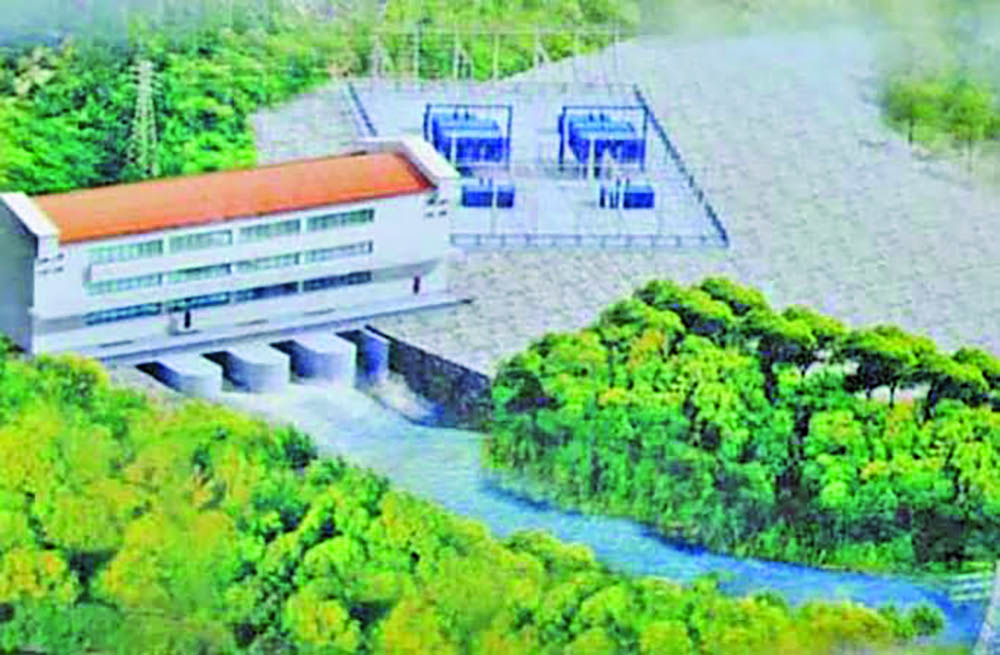
According to the RFP document, the project is expected to deliver a minimum installed capacity of 165MW, including the hydro dam, powerhouse, substation, and a 23-square-kilometre storage reservoir, consistent with environmental studies and permits.
However, it was noted that the size of the hydro may be re-engineered to take into account changes in turbine technology, thus allowing more than 165MW to be generated and transmitted.
Under the revised RFP, developers are required to assume all geotechnical risks associated with the project and must demonstrate proven capability and financial capacity to deliver large-scale hydro projects. Only firms or consortia that have successfully built at least three hydro projects of 100MW or more in the last 10 years will be considered.
The 165MW project was the flagship initiative of the Bharrat Jagdeo-crafted Low Carbon Development Strategy (LCDS) but was blocked by the A Partnership for National Unity+Alliance For Change (APNU+AFC) Coalition both in and out of office.
At the time, the Government had a developer in the United States-based Sithe Global, which was backed by investment major Blackstone Inc. But in 2013, Sithe Global pulled out of the project, citing the lack of consensus in Guyana’s Parliament.
Today, however, the Ali-Administration has managed to secure the backing of major international partners, including Qatar and the United States Export-Import (EXIM) Bank.
In fact, the US EXIM Bank, which is already funding the Gas-to-Energy Project, has signalled interest in financing the hydropower project – one of several major infrastructure initiatives discussed during a September 21 meeting between President Ali and the bank’s President and Chairman, John Jovanovic, in New York.


Discover more from Guyana Times

Subscribe to get the latest posts sent to your email.


Source: Guyana Times

Guyana eyes central role in region’s emerging energy hub – Guyana Times

0

Guyana eyes central role in region’s emerging energy hub

…Pres Ali tells Private Sector to pay attention to regional opportunities

As Guyana continues to build its energy sector, President Dr Irfaan Ali has underscored the importance of the country being positioned as a central hub given the competitive nature of the industry within the region.
“It’s a very active energy landscape in the region, and it will be competitive. It will require a lot of negotiations and integration, but definitely, Guyana, we must position ourselves centrally to this hub that is being created across the region,” the Head of State noted.
He made these remarks during a recent interview on Guyana’s energy future, where he discussed a wide range of issues from electricity supply and its growing demand locally to oil and gas, renewables, energy security and long-term development.
According to President Ali, his view for the country is to eventually become a net producer of energy, not only for domestic use but to also supply neighbouring countries.
For years, the Government has been eyeing the largely untapped Northern Brazil market, which will open up a host of opportunities across multiple sectors, including transport, logistics, and energy.
Guyana has already been driving the development of a regional energy corridor that would connect northern South America and the wider Caribbean to link offshore gas resources, pool markets and build shared infrastructure.

Private Sector opportunities
But while conversations have begun with Suriname to potentially pool natural gas resources and further expand ties with Brazil and Trinidad and Tobago, the Guyanese leader highlighted the recent developments in the energy around the region – something which he says the Guyanese business community should keep an eye on.
“The region is getting very active when it comes to the energy sector, and I hope our local Private Sector and Guyanese are paying attention. You have new exploration going on in Trinidad and Tobago. You have the possibility of a large-scale gas project at Dragonfield between Venezuela and Trinidad. You have an agreement that has been signed, apparently – I’ve not seen it – between Venezuela and Suriname.”
“We are also discussing how the refinery can be integrated with investment from the Dominican Republic [and] Barbados, having a play in it also for refined products and their own energy security, and wider integration with the rest of the Caribbean. We also have to look at where gas would play in all of this. The refuelling port for cruise ships, where a refuelling port is best positioned, how do we be part of that business opportunity that comes from that?” the President noted.
He went on to underscore the importance of regional energy integration and the many possibilities for investments, especially in the maritime and shipping industry. The Guyanese leader added too that there are also interests for bilateral development.
“These are all investors and investments that are available. People are ready to discuss with us, and we’re going to pursue as much of it as possible. And our objective is to create as many opportunities as we can for Guyanese,” he stated.
Suriname cooperation
Already, Guyana has a cooperation framework with Suriname that spans not just energy and natural resources but also environmental services, biodiversity services, bauxite, and infrastructure for connectivity.
In fact, President Ali held a virtual meeting with his Surinamese counterpart, President Jennifer Geerlings-Simons, back in May to advance bilateral cooperation, including in the oil and gas sector.
Following an in-person meeting in Nickerie, Suriname, back in September 2026, the Guyanese Leader says a reciprocal meeting is expected to be held in Georgetown. He said a date will be finalised soon for that follow-up meeting in order to advance cooperation between the two neighbouring countries.
While Suriname is gearing up for its first offshore production in 2028, Guyana started producing light sweet crude in the offshore Stabroek Block in 2019.
United States-based ExxonMobil, along with its coventurers, currently has Floating Production Storage and Offloading (FPSO) vessels operating in the Stabroek Block: Liza Destiny (Liza Phase One Project), Liza Unity (Liza Phase Two), Prosperity (Payara Project), and One Guyana (Yellowtail Project), which together are producing approximately 900,000 barrels of oil per day.
The US oil major is now preparing to fire up its fifth offshore project, the Uaru Development, later this year with the Errea Wittu FPSO, which will take the country’s output to more than one million barrels per day by year’s end.
In the prolific Stabroek Block, ExxonMobil holds a 45 per cent interest, while co-venturers Chevron has a 30 per cent stake and CNOOC the remaining 25 per cent.


Discover more from Guyana Times

Subscribe to get the latest posts sent to your email.


Source: Guyana Times

Govt makes proposal for more efficient use of time, resources at PAC – Guyana Times

0

Govt makes proposal for more efficient use of time, resources at PAC

…APNU welcomes plan, WIN shoots down plan prematurely

With the aim of clearing the backlog at the Public Accounts Meetings (PAC), the Government will be bringing a proposal that will see better utilisation of time and resources when it comes to the parliamentary scrutiny of public funds. This is according to Public Works Minister and Government’s representative in the PAC, Juan Edghill. He made these remarks on Friday during the handing over of the 2025 Auditor General (AG) Report to the Speaker of the National Assembly for

Public Works Minister and PAC member, Juan Edghill

tabling in the House. The PAC is a bipartisan mechanism of the National Assembly that is responsible for scrutinising the audited accounts of the State, ensuring that public money is spent legally, efficiently and for authorised purposes. However, committee meetings over the years have been plagued with a myriad of issues that stalled its work, leading to a backlog of reports under examination. This year alone, the PAC was faced with frequent delays, boycotts and walkouts. But Edghill said that the Government has discussed this issue at length and came up with a solution to bring the backlog to the current year’s report.
“We intend to put forth a proposal of how we can get up to date… So, that when we get the next Auditor General’s Report of 2026 in 2027, we’ll be examining 2026,” he told the House Speaker and other Committee members on Friday. In the past, committee members from the parliamentary opposition have bemoaned the repeated delays of PAC meetings that have hindered the scrutiny of public spendings. Based on previous reports, the committee in the last parliament before the 2025 elections was only able to complete accountability checks up to the 2019 audit report, thus resulting now in a six-year backlog with the new report being handed over on Friday. According to Edghill, “We’ll be coming with a proposal of how we can make that backlog current. And I think that’s one of the important things that needs to be noted because we would like to ensure that the current accounting officers are sitting in the seat answering the questions. And we want to ensure that our country continues to live up to the standards that we’ve pledged to the people of Guyana when we told them to elect us to office – that we would provide transparency, accountability and good governance.” While he opted not to divulge into the details of the planned proposal and did not say whether consolidating the reports was included in Government’s proposal, Edghill, who served in previous bipartisan parliamentary committees both as a member and chairman, subsequently told reporters that the intention is to make better use of the resources. “The utilising of time and personnel more effectively is something that we’ve been discussing. We don’t want to have a REO (Regional Executive Officer) come in March with a full team from Region One to deal with 2020 or 2021. Then he has to come back in August to deal with [another year], and then come back again [another time]. It’s costly and not the best utilising of time,” he asserted.
The Minister ruled out having PAC meetings every day, but noted that having longer sessions could ensure that more work gets done. “The members on our team are prepared to work whenever we sit. So, it’s not how often we meet, it’s what we do when we meet. We’ve said that before,” he declared.

APNU welcomes plan
Meanwhile, committee member from the A Partnership for National Unity (APNU) opposition party, Ganesh Mahipaul, welcomed the Government’s proposed plan to clear the public accounts backlog. “We want the backlog to be cleared. We’ve been championing that for the longest while – that there is need for us to be with current affairs and the current Auditor General’s report so that we can provide the necessary guidance to the accounting officers,” he told reporters following the Minister’s announcement. According to Mahipaul, APNU has always championed the need to merge the reports from 2020 to 2023 in order to fast-track the work of the PAC – something which the current PAC Chairman, Vishnu Panday of the We Invest in Nationhood (WIN) party, says might not work when it comes to properly scrutinising those reports.

Premature
“I find it virtually impossible to combine all the reports…and to have the same efficiency, and to the larger extent, to fulfil the expectation of the general public in Guyana. I doubt whether that can happen, and I am very strong in my doubts,” Panday related to reporters on Friday. But even as he is not in full support of consolidation, the PAC Chairman says he will allow the proposal to be presented to the committee for consideration.


Discover more from Guyana Times

Subscribe to get the latest posts sent to your email.


Source: Guyana Times

Vape, alcohol sales to minors trigger Woolford Ave vending crackdown – Guyana Times

0

Vape, alcohol sales to minors trigger Woolford Ave vending crackdown

The Local Government and Regional Development Ministry has uncovered a series of concerns involving vendors operating along Woolford Avenue, including reports of inappropriate interactions with students, the sale of vapes and alcohol to minors, following consultations with more than 10 learning institutions.
This was revealed by Local Government and Regional Development Minister Priya Manickchand in a social media post, where she expressed concern over the situation surrounding vending along Woolford Avenue.
According to Manickchand, she met with vendors who previously operated along the street, some of whom were seriously impeding traffic flow and access to the more than 10 learning institutions on the Avenue.
She said the meeting was part of a continuing engagement, noting that previous meetings were held with school administrations, teaching staff, boards where applicable, Parent-Teacher Associations (PTAs) and vendors.
Manickchand said some of the issues uncovered during the engagements were particularly unsettling.
“We learnt some unsettling things, including that some vendors were inappropriately speaking to and touching students, that illicit items like vapes and alcohol were being sold to minors, and that abusive behaviour was directed towards school staff when rules, such as no selling during instructional hours, were being enforced.”
Adding to the concerns, Manickchand said the engagements also revealed that some vendors had positively contributed to the school community.
“We also learnt that some vendors added beautifully to the school community. They would help children cross the road, give credit to parents for snacks, wait until kids were picked up before they left for the day, sell cheaper than the canteen and otherwise meet a need that was not being met.”
Manickchand also expressed concern after learning that some electricity meter connections used by the vendors had been sanctioned through official letters from the City Council. She called for the issuance of such letters to be stopped immediately.
“In the end, some schools chose the vendors who were in the immediate past co-operative and had behaved in a manner that they believed they could be accommodated into the school compound, with a view to serving the best interest of the children. The others were invited to remove their caravans and carts, etc. There will be no vending on Woolford Avenue.”
Earlier in September, Guyana Times reported that Local Government and Regional Development Minister Priya Manickchand had met with head teachers, school board chairpersons and heads of Parent-Teacher Associations (PTAs) as consultations continued on the future of vending along Woolford Avenue, Georgetown.

The meeting, which was also attended by Permanent Secretary Miguel Choo-Kang and senior Ministry of Education officials led by Principal Education Officer Immanuel Bridgewater, followed a previous engagement between the Minister and vendors operating along the corridor.
The consultations were aimed at developing an arrangement that would balance the interests of roadside vendors, school canteens, students and parents following infrastructure upgrades along Woolford Avenue.
During the meetings, school administrators and canteen operators were given an opportunity to raise their concerns and provide recommendations before any final arrangements were made.
The discussions also highlighted concerns from school officials about some roadside vending operations, including reports of unlawful and disrespectful behaviour which they said could negatively affect children.
Manickchand said these concerns, along with issues previously raised by vendors, would be considered as the Government worked towards a new system for vending along the upgraded corridor.
She stressed that any new arrangement must be structured, with clear standards governing the operation of vendors, particularly because of their proximity to schools and children.
The issue of vending along Woolford Avenue arose following the first phase of infrastructure upgrades, which included an expanded roadway and improved drainage. Vendors who were removed during the works had raised concerns about the impact on their livelihoods.


Discover more from Guyana Times

Subscribe to get the latest posts sent to your email.


Source: Guyana Times

3 gunpoint robberies reported in 1 night – Guyana Times

0

3 gunpoint robberies reported in 1 night

Police are investigating three separate robberies under arms incidents reported on Friday in Georgetown, West Bank Demerara (WBD) and East Bank Demerara (EBD). In the first incident, which occurred at about 20:30h at a bar on North Road, Georgetown, a 40-year-old security officer of East La Penitence was allegedly robbed of his service firearm. According to preliminary investigations, the security officer was on duty at the bar when he was approached by a male known to him. The suspect allegedly pointed a handgun at the security officer and demanded his firearm.
The officer complied and handed over a 9mm pistol along with 10 rounds of matching ammunition. The suspect then reportedly left the premises on foot and proceeded south along Wellington Street. No arrests have been made in connection with the incident and investigations are continuing. In a separate incident between 19:30h and 20:00h in the vicinity of Stanleytown, WBD, two Cuban nationals, were allegedly robbed while travelling to Wales. Police said the two men, both factory workers, had boarded a silver-grey motorcar, with one of the suspects seated in the front passenger seat. While in the Stanleytown area, the suspect allegedly pulled out a handgun and demanded the victims’ belongings. The men were reportedly relieved of two cellular phones, a wristwatch, a wallet and $8,000.
The 41-year-old and 29-year-old victims were then instructed to exit the vehicle, after which the suspects drove away. Police observed CCTV cameras in the area and said the footage will be reviewed as part of the investigation. No arrests have been made in that matter. Meanwhile, police have arrested two men following an alleged robbery at Nandy Park, EBD, at about 20:20h on Friday. The incident involved a 35-year-old businessman of Peters Hall, EBD, who was reportedly walking along a street with a friend when they were approached by two males on a black motorcycle.
According to police, the pillion rider dismounted, pointed what appeared to be a handgun at the businessman and relieved him of a dark blue iPhone 14 Plus and $10,000. The suspect then reportedly rejoined the motorcycle and both men fled the area. Police ranks conducted checks in the area, resulting in the arrest of two labourers, ages 24 and 22, both of Industrial Site, Ruimveldt.
The men were escorted to Providence Police Station, where they remain in custody pending further investigations.


Discover more from Guyana Times

Subscribe to get the latest posts sent to your email.


Source: Guyana Times

Logie housing – Guyana Times

0

Logie housing

When Rambishoon had signed on to the indentureship contract in India, one of the Arcati’s enthusiastic inducements was that he would be given “free housing”. At the start of Indian indentureship in 1838, the assurance of “lodging” had been given, but the 1939 report investigating the fate of the inaugural Whitby and Hesperus labourers found the labourers had simply been moved into the mud huts and logies – vacated by freed slaves. At Bell Vue a large logie – 100 by 24 feet – was built purposely for its quota of 80 indentureds – including two with families. These accommodations would have been on dirt floors and, at best, raised a foot above the ground and surrounded by stagnant drains.
In 1869, the Inquiry into worker’s protests at Leonora found great variation in accommodation – some was “serviceable”, but other ranges were overcrowded, poorly ventilated, damp, inadequately drained and too close to stagnant trenches. The standard logie would be either 50’ x 2’4, containing five rooms, or 100’ x 24’, containing 10 rooms, each that would house either three bachelors or one family. The roof was of corrugated metal sheets that ensured the rooms were veritable ovens.
Each room was entered from a door into a 10’ open space that ran the entire length of the logie. Here each family would create a kitchen with a mud “fireside” or “chulha” for cooking on one side of their ten feet along with their few utensils and use the other side for storage. From the kitchen one would enter the 14’ x 10’ bedroom, which had a single window at the back wall. The walls between bedrooms, which had to function as apartments, were very thin and did not reach the top of the “V”-shaped roof, ensuring there was absolutely no privacy.
The Commission’s recommendations contributed to the Immigration Ordinance of 1873 calling for “suitable housing” with closer inspections and clearer estate obligations concerning housing, sanitation, hospitals and water. Clearly, nothing drastically had changed in housing after slavery and the initial “experiment” – save the floors of some logies, which were now made of wood, a foot over the ground.
In 1891, three years after Rambishoon arrived, another inquiry found basically the same abysmal conditions as 1871 and made the same recommendations. Subsequently, some logies were raised about three feet above the ground, and Rambishoon would have arrived at Plantation De Willem with the “suitable housing” consisting of a mixture of logies – some with mud floors, others with one-foot or three-foot raised floors.
He had initially been assigned to a mud-floored room along with two other bachelors. In his nostalgic moods he would wistfully describe the family housing at Ishmailpur. It was a mud-walled compound that guaranteed privacy from neighbours. Along the perimeter were several separate huts for his parents and the families of his brothers and himself – plus one open one acting as a byre for the bulls that did their ploughing. The huts were framed with timber, and walls were made of intertwined “wattle” with mud plastered from both sides a foot thick and with the roof thatched with grass, ensuring it was always cool. There was invariably an open “overhang/shed” in front of the huts all facing the courtyard, or “aangan”, which functioned as “sitting rooms” for interacting with family and friends.
Starting in the depot at Calcutta – where hundreds of prospective migrants were huddled under a single thatched roof – and then on the Allan Shaw with everyone sleeping on the floor of the lower deck, Rambishoon was taken aback that De Willem’s “suitable housing” continued the absolute lack of privacy in the communal logies. It was only decades later he saw two-family cottages built, four feet off the ground with stairs and doors front and back and a dividing wall all the way to the ceiling. It was one more instance of the planters’ conviction that the immigrants were lesser beings, bereft of sense or sensibilities.
Unlike in his village, where the women were sequestered behind their mud walls, in De Willem, the almost enforced interaction due to proximity made young bachelors like Rambishoon soon succumb to hormonal urges. He had a liaison with a young lady who bore him a child, Rambharose, but whose father married her off to another, “more suitable” man. The lack of privacy and the scarcity of women led to many such liaisons, for which the women were blamed as being “immoral”.


Discover more from Guyana Times

Subscribe to get the latest posts sent to your email.


Source: Guyana Times

Working… New York – Guyana Times

0

Working… New York

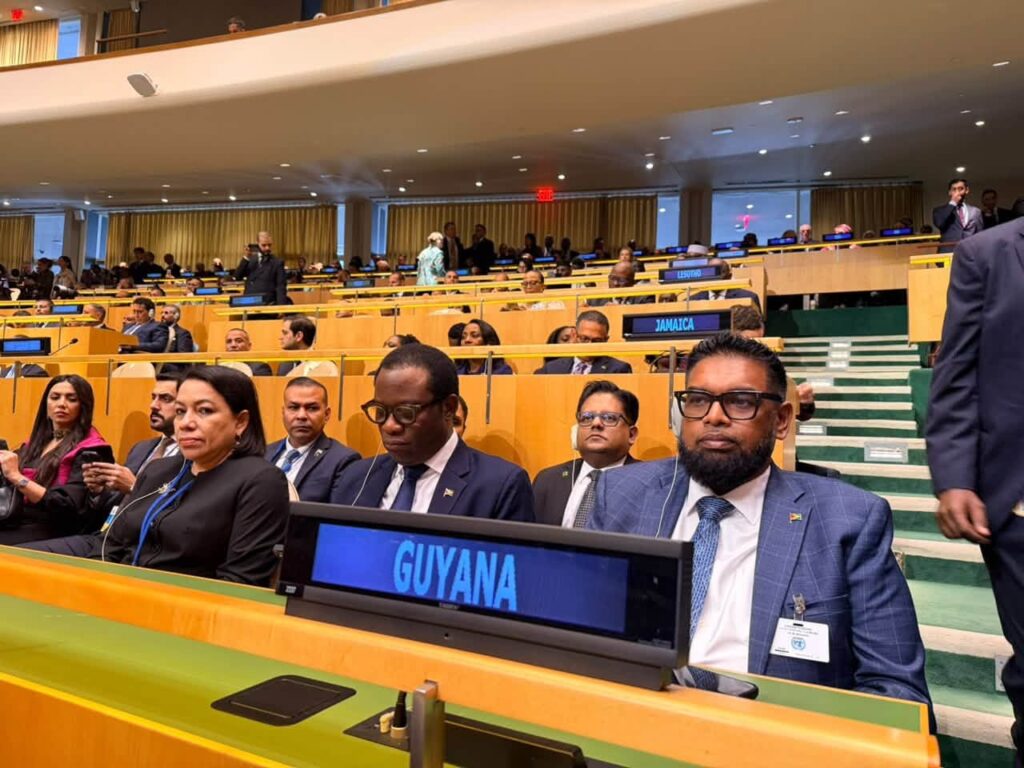
There’s an iconic chorus from that Frank Sinatra hit, “New York, New York”, that came to your Eyewitness’ mind at the reports and videos on President Ali’s trip to NY – the city that’s so nice they had to name it twice! The chorus begins with the line that has entered the English language, “If I can make it there, I’ll make it anywhere!!”
And continues, “It’s up to you/New York, New York/New York, New York/I want to wake up/In a city that never sleeps/And find I’m a number one/Top of the list/King of the hill/A number one”!!! What else can you say about making it big in New York when the President of a small country perched on the top of South America, previously only known for giving Kool-Aid a bad name (thanks, Jim Jones!!), can have the impact he had in the few days he dropped in to address the UNGA??
Yes, we just got oil – which puts us on a lot of radars – but all the other big hitters in oil who make us look like pipsqueaks were there!! Right after his breakfast (roti and bhagee sent over from Little Guyana!!), he met with the head of the US-EXIM Bank, which had signed a US$2 billion MoU initial framework back in July 2022 to facilitate US exports and infrastructure development!! The fella was so smitten that he promised to backstop the entire development of the upcoming Berbice Gas to Shore project!!
And you didn’t see the leaders who’d come to town for the UNGA meet at the swanky midtown EXCLUSIVE Harvard Club – addressing a collection of movers and shakers in the US corporate world!! By the time Pressie was done, he had them eating out of his hands – even standing in a line for a photo op!! That’s star power, baby!! He’d arranged for the money – the US EXIM Bank – and now he had the attention of the entrepreneurial class!!
And he was just winding up for the big one – his meeting with President Trump and other Shield of the Americas leaders in New York!! While other leaders were quaking in their boots at the thought of running into Trump – Pressie Ali was his usual ebullient self!! No lack of self-confidence here!!
And finally, there was the met and greet with the Guyanese Diaspora in the US – not just NY!! Anyone would be forgiven for thinking it was Michael Jackson reincarnated – with thousands of folks milling around hysterically outside the hall hoping for a glimpse – and perchance a smile – from the President!!
And he then offered them a piece of the action in Guyana!! What a guy!!

…at crying wolf!!
For weeks Sanction Man and his Sissie were screaming bloody murder that the PPP was responsible for their Facebook page being suspended!! So not only was the PPP powerful enough to arrange for the US Government to have him and their Daady extradited, but now they were able to compel Zuckerberg – who owns Meta/Facebook – to yank their account!! And that, of course, was while they also had the Yanks yank a Judge’s visa!!
Well, Sanction Man just confessed that because they’d violated copyright laws, Facebook had no other option than to throw the book at them and sanction Sanction Man’s page!! He’s lucky Facebook don’t suspend people for having bots create “followers” – 500,000 of them!!
One of the characteristics of little children is they think they’re the centre of the universe – even to the point if they close their eyes, they’re convinced the world disappears!! This is ONE of Sanction Man’s problems!!
Let’s see him disappear that orange jumpsuit coming up!!!

…the UN
Those who think we’re reflexively supporting the US should consider the positions we’ve taken at the US – a two-state solution and genocide in Gaza!! While seeking to expand the exclusive Security Council by including Africa, LA, and the Caribbean!!


Discover more from Guyana Times

Subscribe to get the latest posts sent to your email.


Source: Guyana Times