Home Blog Page 236

‘Mid-Year Report fails accountability test’ – Ram

0


…says billions in spending and 33.3% growth demand more than statistics

(Kaieteur News) – Chartered accountant Christopher Ram has launched a broadside at the Government’s 2026 Mid-Year Report, arguing that the document falls short of its purpose as an instrument of economic and financial accountability.

In the third and final instalment of his examination of the report, Ram said it contains an abundance of economic statistics and expenditure figures but fails to adequately explain the relationships between them, confront emerging risks or show how headline economic growth is affecting households and businesses.

Ram’s latest criticism comes after he previously questioned the report’s treatment of housing figures and its omission of the Government’s at least $400 million transaction involving the Berbice Bridge Company Inc.

'Mid-Year Report fails accountability test' - Ram

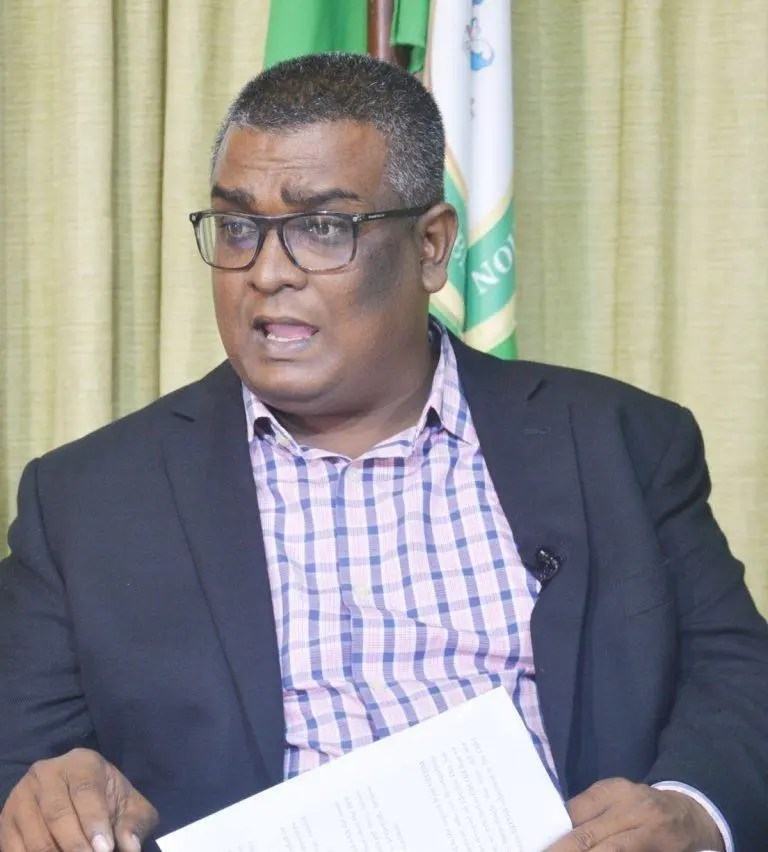
Chartered Accountant Christopher Ram

Growth without enough explanation

Ram focused on the report’s headline growth figures, noting that real GDP expanded by 33.3 per cent during the first half of 2026, while non-oil growth stood at 10.1 per cent.

The figures compare with full-year projections of 20.8 per cent and 10.2 per cent respectively.

According to Ram, the numbers raise questions that the Mid-Year Report should have addressed.

He noted that overall growth is projected to slow substantially during the second half of the year, while non-oil growth is expected to remain almost unchanged.

“There may be sound technical explanations,” Ram said, arguing that “that is precisely what the Report should provide.”

He also pointed to Government capital expenditure approaching $250 billion during the first half of the year, alongside strong growth in construction.

Ram questioned how much of the reported non-oil growth is genuinely independent of the petroleum sector and how much is being generated indirectly through oil-funded Government expenditure.

He said the issue is important if diversification is to mean more than converting petroleum revenues into construction, contracts and consumption.

With the Budget framed around “Putting People First,” Ram argued that the report should provide greater clarity on how the country’s rapid economic growth is translating into the lived experience of households and businesses.

Foreign exchange concerns

Ram also highlighted developments in the foreign-exchange market, which he described as another area the Mid-Year Report failed to adequately confront.

Days after the report was released, President Irfaan Ali disclosed that outstanding foreign-currency demand at commercial banks had exceeded US$200 million and brought former Finance Minister Asgar Ally into discussions aimed at examining the market.

Ram questioned why such an issue was not adequately addressed in the Mid-Year Report.

He said a country experiencing exceptional GDP growth, substantial oil exports and significant foreign inflows should not have businesses struggling to access foreign currency without a clear explanation from the Finance Minister.

Ram also questioned why, after almost six years with Singh back in the Finance portfolio, a former Finance Minister was needed to help examine the problem.

“What is driving the demand? Is it temporary or structural?” Ram asked, arguing that these were matters the Mid-Year Report should have addressed rather than issues emerging after its publication through presidential intervention.

Census delay raises planning questions

Ram also criticised the continued delay in producing the full results of the 2022 Population and Housing Census.

Census Day was in September 2022, but only preliminary results were released in January 2026, with detailed information needed for planning still unavailable, he noted.

He argued that this is significant because Government is making decisions concerning migration, social services, policing, housing, schools, hospitals and labour supply.

The issue, Ram said, becomes more pressing because the Mid-Year Report itself identifies a shift in the national challenge from job creation to the availability and composition of skills.

“How can Government plan confidently for labour, population and allocation of resources when its principal demographic exercise remains incomplete?” he asked.

Ram also questioned why Singh, whose portfolio includes the Bureau of Statistics, has not done more to ensure completion of the census exercise.

Ram targets tax policy

Taxation was another major area of concern for Ram, who argued that Guyana’s transformation into a petroleum-producing economy should have triggered a fundamental reassessment of the country’s tax system.

He said the expansion of oil revenues should have prompted Government to reconsider which taxes remain necessary, how the tax burden should be distributed, which exemptions and concessions remain justified and how much recurrent expenditure can safely depend on petroleum revenues.

Ram pointed to the Duke study, commissioned under a previous PPP/C administration, which he said identified structural weaknesses in the tax system but was largely left unimplemented.

He also noted that the subsequent Coalition Government established its own Tax Reform Committee and sought to implement elements of that agenda.

According to Ram, the PPP/C criticised several of those measures without presenting a comprehensive alternative.

He argued that Singh can no longer treat the weaknesses as inherited problems, given his lengthy periods in charge of the Finance Ministry before and during the oil era.

Ram also raised concerns about the statutory tax appeal system, questioning the failure to keep the relevant Boards of Review continuously operational.

He said there have been periods exceeding a year when the Boards were either not in existence or not functioning.

According to Ram, such a situation denies taxpayers timely independent review while leaving the State’s revenue claims unresolved.

He argued that annual adjustments to tax thresholds, rates, exemptions, VAT, corporation tax and property tax do not amount to comprehensive tax reform.

“Nor can oil revenues disguise the absence of policy,” Ram wrote.

He said Singh should explain the future role of taxation and how Guyana intends to manage its dependence on petroleum revenues.

“He has not done so,” Ram concluded.

‘Too little analysis’

In his overall assessment, Ram said the shortcomings identified in the Mid-Year Report go beyond individual figures or omissions.

He questioned the quality of the report as an instrument of economic and financial accountability.

According to Ram, the document contains substantial statistics and expenditure totals but provides too little analysis of their meaning, insufficient treatment of important risks and inadequate connections between aggregate economic growth and the experiences of citizens and businesses.

He pointed to Section 67 of the Fiscal Management and Accountability Act, which requires the report to inform Parliament and the public about the macroeconomic and fiscal position, the outlook, significant variances and major fiscal risks.

Ram argued that, measured against that purpose, the report is “disappointing at best.”

He said it contains what he described as “too many features of an amateur exercise”—including impressive numbers without sufficient explanation, important economic relationships left unexplored, major weaknesses inadequately confronted and, in the case of the Berbice Bridge transaction, critical information omitted.

Ram said that after years of responsibility for the Finance portfolio, the shortcomings cannot simply be attributed to inexperience.

He argued that Singh must accept direct responsibility for the weaknesses he identified.


Source: Kaieteur News

Edghill dodges questions on MV Barima accountability, resignation calls

0


– insists he will speak “at the right time”

(Kaieteur News) – Minister responsible for the Transport and Harbours Department, Juan Edghill, on Friday repeatedly declined to say whether he has submitted evidence to the Presidential Commission of Inquiry (CoI) into the MV Barima incident, insisting that he will address the matter “at the right time.”

Edghill dodges questions on MV Barima accountability, resignation calls

Minister Juan Edghill

The exchange occurred after the submission of the AG report on Friday at Parliament buildings, where the minister parried direct questions regarding his ministerial accountability and his involvement in public briefings following the maritime incident. When asked by a reporter if he had been requested to make submissions to the Presidential Commission of Inquiry in his capacity as the minister overseeing the sector, Edghill initially feigned uncertainty before reiterating a standard defense. “I said before and I will say it again: any matters to do with the MV Barima, I will speak at the appropriate time,” the Minister said.

Reminded that the CoI has been open and accepting submissions for weeks, the minister sought to distance himself from the body’s proceedings, stating plainly, “I am not a part of the Commission of Inquiry.”

The line of questioning also highlighted confusion over jurisdictional oversight. The minister asserted that while the vessel itself falls under the fleet of the Transport and Harbours Department, for which he holds portfolio responsibility, aspects related to “MV Barima” fall under the Ministry of Public Utilities. When challenged on why he previously spearheaded public press conferences on the matter rather than his counterpart, Minister Indar, the minister dismissed the query, claiming the media was conflating distinct operational responsibilities.

“We are confusing two things,” the Minister responded. “The MV Barima is a member of the fleet that is controlled by the Transport and Harbours Department, of which I have ministerial responsibility…”

Pressure on the government has mounted in the two months since the incident, with affected families holding weekly demonstrations demanding the Minister’s immediate resignation. Asked directly how he responds to these weekly calls, the Minister maintained his stance.

“I will speak to that at the appointed time,” he stated. Pushed on whether a two-month delay was unreasonable for the public and grieving families awaiting answers, the Minister repeated his refrain four times in succession “At the right time I will speak on the matter.”


Source: Kaieteur News

Scotiabank Guyana recognised for digital banking

0


(Kaieteur News) – Scotiabank has been named Guyana’s Best Consumer Digital Bank 2026 by Global Finance and has also earned the award for Best Mobile Banking App in the country, the bank said in a press release.

The double recognition marks the third consecutive year that Scotiabank has been honoured for its digital banking leadership, underscoring the Bank’s continued investment in secure, convenient and innovative banking solutions for clients. The Global Finance Best Digital Bank Awards are among the most respected in the financial services industry, recognizing organizations that demonstrate excellence in digital strategy, customer adoption, product offerings, innovation and user experience. Winners are selected based on their success in attracting and serving digital customers, growth in digital users, measurable benefits delivered through digital initiatives, and the functionality of their web and mobile platforms.

Scotiabank Guyana recognised for digital banking

Nafeeza Gaffoor, Country Head, Scotiabank Guyana

Joseph Giarraputo, Founder and Editorial Director of Global Finance stated: “Digital banking has become one of the most important areas of focus for the financial industry, as banks expand their use of AI, automation and advanced data analytics. Rising expectations for speed, personalization and seamless digital experiences are pushing banks to innovate, while strengthening security, resilience and regulatory compliance. Global Finance’s World’s Best Digital Banks 2026 are the institutions setting new standards for digital banking worldwide.”

Nafeeza Gaffoor, Country Head, Scotiabank Guyana shared: “We are honoured to once again be recognized by Global Finance for our digital banking capabilities. These awards reflect our continued investment in solutions that make banking simpler, safer and more convenient for our clients. As our clients increasingly choose digital channels to manage their finances, we remain focused on delivering intuitive experiences backed by the security, reliability and service they expect from Scotiabank. We thank our clients for their trust and our employees for their ongoing commitment to innovation and excellence.” Across the region, Scotiabank was also named Best Digital Consumer Bank and Best Mobile Banking App in The Bahamas, Barbados, Cayman Islands, Jamaica, Trinidad & Tobago and Turks & Caicos Islands.


Source: Kaieteur News

2026 Mid-Year Report: Beyond the NIS numbers

0

By Christopher Ram

(Kaieteur News) – The 2026 Mid-Year Report states that NIS received about $24.5 billion in the first half of the year against expenditure of $21.9 billion. Those figures suggest a healthy current cash flow but say little about the condition of a social-insurance fund whose obligations extend decades into the future. That is why the law requires periodic actuarial assessment.

Days later, portfolio Minister Dr. Ashni Singh told NIS’s 57th anniversary observance that contributors must not be “pushed around,” that complaints had declined and that the Scheme should be judged by whether people receive the benefits to which they are entitled. He also cited nearly 80,000 additional contributors since 2020 as evidence of progress.

2026 Mid-Year Report: Beyond the NIS numbers

Chartered Accountant, Christopher Ram

But that figure too needs context. In the oil economy, many contributors are temporary or short-term workers, some remaining in Guyana for only a few months. They may contribute at relatively high levels but leave before qualifying for, or ever claiming, benefits under the Scheme, let alone an old-age pension. Numbers without context can therefore materially overstate what the increase means.

That is precisely why contributor growth, by itself, tells us so little about the health of NIS. The Scheme must be judged over the long term – by its actuarial sustainability and, by Singh’s own test, by whether contributors actually receive the benefits to which they are entitled.

Let us see how Singh’s test has worked for two literally long-suffering individuals.

Craig and Zainul

Nathan Craig is 81. He worked for Kaieteur Company Limited and later Linden Mining Enterprise Limited and paid more than the 750 contributions required for an old-age pension. NIS rejected his claim. He appealed in September 2010 and waited thirteen years before the Appeal Tribunal ruled in his favour in October 2023.

NIS then appealed to the National Insurance Commissioner. The problem was that there was no Commissioner in office. Craig had followed the statutory process, waited more than a decade and won, yet still could not reach finality because Government had failed to maintain the office required for the next stage of appeal.  At 81, Craig remains unpaid and does small manual jobs to earn a dollar here and there.

Shariff Zainul’s case is different but equally disturbing. Contributions were deducted from his wages, but substantial amounts were not remitted. NIS produced changing contribution totals and rejected evidence supporting his claim. The High Court ordered that 354 disputed contributions be credited and that his pension be paid from age sixty. The Full Court later set that decision aside and sent the matter back for rehearing.

Fifteen years after reaching pension age, Zainul still has no pension and is now confined to bed. I sent the President a photograph of his condition; there has been no response. The bitter irony is that Zainul continues to bear the consequences of NIS failure, while the employer whose non-remittance helped create the problem appears to have suffered none. I have at least fifteen other NIS matters awaiting a meeting requested two months ago, including one involving a contributor repeatedly travelling from the UK simply to have contribution records merged.

The actuarial record

The National Insurance and Social Security Act requires actuarial review of the Fund at least every five years. The Eighth Actuarial Review, as at 31 December 2011, warned that the Scheme was approaching “crisis stage,” even as earlier recommendations remained unimplemented. By 2016, NIS itself acknowledged that more than 70 recommendations had accumulated from actuarial and reform exercises. The 2023 audited financial statements still carried serious actuarial concerns about the Scheme’s long-term position.

In effect, NIS has accumulated recommendations far faster than it has implemented them. Over the past two decades, the Scheme would be hard-pressed to identify even one significant actuarial recommendation implemented for each year that has passed.

Responsibility extends beyond any one Minister. Dr. Singh bears responsibility for substantial periods during which NIS fell within his portfolio, but so do successive Governments, Boards and managements. The reviews were done and the warnings given. The failure was to act.

Nor can Dr. Singh’s stewardship be separated from the CLICO episode. As Finance Minister in 2009, he told Parliament that NIS had about $5.6 billion invested in CLICO, roughly 20% of the Scheme’s assets. That exposure later had to be dealt with through a government debenture arrangement under the Coalition. The episode should have reinforced the need for stronger investment governance, risk management and institutional reform.

An institution showing its age

The NIS began operations in September 1969, as a pioneering social-security institution, but fifty-seven years later too much of the Scheme still reflects the era in which it was created.

Its contributor and beneficiary populations have expanded enormously, yet its principal facilities remain inadequate. As recently as 2016, NIS itself acknowledged that staff were working in “less than acceptable conditions,” while it was developing online contribution checking, electronic employer schedules and programmes to cleanse contribution data. (National Insurance Scheme) Former General Manager Patrick Martinborough documented how deeply administrative and record-keeping weaknesses became embedded in the Scheme.

Zainul’s case demonstrates the consequence. Defective contribution records are not merely untidy files; they can determine whether a person receives a pension. After so many years with responsibility for NIS, Dr. Singh cannot plausibly treat these as inherited administrative defects. Their persistence is part of his own stewardship.

The pension and the grant

NIS states that the old-age pension must not be less than 50% of the existing Public Service Minimum Wage. The published minimum pension is $43,075, while the current Public Service minimum wage is $102,346, making 50% $51,173.

On NIS’s own published rule, every pensioner receiving the minimum is therefore shortchanged by $8,098 per month. The latest published Annual Report does not tell us how many pensioners receive the minimum, so the total cost cannot be calculated precisely. But for every 10,000 such pensioners, the annual shortfall is about $972 million.

Government meanwhile promoted one-off grants to contributors falling short of the 750 contributions required for a pension, on a “full and final” basis. The 2025 Budget extended that arrangement to persons with 500 to 749 contributions. I argued instead for a pro-rated pension, so that someone contributing for ten, twelve or fourteen years would retain some income for life rather than receive a cheque that eventually disappears.

I am tempted to describe the policy cynically as a combination of the Mahdia Dormitory model: instead of curing the underlying problem, offer a lump sum in full and final settlement and close off the claim, while presenting the intervention as generosity. The circumstances are obviously different, but the administrative instinct is familiar – settle the claimant rather than repair the system.

The irony is hard to miss. Government publicised one-off payments with one hand while the minimum pension appears to have fallen below NIS’s own benchmark with the other. The grant was once only; the pension shortfall recurs every month.

And the $10 billion?

In his 2025 Budget Speech, Dr. Singh said Government would be “injecting $10 billion into the Scheme” to finance the full-and-final grants – subject to claimants forgoing their legal rights. NIS, however, says it received only periodic reimbursements for grants actually paid, and that total payments under the programme fell far short of $10 billion. Yet the 2026 Estimates show virtually the entire $10 billion provision as revised expenditure for 2025.

Taken together, the pension shortfall, the full-and-final grants and the supposed $10 billion injection begin to resemble a fiscal three-card trick. The cards now need to be turned face up: how much was actually paid in grants, how much was reimbursed to NIS, how much is owed to minimum pensioners under the 50% rule and, if virtually the whole $10 billion was recorded as spent, where did the balance go?

NIS and accountability

The latest annual report currently published on the NIS website is for 2023. There is none listed for 2024 or 2025. For an institution whose solvency depends on contributions, investments, demographics and future benefit obligations, reporting years behind is unacceptable.

Nor can failure to lay a report in Parliament justify keeping existing information from contributors and the public. Accountability also requires functioning statutory offices, reliable records and public reconciliation of the $10 billion.

Perhaps the larger failure is that Guyana has changed dramatically while the Scheme has changed far too little. A modern NIS should be capable of addressing gender-neutral parental benefits, unemployment protection and some form of medical support for elderly pensioners. The old legislation, old buildings, old systems, old records and old benefit architecture cannot simply be carried indefinitely into a new economy.

Patrick Martinborough warned that national insurance must change with its environment if it is to remain relevant. The actuaries have repeatedly identified the weaknesses and prescribed reforms. Dr. Ashni Singh now tells NIS that contributors must not be pushed around and that the test is whether they receive the benefits to which they are entitled. For my part, I have been advocating changes to national insurance since the late 1970s, including working with trade unionists Nanda Gopaul and Lincoln Lewis.

The voices have therefore not been absent. Nor have the diagnoses. What has been missing is sustained action – particularly by Ashni Singh and the PPP/C.

There is little in the record to suggest that this column will have any greater impact on the NIS administration or the Government than the actuaries, Martinborough and others who have warned before it.

And that is the true tragedy of the NIS.

Christopher Ram, wrote Grenada’s National Insurance Act and Regulations and served as the first Chairman of its National Insurance Board.


Source: Kaieteur News

PAC clash erupts over audit backlog, spending and Auditor General’s extension

0


…Opposition MPs challenge report consolidation, govt. project delays

(Kaieteur News) – Tensions boiled over on Friday as Public Accounts Committee (PAC) members clashed over how to clear a multi-year audit backlog, scrutinise delayed capital projects and address the controversial extension of Auditor General Deodat Sharma beyond the normal retirement age.

PAC Chairman Vishnu Panday (APNU) and Opposition MP Ganesh Mahipaul both questioned a proposal to consolidate several outstanding annual reports into fewer hearings, while raising concerns about government spending, contract management and the handling of audit requests.

PAC clash erupts over audit backlog, spending and Auditor General’s extension

MP, Vishnu Panday

Panday said he was not convinced that combining several years of audit reports into single hearings would provide the level of scrutiny expected by the public. “I am not fully in support of the compiling or what we call the combining of the various yearly reports backlog for presentation,” Pandey told reporters.

He said attempting to deal with reports spanning several years in consolidated hearings could undermine the committee’s effectiveness. “If you ask my take on it, then I find it virtually impossible to combine all the reports…perhaps from 2020 to 2024…and to have the same efficiency, and to a larger extent fulfill the expectation of the general public,” he said.

Panday argued that accounting officers and government agencies should be given adequate opportunity to account for their activities on a year-by-year basis before the PAC reaches conclusions. Minister of Public Works Juan Edghill, however, defended the proposal, arguing that the existing approach unnecessarily consumes time and public resources.

“We don’t want to have a Regional Executive Officer (REO) come in March with a full team from Region 1 to deal with 2020 or 2021, and then he has to come back again in August to deal with [another year],” Edghill said. “It’s costly and it’s not the best utilization of time… It’s not how often we meet, it’s what we do when we meet.”

Mahipaul agreed that the backlog must be cleared but blamed the ruling People’s Progressive Party/Civic (PPP/C) for the delays. “We are still in 2019. We have to wrap up 2019 before we move to the other years,” Mahipaul said.

He attributed the backlog to what he described as “absenteeism” and the “continuous unavailability” of PPP/C members for regular PAC meetings.

Panday also raised concerns over delays and potential cost increases associated with major government infrastructure projects. Against the backdrop of the $1.55 trillion 2026 National Budget, he questioned the need for the Government to return to Parliament during the year for supplementary funding when, according to him, progress on some projects had been limited.

“In project management, time is of the essence; time is money, huge money,” Panday said.

“With these government contracts, if you are talking about billions of dollars, then you can imagine if you have a time delay of one or two years, it is running into billions of dollars more.”

Mahipaul said the Opposition has also written to the Auditor General seeking formal audits of several infrastructure and relief programmes. The requests include audits of the Bellevue, Jimbo Grove, Meten-Meer-zorg and Charity pump stations, along with various cash grants distributed to farmers following flooding. Mahipaul said the PAC has not yet received written acknowledgement of the requests.

PAC clash erupts over audit backlog, spending and Auditor General’s extension

MP, Ganesh Mahipaul

He also criticised the prolonged evaluation of tenders relating to the salvage of the M.V. Barima, describing the process between September 8 and September 25 as “wickedness” and warning that continued exposure to salt water could compromise physical evidence.

Both Panday and Mahipaul also objected to the extension of Auditor General Deodat Sharma beyond the normal retirement age. Panday questioned the rationale for the decision and alleged that Sharma’s political connections influenced the extension. “I believe that Deodat Sharma is closely connected to the present government,” Panday asserted.

He argued that decisions concerning significant constitutional and statutory appointments or extensions should involve consultation with the Opposition Leader. “Discussions of that nature… ought to have engaged the attention of the Leader of the Opposition,” Panday said.

“Since that is not being done, then it bespeaks the quality and type of government we have today in Guyana.” Mahipaul framed the issue as one of institutional succession and staff morale. “Whenever someone has reached the age of retirement, they should go their merry way and allow others to elevate so that everyone can have a fair cut of the pie,” he said. He argued that extensions can prevent other public servants from being considered for promotion when senior positions remain occupied.

Edghill’s PAC role questioned

The two MPs also addressed calls by APNU for Edghill to step down from his ministerial portfolio following the M.V. Barima tragedy, and whether that controversy should affect his participation on the PAC. Panday acknowledged the political protest by APNU members but noted that the PAC Chairman does not have the authority under Parliament’s Standing Orders to unilaterally remove an elected MP from the committee. Mahipaul, meanwhile, distinguished between Edghill’s responsibilities as Minister of Public Works and his role as a parliamentarian.

PAC clash erupts over audit backlog, spending and Auditor General’s extension

Minister of Public Works, Juan Edghill

“As Minister of Public Works, he oversees the Transport and Harbours Department… We believe he should recuse himself as Minister of Public Works and give way for a proper investigation,” Mahipaul said. He stressed that the Opposition was not calling for Edghill to resign as an MP.

“We have not called for his resignation as a Member of Parliament… But as to whether our party will continue to participate on the committee, that decision is yet to be made at our party level,” Mahipaul said.


Source: Kaieteur News

New road safety campaign targets speeding nationwide

0


(Kaieteur News) – Dozens of road safety stakeholders recently gathered at the Watooka Guest House in Linden for the launch of the Socially Inclusive and Gender Responsive Road Safety Awareness Communication Strategy, being implemented by the Ministry of Public Works through consulting firm FRED Engineering.

The strategy is a key component of the Linden to Mabura Hill Road Upgrade Project, funded by the United Kingdom Caribbean Infrastructure Partnership Fund (UKCIF) and the Caribbean Development Bank (CDB). With the overarching message “Be the reason everyone is safe,” the strategy was developed through extensive consultations involving community leaders, public and private sector representatives, youth and civil society organisations. It includes a six-week nationwide speeding campaign and a community-based general road safety campaign.

New road safety campaign targets speeding nationwide

From left to right: Road Safety Champions Carlvin Burnett, Maylene Couchman and Malika Allicock at the Socially Inclusive and Gender Responsive Road Safety Awareness Communication Strategy launch.

According to a press release, CDB Programme Manager, Infrastructure Partnerships (UKCIF), Sharon Griffith, applauded the initiative, noting that “infrastructure alone does not guarantee safety.” She said the true measure of a road is whether people can use it safely, reliably and equitably.

In his feature address, Kester Hinds, Manager of Traffic, Safety and Maintenance at the Ministry of Public Works, called for a cultural shift in the mindset of road users across Guyana. “As a society we must develop a culture in which unsafe behaviour is no longer accepted as normal,” Hinds said. He noted that every collision has consequences extending beyond the vehicles involved, affecting families, children, parents, colleagues and communities.

His sentiments were echoed by Permanent Secretary of the Ministry of Public Works, Vladim Persaud, who stressed the need for commuters to exercise greater care while using the nation’s roadways.

New road safety campaign targets speeding nationwide

Sharon Griffith, Programme Manager, Infrastructure Partnerships (UKCIF), Caribbean Development Bank speaking at the Socially Inclusive and Gender Responsive Road Safety Awareness Communication Strategy launch.

Dr. Jeteendra Singh of the Ministry of Health highlighted the burden of traffic crashes on the healthcare system, noting that Guyana recorded 137 road fatalities in 2025. “Preventing traffic injuries is an investment in the health and well-being of our population,” Singh said, adding that the number of road deaths was far greater than deaths from infectious diseases such as tuberculosis.

Assistant Police Commissioner Mahendra Singh pledged the Guyana Police Force’s support for the initiative before officially launching the strategy alongside Toshao Sydney Allicock.

“Road traffic education is one of the most important pillars of road traffic management,” Singh said, stressing that there is no substitute for creating greater public awareness about responsible road use.

The multi-channel strategy will feature road safety champions Malika Allicock, Maylene Couchman and former soca monarch Carlvin Burnett, and aims to raise awareness and save lives through messages such as “Please Chill, Speed Kills!” and “Road Safety Rules Are Your Best Tools.”

The campaign will also utilise culturally relevant communication products, including a video poll, five video reels, billboards, social media cards, bumper stickers, rubber bracelets, brochures and pocketbooks for project-area spokespeople. Community partners, including Hits and Jams 94.1 FM, Prudential Driving School, Fast Learners Driving School, Hearthrob Dynamics and EdYouFM, will support the campaign by showcasing its materials and communication products throughout the implementation period. The launch culminated in an energetic performance by road safety champion Carlvin Burnett of the nationwide speeding campaign jingle.


Source: Kaieteur News

Govt. evaluating fresh bids for Amaila hydro-power project – Pres. Ali

0


(Kaieteur News) – The National Procurement and Tender Administration Board (NPTAB) has received a number of bids from reputable companies, again interested in building a hydro-power project at the Amaila Falls in Region Eight.

President Irfaan Ali in an interview with ‘Fueledgy’ shared an update on the energy project as the country continues to suffer daily blackouts.

He said, “It’s at the evaluation stage now so as soon as that evaluation is completed I have instructed that we move to negotiate with the best ranked bidders who give us the best possibility.”

Govt. evaluating fresh bids for Amaila hydro-power project - Pres. Ali

President Irfaan Ali

Back in May this year, five bids were opened at NPTAB for the hydropower project. It was reported that three Chinese firms submitted proposals to the government while the other two were headquartered in the United States of America and India.

Ali noted, “They have to agree to the terms, the terms that make economic sense for us and would meet the energy cost that we want to deliver to the people of this country.”

The government, in its revised Request for Proposals (RFP) which was issued earlier this year, stated that the hydro project will be done under a Build-Own-Operate-Transfer (BOOT) model, with a minimum installed capacity of 165 Mega Watt (MW).

In a summary of the scope of work, the RFP detailed that the project includes a 165 MW installed hydro dam, plant, and substation at Amaila site, and related works.

The project involves the creation of a 23 square KM storage reservoir consistent with the environmental reports and studies and prior permitting. Also interested parties would have to assume all geo-technical risks including guarantees relating to the structure of the reservoir and dam.

The government also stated that the transmission network will be built separately.

Under the BOOT arrangement, the Government of Guyana (GoG) will purchase the electricity from the private developer. As such, the RFP explained that government will select a suitable partner based on (i) lowest Power Purchase Agreement (PPA) price, Engineering, Procurement and Construction (EPC) price, operating cost and capital amortisation; (ii) timeframes to complete and (iii) ability to finance the project on a PPA basis.

Since assuming office in 2020 under the first Irfaan Ali-led PPP administration, government tendered twice for a contractor for the project but both were unsuccessful in materialising.

The Amaila Falls Hydro project was introduced by a previous PPP/C Administration in 2011. However, the project faced obstacles in its realisation when the A Partnership for National Unity (APNU) and the Alliance For Change (AFC) Opposition parties, stopped the project back in 2014.

In its 2020 election manifesto, the PPP-administration noted that the project will be revived. However, the PPP government was unable to do so before the end of the first term in office.

In 2021, negotiations hit a stalemate after Cabinet granted a no-objection for the Prime Minister’s office to engage the China Railway Group Limited for construction. Discussions faltered as the company sought to alter the project’s model due to financing challenges for a BOOT model, requesting a shift to an EPC model. The government was reluctant to switch to the EPC option, resulting in the talks with the Chinese contractor coming to an end.

The government later issued a revised RFP under the BOOT model for the Amaila Falls project and four local and international firms submitted proposals for the Amaila Falls project that was scheduled to begin in 2027. However, this too was stalled.

Early in 2025, the government announced that it would once again go to tender for the project.


Source: Kaieteur News

Give jack his jacket

0


(Kaieteur News) – A man stuck in traffic on the East Bank one morning finally lost patience. He looked ahead. Traffic was moving. He looked to the front and traffic was moving. He looked to the back and traffic was moving He looked to his right side and traffic was moving. He looked to his left side and traffic was moving.

“Wait nah,” he said. “So how come everybody moving except me?”

His passenger looked at him and said, “Because you is the only one following the traffic rules.”

There is plenty left to be desired about traffic management in Guyana. Sometimes the police seem to disappear precisely when motorists need them most. A bottleneck develops, vehicles begin squeezing into every available inch of road, somebody decides that the shoulder is actually a passing lane, and another driver suddenly discovers that the rules of the road are merely suggestions.

But let us give credit where credit is due. Every weekday morning and afternoon, when the East Bank and East Coast Public Roads are carrying thousands of vehicles, the traffic authorities are out there doing a job that is easy to criticize and much harder to perform. They stand in the sun, rain, fumes and noise, directing traffic and keeping vehicles moving. And anybody who has watched what happens when there is no one around to impose some order knows exactly what that means.

Without the traffic police, some intersections would probably require air-traffic control. This is not to say the system is perfect. Far from it. More police visibility at strategic points could prevent indiscipline before it becomes gridlock. Better enforcement, better planning and smarter traffic management are still badly needed.

But every morning and every afternoon, those officers are performing a thankless public service. So next time traffic moves steadily along the East Bank or East Coast, spare a thought for the people in uniform making it happen. Because without them, Dem Boys suspect that all hell would break loose during peak hours.

Talk half. Leff half.


Source: Kaieteur News

Article 6, Part I: Before the Second Pipeline: Guyana Needs a Gas Portfolio, Not Just More Projects

0


– Before Guyana decides how much infrastructure to build, it needs an independently understood picture of what gas will be available, when, and under what reservoir constraints

By Anthony E. Paul
Senior Energy Governance, Policy & Strategy Advisor; formerly Director of Geology and Geophysics, Trinidad and Tobago Ministry of Energy; Amoco Trinidad and BPTT Manager responsible for Exploration and Appraisal / Gas Field Development / Oil Production

(Kaieteur News) – When I began writing about Guyana’s emerging gas industry earlier this year, much of the discussion centred on an important transition. Guyana had demonstrated an extraordinary ability to develop oil quickly, but natural gas would require a different approach.

Oil can be produced, stored, loaded onto a tanker and sold into an established international market. Gas is much less forgiving. Reservoir management, offshore production, pipelines, processing, electricity generation, industrial demand, contracts, financing and pricing all have to be brought together, often within relatively narrow windows of time.

Article 6, Part I: Before the Second Pipeline: Guyana Needs a Gas Portfolio, Not Just More Projects

Anthony Paul

That was the point behind my earlier argument that gas demands simultaneity. A pipeline is of limited value if the receiving facilities are not ready. An industrial plant cannot operate simply because gas may become available at some future date, and a power station, pipeline and upstream supply cannot each be planned on separate clocks without creating consequences somewhere in the system.

Guyana already has practical experience of that problem. ExxonMobil completed the offshore-to-shore Gas-to-Energy pipeline in December 2024, while the downstream Natural Gas Liquids and power facilities at Wales remained under construction. Nearly two years later, the pipeline is still awaiting commissioning of the facilities intended to receive and use the gas.

The issue is not simply that one contractor finished before another. Large projects frequently slip. The more important point is that a completed pipeline still has to be monitored, preserved and maintained while it waits, while the economic benefits expected from the integrated development are postponed until the system as a whole is ready.

That experience matters because Guyana is already looking beyond Wales Phase I. Government is considering additional generating capacity, another gas pipeline and a range of prospective industrial uses. The country is therefore moving from the challenge of completing one gas project towards the much more demanding task of managing several sources of supply, pieces of infrastructure and prospective users as parts of one national system.

A second power plant may make sense. A fertiliser plant, petrochemical development or another pipeline may also make sense. But several individually attractive projects do not automatically amount to a coherent gas strategy. The real test is whether they fit together technically, commercially and temporally, and whether their combined development advances Guyana’s long-term interests.

Before the second pipeline, answer the first question

The first question surrounding another pipeline should not be its diameter, route or landing point. Those questions matter, but they come later.

The starting question is more fundamental:

What gas will reliably flow through it, from which reservoirs, beginning when, at what rates and for how long?

Much of Guyana’s offshore gas is associated with oil. It cannot therefore be regarded simply as an independent inventory of molecules waiting to be assigned to the next industrial project. Gas plays an important role in reservoir behaviour and, depending on the field, reinjection may contribute to maintaining pressure and maximising oil recovery. Producing gas earlier or faster can therefore affect oil production, ultimate recovery and the economics of the upstream development itself.

Those circumstances will not be identical across every reservoir. Some gas may become commercially available relatively early, while other volumes may remain important to pressure support. Some discoveries may contain non-associated gas, while others may be condensate-rich and present different economics, processing requirements and development options.

This is why national gas planning should begin not with a pipeline map, but with an independently understood picture of the resource base and its deliverability.

Government does not have to replace the operator or become a reservoir engineering company. It does, however, need sufficient independent technical and commercial capability to interrogate reservoir models, development plans and production forecasts. It needs to understand not merely how much gas has been discovered, but how much can realistically become available for commercial use, when it may become available, what reservoir constraints apply and how different development decisions could alter those outcomes.

An international oil company will quite properly optimise its investments across a global portfolio. Guyana’s Government has a different responsibility: it must optimise the use of Guyana’s petroleum resources in Guyana’s long-term interest. Those two perspectives can be aligned, but they should not be assumed to be identical.

 From individual fields to upstream resource orchestration

This is where Guyana may need to adopt what I describe as upstream resource orchestration: the deliberate management by the State of discoveries, development timing, production rates, reservoir requirements, infrastructure dependencies and future resource potential as one national portfolio.

This does not mean government micromanaging petroleum operations or unnecessarily slowing development. It means recognising that decisions made about one field can affect the choices available elsewhere, and that the country needs to understand those interactions before individual projects progressively determine the shape of the wider system.

If gas from one development is committed under a long-term agreement, that commitment may influence how another field is developed. If infrastructure is sized only around gas that is presently available, it may become a bottleneck when additional discoveries are brought forward. Conversely, infrastructure built around optimistic assumptions about future supply can leave the country carrying underused capacity for many years.

The same principle applies to timing. One field may be delayed, another may produce less gas than forecast, and a new discovery may create additional supply sooner than expected. A future gas development may also contain a different mix of dry gas, condensate and associated liquids, changing the economics of how the resource should be processed, transported and marketed.

Planning therefore has to deal not only with the expected case but with alternative scenarios. That does not create uncertainty; the uncertainty already exists. The purpose of planning is to understand it before infrastructure and long-term contractual commitments progressively close off future choices.

This is particularly important before a second major pipeline is committed. Pipelines are long-lived assets. Once built, they influence where industries locate, which fields are connected and which developments become commercially attractive. An early infrastructure decision can therefore shape the petroleum and industrial system for decades.

Guyana’s first pipeline was principally about proving that offshore gas could be brought ashore and put to productive use. The next pipeline poses a more strategic question: what resource system is that pipeline being built to serve?

That question needs a technically credible answer before Guyana moves much further from a project-by-project approach towards development of a national gas economy.

Understanding the supply side, however, is only half of the problem. Once Guyana knows what gas may be available, it must decide what that gas should do for the country, which uses create the greatest sustainable national value, and which institution will be responsible for keeping supply, infrastructure and demand aligned as the system grows.

That is the subject of Part II.


Source: Kaieteur News

Govt Wins Hospital Site Battle as VAMED Takes Fight to Appeal Court

0

By Mark DaCosta- The Full Court has ruled decisively in the Government’s favour, lifting five protective orders that had barred the Ministry of Health from entering the Georgetown Paediatric and Maternal Hospital and New Amsterdam Hospital Campus sites, clearing the way for the State to reclaim possession of the properties, containers and equipment even as a €45.3 million payment dispute with Austrian contractor VAMED Engineering GmbH heads to international arbitration.

VAMED has now taken the fight to the Court of Appeal, alleging that the Ministry has since moved onto both sites and begun interfering with tens of millions of euros’ worth of its property, and is seeking an urgent stay of the Full Court’s order.

For a nation that watched the sod-turning ceremonies at Goedverwagting and New Amsterdam with genuine excitement, the unravelling of the partnership has been sobering.

What began in 2018 as a bilateral understanding between Guyana and Austria, underwritten by roughly €160 million in United Kingdom export finance and hailed as Guyana’s largest-ever public health investment, has degenerated into a courtroom battle over unpaid invoices, seized containers and the limits of the State’s power over foreign investors.

The origins of the quarrel lie in money.

VAMED maintains that it completed and had certified “substantial works” on both the 256-bed mothers’ and children’s hospital and the 150-bed New Amsterdam facility, yet was never paid. Through its attorney, C.A. Nigel Hughes of Hughes, Fields and Stoby, the company put the outstanding sum at €45.3 million, while noting that the Government’s own supervising engineer had independently estimated the State’s indebtedness at approximately €37.94 million.

Compounding matters, Hughes disclosed in July that UniCredit’s loan facility to Guyana, guaranteed by UK Export Finance and allowing borrowing at roughly one per cent annually, lapsed in November 2025 after the Government failed to renew it despite prompting from both lenders.

VAMED says the lapse stripped away the payment security underpinning the contract.

The Ministry of Health has presented a different account, maintaining that VAMED fell behind schedule, missed milestones and failed to keep pace with the works required.

Full Court Overturns Protective Orders, Clearing State Takeover

With no resolution in sight, VAMED announced in mid-July that it would commence international arbitration in Guyana under the rules of the Paris-based International Chamber of Commerce.

Both contracts contain arbitration clauses. Hughes said his client preferred a formal tribunal rather than a public dispute, stating that “the rule of law and contractual accountability require these issues to be determined in a formal and impartial process.”

Tensions nevertheless escalated on the ground.

VAMED alleged that on July 28, the Ministry, contrary to an earlier undertaking by the Attorney General, moved onto the Ogle and New Amsterdam sites and forced the contractor’s private security firm to vacate.

VAMED then sought emergency protection from the High Court.

On August 6, Justice Renita Singh declined to grant the sweeping conservatory and restraining orders sought by VAMED, but issued five narrower preservation orders directing both sides to leave the sites and leave untouched the 52 shipping containers of equipment at the Georgetown location, as well as the contractor’s documents and designs pending arbitration.

VAMED says the containers alone hold equipment worth more than €32 million.

Justice Singh also formally referred the payment dispute to arbitration, a decision neither side has challenged.

The Attorney General’s Chambers, led by Mohabir Anil Nandlall SC, appealed the preservation orders.

On September 22, the Full Court, comprising Chief Justice Navindra Singh and Justice Zamilla Ally-Seepaul, sided with the State.

The Attorney General’s Chambers subsequently quoted the judges as finding that “the Preservation Orders cannot stand” because they were “inconsistent with the Learned Trial Judge’s findings” and their legal foundation was inadequately established.

Much of the ruling turned on Section 16 of the State Liability and Proceedings Act, which generally shields the Government from injunctions in civil proceedings.

The court found that the prohibition could not be circumvented by describing orders regulating the State’s conduct as preservation orders or by relying on the Civil Procedure Rules.

The judges also found that the orders lacked proper grounding in the Arbitration Act 2024, which permits courts to grant interim protective measures in support of pending arbitrations.

The Full Court left undisturbed the refusal of the original conservatory orders and the referral of the payment dispute to arbitration, while ordering VAMED to pay G$500,000 in costs.

The Attorney General’s Chambers said the ruling means the Ministry of Health is now cleared to take possession of the sites, containers, equipment and associated construction materials and proceed with the projects.

VAMED Appeals as Contractor Claims Equipment Is Being Interfered With

VAMED has rejected that outcome and has taken its case to the Court of Appeal, seeking an urgent stay.

In papers filed with the appellate court and supported by an affidavit from employee Aaron Heward Mills, the contractor alleges that Ministry personnel have moved onto both sites and begun “removing, opening, and interfering with” its cranes, generators, containers and other materials.

The company describes the alleged interference as “ongoing and irreparable”, arguing that once its property is dispersed it cannot necessarily be restored to its original condition or location.

Hughes is also challenging the Full Court’s interpretation of the preservation orders, arguing that there is a distinction between an injunction restraining the State and an order preserving the status quo pending arbitration.

Whether that argument will persuade the Court of Appeal remains to be determined.

For now, the Government has control of the hospital sites and the equipment, while VAMED continues its legal challenge.

Meanwhile, the two long-promised hospitals remain at the centre of a dispute that has moved from a major international development project to a complex legal battle over payment, contractual obligations, government authority and the future of critical public health infrastructure.

The eventual arbitration could determine not only how much, if anything, Guyana owes VAMED, but also the financial consequences of a partnership that was once presented as a landmark investment in the country’s healthcare system.


Source: Village Voice News