Home Blog Page 175

Healthy Streets Initiative: Practical, aesthetic elements being balanced as Thomas Street Avenue works advance – Guyana Times

0

Healthy Streets Initiative: Practical, aesthetic elements being balanced as Thomas Street Avenue works advance

– President Ali, Minister Manickchand updated on enhancement project

Enhancement works on the avenue along Thomas Street in Georgetown are progressing, with emphasis being placed on balancing the aesthetic transformation with critical issues such as drainage.
On Friday, President Dr Irfaan Ali, along with Local Government and Regional Development Minister Priya Manickchand and other officials, inspected the ongoing works, which extend from Lamaha Street to Church Street.
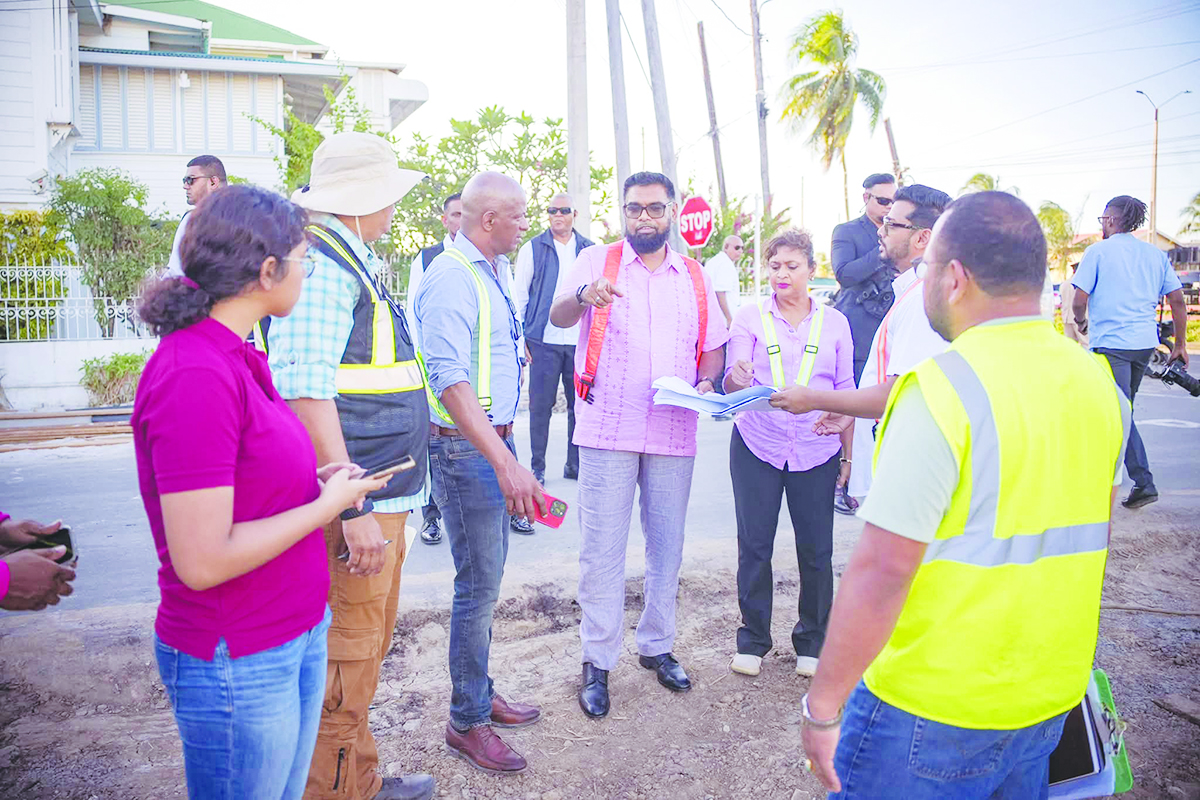
President Dr Irfaan Ali and Local Government and Regional Development Minister Priya Manickchand receiving an update on the Thomas Street Avenue works

The upgrade of Thomas Street Avenue is the first project being implemented under President Ali’s Healthy Streets Initiative – an urban renewal project being executed in collaboration with the United Kingdom-based The King’s Foundation to create healthier, greener, safer, and more functional public spaces in the city.
During the visit, engineers outlined both the practical and aesthetic elements guiding the transformation of the avenue. Particular attention was given to ensuring that the roadway, avenue, and drainage infrastructure function cohesively, with the President stressing the importance of appropriate levels between the road, drains, and avenue as works progress.
Moreover, the Head of State also shared his vision for the completed space and provided input on several aspects of the design. Drawing on his strong background in urban planning and development, the Guyanese leader also examined how elements being introduced along Thomas Street could inform the transformation of other avenues across Georgetown.
Through the Healthy Streets Initiative, The King’s Foundation is redesigning public spaces for better safety, green infrastructure, and climate resilience under the Low Carbon Development Strategy (LCDS) 2030.
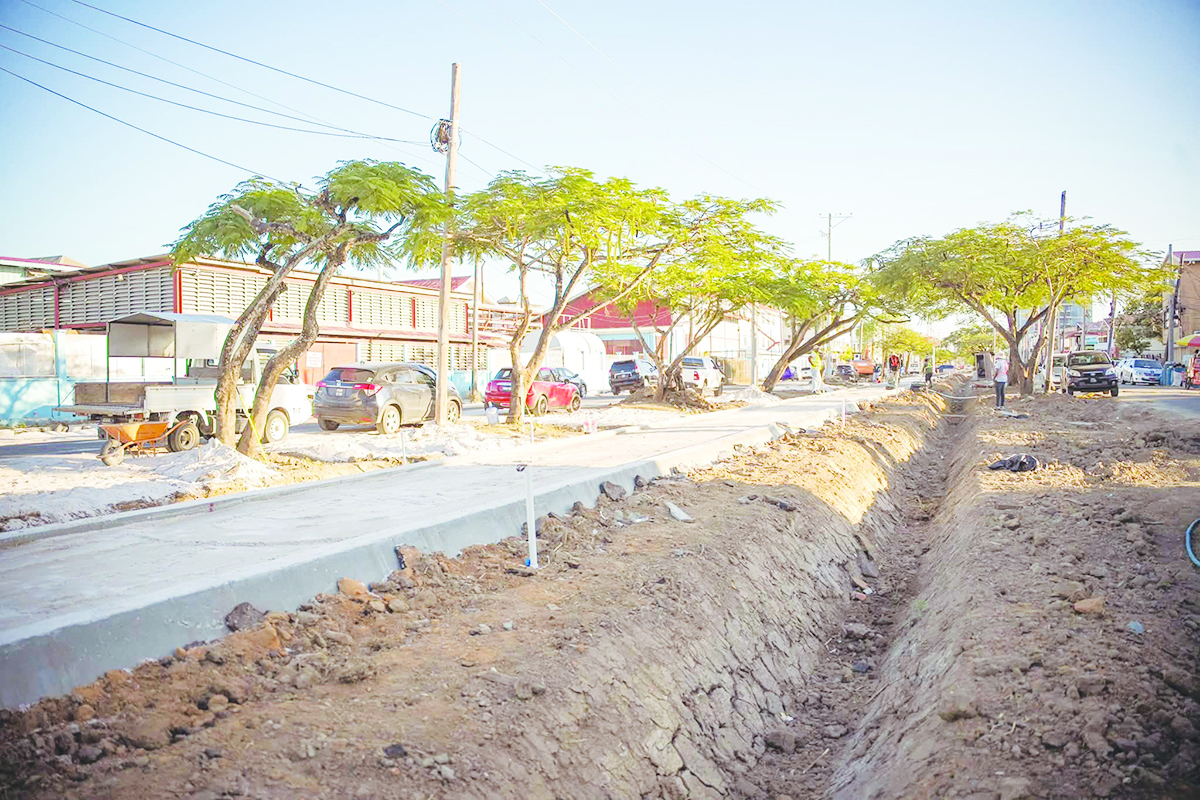
Works on the avenue along Thomas Street in Georgetown are progressing

Minister Manickchand has reiterated the importance of keeping the project on schedule while ensuring that its green character is preserved. She stressed that existing trees should not be unnecessarily boxed off as the avenue is developed, with the project intended to work with and enhance the existing natural environment.
Following the engagement, President Ali and Minister Manickchand walked the length of the project area with lead engineers Raul Boyer and Satrohan Nauth, other engineers, Project Manager Gregory Sukull, and other officials to further assess the ongoing works and the progress made to date.
Meanwhile, this Thomas Street project forms part of the government’s broader efforts to transform Georgetown through sustainable urban development while creating public spaces that are more accessible, attractive, and responsive to the needs of the people who use them.
Only earlier this week, Minister Manickchand visited the Thomas Street project alongside representatives of The King’s Foundation to assess ongoing works.
These visits come on the heels of His Majesty King Charles’ upcoming visit to Georgetown.
The King, who founded the organisation back in 1990 and serves as its Royal Patron, will embark on a State Visit to Guyana from October 29 to 30.
Among the events on his packed agenda, the British Royal will tour a garden in Georgetown and learn about the park’s botanical features and ongoing conservation work within the city. His Majesty will also meet young Guyanese people from environmental clubs taking part in activities focused on sustainability and conservation.
King Charles’ visit to Guyana will also coincide with the Global Biodiversity Alliance Conference, set for October 30 and 31. There, he will meet scientists, Indigenous community members, and innovators to hear about their work on biodiversity, conservation, and restoration.
His Majesty will also hear about the work of the Iwokrama International Centre for Rainforest Conservation and Development, an organisation that manages roughly 371,000 hectares of tropical forest in Guyana, and of which His Majesty has been Patron since 2000, following a visit to the forest as Prince of Wales.
The King will wrap up his engagements in Guyana along the Georgetown seawall, where he will engage participants from the Wilton Park Commonwealth Sustainable Cities Initiative Dialogue to hear about the practical steps being taken toward sustainable urbanisation ahead of the 2026 Commonwealth Heads of Government Meeting in Antigua and Barbuda.
Whilst at the seawall, His Majesty will also hear about the renewed focus on mangrove restoration and the work being undertaken to replant mangroves that help protect Georgetown’s coastline and encourage wildlife to flourish.
King Charles has long backed Guyana’s environmental leadership and continues his support for sustainable development in the country through collaborations with The King’s Foundation. These include the Georgetown Urban Framework Plan.
Developed in collaboration with national and local stakeholders, the Framework Plan has been created by experts in The King’s Foundation’s Projects Team. It sets out a long-term vision to transform Guyana’s capital city, Georgetown, into a resilient, connected, and inclusive capital that balances heritage protection with modern, low-carbon growth. The plan addresses some of the city’s most pressing challenges, including drainage and flood resilience, transport and mobility, urban expansion, and the protection of historic buildings.
Working alongside the Office of the President and other key national stakeholders, The King’s Foundation has helped shape a strategy that reimagines Georgetown as a garden city, supporting walkable neighbourhoods and revitalising its historic waterfront.


Discover more from Guyana Times

Subscribe to get the latest posts sent to your email.


Source: Guyana Times

More than 3700 students to graduate at UG’s 60th Convocation – Guyana Times

0

More than 3700 students to graduate at UG’s 60th Convocation

The University of Guyana (UG) is preparing to celebrate a significant milestone as it hosts its 60th Annual Graduation Ceremonies, with more than 3700 graduands set to receive their degrees, diplomas and certificates this November.
The ceremonies will take place at the Turkeyen Campus on November 17 and 18, followed by the University of Guyana’s (UG) Berbice Campus on November 20, and the Institute of Distance and Continuing Education (IDCE) Extra-Mural Programme graduation on November 28.
The ceremonies will celebrate the achievements of students who are joining the national, regional and international workforce.

Students of the College of Medical Sciences at the University of Guyana’s 2025 Convocation Exercise at the Turkeyen Campus

The institution is set to graduate more than 3700 students, making this one of the largest graduating cohorts in the institution’s history.

The schedule of Graduation Ceremonies is as follows:
Tuesday, November 17, 9:00h – 11:30h:
Faculty of Engineering and Technology; and School of Entrepreneurship and Business Innovation.
Tuesday, November 17, 16:00h – 18:30h:
Faculty of Natural Sciences; College of Medical Sciences; Faculty of Earth and Environmental Sciences; and Faculty of Agriculture and Forestry.
Wednesday, November 18, 9:00h – 12:00h
Faculty of Education and Humanities.
Wednesday, November 18, 16:00h – 19:00h
Faculty of Social Sciences; UG’s Institute of Distance and Continuing Education; Institute for Human Resiliency, Strategic Security and the Future; and College of Behavioural Sciences and Research.
Friday, November 20 at 15:00h
University of Guyana Berbice Campus (UGBC) Graduation Ceremony
The four ceremonies for graduands of the Turkeyen Campus will be held at the Sattaur and Ameena Gafoor Multipurpose Auditorium.
The ceremony for UGBC graduands will take place at the University Lawns, Berbice Campus, Tain Settlement, while the IDCE Extra-Mural Programme graduation will be held at the Sattaur and Ameena Gafoor Multipurpose Auditorium.


Discover more from Guyana Times

Subscribe to get the latest posts sent to your email.


Source: Guyana Times

Father of 2 dies in 3-vehicle collision at Manchester – Guyana Times

0

Father of 2 dies in 3-vehicle collision at Manchester

A father of two was killed in a three-vehicle collision along the Manchester Public Road, Corentyne, on Friday evening leaving a father of two dead.
The dead man has been identified as 27-year-old Chatram Bridgbasie also known as “Tony,” of Lesbeholden North, Corentyne, Berbice, Region Six (East Berbice-Corentyne).
The accident occurred at about 19:45H and involved a motorcycle, CH 298 which was at the time being driven by the now deceased and two motorcars, PAN 7003 and PAH 1597.
Police said PAN 7003 was proceeding along the Manchester Public Road when Bridgbasie, who was proceeding in the same direction with a 33-year-old pillion rider, allegedly attempted to overtake the vehicle.
As such, the motorcyclist lost control collided with the right rear portion of PAN 7003. The motorcycle then swerved and collided with the right side of PAH 1597, which was travelling in the opposite direction.

The now dead Chatram Bridgbasie and his wife in happier times

Bridgbasie and the pillion rider fell onto the roadway and sustained injuries. They were picked up and taken to the Port Mourant Public Hospital, where Bridgbasie was pronounced dead.
The pillion rider was treated for lacerations before being transferred to the New Amsterdam Public Hospital. Police said his condition was stable.
Police alleged that the motorcycle had been travelling at a fast rate before the collision and said Bridgbasie was not licensed to operate it. According to the Police statement, neither Bridgbasie nor Satram was wearing a safety helmet.
The driver of PAN 7003 is a member of the Guyana Police Force (GPF), while the 29-year-old Whim Village man who was driving PAH 1597 is a member of the Guyana Defence Force (GDF).
Both drivers were contacted at the scene and escorted to the Whim Police Station, where breathalyser tests returned zero readings. Police said they were in custody assisting with the investigation.
Meanwhile, Bridgbasie’s mother-in-law, Kavita Sookram, said his death has left the family devastated, particularly her pregnant daughter.
Sookram estimated that her daughter is about four or five months pregnant. Bridgbasie and her daughter had been together for approximately 11 years and already have two children.

The area where the accident took place

The aggrieved woman related that she was returning from work at around 21:00h on Friday evening when a friend stopped her and asked whether she had heard anything. She knew nothing about the accident at the time.
She was subsequently told that her son-in-law had been involved in an accident, but initially did not know which son-in-law the person was referring to. Then she was shown a photograph.
“When she show me picture, then me say me sure that he’s dead,” Sookram recalled.
Family members subsequently made their way to the mortuary and police station as they tried to come to grips with what had happened.
For Sookram’s pregnant daughter, the loss of the man with whom she had spent approximately a decade and raised two children has been particularly difficult.
“Well, she’s sad. Everybody talking to her because she pregnant. Everybody tells her she got to live.”
Sookram said Bridgbasie and her daughter had their “little ups and downs,” but nothing she regarded as serious. “Very good they living,” she said.
For Sookram, the suddenness of the tragedy has also been difficult to comprehend. “I never expect. I never expect.”
She described the relationship she shared with her son-in-law simply as “very good.”
Sookram said she could shed little light on Bridgbasie’s movements before the crash because she had been at work.
Asked whether she knew where he was going or coming from, she replied: “No, no. Because me went there. Me know nothing of him. Me leave here, me have to reach work till one o’clock and come home nine o’clock.”
His death now leaves his longtime partner preparing for the birth of their third child while raising the couple’s two young children.
Police said Bridgbasie’s body was taken to a funeral home where it is awaiting a post-mortem examination (PME). Investigations into the accident are continuing.


Discover more from Guyana Times

Subscribe to get the latest posts sent to your email.


Source: Guyana Times
TGA to launch weekly nonstop flights to French Guiana under new Air Service Agreement – Guyana Times

0

TGA to launch weekly nonstop flights to French Guiana under new Air Service Agreement

Days after Guyana inked a modernised Air Services Agreement with the French Republic, Trans Guyana Airways (TGA) welcomed the initiative, stating that it demonstrates the direct impact that progressive Government policy and aviation diplomacy can have on private-sector growth and national development.
The first agreement was signed approximately 50 years ago, in 1976.
TGA, in a statement on Saturday, stated that the modernised bilateral framework will create new market access and, more importantly, will open a tangible commercial opportunity for a local operator to expand its international footprint, develop a new route, and contribute directly to greater regional connectivity.
“The signing demonstrates that international aviation engagement can move beyond dialogue and translate into real opportunities for Guyanese businesses, travelers, and the wider economy,” TGA stated.
However, under the Agreement, TGA has been designated by Guyana to operate scheduled services between Guyana and French Guiana, which includes passengers and cargo.
As such, TGA stated that it has already commenced the necessary administrative and regulatory preparations with the relevant authorities, with the intention of launching at least two weekly nonstop flights between Georgetown and Cayenne, subject to the required operating approvals.
A journey that can currently take as much as 24 hours by existing surface connections could be reduced to approximately 1 hour and 15 minutes by air.
Direct access to Cayenne can create onward connectivity opportunities through airlines serving French Guiana, including Air France, strengthening Guyana’s links with the French Caribbean, Europe, and other markets. It can also stimulate two-way tourism, business travel, investment, and trade while improving the movement of people and goods across the Guiana Shield.
On this note, the airline commended the Government of Guyana for creating an enabling environment in which Guyanese private enterprise can convert national aviation policy into commercial activity, jobs, connectivity and economic value.
“TGA looks forward to playing its part in turning this landmark agreement into an operating air bridge between Georgetown and Cayenne, bringing Guyana and French Guiana closer together and creating new opportunities for our people, businesses and region,” the release added.


Discover more from Guyana Times

Subscribe to get the latest posts sent to your email.


Source: Guyana Times

Guyana on the World Stage – Guyana Times

0

Guyana on the World Stage

King Charles III’s upcoming visit reminds us that there was a time when telling someone abroad you came from Guyana invited a discussion about Ghana. Today, oil has considerably improved the world’s geographic perspicacity, and investors, airlines, and international institutions are discovering that this small country on South America’s northern shoulder deserves attention.
The Government is sensibly trying to turn that attention into something more durable than curiosity about another offshore discovery. International cricket, biodiversity diplomacy, investment promotion, and ambitions for an aviation hub form part of an effort to establish Guyana as a place where business, ideas, and people converge.
Oil opens doors, but a country must still decide what to carry through them. Greater visibility can attract investment, widen export markets, recruit expertise, and build diplomatic relationships. For a small state facing Venezuela’s territorial claim, international recognition also has strategic value since relationships developed through commerce, conservation, and diplomacy can strengthen the constituency interested in Guyana’s stability.
Among the strongest initiatives is the Government’s attempt to establish itself as a leader in biodiversity conservation. The inaugural Global Biodiversity Alliance Summit in July 2025 and the agreement with Yale University supporting biodiversity research and a national information system give this ambition substance. They offer a route to scientific partnerships, conservation financing, and stronger management of our natural resources.
This is especially valuable because our forests can sustain an international identity that outlasts our petroleum boom. But credibility requires consistency, and conservation leadership is being reflected in mining oversight, forest protection, and meaningful Indigenous participation. The world will eventually look beyond the speeches to examine what happens upriver.
Cricket provides another promising platform. The Global Super League has explicitly positioned Guyana as a destination for international cricket and sports tourism. It draws on something we already possess: a cricketing culture that needs no consultant to invent it. Yet television exposure is only the beginning, and as the refocus on tourism emphasises, the developmental return will depend on visitors buying local food, taking local tours, using local transport, and extending their stay beyond the final over.
The renewed aviation-hub ambition deserves the same combination of encouragement and scrutiny. In September, President Ali announced readiness to finalise negotiations with airlines interested in using CJIA’s proposed second terminal as a hub. A successful hub could improve connectivity, support tourism, and open opportunities for cargo and agricultural exports.
Guyana is right to seek a larger place in the world since remaining obscure is hardly a development policy. As the Government emphasises, the task now is to make prominence productive by converting today’s petroleum attention into skills, institutions, markets, and enterprises that will serve us tomorrow.
Our growing relationship with Washington also gives our international strategy a particularly consequential dimension. Our founding membership in President Trump’s Shield of the Americas places us within a coalition pursuing security, economic, and diplomatic coordination, and President Ali’s participation in the September meeting reinforces that visibility. The developmental question is what this cooperation delivers in intelligence, institutional capacity, and protection against transnational crime.
Security matters to investment since businesses planning factories, ports, or tourism ventures need confidence that their assets will operate in a stable country. Cooperation against trafficking can support that confidence, provided commitments remain consistent with our sovereignty and international obligations. Membership should be assessed through its practical results and the responsibilities it entails.
The relationship also has a substantial financing component. US EXIM’s approximately US$527 million loan for the Wales gas-to-energy project connects American commercial interests with Guyana’s need for reliable, affordable electricity. Importantly, that agreement was signed in January 2025, before President Trump’s second inauguration and before the Shield initiative. It therefore reflects a broader bilateral relationship whose development spans Administrations.
Taken together, these relationships suggest that our increased prominence is opening opportunities with direct developmental significance. Their ultimate value depends on implementation, sound financing, and a foreign policy that preserves room for independent decisions. The measure of success is whether access abroad produces greater security, productive capacity, and opportunity at home.


Discover more from Guyana Times

Subscribe to get the latest posts sent to your email.


Source: Guyana Times
Thinking… – Guyana Times

0

Thinking…

… rich

Some folks are clearly stuck in the era when we used to be accused of going around the world with a begging bowl!! Looking at our Government’s borrowing has raised the alarm bell. I suggest the marshals are already approaching the seawall to garnish our country!! The fact of the matter is a country’s debt can’t be judged just by counting the zeros – you gotta examine its income, repayment obligations and what the borrowing actually builds!!
Sure, our debt’s growing – public and publicly guaranteed debt was US$8.57 billion by June, up from US$7.74 billion at the end of 2025. While that deserves scrutiny, it doesn’t, by itself, establish that we’re borrowing beyond our means – which is increasing!! We gotta look at the repayment burden, where debt service absorbed 5.5 per cent of Government revenue in 2025, versus 8.5 per cent in 2020!! Similarly, overall debt was 28.6 per cent of GDP – waay below the 47.4 per cent in 2020!!
What’s game-changing is the improvement in our oil entitlement, with Pressie announcing in August that we’re now entitled to 39.8 per cent of Stabroek crude production – following Exxon’s consortium’s recovery of accumulated investment costs!! That substantially strengthens our country’s revenue prospects and our capacity to repay development loans!! So, critics need to update their arithmetic – a debt burden assessed against yesterday’s revenues can give a misleading picture of tomorrow’s repayment capacity!!
So why borrow when oil money’s flowing? Well, because infrastructure demands large upfront payments – while its benefits stretch over decades!! Affordable loans – and THAT’s the key – can allow us to complete essential investments sooner while retaining financial reserves!! Cause borrowing carries interest costs and preserving savings makes sense when the financing terms, project benefits and value of maintaining a buffer justify it – as it does!!
After all, there’s a cost to waiting – farmers lose produce on miserable roads; businesses spend money generating their own electricity, and flooding destroys household savings!! Those losses don’t appear in the critics’ debt calculations, but Guyanese pay them all the same!! ‘ Cause the strongest defence of borrowing is therefore the productive economy it can create – reliable power, transport, drainage, education and healthcare can make businesses more competitive and citizens more capable. Oil revenues offer an opportunity to finance that transformation before petroleum income eventually peters out!!
Now all of this doesn’t mean that the Government doesn’t have to be careful – it always should be!! But we gotta accept that we have stronger grounds for development borrowing than we had before oil!! The real debate, then, should be over affordability, execution and results – and there have been some valid criticisms here like with the Wales GtE project!! Let the critics examine those matters closely!!
But shouting “debt” whenever a bridge or hospital is financed contributes precious little to building our country!!

…about Ministerial ineptitude
They say “moon does run till daylight, ketch am”, don’t they?? Well, it’s revealed that the Sanctimonious Gangster’s disastrous appointment of Minister of Agriculture ran deeper than we’d learnt!! And that’s saying quite a lot for a fellow who didn’t know the difference between a cane field and a rice field!! All he knew – from books – that they were members of the grass family!! – yet was put in a position to decide their fates!!
And decide he did, didn’t he?? One industry was almost shut down – throwing thousands of workers into the bread lines – while the other saw its markets shrink and prices plunge!! But that pales in comparison to the revelation that the fella single-handedly torpedoed our Gilbakka trade to the US – leaving hundreds of thousands of our compatriots in New York suffering from withdrawal symptoms that are still manifesting themselves!!
Seems the deskbound wonder received a questionnaire from the USDA about our Gilbakka processing – and faked the answers!!
A failure in paperwork too!!

…about Chinese funding
It’s been revealed that the Chinese 76-year-old killer of the six-year-old kid owed US$3M to the kid’s parents. That’s GY$660 Million!! Can you imagine the turnover these Chinese restaurants are having??
Guyanese eating out!!


Discover more from Guyana Times

Subscribe to get the latest posts sent to your email.


Source: Guyana Times

Life Practices – Guyana Times

0

Life Practices

Roar by Ravi Dev

As Rambishoon settled into De Willem’s plantation life, he realised that the rhythm from the demands of “agreement”/Girmit had a most profound effect on the quality of his life. With only Saturday afternoons after getting paid and Sundays as his own, he was inducted one Saturday into visiting a rum shop on the De Willem Public Road, where a ramshackle village had coalesced by freed Africans, who had departed the logies and built cottages on either side of the road. The Portuguese, preceding the Indians into indentureship, and the Chinese who followed, had quickly monopolised the rum shops as well as “salt goods” stores that did brisk business there. Time-expired Indian indentureds gradually joined them and started to build cottages modelled on the houses they had left behind in India.
While Rambishoon was very lonely and enjoyed the camaraderie of the rum shop, he did not enjoy counting the money remaining that he could “put away” that week and resolved those rum shops were not his thing. After he married Sanicharie, he would occasionally purchase a “flattie” of rum – the smallest bottle available and measuring an eighth of a pint – to drink before the special meal on Saturday evenings. His son, my Nana Ramlagan, would follow this practice, and I never saw him inside a rum shop in the years I lived with him before he passed. I purchased his “flattie” most Fridays from a side window of the Chinese rum shop, Chee-a-Tow.
While being “religious” was an alien concept to Rambishoon and his fellow 19th-century indentured labourers, he was used to the practice of being the “jajman” of a village Brahmin who would be invited to perform various pujas in the family compound. “His Brahmin” family lived in a separate section, or “tola”, of Ishmailpur. This relationship was a hereditary one, and they had a tight web of reciprocal duties of which pujas were only one. There were the consultations regarding the suitability of brides and bridegrooms and the performance of weddings and other life-cycle rituals (the sixteen sanskaras), like the naming of children and the final immolation on the pyre.
At De Willem, there were a few individuals preceding Rambishoon who had asserted their Brahmin lineage and started performing family rituals for individuals and families in the logies. They were typically time-expired immigrants or British Guiana-born, and bereft of texts, relying on memory and traditions passed down from parents and elders, adapted their practices to their new realities. One interesting adaptation was the formation of new “jajmani” relationships that slowly transcended the old, rigid caste distinctions. Sadly, anti-Chamar prejudices stubbornly persisted. One of the first rituals that Rambishoon witnessed was the burial rites (Anteyeshi) for the deaths that occurred almost weekly in Zeeburg-De Willem, where he realised to his horror that, legally, they could not be cremated but buried. They were interred in a burial ground immediately south of the Zeeburg Public Road.
In Rambishoon’s Ishmailpur, recitations of the Ram Katha – the story of Sri Ram from Tulsidas’ Ramcharitmanas – written in the vernacular were quite popular, and everyone could chant favourite verses (Chaupis or dohas) that guided their lives. Rambishoon’s was “Karma pradhāna bisva kari rākhā | Jo jasa karai so tasa phalu chākhā – Action (karma/hard work) is the ruling principle of this universe. Whoever acts reaps the fruits corresponding directly to their efforts.” This Ram Katha tradition was continued in the logies informally during chantings in the evening gatherings after work in the logies or more formally on Sundays when collections would sponsor visits by Brahmin exponents – fiercely contested by local exponents. The Indian practice of parsad, or mohanbhog, being served, was continued along with communal feeding.
Another practice that was transformed in Zeeburg-De Willem was the sponsoring by families – as in North India – of Satyanarayan Kathas, consisting of five chapters from the Skanda Puran, as an offering of thanks to the Supreme on full-moon (Purnima) nights. An exponent’s (Pandit’s) primary qualifications in the 19th century were simply the ability to chant the Ramayan and navigate the steps of the Satyanarayan rituals.
To Rambishoon’s great consternation, the Chhath Puja, performed universally and ostentatiously by agriculturalists like Kurmis in the Bhojpuri belt for life-giving Surya (the Sun) for familial well-being, could not be replicated in De Willem – or the rest of British Guiana for that matter. Not requiring Brahmin participation, the rigours of the four-day festival, demanding days of complete fasting and the institutional memory of women, were made impossible by the procrustean plantation order.


Discover more from Guyana Times

Subscribe to get the latest posts sent to your email.


Source: Guyana Times

Dr Karen Cummings is so wrong – certainly not truthful – Guyana Times

0

Dr Karen Cummings is so wrong – certainly not truthful

Dear Editor,
It is farthest from the truth that “Guyana is lagging in the Caribbean in terms of breast cancer survival, (despite its oil wealth).” This was the fulmination from Former Minister of Health, Dr Karen Cummings of A Partnership for National Unity (APNU), who a few days ago “… raised concerns over Guyana’s breast cancer survival rate, highlighting a gap between the country’s rapidly growing wealth and the health outcomes of its citizens.”
First, I clearly understand this outburst, as this is her role; she is “more political than medical.” In fact, Dr Karen Cummings is not a “specialist” in hard-core medical practice/medicine, but her training is in “being a public health specialist and a primary care physician.” She truly lacks the expertise in any kind of specialized clinical branch of medicine, like oncology or cardiology.
Aside from being unsuited to make this assessment, she must be a bitter woman, as she did not succeed in her “attempted election rigging” when, as Minister of Foreign Affairs, she threatened to revoke the credentials of international election observers during the March 2020 general elections.
Secondly, the mind is still fresh with her tenure when there were chronic medicine shortages across Guyana, and breast cancer staging and diagnostics remained heavily centralized. She did not touch that area. In fact, the entire public healthcare system relied on only a single mammography machine stationed at the Georgetown Public Hospital Corporation (GPHC). And will we ever forget the horrible inefficiencies in supply chain management that led to localized stockouts of critical drugs and equipment across most public medical centers?
Honestly, I really find it unpalatable that many of her type, who bungled up when they were in charge, are now freely criticizing the ‘betterment’ that confronts them.
Editor, apart from her proven ineptitude and immoral stance on elections, hard facts show that Guyana is not lagging in breast cancer survival. Obviously, the ‘politician’ did not take time to observe and compare. Hopefully, this letter will motivate her.
For one, Guyana now boasts mammography services outside of the GPHC-Region Two (Pomeroon-Supenaam) – Essequibo Coast; Region Six (East Berbice-Corentyne) – Berbice; Region 10 (Upper Demerara-Berbice) – Linden; and Region Nine (Upper Takutu-Upper Essequibo) – Deep Hinterland. This resulted as the Ministry of Health, responding with immediacy to the need, was able to operationalize additional mammography machines across the country.
Number two is that Guyana recently launched a collaborative partnership with surgical teams from the UK, Trinidad & Tobago, and Jamaica to perform breast reconstruction surgeries “right at the GPHC.” This is simultaneous with training local doctors to standardize this care. Add to this that Guyana is establishing cross-border agreements, such as the recent initiative with Martinique, to import advanced radioactive nuclear drugs and isotopes for targeted cancer therapies. So how dare we ignore or sideline these kinds of interventions and additions?
Now, by way of informing instructively, it is a fact that the entire Caribbean region is struggling to cope with high breast cancer mortality-facing death rates up to two times higher than the United States.
And yes, previously, Guyana’s historical lack of centralized tracking, limited equipment, and aggressive tumor biology did place it at a serious disadvantage. But in recent times, the MOH, under the Ali-led administration, has made aggressive healthcare investments, and now there is a noticeable ‘narrowing of the gap’ between Guyana and the more medically advanced islands.
But still, there is no need to disparage Guyana, as it is Barbados, The Bahamas, and Jamaica that lead the Caribbean in breast cancer mortality rates. The irony is that some of the wealthiest Caribbean nations, with better baseline infrastructure, suffer from the highest breast cancer mortality rates globally, and Barbados consistently records the highest age-standardized mortality rate for breast cancer in the world.
I close by asserting that Guyana’s distribution in breast cancer care is very commendable. Yes, as they say in the US, Canada, and Australia, for example, the highly successful five-year breast cancer survival rates are up to the 80th percentile, but there are noticeable “significant disparities” existing within these places due to “uneven access” to screening, differing healthcare budgets, and historical bottlenecks.
I agree that Guyana has quite a way to go. We have to be patient and hardworking, and the Ministry of Health is indeed being assiduous. All I say is to keep up the good work and ignore the few Karens.
Yours truly,
Raymond Anderson


Discover more from Guyana Times

Subscribe to get the latest posts sent to your email.


Source: Guyana Times

Grief never ceases for Green’s fatalities – Guyana Times

0

Grief never ceases for Green’s fatalities

Dear Editor,
“Elder” Hamilton Green’s plaintive cry is that “if there is one drop of humanity left, if there is a tincture of love lingering in this (PPP) Administration, they will use the authority they have to free three men from behind bars, who, from all information available, neither plotted nor planned the privation of 72 fellow citizens on that fateful day, when they reported for work at the Transport and Harbours Department.
So, on the same token, if “… there is one drop of humanity left, if there is a tincture of love lingering in this…” ELDER Green, he will come clean on a few things that have etched a sordid dent in the memory of all Guyanese.
Editor, I grieve for the families and relatives of Jagan Ramessar and Bolanauth Parmanand, two Indo Guyanese who were cruelly gunned down under the watch of Elder Hamilton Green during the infamous, “heavily rigged” 1973 General Elections. Under Elder Green’s supervision and instruction, utilising state security forces, the two hard-working, humble and honest “sons of the soil,” were riddled “only for being” part of a peaceful crowd, trying to prevent the military from the forceful and illegal seizing and tampering with ballot boxes.
I ask, “Who was the ‘high-ranking Minister and organiser?’” It was Green; he was the commandeer, enacting “aggressive political strategy” that authorised security forces to use lethal force to ‘protect the fraudulent’ election machinery of the PNC.
It is not too late for Green to visit Parmanand’s widow, Dhanmattie Bholanauth, who is still alive and grieving. At the time of his demise, Parmanand was 42, and he left behind several children, who were forced to grow up without their father. His children and wider extended family still keep his legacy alive, as they are still to overcome what Green meted out to them.
I am sure that Green has the wherewithal to offer some explanations and seek their forgiveness.
Then there was Jagan Ramessar, who was only 17 years old when “authorised (by Green) state security forces gunned him down”, and up to this day, his siblings and extended relatives are numb. His parents, in grief, have since passed away. The grieving fraternity would love to meet Green, if only to see his face.
Editor, the list of fatalities and casualties is quite long, so I will only add Father Bernard Darke, who on July 14, 1979, was publicly stabbed to death on the streets of Georgetown. At the time, he was photographing an anti-government protest.
Green, at the time, was using the House of Israel, a notorious and thuggish religious cult, which functioned as the ‘state-sponsored paramilitary arm for the PNC. Green was the medium who protected, funded, and deployed the House of Israel to violently suppress protests and strike down critics. Green’s rampage was tantamount to modern-day terrorism.
So, he, Elder Green, needs to see if he has a “smidgen” of humanity left in him. If he has any, then he needs to offer some token of solatium to the bereaved.
Yours truly,
Hargesh B Singh


Discover more from Guyana Times

Subscribe to get the latest posts sent to your email.


Source: Guyana Times

Key details missing  on US$55b cost-recovery milestone

0

https://kiskadeewatch.com/opinion/letters/key-details-missing-on-us55b-cost-recovery-milestone/

Letters To The Editor

Key details missing  on US$55b cost-recovery milestone

Dear Editor,

If you have a large mortgage, you know how much it can shape every major financial decision. Do you replace a refrigerator that is on its last legs or a noisy washing machine? Do you keep the car for one more year to avoid straining the monthly budget? A large mortgage constrains financial flexibility. When it is finally paid off, the change is significant: a major obligation disappears, making it easier to plan future spending.

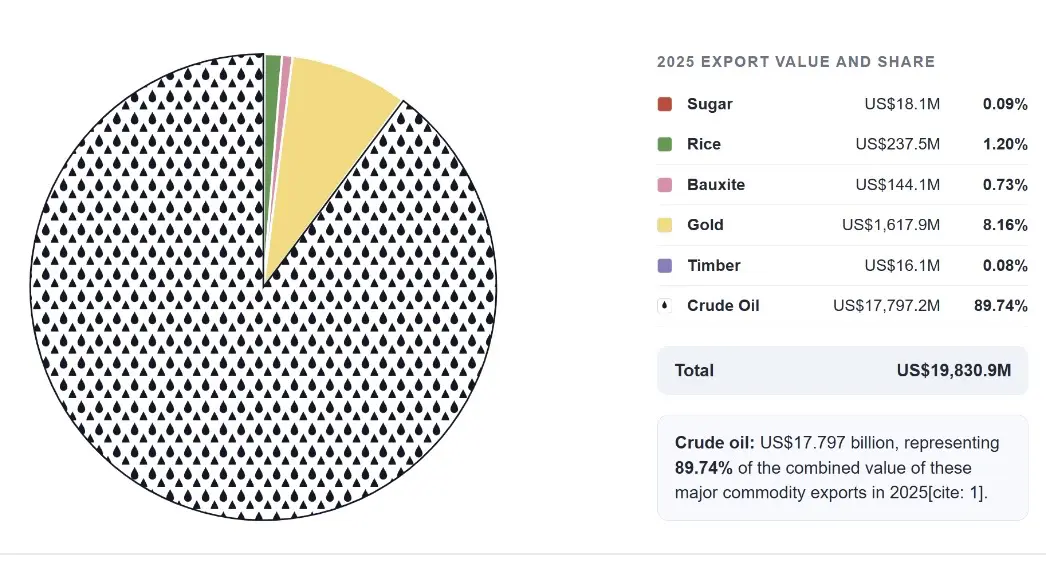
Guyana is in a similar position with oil. From 2023 through 2025, crude oil accounted for roughly 90% of exports. In 2025, Guyana exported about US$17.8 billion in crude oil, compared with roughly US$1.6 billion in gold, while sugar exports were comparatively small, see pie chart below or https://www.oggn.org/infographics/pie-chart-2025-bog.html. In the first half of 2026, the Mid-Year Report states that 163.3 million barrels of oil were produced and that crude oil averaged US$92.50 per barrel. If those first-half figures were simply annualized, the gross value would be about US$30.2 billion – nearly twice the 2025 oil-export figure. That is an illustration, not a full-year forecast.

Against that backdrop, Exxon stated during its Q2 2026 investor conference call that US$55 billion in capital and operating costs had been recovered for the Stabroek Block. The statement did not provide a project-by-project breakdown. For purposes of this discussion, we assume the figure relates to seven projects, including the four currently producing about 900,000 barrels per day, with a fifth project expected to add roughly 250,000 barrels per day.

For perspective, US$55 billion is an extraordinary sum in relation to Guyana’s historical public finances. From independence to when the Stabroek Block contract was signed in 2016, let’s call that 50 years, the combined annual budgets did not come close to US$55 billion. Yet the Ministry of Finance’s 2026 Mid-Year Report does not state that US$55 billion has been recovered, or identify which Stabroek projects are included in that figure, or provide a project-by-project breakdown of recovered costs. Nor does it quantify how much future projects – including the eighth, ninth, and tenth developments – could add to the cost bank and how those additions could affect Guyana’s share of gross oil revenue.

The Mid-Year Report vaguely explains how the cost bank affects Guyana’s revenue. Section 3.63 (p. 21) states:

“However, it must be emphasised, that the clearing the historical cost bank balance does not by itself deliver a 50 percent share of gross revenue to Government. The Stabroek Block partners will continue to recover current costs, lower than 75 percent of gross revenue, and Government will receive more than 12.5 percent of gross revenue in profit oil. As additional projects are approved, and their development costs enter the cost bank, the profit-oil ratio will move again.”

Source: Ministry of Finance, Mid-Year Report 2026, section 3.63, p. 21.

On August 18th, 2026, President Ali said, “Stabroek Block oil has increased from 12.5% to 39.8%”. However, the BoG report published 10 days later, dated August 28th, 2026, does not mention that Guyana’s profit share of the Stabroek Block has increased from 12.5% to 39.8%.Nor does the BoG report mention the overall take has moved from 14.5% to 41.8% of oil revenues. Instead, the BoG report states that Government will receive more than 12.5% of gross revenue in profit oil while the Stabroek partners continue to recover current costs. That is astounding given at the current production of 900,000 barrels/day at US$100 a barrel, we are talking per a month between US$392 million (14.5%) and US$1.129 billion (41.8%) or a difference of U$737 million.

In President Ali’s address, see https://www.youtube.com/watch?v=kiP-WwYh1l4&t=593s , he further states with respect to the 39.8%, “This has occurred as I said because the cost bank has been recovered two years earlier than originally expected.”

Without the underlying cost-bank figures and assumptions, readers cannot readily reconcile the President’s claim with what is stated in the BoG report.

The mortgage analogy is useful because paying down a large obligation improves forecasting. Once a household mortgage is substantially reduced or paid off, the family can estimate more accurately when it can afford major purchases. The same principle applies here: if US$55 billion in costs have been recovered, then the size and composition of the remaining cost bank are central to understanding how much oil profit Guyana may receive in the years ahead.

In the Bank of Guyana’s 119-page 2026 Half-Year Report, rice and sugar combined are mentioned almost as many times as oil. Yet, as the pie chart above shows, rice and sugar together accounted for just 2% of Guyana’s exports in 2025, compared with oil’s 90% share.

The BoG is obviously misguided in its focus and priorities but why? 

This raises a straightforward transparency question: why does the 2026 Mid-Year Report not provide the US$55 billion figure, the projects to which it relates, the remaining cost bank, and the expected additions from future projects? Without those details, readers cannot independently assess how the cost bank feeds into the Government’s petroleum-revenue projections.

Yours faithfully,

Darsh Khusial

Kenrick Hunte

Frederick Collins

Janette Bulkan

On behalf of OGGN | www.oggn.org/about a 501(c)(3)

You reached the end of this article without encountering a paywall.

That is deliberate. We believe reliable journalism about Guyana should be available to everyone from the hinterland to the coast, including those who cannot afford to pay for it. But investigating, reporting and publishing every story takes time, energy and resources. Keeping our journalism open depends on the commitment of readers who can chip in and contribute to help cover the cost for everyone.

Please join the Kiskadee family by taking a subscription. Every contribution counts to our commitment to our journalists, to our readers, and to independent, public-interest journalism.

And please spread the word. One one dutty build dam!


Become a supporter


Source: Kiskadee Watch

