…Ambassador says US companies face an “onerous and unpredictable tax regime”
(Kaieteur News) – United States (US) Ambassador to Guyana, Nicole Theriot has called for more tax incentives and other support mechanisms to benefit American firms.
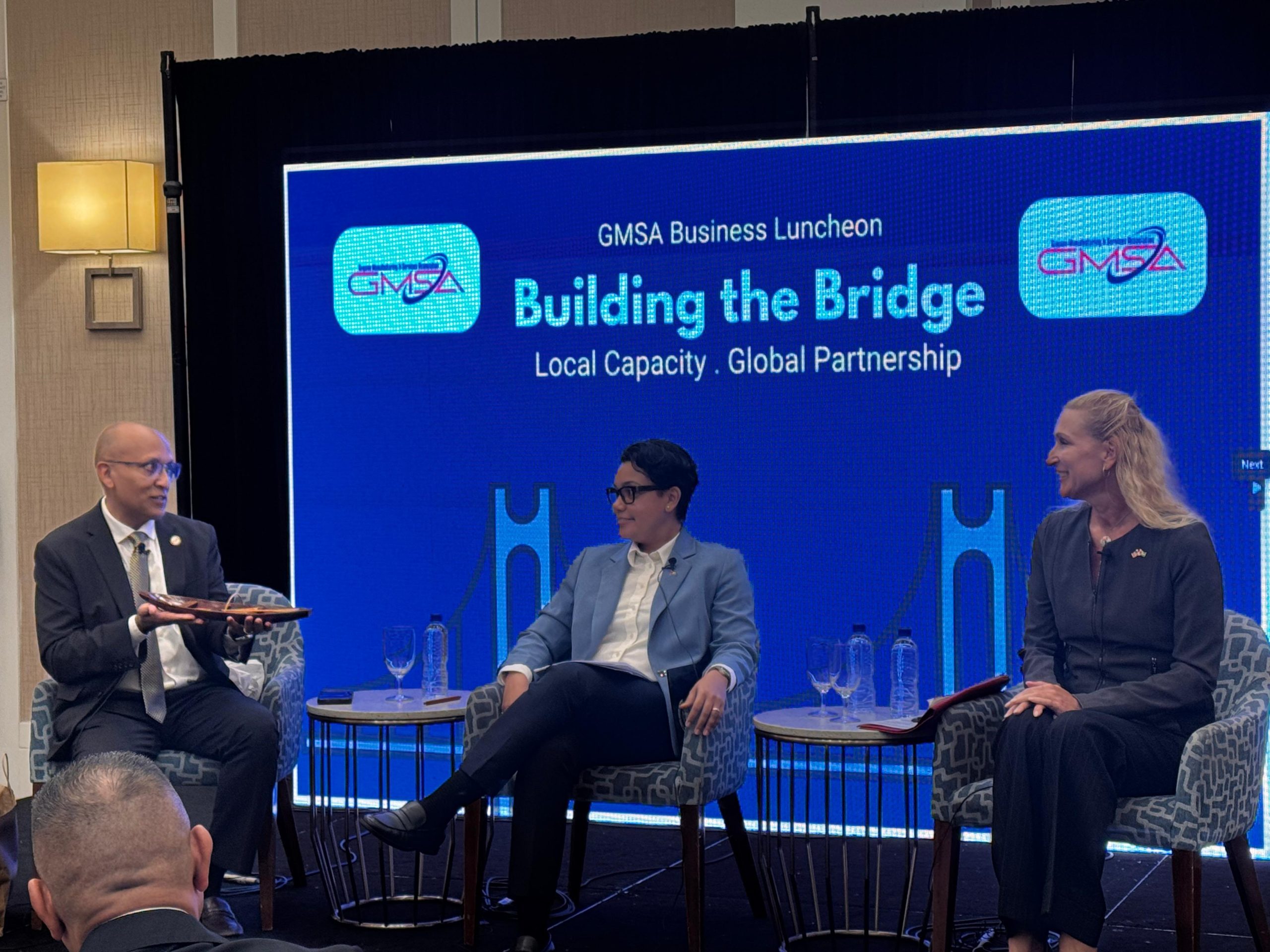
The diplomat during a business luncheon on Tuesday, hosted by the Guyana Manufacturing Services and Association (GMSA), recognised efforts by the Government of Guyana (GoG) to implement tax incentives for local businesses. She however pointed out that this was one of the hurdles faced by American companies that are eager to invest in the country.
During a panel discussion alongside Minister of Tourism, Industry and Commerce, Susan Rodrigues, she said, “At the US Embassy, we are inundated, when I say it, I mean it, inundated with calls from US companies who are eager to enter the Guyanese market.”

(From left) GMSA President, Rafeek Khan, Minister of Tourism, Industry and Commerce, Susan Rodrigues and US Ambassador to Guyana, Nicole Theriot
Be that as it may she explained the reason why more US companies are not yet in the country and why American firms still import most of their goods and services. According to her, “The answer to both of those questions is basically the same. What companies tell me, time and time again, is that they struggle to find local partners who can deliver at scale. They also face potential hurdles like logistics, energy costs, an onerous and unpredictable tax regime, and access to land and skilled workers.”
The Ambassador continued, “And it’s wonderful to hear all of these tax incentives and other support mechanisms being put in place for local businesses but the international companies are still struggling a little bit with this. Hopefully, we’ll be able to overcome these challenges together.”
But while she spoke of the tax hurdles that humbug American companies, US energy giant and partners ExxonMobil do not pay taxes to the GoG, as agreed under the 2016 Production Sharing Agreement (PSA).
On the sidelines of the event, this newspaper asked Ambassador Theriot whether she believes the company should now pay taxes, like every other business in the country, especially now that it has recovered all of its investments.
To this end, she said explained that the company was not simply dodging tax payments to the state but is merely enjoying an agreement that was made years ago.
“That is not up to me. Whatever deal the government made with that company is what they’re abiding by…they’re certainly not avoiding paying taxes. That was clearly something that was agreed to,” she noted.
In accordance with the Petroleum Agreement, ExxonMobil does not pay taxes to the GoG. In fact, the sweetheart deal Exxon signed states in Article 15.1 that the contractor (ExxonMobil Guyana Limited) as well as its affiliates shall not be subjected to tax, value-added tax, excise tax, duty, fee, charge, or impost in respect of income derived from petroleum operations, property held or transactions except as specified under the agreement.
Further, Article 15.4 states that the sum equivalent to the taxes owed by the company will be paid by the minister responsible for Petroleum to the Commissioner General of the GRA. The contract also allows for the issuing of a receipt to ExxonMobil, indicating that it has met the local tax requirements to avoid the burden of double taxation.
Just last month Kaieteur News reported that ExxonMobil Holdings Corporation in a Securities Exchange Commission (SEC) recently said it paid a whopping US$1.1B in taxes to the Guyana Revenue Authority (GRA) in 2025 as part of its massive ongoing petroleum activities in the country.
The company is now producing about 900,000 barrels of oil per day in the Stabroek Block from four projects – the Liza One, Liza Two, Payara and Yellowtail.
Outspoken Attorney and Chartered Accountant, Christopher Ram said the lopsided Exxon deal must now change since the operator has recovered all of its investments.
Ram said, “Now that this moment has arrived, and the project has become risk-free, it is entirely appropriate that the government calls Exxon to the table and say, look we must renegotiate this contract now.”
Ram’s first demand is that the Contractor file, be assessed, and pay its own taxes like every other company operating in Guyana, and receive a receipt for money it has actually paid. If the companies insist that a tax concession was part of the bargain, he says, then let it be a concession with an end date: a defined ten-year waiver running from first oil in December 2019 and expiring in December 2029. Ten years is a holiday. Thirty is a transfer.
Second, Ram wants an increase in the rate of royalty from 2% to at least 6% moving up to 10% within five years.
Read more here: https://kaieteurnewsonline.com/2026/08/18/time-to-change-exxon-deal-is-now-chris-ram/
Source: Kaieteur News