Home Blog Page 8

GECOM has lost its way – time for reversal

0

Business and Economic Commentary  By Christopher Ram

Part One of Two: The cost of an electoral institution

In January 2012, I questioned whether Guyana received value for money from its elections machinery. In 2015, I noted that the cost per vote had risen from G$520 in 1997 to G$24,746 in 2011. My concern extended beyond polling-day costs to sustaining an institution seldom subjected to financial scrutiny. Fourteen years later, the questions remain unanswered and the sums have multiplied.

The subject now requires two articles. This first examines how a temporary Elections Commission became permanent, its costs across five-year General Election and three-year Local Government Election cycles, and whether expenditure has been audited. The second addresses the commissioners: their remuneration, attendance, performance, the Commission’s paralysis and the case for replacing the present arrangement. Before examining its governors, we should establish what taxpayers pay for the institution.

From temporary oversight to permanent institution

Before 1992, Article 161 of the 1980 Constitution provided for a chairman appointed by the President and one commissioner representing each party holding at least five seats in the National Assembly. Appointments were tied to an election and ordinarily ended three months afterwards. The 1985 Commission had three members, but a separate National Registration Commission handled voter registration, identification cards and other administration. Comparisons with today’s GECOM must include both bodies’ costs.

The earlier system was hardly a golden age. Beginning in 1968, the electoral system was compromised and corrupted, largely to deliver whatever results the PNC wanted. To his discredit, Hoyte joined in that process to deliver one of the most discredited elections in 1985. Enter the Carter Center whose reforms included a formula for GECOM of three government nominees, three opposition nominees and a chairman. It was a political compromise intended to restore confidence, not an arrangement suitable for all time. The Commission remained temporary for the 1992 and 1997 elections. In 2000, constitutional amendments made it permanent, while retaining its politically divided composition and consolidating important electoral responsibilities under it.

The need for continuity in electoral administration was never in question. What was questionable was the decision to make a politically constituted Commission permanent. Registration systems, trained staff, secure records and election planning cannot be reconstructed from nothing every five years. But a permanent professional secretariat is not the same thing as a permanently politicised governing commission. The question, after more than a quarter-century, is whether the benefits of continuity required this particular structure and its recurring costs.

The full cost of an electoral cycle

GECOM costs tons of money between elections: staff, commissioners, accommodation, technology, registration and transport. An election-year allocation is therefore incomplete. We must examine expenditure across the entire cycle, separating election costs from the organisation’s standing costs.

A reconstruction of the Ministry of Finance’s published estimates for GECOM, Agency 11, indicates expenditure of approximately G$11.18 billion in 2011–2015, G$16.63 billion in 2016–2020 and G$18.73 billion in 2021–2025, giving a fifteen-year total of G$46.53 billion. Original budgetary allocations over the same period amounted to approximately G$61.98 billion, a difference of G$15.45 billion, or almost 25%. These figures are drawn from published budget estimates rather than a complete series of separately audited GECOM accounts, and the 2025 expenditure is revised rather than final. Supplementary appropriations and other adjustments must therefore be reconciled before conclusions can be drawn about unspent funds. Nevertheless, the figures raise serious questions about the reliability of GECOM’s budgeting and financial management. More fundamentally, what has Guyana received in return for G$46.53 billion in reported expenditure, and where is the independent audit evidence demonstrating that this enormous expenditure represented value for money?

This does not mean G$46.5 billion was wasted. Elections were held and registers maintained. But what did expenditure achieve, why did costs change, and how much supported the permanent establishment rather than elections? It would be equally misleading to divide every five-year total by the votes cast in the final year and call the result the cost of a vote. The 2011–2015 period, for example, included two General Elections, whereas the next two periods included one each.

GECOM has never bothered with indulging in this level of accountability.

Local elections and value for money

Local Government Elections are intended to follow a three-year cycle, although postponements have disrupted that timetable. Elections were held in 2016, 2018 and 2023. Allocations were also made in years when anticipated elections did not take place. How much was actually spent preparing for postponed polls, what was surrendered, and what additional costs followed the delays? Because the same staff, premises and equipment serve both local and national elections, their costs cannot simply be added together. A meaningful examination would identify direct costs and allocate shared expenditure fairly. But GECOM has shown little appetite for this level of accountability.

Guyana’s geography makes elections expensive. Remote communities, rivers and difficult transport routes cannot be ignored in international comparisons. But these challenges make rigorous procurement, sound planning and independent performance auditing more necessary, not less. A proper value-for-money review would examine staffing, commissioners’ benefits, registration and technology expenditure, procurement and operational readiness, and establish what improvements the public has obtained.

Where are the audited accounts?

Article 223(2) of the Constitution places constitutional commissions within the Auditor General’s audit mandate. Yet a straightforward public account remains elusive: for each year, which GECOM financial statements were audited, when, with what opinion, and where are the reports? The Audit Office’s published register gives GECOM the puzzling notation ‘Established as at 2015’ rather than a clear last-audit year. That does not prove no audit work occurred, but it calls for a transparent record of completed audits.

Reporting spending in the national accounts is no substitute for examining internal controls, programmes and economy. GECOM should identify the financial statements prepared; the Audit Office should identify the audits completed and their findings. The Audit Office warrants separate treatment; taxpayers need credible evidence to assess value for money.

This time, it is the Auditor General, the Public Accounts Committee and the Parliament which have not bothered about their constitutional authority.

Who is asking the questions?

GECOM needs far more than post-elections scrutiny by the Private Sector Commission, always eager to pronounce on election results, but not on cost control and efficiency. What has the Public Accounts Committee done to establish the state of GECOM’s audits, and why has Parliament continued to approve substantial estimates without a fuller public accounting of results? The President, Government and Opposition bear responsibility for the structure they preserve, as much as for the conduct of an election.

That international observers noted improvements in the 2025 polls does not distinguish between a reasonably managed polling day and a sound institution. The arrangement devised for the 1992 return to democracy should not survive indefinitely merely because political parties have become comfortable with it. Guyana needs independent, professional election administration, not an expensive political compromise preserved without proof of its worth. Part Two will examine the leadership and performance of those who occupy the Commission.

Next week we turn our attention to the Commissioners themselves and their apparent concern with their personal interests rather than with the public good and their constitutional obligations.


Source: Kiskadee Watch

Lindeners Had to Take to the Streets Before Government Moved to Address Power Crisis

0

After months of unreliable electricity, prolonged blackouts and water disruptions, residents of Linden had to take to the streets before the government announced an intervention to protect the town’s water supply from the consequences of the failing electricity service.

On Monday, November 2, residents staged a protest outside the Linden Utility Services Co-operative Society Limited (LUSCSL), demanding an end to the persistent power interruptions that have disrupted households, businesses, schools and access to potable water.

By Tuesday night, the Ministry of Public Utilities announced that a 750-kilovolt-ampere (kVA) backup generator had been installed at the West Watooka Water Treatment Plant, replacing the existing unit and strengthening the facility’s ability to continue operating during electricity outages.

The timing of the announcement was striking. Residents had been enduring the consequences of the electricity crisis for months, yet the generator intervention came only after public frustration spilled onto the streets.

The new generator may help prevent another interruption to water production at West Watooka, but it does not address the central grievance driving the protests: Lindeners cannot depend on a consistent electricity supply.

During Monday’s demonstration, protesters carried placards and chanted, “No water, no light, all-you will get it right.” Demerara Waves reported that residents in parts of the town had experienced more than 30 hours without electricity.

The consequences extended beyond household inconvenience. Residents reported damaged appliances, spoiled food and disruptions to small businesses. Some boat operators and route taxi services halted operations, while many parents kept their children home from school.

One protester, describing the daily uncertainty, said:

“This is sickening, every day is blackout and when the light go, the water going, no water, no light, by the time the light come on, it coming off, yuh can’t catch ya self and this heat is ordinary, we tired, we tired.”

The protest was not simply about the absence of electricity. It was about the failure of two essential services to function reliably and the burden being placed on residents to cope with repeated disruptions.

Government responds after public pressure

The Ministry said the decision to replace the West Watooka generator followed Tuesday’s engagement with regional officials and the electricity service providers operating in Linden.

Public Utilities Minister Deodat Indar reportedly instructed his Director-General, Alfonso De Armas, to oversee the deployment. GWI Executive Director of Projects Marlon Daniels and Director of Operations Jawaharlal Ramjug were also involved in coordinating the replacement and technical support.

The ministry further said that Indar had directed that all water treatment plants across Linden be equipped with backup power systems to reduce the impact of electricity interruptions on water production and distribution.

The meeting included Region Ten Regional Executive Officer Dr Gregory Harris, as well as representatives of the Linden Electricity Company Incorporated (LECI), which serves Mackenzie, and LUSCSL, which serves Wismar.

In a statement, the ministry said:

“The Ministry’s priority remained clear — to safeguard essential water services for Linden residents through coordinated interventions, while the respective electricity service providers addressed the ongoing power supply challenges.”

That commitment, however, leaves a larger question unanswered: when will the electricity providers and government deliver a permanent solution so that residents are not forced to depend on emergency arrangements to access basic services?

A crisis rooted in inadequate capacity and infrastructure

The latest protest is part of a wider dispute over whether Linden’s electricity generation and distribution systems can meet the town’s growing demand.

In August, LECI acknowledged that its maximum available generation capacity stood at approximately 14.5 megawatts, while peak demand had exceeded 15 megawatts. The company attributed the shortfall to increased electricity consumption, unusually high temperatures and expanding residential and commercial activity.

The growing number of sawmills operating in the area has also intensified questions about the pressure placed on the electricity network, particularly given Linden’s subsidised electricity rates.

During Monday’s protest, APNU parliamentarian and former Linden mayor Sharma Solomon argued that the problem extended beyond generating capacity to the ageing transmission and distribution infrastructure.

Solomon said the government needed to stop relying on short-term interventions and invest in a long-term energy solution.

He called for a 100-megawatt generation system, together with a comprehensive upgrade of the town’s electricity transmission and distribution network. He argued that the proposed capacity would accommodate housing expansion, infrastructure development and growing commercial and industrial activity.

Solomon also questioned the adequacy of the government’s broader energy planning, pointing to the need for generation capacity that reflects Linden’s present requirements and future development.

His proposal underscores the central issue confronting the town: additional electricity generation alone will not guarantee reliability if the network responsible for transmitting and distributing that power remains inadequate.

Relief is not the same as a solution

The 750-kVA generator at West Watooka is a necessary intervention, particularly for residents who have experienced water disruptions whenever electricity fails. The proposed backup systems at other treatment plants could provide further protection.

But the installation does not restore electricity to homes, businesses and schools, nor does it resolve the generation and distribution problems that have triggered repeated outages.

The government must now explain what concrete measures will be taken to stabilise electricity supply, how soon additional capacity will become available and whether the existing network can support Linden’s expanding residential and commercial needs.

For residents, the sequence of events is telling. They endured prolonged blackouts and water shortages, took to the streets to demand action, and only then saw a government announcement addressing one consequence of the crisis.

Lindeners should not have to protest to secure the reliable electricity and water services that are essential to their daily lives.


Source: Village Voice News

GFF Awards $118 Million Contract for First Phase of Blue Water Shipping Stadium

0

The Guyana Football Federation (GFF) has awarded a $118 million contract to local construction and engineering firm B&J Civil Works for the first phase of the proposed Blue Water Shipping Stadium at D’Urban Park, Georgetown, with construction scheduled to begin next Tuesday, November 10.

The contract was signed on Tuesday, November 3, at the GFF Secretariat in the presence of GFF President Wayne Forde, Second Vice-President Rawlston Adams, General Secretary Pushpargha Chattopadhyay and B&J Civil Works Chief Executive Officer Beverly Tapp.

According to the Federation, the procurement process was publicly advertised on August 27, 2026, and attracted bids from six contractors. Following an evaluation by the GFF’s Tender Management Consultant, B&J Civil Works was selected as the successful bidder.

Phase One will focus on site preparation and the development of supporting facilities, including two grassroots mini-pitches, spectator bleachers, floodlighting, male and female dressing rooms, washroom facilities, a security station, perimeter fencing, bridge and culvert infrastructure, and the main entrance and access works.

GFF President Wayne Forde described the project as one of the Federation’s most ambitious infrastructure investments, saying it would provide a foundation for the long-term development of football while supporting Guyana’s broader sports tourism ambitions.

“Investing in modern football infrastructure is fundamental to the long-term growth and sustainability of our sport. The Blue Water Shipping Stadium represents one of the most ambitious infrastructure investments undertaken by the GFF.”

Forde said the Federation was embracing President Irfaan Ali’s vision of positioning Guyana as a regional sports tourism hub and intended to contribute through the development of a facility capable of hosting international competitions.

“We are building a facility that will serve our football, attract international competitions and create lasting opportunities for future generations,” he said.

FIFA and Concacaf provide technical support

The GFF said the project is being advanced with technical support from FIFA and Concacaf, with FIFA providing design and engineering oversight and Concacaf undertaking technical evaluations and offering guidance on operational requirements.

The Federation said this collaboration is intended to ensure that the stadium’s development aligns with the relevant standards and guidelines for hosting international matches.

The two mini-pitches planned under Phase One will also support the FIFA Football for Schools (F4S) programme, established through a Memorandum of Understanding signed by FIFA, the GFF and the Government of Guyana in 2022.

The facilities are expected to provide schools and surrounding communities with modern spaces for football activities, expanding access to the sport and strengthening grassroots development.

Stadium expected to accommodate 10,400 spectators

When completed, the Blue Water Shipping Stadium is expected to accommodate approximately 10,400 spectators and serve as the home venue for Guyana’s senior men’s and women’s national teams, the Golden Jaguars and Lady Jags.

Beyond international football, the proposed multifunctional facility is intended to host GFF Elite League matches, national team activities, concerts, exhibitions, cultural programmes and other public events.

The GFF said the project represents a significant step towards improving the country’s sporting infrastructure, creating opportunities for young people and supporting the development of sports tourism.

The Federation also acknowledged the support of President Ali and the Government of Guyana, while expressing appreciation to Blue Water Shipping for its partnership and contribution to advancing the stadium project.

With the first phase expected to get underway on November 10, attention will now turn to the execution of the $118 million contract and the delivery of the initial facilities that will form the foundation of the proposed national football stadium.

The GFF has presented the project as an investment extending beyond football, with the potential to provide a venue for international sporting events and wider public activities. Its eventual impact, however, will depend on the timely completion of the works and the realisation of the Federation’s plans for the facility.


Source: Village Voice News

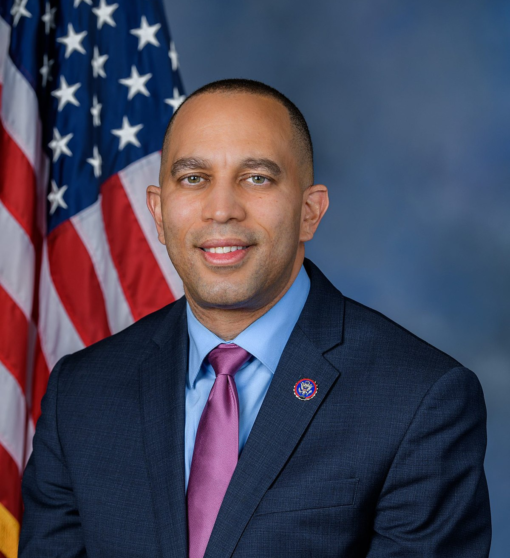
USA | Hakeem Jeffries Poised to Make History as First Black House Speaker

0

Democratic House Minority Leader Hakeem Jeffries is poised to become the next Speaker of the United States House of Representatives after Democrats captured control of the chamber in Tuesday’s midterm elections, delivering a major political setback to President Donald Trump and the Republican Party.

Celebrating the Democratic victory before an enthusiastic crowd in Washington, Jeffries declared that the election marked the beginning of a new political chapter for the country, promising that his party would pursue lower living costs, improved access to healthcare and greater accountability in government.

“America is back. Today begins the great American comeback,” Jeffries proclaimed.

He said voters had delivered a decisive message to Washington and rejected what he described as extremism and corruption.

“The American people have spoken and made clear that they’ve had enough of the extremism, enough of the corruption. They want a Congress that’s going to deliver for the American people.”

Jeffries also warned that Democrats understood the responsibility accompanying their electoral victory and would have to demonstrate that they could improve the lives of ordinary Americans.

“This is a change election. We need to deliver dramatic change. Things are broken.”

He pledged that Democrats would make affordability a central priority, specifically identifying the cost of housing, groceries and fuel as issues requiring urgent attention.

“We will fight hard to lower the high cost of housing and groceries and gas,” he told supporters.

Jeffries also promised to work towards restoring healthcare protections and reversing cuts to Medicaid, the federal programme that provides healthcare coverage to low-income Americans and people with disabilities.

“We’re going to fight hard to make sure that we can ensure that every single American can afford to go see a doctor when they need one.”

He further pledged to hold the Trump administration accountable, accusing individuals in positions of power of prioritising personal enrichment over the public interest.

“We’re going to bring accountability to those who have visited unprecedented corruption on this country.”

Jeffries added that the election was not simply a victory for one political party.

“This is not a partisan moment. This is a patriotic one. It’s a red, white, and blue moment because America has won tonight.”

Democrats secure House majority

The Democratic victory gives the party control of the 435-member House of Representatives, where 218 seats are required for a simple majority.

Democrats entered the election seeking to overturn the Republican majority and needed a net gain of at least four seats based on the pre-election balance.

The latest reported tally placed Democrats at 228 seats and Republicans at 139, with several races still awaiting final calls. That represented a net Democratic gain of 25 seats against the previous party balance, although the final margin remained subject to outstanding results.

The Republican defeat means current Speaker Mike Johnson is expected to surrender the gavel when the new Congress convenes in January 2027.

Historic moment for Jeffries

At 56, Jeffries has led House Democrats since January 2023, when he succeeded former Speaker Nancy Pelosi. He became the first Black lawmaker to lead either party in the House.

His anticipated election as Speaker would make him the first Black American to hold the powerful position, placing him at the centre of congressional decision-making and oversight of the Trump administration.

The Speaker controls the House legislative agenda, determines which bills receive consideration and exercises considerable influence over committee assignments and investigations. The officeholder also stands second in the presidential line of succession, behind the Vice-President.

Jeffries is expected to be formally selected as the Democratic nominee for Speaker when the party’s newly elected lawmakers meet later this month. The full House will vote when the new Congress assembles in January.

His leadership will not be without challenges. He must maintain unity among moderate and progressive Democrats, some of whom have differing positions on healthcare, housing, foreign policy and other priorities.

Although Democrats will control the House, Trump remains President and retains the power to veto legislation. The party will therefore need to navigate a difficult relationship with the White House while attempting to advance its legislative programme.

For Jeffries, however, Tuesday’s result represents a historic political breakthrough and an opportunity to lead a Democratic majority determined to challenge the President’s agenda.


Source: Village Voice News

Democratic control of US House provides Guyana’s opposition with unprecedented oversight toolkit 

0

ear Editor,

It is easy to see why Guyana’s opposition views potential Democratic control of the U.S. House under Representative Hakeem Jeffries as a major strategic asset. Congressman Jeffries’ deep roots in Brooklyn, home to a vibrant Guyanese diaspora, and his history of receiving opposition delegations mean that key allegations against the ruling PPP/C government have already reached the highest levels of congressional leadership.

If House control were realized, this relationship could influence Guyana’s domestic and foreign affairs in two concrete ways:

First, House leadership controls the legislative calendar and could mandate formal hearings through the House Foreign Affairs Committee regarding opposition allegations of systemic ethnic marginalization and uneven oil wealth distribution. Elevating these claims to Capitol Hill committee rooms would apply intense diplomatic pressure on Georgetown, forcing the State Department and the U.S. Embassy to formally account for institutional transparency and equity in Guyana.

Second, control over key committees like House Appropriations and Financial Services provides leverage over international development financing and U.S. regulatory oversight. Congressional inquiries into state procurement practices and the management of Guyana’s Natural Resource Fund could introduce heightened scrutiny for foreign investors and multilateral lenders, creating a chilling effect on how major public infrastructure contracts are financed and awarded.

Yet, even with these formidable legislative levers, a critical boundary remains. Official foreign policy and defense strategy are executed by the U.S. Executive Branch. For the White House and the Department of State, protecting U.S. commercial energy operations led by ExxonMobil and maintaining Guyana’s territorial integrity against Venezuelan aggression remain paramount national security imperatives.

Democratic control of the House provides Guyana’s opposition with an unprecedented megaphone and oversight toolkit in Washington, but it will not override the core realpolitik that governs U.S. diplomatic strategy in Georgetown. Ultimately, the country’s political destiny will still be decided at the ballot box by Guyanese voters.

Sincerely,

Keith Bernard


Source: Kiskadee Watch

Judge to rule November 13 on Mohamed bail request

0

-says he must not be kept in oppressive conditions

Opposition Leader Azruddin Mohamed will remain at the Lusignan Prison pending a High Court ruling expected on November 13, when Justice Priscilla Chandra-Hanif is scheduled to deliver her decision on an application challenging the refusal of bail in his cybercrime case.

During this morning’s proceedings at the High Court, Justice Chandra-Hanif directed that all submissions must be filed by November 12, ahead of her ruling the following day. She also ordered that Mohamed personally provide affidavit evidence supporting the claims advanced in the application filed by his mother, Bonita Mohamed.

The hearing also brought renewed scrutiny to Mohamed’s conditions of detention, particularly allegations that he is being subjected to approximately 23 hours of artificial lighting daily inside his prison cell.

Justice Chandra-Hanif expressed concern over the reported lighting arrangements, indicating that such prolonged exposure was unacceptable and making it clear that Mohamed must not be held under circumstances that are oppressive.

During the proceedings, Attorney General and Minister of Legal Affairs Anil Nandlall SC presented the Court with a photograph purporting to show the cell in which Mohamed is being detained at the Lusignan Prison.

However, the Judge indicated that she had not personally visited the prison in some time and requested that Mohamed’s defence team also provide photographic evidence of the cell for comparison.

The request came amid conflicting accounts of the Opposition Leader’s detention conditions, with his family alleging that he is being held in solitary confinement, exposed to extreme heat and subjected to prolonged artificial lighting.

The Judge also addressed the distinction between security measures that may be necessary for a prisoner’s protection and detention arrangements that could amount to oppressive treatment.

While acknowledging that prison authorities may have legitimate security considerations when determining where an inmate should be housed, Justice Chandra-Hanif made it clear that such considerations should not result in oppressive circumstances.

The Court has not yet made a final determination on whether the conditions alleged by Mohamed’s family have been established.


Source: Kiskadee Watch

Min Mustapha urges students to explore beekeeping opportunities

0

Minister of Agriculture Zulfikar Mustapha on Wednesday encouraged students to consider beekeeping as a viable agricultural enterprise, assuring them of the ministry’s support through training and the provision of essential equipment.

The minister made the remarks while presenting prizes to students from several secondary schools who excelled in the cooking competition during the recently concluded Honey Fest 2026.

Minister Mustapha along with teacher and students of Buxton Practical Instruction Centre

Minister Mustapha commended the students for their creativity and participation, noting that such initiatives expose young people to the various opportunities available within the agriculture sector.

He highlighted the continued development of Guyana’s apiculture industry, including the significant increase in honey production over the past six years and the growing demand for honey and honey-based products locally and regionally.

Minister of Agriculture Zulfikar Mustapha engages students

The minister encouraged students interested in entering the industry to take advantage of the ministry’s support, which includes training, beekeeping suits and hive boxes.

Queen’s College emerged as the overall winner of the competition, receiving a refrigerator, while Buxton Practical Instruction Centre placed second and received a gas stove.

Christ Church Secondary secured third place and was awarded a microwave, while St Joseph High School and Golden Grove Secondary placed fourth and fifth, respectively, receiving food processors.

One of the young beekeepers

In the individual cooking categories, Christ Church Secondary won best appetiser, while Queen’s College secured both best main course and best dessert.

Two young beekeepers from Sandvoort Village, Oris Sinclair Jr and Aiden Hope, were also recognised as the youngest apiculturists. Each received 10 beehive boxes, a complete beekeeping suit and a smoker to support the expansion of their operations.

Students who were presented with beekeeping boxes

Additionally, three recent graduates of the Guyana School of Agriculture (GSA) received inputs to expand their honey production operations.

CATEGORIES
TAGS


Source: Department of Public Information (DPI)

WIN supporter arrested for making ‘Channa Bomb’ comments at protest

0


Police are investigating a video circulating on social media in which an individual allegedly made statements about making explosives, commonly referred to as “Channa bombs”, during a protest held on Monday, November 2, 2026, outside the Georgetown Magistrates’ Court and its environs.

As part of the investigation, a 27-year-old male of Chesney, Corentyne, Berbice, was arrested on Tuesday, November 3, 2026.

Further investigations revealed that the video was recorded during a Facebook Live broadcast from an account under the name “FS Khan”, while the protest was taking place in connection with the extradition hearing of Azruddin Mohamed.

The video also captured individuals throwing missiles at Police ranks, while a male voice was heard saying, “Burn the place.”

During questioning, the suspect acknowledged being present at the protest and conducting the livestream. He stated that several persons in his immediate surroundings were making threatening remarks towards Police officers.

Police continue to investigate the circumstances surrounding the statements and possible offences relating to threats of violence and incitement. Investigations are ongoing.


Discover more from INews Guyana

Subscribe to get the latest posts sent to your email.


Source: INews Guyana