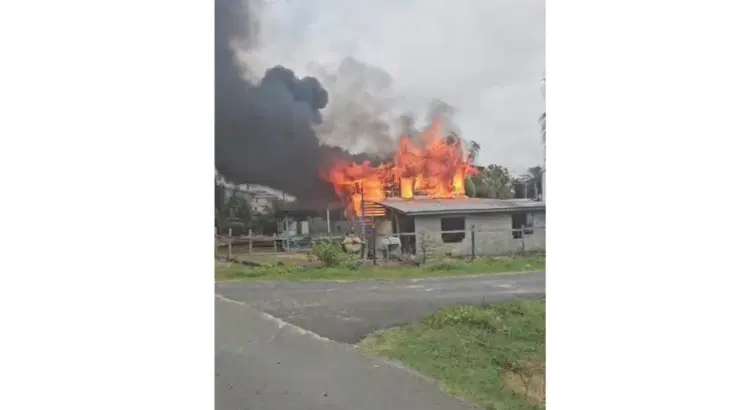
Sixty-eight (68) houses were destroyed by fire in Regions Five and Six between January and September 2026. One of the fires led to the death of a woman at Blairmont.
Division Fire Officer Clive McDonald told reporters that the number of house fires was slightly higher than the 67 recorded in the corresponding period last year, when no fatalities were reported.
The lone fatality this year was Bibi Shafroon Ramprashad, known as “Zina,” of Lot 95, Number Two Settlement, Blairmont, West Bank Berbice (WBB). Ramprashad, who was wheelchair-bound, died on June 2 after a fire broke out at her home while she was alone.
McDonald also reported several other fire incidents across the two regions during the first nine months of the year. These included fires affecting one church, 10 government buildings, six businesses, two sheds, one stall, four bonds, one lubricant facility and one rice mill. Included in the total are 32 electrical fires along with 12 vehicle fires.
The division further recorded 92 garbage fires and 256 grass fires during the period.
Investigations revealed that 344 fires across some categories were deliberately set, while 46 were classified as maliciously set, McDonald said.
He attributed the increase in grass fires to people lighting fires and leaving them unattended, allowing the flames to spread across open fields and other lands amid the prevailing El Niño conditions.
“We are imploring on citizens of Regions Five and Six to follow our guidelines posted on our social media platforms as it relates to grass fires so that we can reduce it,” McDonald said.
He warned that grass fires not only place property at risk but can also affect nearby communities and reduce visibility for motorists, creating dangerous road conditions.
McDonald urged residents to report suspicious activities and fires at abandoned properties, while encouraging the public to follow fire prevention guidelines.
He added that the division has been conducting public sensitisation exercises to educate residents on fire prevention methods and techniques.
Guyana is aiming to end onion imports by the end of this year as the government expands local production, with Region Nine expected to lead cultivation alongside Regions Two, Five and Six.
Minister of Agriculture Zulfikar Mustapha said the country is targeting approximately 500 acres of onion cultivation as part of efforts to meet domestic demand through locally grown produce.
“At the end of this year we will not import any onions. Region Nine will produce all the bulk of our needs, plus Region Two, Region Five and Region Six,” the minister said.
Guyana began onion production as part of an integrated farming approach aimed at diversifying agricultural output, reducing reliance on imported produce and creating additional income opportunities for farmers.
The initial pilot project in Region Nine, Upper Takutu-Upper Essequibo, recorded a harvest valued at more than $15 million, demonstrating the potential for local onion cultivation to contribute to the country’s food supply.
Minister Mustapha said the initiative forms part of a broader crop diversification drive that includes corn, soya, broccoli, cauliflower, carrots and lettuce, among other high-value crops.
He noted that farmers are embracing the integrated farming approach and encouraged interested persons to contact the National Agricultural Research and Extension Institute (NAREI) to explore opportunities to cultivate onions.
The government is prepared to support farmers who wish to enter the sector, including those with relatively small plots of land.
“I have already passed instructions that as long as they have an acre or two, we’ll work along with them. We will try as much as possible to provide the planting material, and we will give them all the technical guidance so that they can come on board,” Minister Mustapha said.
Through the expansion of onion cultivation and support for farmers, the government is seeking to strengthen domestic production capacity and move Guyana closer to meeting its onion needs without depending on imports.
This move forms part of the Caribbean Community’s (CARICOM) target of reducing the region’s food import bill by 25 per cent by 2030.
Police are investigating the alleged murder of 28-year-old Romel Toney of Kairuni, Soesdyke-Linden Highway.
The crime occurred on Saturday, October 10, 2026, at about 21:00 hrs at Amelia’s Ward, Linden.
Police said preliminary information revealed that Toney was involved in an altercation with another male, during which he sustained an injury to his neck. He subsequently died.
Investigations into the circumstances surrounding the incident are ongoing.
The Guyana Police Force did not indicate whether the suspect was known or is in custody; however, they promised an update shortly.
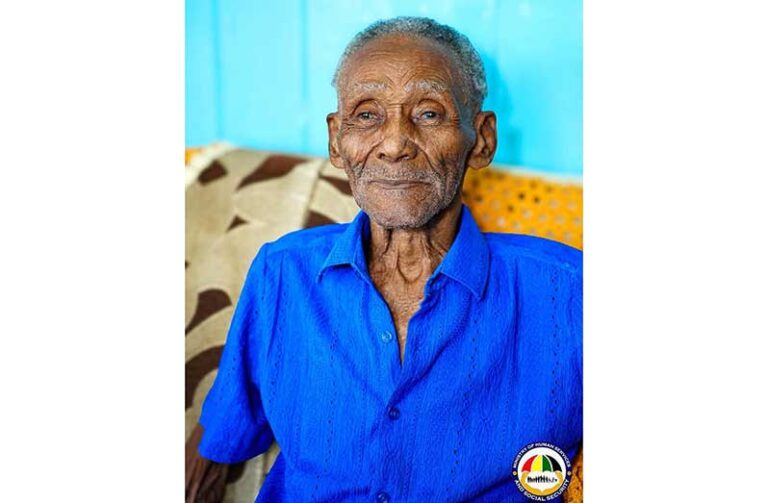
Aubrey Osmund Roberts, affectionately known as “Uncle Aubrey” or “Labba”, a longtime resident of Golden Grove, East Coast Demerara, has celebrated his 100th birthday, marking a century of life, family and community connections.
Roberts, a familiar figure in the village, has spent much of his life working hard and raising his 17 children, building a family legacy that has grown across generations.
To mark the milestone, representatives of the Difficult Circumstances Unit (DCU) of the Ministry of Human Services and Social Security visited the centenarian and presented him with a care package on behalf of subject Minister Dr Vindhya Persaud.
The ministry shared the occasion in a Facebook post, celebrating Roberts’ long life and his contributions to his family and community.
Persaud also extended birthday greetings, wishing Roberts continued happiness, love and many more cherished moments surrounded by his loved ones.
The visit forms part of the ministry’s efforts to recognise and celebrate senior citizens, particularly those reaching significant milestones.
Reaching 100 is a rare milestone that offers an opportunity to reflect on a life shaped by changing generations, personal experiences and enduring family relationships. Roberts’ story also highlights the important place older people hold within families and communities, where their experiences and memories connect younger generations to the past.
For Roberts and his family, the centenary marks not only a birthday but also a celebration of the many years, relationships and memories accumulated over a century.
The ministry’s visit brought official recognition to the occasion, honouring a Golden Grove resident whose life has been marked by hard work, family responsibilities and lasting community ties.
By Mark DaCosta-On the afternoon of Wednesday, 6 October 1976, a Douglas DC-8 lifted off the runway at Seawell Airport in Barbados and climbed into the sky above the Caribbean Sea. Within minutes, two bombs had torn through it. All 73 people aboard died when Cubana de Aviación Flight CU-455 plunged into the Atlantic. Eleven of them were Guyanese, and most were young people on their way to build futures that were never allowed to begin.
This month marks half a century since that day. For many families in our country, the passing of fifty years has not softened it.
The flight had begun its journey at Timehri, as the airport now named for Cheddi Jagan was then known. Its route took it through Trinidad and Barbados, onward to Jamaica, and finally to Havana. Aboard were 48 passengers and a crew of 25: 57 Cubans, 11 Guyanese and five North Koreans. Among the Cubans were members of the national fencing team, young athletes returning home from a regional championship.
The Guyanese passengers were Raymond Persaud, Rawle Thomas, Jacqueline Williams, Rita Thomas, Eric Norton, Gordon Sobha, Ann Nelson, Margaret Bradshaw, Violet Thomas, Sabrina Harripaul and Seshnarine Kumar. Official accounts record that several were scholarship students bound for Cuba to study medicine, engineering and other disciplines. Rawle Thomas was just 19. In an independent Guyana that was still defining itself, these were exactly the young people a young nation hoped would return home to serve it.
Their deaths came at a moment of regional courage. Only four years earlier, in 1972, Guyana, Barbados, Jamaica and Trinidad and Tobago had jointly established diplomatic relations with Cuba, an independent step taken despite considerable pressure. The scholarships that sent our students to Havana were fruits of that new friendship. The bombing of Flight 455 was therefore not only a catastrophe for the families on board. It was an assault on the idea that small Caribbean states could choose their own partners.
The investigation that followed pointed to two Venezuelans, Hernán Ricardo Lozano and Freddy Lugo. They boarded in Trinidad and Tobago, left the aircraft in Barbados, and were later arrested. Reports say they implicated Luis Posada Carriles and Orlando Bosch, Cuban exiles with long histories of anti-Castro militancy, as the organisers of the plot. The decades that followed brought no conviction of either man for the bombing, and both died in the United States. For the families, that absence of accountability has been a second grief.
Although diminished with time, it is a grief our state has refused to let pass quietly. At the 2015 commemoration, then President David Granger reminded the nation that “Guyana, a small state, was one of the earliest victims of international terrorism.” He added that justice for the victims remained outstanding. Rawle Thomas’s brother, Jeffrey, laid the wreath on behalf of the bereaved families that year, a reminder that behind the statistics are siblings, parents and friends who still count the years.
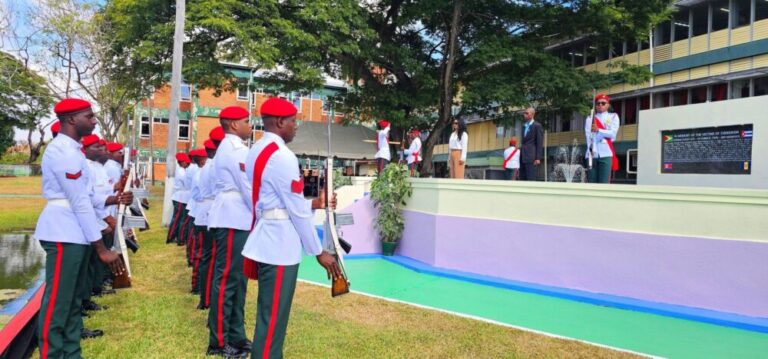
Each October, Guyana gathers at the Cubana Air Monument on the University of Guyana’s Turkeyen campus. Presidents, ministers, diplomats and relatives have stood there in recent years to lay wreaths and observe silence. In Barbados, a companion monument at Paynes Bay, St James, draws regional leaders on the same date. Cuba observes 6 October as its Day of Victims of State Terrorism, and Caribbean voices have urged a wider international day of remembrance so that the 73 are not forgotten.
Perhaps the most telling feature of this remembrance is how little it has changed. Governments come and go, yet the ceremony continues, the names are read, and the solemn promise is repeated that our region will not allow such an act to be forgotten or repeated.
Fifty years is long enough for a generation to grow up knowing the tragedy only from a monument and a date. That is exactly why it matters to tell it plainly. Eleven Guyanese set out on a journey of promise, carrying their families’ hopes and our country’s. They deserve to be remembered by name, as the young people they were, and not merely as figures in the history of a crime.
A pension is more than a monthly payment. It represents years of labour, sacrifice and contributions by workers who helped build Guyana’s economy. The right to pension, and the right to receive the correct pension, must therefore be treated as a matter of justice, dignity and accountability.
Workers cannot be expected to spend decades contributing to the National Insurance Scheme (NIS), or serving in the public sector, only to encounter unexplained deductions, missing contributions, incorrect calculations, administrative delays or uncertainty about the benefits to which they are entitled.
The Guyana Trades Union Congress (GTUC) maintains that workers must be informed of their rights, protected by the law and able to challenge decisions that deprive them of their lawful entitlements.
The Constitution protects pension rights
Guyana’s Constitution provides an important safeguard under Article 149B, which states:
“Every public sector worker shall enjoy an absolute and enforceable right to any pension or gratuity granted to him or her under the provision of any law or collective agreement of any kind whatsoever.”
This constitutional provision makes clear that pension and gratuity entitlements granted to public sector workers under applicable laws or collective agreements are enforceable rights, not favours that an employer or government may grant or withdraw at its discretion.
The GTUC calls on public employers to respect these obligations, maintain accurate employment and service records, honour collective agreements and ensure that eligible workers receive the full benefits due to them.
Where disputes arise over pension calculations, qualifying service or the interpretation of an agreement, workers must have access to transparent explanations and effective avenues of redress.
NIS contributions must translate into correct benefits
Under the NIS’s published rules, an insured person generally qualifies for an old-age pension at age 60 after paying at least 150 contributions and having at least 750 contributions paid or credited. Those who satisfy the age requirement and have at least 50 contributions, but do not meet the pension conditions, may qualify for an old-age grant instead.
These distinctions matter. A worker’s entitlement depends on the applicable legislation, contribution history and qualifying conditions. Consequently, the accuracy of an individual’s contribution record is essential.
The GTUC urges workers to check their NIS records, retain payslips and other evidence of deductions, and promptly query missing contributions. Employers must fulfil their statutory responsibilities, while NIS must ensure that records are properly maintained and benefit decisions are accurately calculated.
A worker should not have to bear the consequences of an employer’s failure to remit contributions or of administrative errors beyond that worker’s control.
International labour standards and social protection
The International Labour Organisation’s Social Security (Minimum Standards) Convention, 1952 (No. 102) establishes international benchmarks for social security, including old-age benefits. However, Guyana has not ratified Convention No. 102, according to the ILO’s published records. It is therefore an international standard to which the country can look in strengthening social protection, rather than a ratified convention binding Guyana as such.
Guyana should continue strengthening its pension protections, improving access to information and ensuring that its social security arrangements respond to the realities of workers and retirees.
The right pension must be the correct pension
Receiving a pension is not enough if the amount is wrong. A pension calculated using incomplete contribution records, incorrect insurable earnings or an erroneous assessment can leave a retiree struggling to meet basic living expenses.
The NIS publishes a formula for calculating old-age pensions based on relevant insurable earnings and contribution history, subject to prescribed minimum and maximum limits. Its published guidance states that the pension rate must not fall below 50 per cent of the public service minimum wage or exceed 60 per cent of average weekly insurable earnings.
The GTUC calls for transparent calculations, accessible contribution histories and a clear process through which workers can request reviews and challenge errors. Where underpayments are established, the responsible authority must take appropriate steps to correct them and pay outstanding amounts in accordance with the law.
A call for accountability and pension security
The GTUC urges the Government, NIS, public sector employers and all relevant authorities to:
Ensure that pension entitlements are calculated accurately and paid promptly.
Strengthen the monitoring of employers’ contributions and compliance with the law.
Provide workers with accessible records of contributions, qualifying service and pension calculations.
Establish efficient procedures for investigating complaints and correcting underpayments.
Protect pensioners from unnecessary bureaucratic delays and ensure that decisions are properly explained.
Engage trade unions in reviewing pension policies, improving social security and protecting workers’ retirement interests.
Workers must also be encouraged to understand their rights before retirement, verify their records and seek assistance when discrepancies arise.
The GTUC emphasises that pension security is inseparable from workers’ dignity. Those who have given years of service to their country must not be left to fight alone for benefits they have lawfully earned.
Guyana’s development must be measured not only by economic growth, oil revenues or national budgets, but also by how it treats the people whose labour sustains the economy.
A pension is deferred income earned through work and governed by applicable law. The correct pension, paid at the correct time, is a matter of justice.
Workers built the wealth. Their retirement rights must be protected.
Attorney-at-law Nigel Hughes has confirmed that his client, Daniel Seeram, the National Border Patrol Director and former Region Four Chairman, is “in the prison”, but did not identify the facility holding the convicted official. The disclosure leaves critical questions unanswered about where Seeram is being detained and when the court’s remand order was finally executed.
Hughes, Seeram’s lead defence counsel, confirmed to Kaieteur News that his client is serving pre-sentencing detention in accordance with rulings by both the Magistrate’s Court and the High Court. However, sources at Lusignan Prison told the publication that Seeram had not been taken there.
The latest confirmation follows a controversy sparked by Opposition Leader Azruddin Mohamed, who said in a social media post on October 5 that checks at Lusignan Prison and Camp Street Prison in Georgetown indicated Seeram was not being held at either facility. Senior prison officials had confirmed Seeram had not been handed over by the police following the High Court ruling.
Hughes’ statement indicates that Seeram is now in a prison facility, but he has not disclosed which one or when his client was transferred. The authorities have not provided a clear public account of the circumstances surrounding his admission into prison.
Manickchand questions equal treatment
The controversy has also drawn comment from Minister of Local Government and Regional Development Priya Manickchand, who addressed the matter in a social media post.
Manickchand questioned whether the usual legal procedures were being followed after Seeram’s conviction and the decision to remand him pending sentencing. While acknowledging his right to pursue legal remedies, she questioned whether an order staying the remand had been made or sought.
“I don’t know what the facts are between Mr Seeram and the complainant. And I don’t need to know,” she said, noting that the court had heard the case, found Seeram guilty and ordered him remanded pending sentence.
She warned against making exceptions for particular individuals.
“Every single time we offer a ‘but this one is different’ we halt the progress we should be making. And it is time we stop.”
Manickchand also argued that the handling of such cases has implications for women who report domestic violence, saying victims must have confidence that their rights will be protected regardless of an accused person’s status or access to high-profile legal representation.
High Court upheld remand order
Seeram was found guilty on October 2 by Magistrate Abigail Gibbs of assault causing actual bodily harm against his former wife, Farzana Hamid. The case arose from an incident at their Cummings Lodge residence on September 11, 2023. He was remanded pending sentencing, scheduled for November 2, 2026.
Hughes subsequently applied to the High Court for judicial review of the magistrate’s decision, arguing that Seeram should not have been remanded before the court received the probation report, victim-impact statement and submissions on mitigating and aggravating circumstances.
On October 5, Justice Joy Persaud-Singh dismissed the application, finding no indication that Magistrate Gibbs had acted unlawfully, irrationally or outside her jurisdiction. The decision to refuse bail pending sentencing was upheld.
The unresolved issue is why the authorities’ earlier accounts of Seeram’s custody differed from Hughes’ subsequent confirmation. An authoritative explanation from the Guyana Police Force and the Guyana Prison Service would establish when he was transferred and where he is being held.
Seeram is scheduled to return to the Sparendaam Magistrate’s Court on November 2 for sentencing.
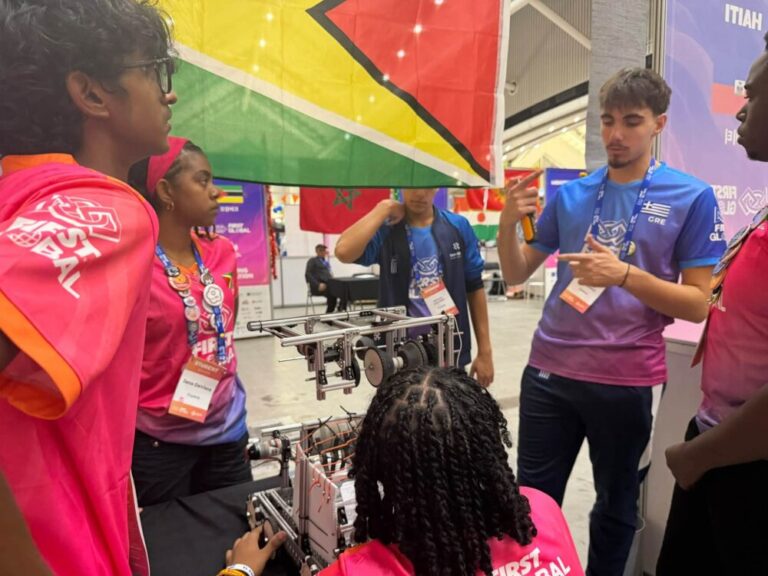
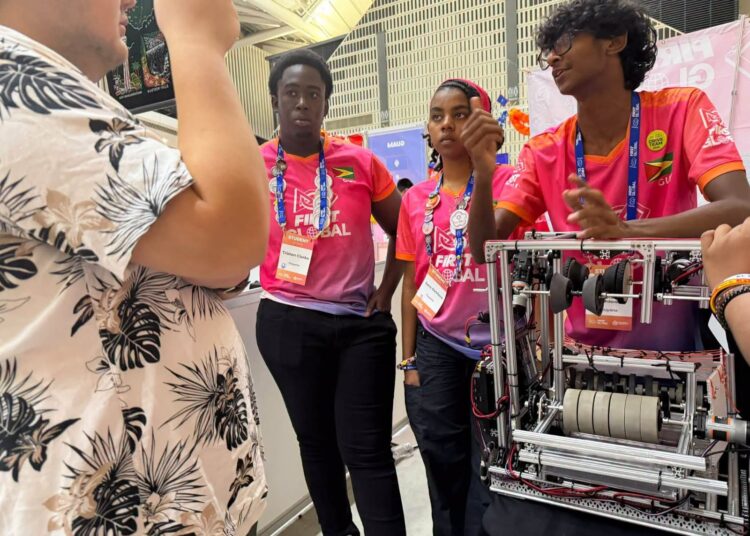
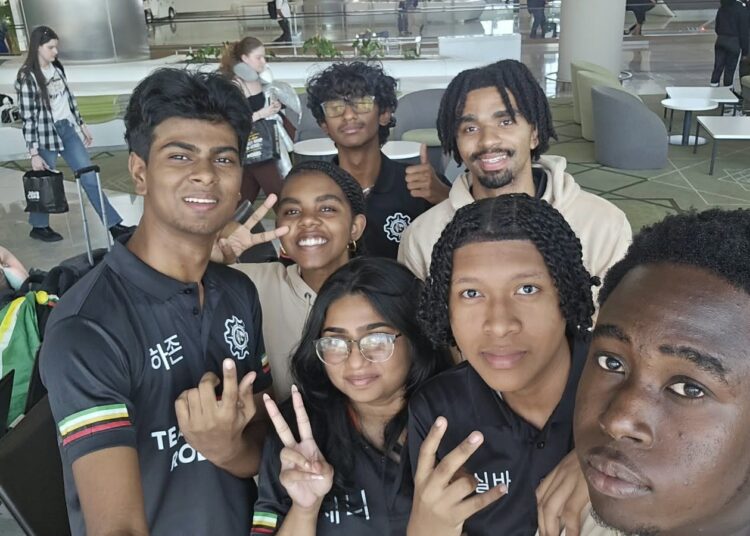
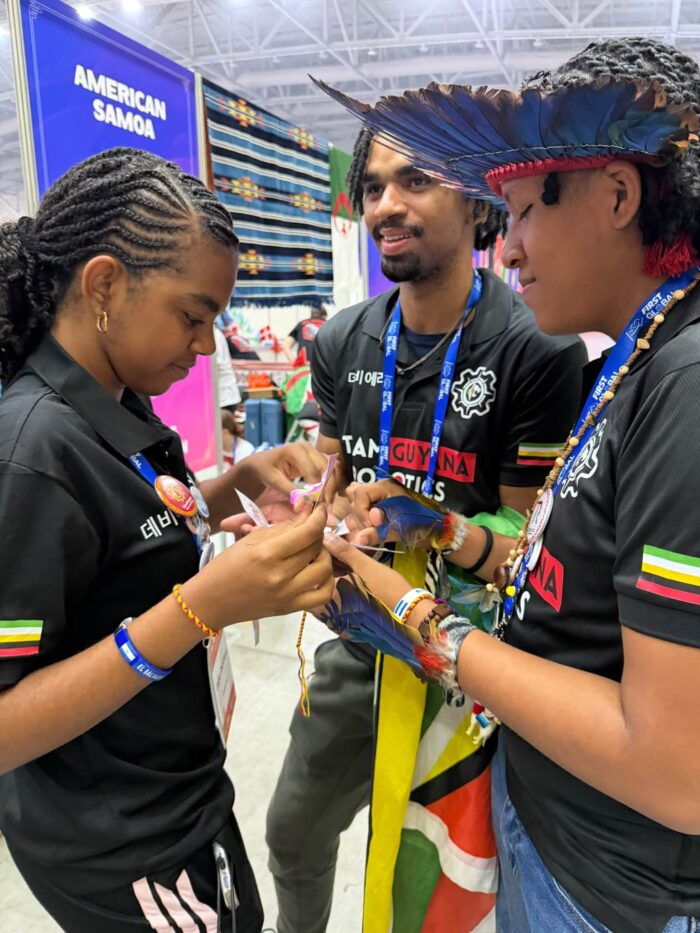
Team Guyana Robotics returns from South Korea with valuable international experience and the pride of having represented the country at the 2026 FIRST Global Challenge. The five-member team made an impressive early impact, climbing to 22nd place after its opening matches and breaking into the top 25 among more than 190 competing nations.
Guyana’s 84th-place finish placed the team within the top half of the field—an achievement in itself for the five young innovators. Beyond the ranking, the students gained invaluable international exposure, sharpened their technical skills and demonstrated that young Guyanese can compete on the global stage when given the opportunity.
The competition ran from October 7 to 10 in Incheon, South Korea, bringing together teams from more than 190 countries under the theme “Igniting Innovation”.
Guyana’s robot, named Panthera Harpia, was developed for a wildfire-themed challenge that tested students’ ability to design, programme and operate a machine to collect and place game pieces before completing a climbing task.
Uzbekistan, China and Mexico finished first, second and third respectively in the final national-team rankings.
The winning alliance comprised Uzbekistan, Moldova, Venezuela and El Salvador, which collectively scored 1,060 points in the finals. The runner-up alliance scored 1,016, while the third-place alliance scored 1,009.
Alliance results are separate from individual national-team rankings, as teams from different countries combine their robots and performance to compete for the tournament title.
Jamaica earns gold and bronze
Jamaica also secured recognition, winning the Ustad Ahmad Lahori Award for Innovation in Engineering and sharing bronze with Nigeria in Engineering Documentation.
Jamaica finished 100th in the overall national-team rankings, demonstrating that technical awards can recognise innovation and engineering work beyond a team’s final position on the leaderboard.
The Jamaican delegation included students from several schools across the island. Its awards highlight the competition’s broader focus on creativity, technical documentation and problem-solving alongside match results.
2026 Team Guyana Robotics in Korea
More than a leaderboard
For Guyana’s students, the experience extended beyond points and rankings. Competing internationally exposed them to different engineering approaches, encouraged collaboration and gave them a demanding environment in which to apply their knowledge.
Before travelling, team members spoke about the months spent developing and rebuilding their robot, the challenges of synchronising mechanical systems with programming, and the importance of teamwork.
David Da Silva, 16, the team’s driver and lead engineer, described the challenge of getting the robot’s hardware to work effectively with its code. Eashan Harjohn, 18, identified teamwork as one of the biggest lessons of robotics.
The students also worked around limited preparation resources, including the absence of a full competition field for practice. Their efforts to test and improve the robot with the equipment available reflected the practical problem-solving that STEM education is designed to encourage.
Jana Deviera, the team’s only female student travelling to the competition, highlighted the importance of representing girls in robotics.
“I think it’s really great that I can be able to be an example to other girls, other young girls so they can see me and be empowered and they can know that they can also do this,” she said before the competition.
Her participation underscores the importance of encouraging more girls to explore engineering and technology.
2026 Team Robotics Guyana
STEMGuyana’s contribution
Team Guyana Robotics operates under STEMGuyana, founded by Dr Karen Abrams to expand access to science, technology, engineering and mathematics education and help young people develop practical skills.
Its programmes include robotics teams, coding activities, after-school clubs and Learning Pods designed to strengthen children’s academic and technical abilities. The organisation’s work across Guyana helps young people explore technology and learn through hands-on projects.
International competitions such as FIRST Global allow selected students to apply those skills in a challenging environment. Participants can also bring lessons home and inspire younger students to pursue robotics and other technology-driven fields.
The team’s participation has benefited from corporate and community support. MODEC has supported STEMGuyana’s robotics activities and Learning Pods programme, including expansion in Regions Two and Eight. ENet and APAN Energy Services also supported the team’s participation.
Such backing is essential because international competition requires equipment, mentorship, training, travel and time to test designs.
2026 Team Guyana Robotics in Korea (Team face book’s photo)
Commending the team
The five students deserve commendation for their determination, ingenuity and commitment to representing Guyana on the international stage at a time when technological innovation is becoming increasingly competitive. Despite working with limited resources, they rose to the challenge, tested their abilities against the world’s young innovators and gained experience that cannot be measured by a final ranking alone. Their 84th-place finish does not define their potential; the skills they developed, obstacles they overcame and international exposure they gained are achievements in their own right.
STEMGuyana also deserves recognition for helping turn young people’s curiosity into practical skills, creating opportunities for them to experiment, collaborate and discover what they are capable of achieving. But talent alone is not enough. These young innovators need sustained investment, modern equipment, mentorship and support from businesses, educators, communities and the wider society to compete on an increasingly demanding global stage.
Guyana’s early rise to 22nd place demonstrated that its young people can make their mark internationally. The experience gained in South Korea should now become a foundation for stronger preparation, greater ambition and improved performance in future competitions.
Ultimately, this journey is about more than robotics or rankings. It is about showing young Guyanese that their ideas have value, that limited resources need not extinguish ambition, and that with the right opportunities and support, they can help shape the technological future of their country. Their journey from Guyana to South Korea is not the end of an achievement, but a starting point for what they—and the next generation of Guyanese innovators—can accomplish.
Romel Toney, a 28-year-old of Kiruni, Soesdyke-Linden Highway, was killed on Saturday night during an altercation at Amelia’s Ward, Linden.
Preliminary information revealed that sometime around 21:00h, Toney was involved in an altercation with another male, during which he sustained an injury to his neck. He subsequently died.
Police are currently conducting investigations into the circumstances surrounding the incident.
An update will follow as the probe continues.
Discover more from INews Guyana
Subscribe to get the latest posts sent to your email.
I noted the Regional Executive Officer (REO) for Region 10 making claims about progress in agricultural development. I respectfully challenge the officer to substantiate these claims with verifiable data rather than public statements.
Could the REO publish the acreage currently under cultivation in Region 10, along with a breakdown of the crops and other agricultural products being produced and their respective production volumes?
The public also deserves to know what percentage of the food supplied to Linden each month is produced locally and what percentage comes from outside the region. My understanding is that between 65 and 70 per cent of the food entering Linden comes from elsewhere. If the REO disputes this figure, the officer should publish the relevant data.
Agricultural development cannot be measured by promotional posts on Facebook or claims of progress. It must be demonstrated through land under cultivation, production volumes, investment, market access and the contribution of local farmers to the food supply.
The PPP/C Government must also answer for the longstanding concerns surrounding agricultural development in Linden and its surrounding communities. Why have the Wismar and Rockstone cooperatives reportedly not received the 500 acres of agricultural land for which they paid? What is preventing these farmers from accessing land they say they purchased for agricultural purposes?
In my view, agricultural production in Linden began to decline when the Surapana farm was shut down and cattle and other ruminants were removed from Moblissa along the Linden-Soesdyke Highway. The wells at Moblissa were also destroyed, although three were subsequently restored to operation under the APNU administration.
These developments raise important questions about the management of agricultural assets and the support provided to farmers over the years. The REO should explain what has been done to restore production, expand cultivation and create opportunities for farmers in Region 10.
I intend to examine the agricultural development claims being promoted on the REO’s Facebook page, one item at a time, and compare them with the realities confronting farmers and consumers in Linden.
The people of Region 10 deserve more than political rhetoric. They deserve an agricultural development plan with clear targets, timelines, budgets and measurable outcomes. Where is that plan? How much land will be brought under cultivation, what will be produced, and how will local farmers be supported to supply Linden’s markets?
The PPP/C Government must also explain why, after years in office, so many questions remain about the use of agricultural land and the development of local production.
The people of Linden should not have to depend so heavily on food brought in from elsewhere while the region’s agricultural potential remains underdeveloped. The REO should publish the figures, provide the plan and demonstrate what progress has actually been made.