Home Blog Page 53

Ally’s Tesla Plaid takes nine-second title at Berbice Invasion

0

Imran Mohamed Ally drove his Tesla Plaid to victory in the nine-second class as thousands of fans gathered at Rose Hall Canjie for the Guyana Motor Racing and Sports Club’s (GMR&SC) Berbice Invasion on Sunday.

Competing in car number 1998, Ally was among the winners across seven car brackets, a female category and three motorcycle classes at the meet.

Ashley Persaud-Jewanram secured the female title in her Toyota GT-86, number 162, while GMR&SC President Mohamed Shairaz Roshandin combined his organising role with a win in the 13-second class, driving his Mitsubishi Evolution X, number 30.

The motorcycle honours went to Shem Chattersingh, Stephon Vishmon and Steven Chung.

Chattersingh won the 600cc Superbike category on his Suzuki GSX-R, number 1011. Vishmon claimed the 1000cc Superbike title aboard a BMW 1000 RR, number 342, and Chung took the 125cc–212cc class on bike number 251.

In the remaining car brackets, Paramdeo Seeram won the 11-second category in his Toyota Allion 4WD, number 216, while Sayyad Ramcharran secured the 12-second title in a Toyota Corolla EE90, number 137.

Romaine Henry topped the 14-second class in a Toyota Celica, number 81. Toyota Corolla Fielder Wagons delivered victories for Ramesh Persaud in the 15-second bracket, driving number 484, and Afzal Maiku in the 16-second category, driving number 289.

Beyond the results, the meet marked a milestone for the venue, which hosted time-bracket drag racing for the first time in the GMR&SC’s modern history.

The club described the turnout as one of its largest outside the South Dakota Circuit, with the response encouraging plans for an annual Berbice event.

Roshandin thanked spectators, competitors and their families for supporting the meet, saying the enthusiasm from the Ancient County had heartened the organising team.

He acknowledged that organisers encountered some setbacks but said they overcame those challenges to deliver the day’s racing.


Source: Kiskadee Watch

Press Release: 102 graduate from Guyana School of Agriculture as Minister Mustapha highlights expanding opportunities in the sector

0

One hundred and two students graduated from the Guyana School of Agriculture (GSA) today during the institution’s 61st Graduation Ceremony, with Agriculture Minister, Hon. Zulfikar Mustapha, reaffirming the Government’s commitment to strengthening agricultural education, expanding opportunities for young professionals and preparing a skilled workforce to support Guyana’s rapidly developing agriculture sector.

Delivering the feature address, Minister Mustapha commended the graduates on their achievements and underscored the important role the institution continues to play in developing the human resources needed to advance agricultural production, research, innovation and food security.

The Class of 2026 comprised 65 females and 37 males who completed studies across six programmes offered at the Mon Repos and Essequibo campuses. Of the 102 graduates, 66 earned either a Credit or Distinction, while ten students who were referred in 2025 successfully completed their programmes this year.

The graduating class represented nine of Guyana’s ten administrative regions, along with 12 students from CARICOM countries, including ten from Grenada and two from Saint Lucia. Two Grenadian nationals, Mr. Jacob Thomas and Ms. Adonis Jones, were also recognised among the year’s outstanding performers.

Reflecting on the institution’s contribution to national development, Minister Mustapha noted that the GSA has remained an important source of trained agricultural professionals since its establishment in 1963.

“For more than six decades, the Guyana School of Agriculture has played an important role in preparing men and women for service in agriculture and national development. Since its establishment in 1963, the institution has produced 4,497 graduates who have gone on to serve as farmers, extension officers, animal health professionals, foresters, agro-processors, researchers, and agricultural leaders,” the Minister said.

He explained that the institution’s expansion from its original agricultural programme to include Forestry, Fisheries, Agro-Processing, Animal Health and Veterinary Public Health, and Livestock Production and Management reflects the changing demands of the sector.

With advancements in technology, evolving consumer expectations, increasingly competitive markets and the effects of climate change, Minister Mustapha stressed that agricultural education must continue to adapt to ensure graduates are equipped with relevant technical knowledge, practical skills and innovative approaches.

“Our educational institutions must therefore continue to equip students with the knowledge, practical skills, and innovative thinking needed to respond to these developments,” he stated.

Minister Mustapha also highlighted the Government’s significant investments in agriculture under the leadership of President Dr. Mohamed Irfaan Ali, noting that the sector recorded growth of 11.5 percent in 2025, while budgetary allocations increased from $18.4 billion in 2020 to $113.2 billion in 2026.

He said these investments are supporting the modernisation of production systems, expansion of agricultural infrastructure, increased access to technology and the development of new opportunities in crop and livestock production, agro-processing and other areas of the sector.

Against this background, the Minister emphasised that institutions such as the GSA have an increasingly important responsibility to prepare graduates to participate meaningfully in Guyana’s agricultural transformation.

He welcomed the School’s successful re-registration with the National Accreditation Council of Guyana through 2029, describing the achievement as an important step in maintaining recognised educational standards and ensuring the continued relevance of its programmes.

Minister Mustapha also pointed to ongoing partnerships with the Inter-American Institute for Cooperation on Agriculture (IICA) and EMC, which have supported training in hydroponics and protected agriculture. He noted that the introduction of digital farm record systems, collaboration with the National Agricultural Research and Extension Institute (NAREI), and continued training for farmers and extension officers are helping to strengthen the link between agricultural education, research and practical production.

Addressing the graduates, the Minister said the increasing participation of women in agricultural education was an encouraging development, particularly as the sector continues to offer a wider range of professional and entrepreneurial opportunities.

“Of the 102 graduates, 65 are women and 37 are men. This is a significant reflection of the changing face of agriculture in Guyana,” he said.

He urged young people to recognise that modern agriculture extends well beyond traditional farming and offers career opportunities in science, technology, business management, research, veterinary services, environmental management, logistics and marketing.

Minister Mustapha further highlighted the importance of providing young agricultural professionals with opportunities to establish their own enterprises, noting that financing available through the Guyana Development Bank could assist eligible young entrepreneurs in developing farms, agro-processing businesses and agricultural services.

“But access to education must be matched by access to opportunity. That is why the Government is also working to expand opportunities for young entrepreneurs,” he stated.

Among the outstanding graduates recognised during the ceremony was Ms. Analesia D’Aguiar, who received the Chairman’s Prize for being the best graduating student in the programmes offered at the Essequibo Campus. Ms. D’Aguiar completed the Certificate in Forestry programme with a GPA of 3.97, the highest recorded in the graduating class.

Mr. Marlon O’Donoghue received the Chief Executive Officer’s Prize for being the best graduating student in the two-year programmes offered at the Mon Repos Campus. He completed the Diploma in Agriculture programme with a GPA of 3.71.

The Guyana School of Agriculture commenced operations on September 9, 1963, at Mon Repos, East Coast Demerara, and has since developed into a key institution for agricultural training, producing graduates who continue to contribute to Guyana’s agricultural development and the wider Caribbean.

CATEGORIES
TAGS


Source: Department of Public Information (DPI)

Kashif and Shanghai returns with $3m title chase in Linden

0

Sixteen first-division clubs will compete for a $3 million first prize when the Kashif and Shanghai knockout football tournament returns on December 13, 2026, ending an absence of approximately 11 years.

The invitational championship will be staged at Linden’s Mackenzie and Bayrock stadiums, with the final set for January 1, 2027, at Bayrock. Both venues are equipped with floodlights and other facilities to accommodate the tournament.

Competing under the theme “Destination Linden/Football means Business”, the teams will also pursue substantial rewards beyond the title. The runners-up will receive $1.5 million, while the third- and fourth-placed teams will earn $1 million and $500,000 respectively. All cash prizes are in Guyana dollars.

The tournament’s Most Valuable Player will receive a new motorcycle, while the leading goalscorer will collect $500,000.

Co-directors Kashif Muhammad and Aubrey “Shanghai” Major outlined the plans during Saturday’s media launch at the Cliff Anderson Sports Hall, where representatives of clubs invited from outside the Upper Demerara Football Association were also present.

Muhammad reflected on the competition’s beginnings in 1989 and stressed that the standards associated with the tournament would remain central to its return.

“We have always prided ourselves on upholding high standards and this has contributed to our success over the years,” he said.

Each participating club is scheduled to receive $150,000 to support its preparations. However, Muhammad said clubs that failed to attend Saturday’s launch would not receive the full amount, emphasising that punctuality and adherence to the organisers’ requirements were expected.

Clubs will be permitted to field three guest players, who must also be first-division footballers. Teams may recruit those players locally or from overseas.

Host association Upper Demerara will have eight representatives: Capitol FC, Topp XX, Eagles United, Milerock FC, PDEY Stars, Botofago FC, Aroaima United and Winners Connection.

Georgetown’s invited clubs are Rhythm Squad, Beacons FC and Pele FC. They will be joined by Pouderoyen FC of West Demerara, Timehri United of East Bank Demerara, Buxton Stars of East Demerara, Cougars of Berbice and Riversview of Bartica.

The team briefing and fixtures draw are scheduled for November 20, 2026.

Mackenzie Stadium will stage the opening match day on December 13, followed by matches on December 20, Christmas Day and December 29. Bayrock Stadium will host games on December 18, December 22 and Boxing Day before staging the New Year’s Day final.

Beyond the football, the organisers are preparing a programme of activities intended to attract visitors and create business opportunities across Linden.

Muhammad said discussions had already been held with local businesses about maintaining high service standards during the tournament. Hotels, restaurants, barbershops, salons, vendors, taxi operators and other service providers are being encouraged to prepare for the thousands of visitors organisers expect in the mining town.

A fitness walk is scheduled for Sunday, December 27, from 6:00 a.m., with the route still to be confirmed. Later that evening, the Mackenzie Stadium tarmac will host “Pan, Soca and Flavours”.

A tour of Linden’s historical sites is planned for Wednesday, December 30, while an after-football show at the Bayrock Stadium tarmac will follow the final on January 1.


Source: Kiskadee Watch

US$15B in oil exported in first six months; Guyana received only US$1.9B

0


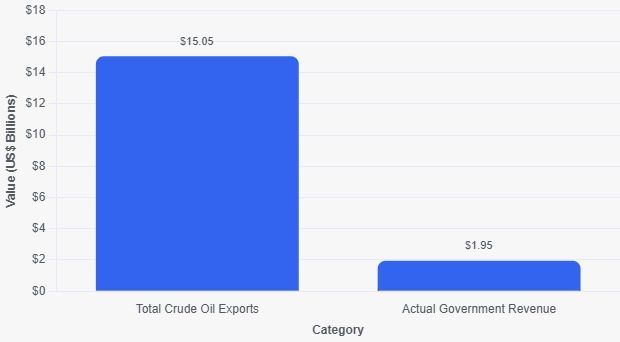
(Kaieteur News) – A staggering US$15B in oil was exported from Guyana during the first months of 2026, 40% more when compared with the same period last year.

The Bank of Guyana half year report for 2026 states, “Crude oil export earnings amounted to US$15,053.7 million, US$6,787.6 million higher than the same period one year ago.”

Central Bank pointed out that the increase earnings were as a result of more oil leaving the country and higher prices during the period.

Kaieteur News understands that 162.4 million barrels of oil were exported during the first six months of the year, compared with 116.1 million barrels one year ago – a 40% increase.

Meanwhile, BoG reported, “The average export price received for crude oil also increased by 30.1 per cent or US$21.45 to US$92.68 per barrel from US$71.23 per barrel one year ago.”

US$15B in oil exported in first six months; Guyana received only US$1.9B

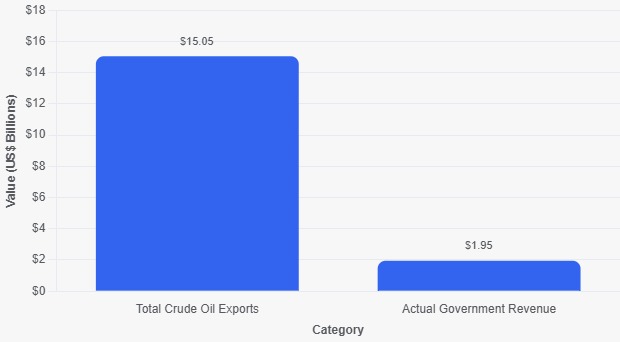
Chart showing the oil exported during the first six months of 2026 versus Guyana’s earnings.

But while a massive US$15 billion in oil left the country in six months, Guyana only received US$1.9 billion of the earnings from the sector.

According to Petroleum Receipts published by the Ministry of Finance and seen by this newspaper, Guyana got US$761M between January and March 2026. The country’s Natural Resource Fund (NRF) received an additional US$1.2B between April and June.

This is as a result of the deal Guyana signed with ExxonMobil and its partners in 2016. The deal allowed ExxonMobil to take up to 75 per cent of Guyana’s oil each month to pay for developments in the Stabroek Block. The remaining 25 per cent was split equally with Guyana and the contractor – meaning 12.5 per cent of profits came to the country and an additional 2 per cent royalty.

The formula has now changed as ExxonMobil has recovered its US$55 billion investments made in the country for the seven projects approved by government.

President Irfaan Ali announced that Guyana’s profit share has climbed significantly from 12.5 per cent to 39.8 per cent as operating costs still remain.

As expenses have been recovered, the head-of-state noted that the share of oil to repay costs have been reduced from 75 per cent to 20 per cent.

As a result, the NRF has recorded higher inflows since August this year. The BoG reported that in August alone, Guyana’s earnings were US$778 million using an exchange rate of $208 for one USD- more than the country received during the first quarter. Notably, the revenue for August included profit oil and a signing bonus payment.

Meanwhile, in September, the oil fund received another US$768 million for profit oil payments, taking the country’s total earnings for the year so far to US$3.5 billion.

During the presentation of this year’s budget, Finance Minister Dr. Ashni Singh revealed that Guyana is anticipated to earn US$2.8B billion. He explained, “Government is expected to earn approximately US$2.4 billion in profit oil and US$375.3 million in royalties. In addition, a signing bonus of US$17 million will be deposited for the new PSA signed for exploration activities in Block S7.”


Source: Kaieteur News

Barima victims still waiting for promised relief

0


 By Khadidja Bâ 

(Kaieteur News) – Months after the catastrophic sinking of the MV Barima, grieving families, survivors, and residents from White Water, Mabaruma, Wauna, and surrounding communities are speaking out against what they say is a profound abandonment by the State and humanitarian agencies.

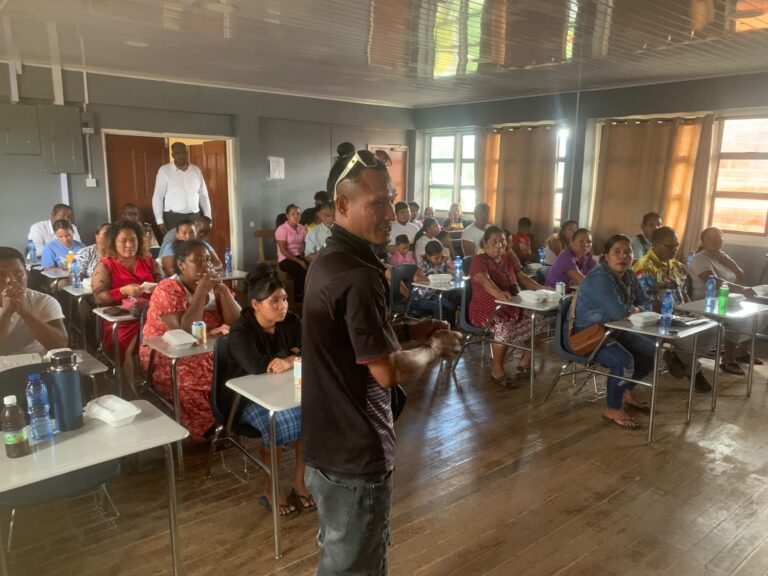
During community hearings on Monday addressing the disaster, relatives of those lost and individuals who barely escaped the river, voiced deep frustration over unfulfilled promises of financial assistance, systemic neglect, and the absence of sustained psychological counseling.

Community members gathered in the NAREI Compound, Kumaka to share harrowing accounts of survival, loss, and the heavy financial tolls exacted by the tragedy. For many families, the burden of traveling long distances to attend hearings and maintain memorials has drained limited resources, while official relief remains elusive. Survivors noted that despite public talk of extensive support packages, families have only received about $6,000 worth of goods and support thus far, leaving them largely to fend for themselves without adequate mental health counseling.

Barima victims still waiting for promised relief

Families speaking with the Commissioners at Kumaka.

Barima victims still waiting for promised relief

“Today is my son birthday…he same one that died… Today is his birthday and I come out here to go and paint his tomb,” shared one grieving father who traveled from the Barima River to honour his young child lost in the disaster. “So, I wish if you all could remind them about the promise, they must not keep it. Because what they’re saying, we hear from the news that millions, a hundred and something million, are all going out to support these people, survivors and losses of family. And no money is coming to you. We don’t know where the money is going. So, you have to remind them for me, sir… Because they’re not coming up the way they’re supposed to be.”

Residents criticised the sluggish rollout of support promised by entities such as the Heart Initiative and government bodies. Expressing the widespread anger felt across the region, resident Eva stated plainly, “The president is failing us.”

Speaking on behalf of affected households, resident Andrew Cox directly confronted the commission regarding the toll the ongoing procedures take on residents:

“The reason why I am raising concerns in the promises and requests and so, is because this is multiple times, you know, police coming to the region, or evening to the village, and would ask the same question over and over. And I think it is being watched. Because in the same question, people come in and ask over and over and over. And it is affecting some of the people as well. Because when they come and question the people, they feel like they are being pressured.”

Families speaking with the Commissioners at Kumaka.

Survivors offered vivid, harrowing recollections of the disaster, detailing a sequence of mechanical failures, extreme overloading, and safety hazards that preceded the vessel’s capsizing.

Passengers recounted that the MV Barima experienced multiple engine failures throughout the journey, stopping around 5:00 p.m. and again at 9:00 p.m. before tragedy struck near 10:00 p.m. Witnesses described a vessel packed heavily with cargo, gas bottles, barrels of fish, generator equipment, and big rollers riding precariously low in the water, with many passengers forced to set up hammocks in overcrowded spaces. Adding to the peril, life jackets were reportedly locked away inside a wooden cage-like structure. One survivor recounted attempting to take her daughter to the washroom downstairs prior to the capsizing, but turned back because water was already visibly pooling below, “I take my daughter for urinating at the washroom. I can’t go downstairs because I see water, and I can’t. I just come back and go outside. And my daughter was so frightened.”

Families speaking with the Commissioners at Kumaka.

Describing the total darkness and immediate panic as the ship went down in mere minutes, another survivor recalled “When my daughter jumped up in the water, she said, ‘Water, mommy, water.’ When we jumped up, a picture, we didn’t have no light, no way. So, the engine had cut off… And then suddenly, the boat came down… No light, no light. Let me jump up and pick up my babies in the dark… In the third black hole… The water cover everything inside.”

She recounted the testimony of a crew member who noticed the rising water level from below, “This boat was sink by water… He keep seeing how the water lodging up. He said, the water not coming off. Like, how it’s lashing and come off. The water just coming up from the bottom. Like he said, the water just coming up, he said. The water coming from the boat bottom, pulling up. So that when the water reach the engine and cut it off, he said, that caps over the boat.” Another survivor detailed the terrifying fight for life after being thrown into the open river, “When I got out of the boat, I saw the boat was totally torn, but when I got out of the water, the boat was completely submerged… We were there the whole time in the water… When we reached, it was quarter past five. They picked us up. Quarter past five. They picked us up from 10 o’clock. We had the whole night in the water. The whole night.”

Rosita Persaud, whose brother Leonardo was traveling to surprise their family, joined others in mourning loved ones lost to the deep waters. Commission representatives attending the hearings acknowledged the grievances, noting the profound fatigue and frustration felt across the communities.

Addressing the inquiries regarding timelines and State promises, COI Chairman Godfrey Smith stated “We are estimating six months. So sometime next year, that would be what? March. That’s what we’re aiming for. We want to work as fast, but as carefully as possible… We are not the government. As I explained earlier, we come from different countries to come and investigate this thing. But what we can do, what I, as the chairman can do, is to pass on a message to say, I came here, and all the people are saying they’re not getting the help that was promised. I can pass that on forcefully, and I will do that.”

Another commissioner emphasised the broader regulatory focus of the inquiry “Our mission is not solely to answer what happened, because what could happen again. So, our focus is a little broader than that… Getting the facts as to why this happened. But just as importantly, doing everything we can to ensure it never happens again anywhere in Guyana… That involves the rules for vessels on your waterways… Limits of how many people can travel on a vessel, and ensuring those limits are respected. Essentially, safety.”

As families continue to pick up the pieces, the demand from White Water, Mabaruma, Wauna, and surrounding communities remains clear, immediate financial relief, genuine psychological support, and accountability for the structural failures that led to the MV Barima catastrophe.


Source: Kaieteur News

Saudi capital’s airport to remain shut this week as airlines cancel services

0


(Reuters) – Authorities ​have extended the closure of Riyadh’s international airport until Saturday and airlines scrapped flights after continuing attacks by Yemen’s Iran-aligned emptied the skies over Saudi Arabia’s capital.

Operations at King Khalid International Airport, Saudi Arabia’s second-busiest airport after Jeddah, were suspended to “allow for the completion of procedures to ensure the safety and operational readiness of the airport’s facilities”, the Saudi civil aviation authority said in a statement.

A Notice to Airmen (NOTAM) issued later in ​the day showed that the airport will stay closed until 2100 GMT on October 17.

The airport has been shut since an ​attack on Saturday that killed 13 people and wounded more than 300, the deadliest in the kingdom in ⁠more than a decade. On Sunday, another attack killed one person and injured nearly a dozen others.

Saudi capital's airport to remain shut this week as airlines cancel services

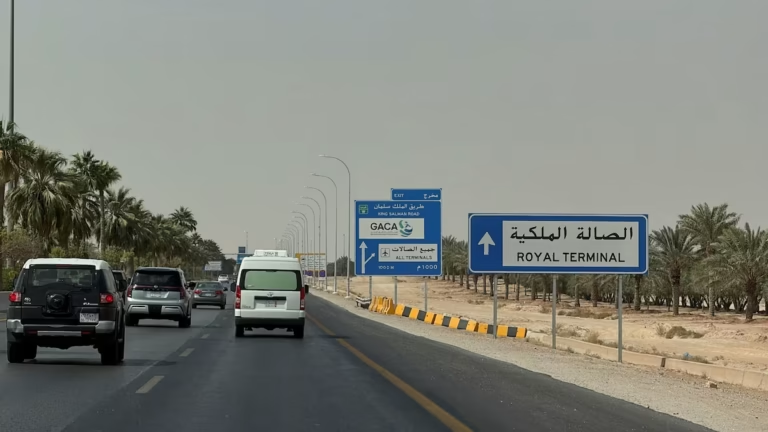
General view of the highway leading to the King Khalid International Airport in Riyadh, Saudi Arabia, October 12, 2026. Picture taken with a mobile phone. REUTERS

The attacks marked one of the ​most significant disruptions to Saudi aviation in years, adding to pressures on an industry already grappling with conflict across the Middle East and with ​higher jet fuel prices that are eating into profits.

They have also raised worries over civil aviation becoming a target in armed conflict.

CRISIS OVERSHADOWS ⁠SAUDI BUSINESS OUTLOOK

The disruption has forced airlines across Europe and Asia to suspend services, while the Federal Aviation Administration advised US carriers on Sunday to exercise caution when flying to or over Saudi Arabia. EU aviation body EASA widened a Saudi airspace warning on Friday, citing missile and drone attacks.

“The impact goes beyond Saudi Arabia to the wider region and to its global connections,” said aviation analyst John Strickland.

OPSGROUP advised airlines to avoid ​the southern aviation corridor over the ​Middle East altogether, and take ⁠a route from Europe to Asia over central Asia.

That adds “extensive distance” for some routes and “closes off options for getting into Dubai, Abu Dhabi for most western carriers,” Zee said.

Lufthansa Group (LHAG.DE), opens new tab has cancelled all flights to Riyadh ​until October 16, while Air France-KLM (AIRF.PA), opens new tab has extended a suspension to and from Riyadh until the end ​of the month. ⁠Abu Dhabi’s Etihad Airways also extended cancellations.

Delta Air Lines (DAL.N), opens new tab said it was delaying planned services from Atlanta to Riyadh, initially due to start on October 23, until March 2027.

The escalation with the Houthis has raised concerns over the broader economic impact. Saudi Arabia’s real GDP is projected to contract by 3.6% ⁠this year, ​reflecting a combination of factors including lower oil activity.

The attacks have put events scheduled ​in Riyadh this month under pressure, including the kingdom’s flagship investment conference and the WPC Energy Congress, where several top oil executives were dropped from the programme.


Source: Kaieteur News
Nearly 30% of Development Bank applications target agriculture – Pres Ali

0


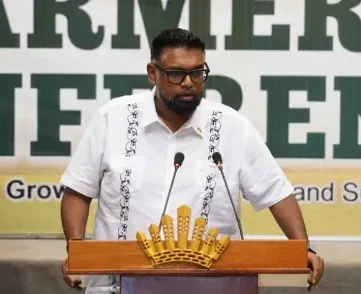
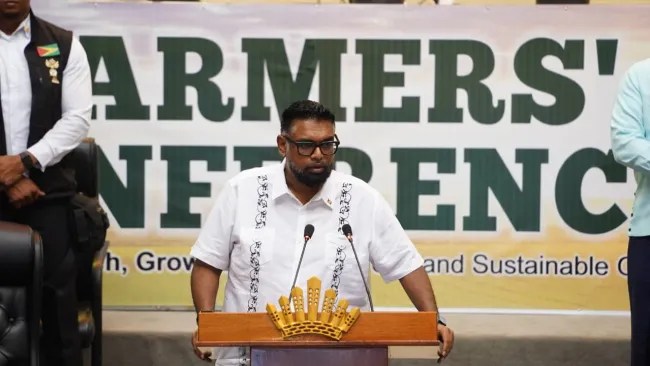
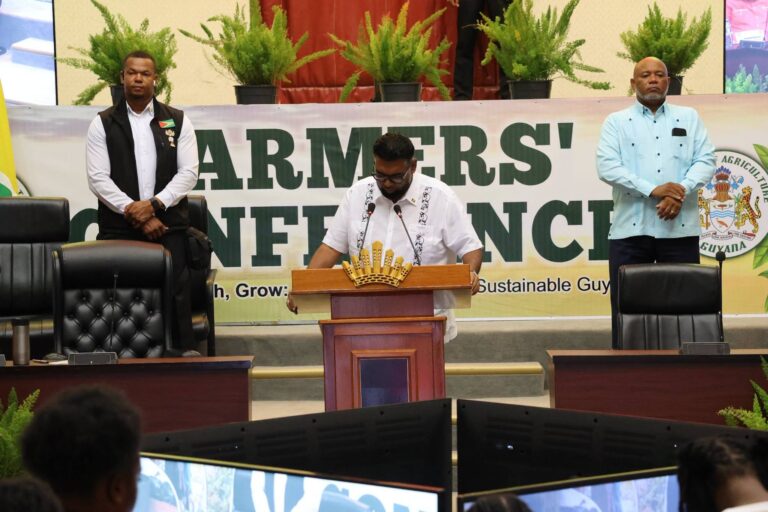
President Dr Irfaan Ali on Monday disclosed that nearly 30 per cent of applications submitted so far to the Guyana Development Bank since its launch last week are from the agriculture sector.

He made this disclosure at the opening of the Farmers’ Conference, held at the Arthur Chung Conference Centre, where he added that these applications reflect growing interest in the agriculture sector, which contributes six per cent of Guyana’s Gross Domestic Product (GDP) and accounts for one-fifth of the country’s non-oil GDP.

“Not only have we brought back production and instilled confidence in the system, but we are nurturing a new generation of young Guyanese who see a future in agriculture, who see a future in investing in agriculture. We have been able to build the consortiums of young people, now in poultry,” the President said.

He encouraged those present to listen to the stories of young agricultural entrepreneurs, noting that the growing interest in the sector indicates that the Government’s policy direction is generating renewed enthusiasm for agriculture.

“You should listen to their stories. And if there is one indication as to how the policy direction is leading to a new wave of excitement, a new wave in agriculture,” he said.

“It’s a fact that almost 30 per cent of all the applications so far in the Development Bank are in the agricultural sector. Almost 30 per cent are in the agricultural sector. That is productivity. That is in production. And once we have people interested in the production of goods, especially in the agricultural sector, then what the IMF report is saying about us today will continue to expand and continue to grow,” he added.

The Guyana Development Bank is now operational, marking the fulfilment of a key commitment to expand access to financing for entrepreneurs and small businesses across Guyana.

The new institution will provide up to G$3 million in zero-interest, zero-collateral financing, creating a new avenue for Guyanese seeking to establish or expand their businesses.

At the launch last week, President Ali highlighted that the bank is intended to address the financial barriers that have long prevented aspiring entrepreneurs, including young innovators, single mothers, farmers and skilled tradespeople, from accessing the resources needed to start or grow their enterprises.

This publication reported that with an initial capital of US$100 million, the State-backed financial institution offers loans of up to G$3 million to citizens and small and medium-sized enterprises (SMEs) across a wide range of sectors, without requiring collateral or charging interest.

Over the past few months, the Government has been ramping up its public education programme to sensitise citizens across the country about the financial institution. In addition to zero-interest and zero-collateral loans, the bank will also offer business support and mentorship services.

In a message marking the operationalisation of the bank, President Ali said its establishment fulfilled a commitment made in the People’s Progressive Party’s 2025 manifesto to create an inclusive financial system in which no citizen is left behind in the nation’s transformation.


Discover more from INews Guyana

Subscribe to get the latest posts sent to your email.


Source: INews Guyana