Home Blog Page 48

Man admits manslaughter after beating victim’s head against concrete foundation

0

A man who repeatedly struck another man’s head against a concrete foundation at Belle West, West Bank Demerara, in July 2016 has pleaded guilty to manslaughter and will be sentenced on November 5.

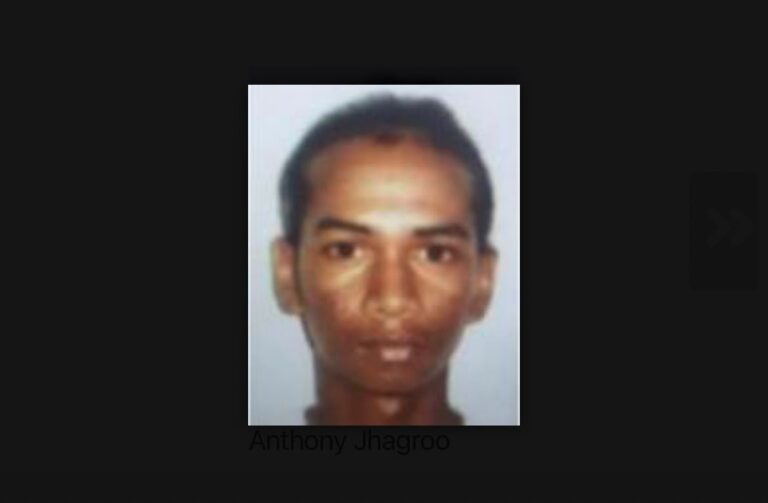
Anthony Jhaggroo, called “Sunny”, entered the plea before Justice Navindra Singh at the Georgetown High Court for the murder of Yugheshwar Shiwchand, known as “Shah Rukh Khan”, who died five days after the attack.

The court heard that on July 5, 2016, Shiwchand entered Jhaggroo’s yard at Belle West, Canal No. 2, naked and attempted to enter his home while asking for Jhaggroo’s mother and sister.

Between 9 pm and 10 pm, the men scuffled on the verandah. Jhaggroo pushed Shiwchand to the ground and chased him from the yard before going to Shiwchand’s home at 485 Belle West to complain about the incident.

Shiwchand subsequently returned, shirtless, and attempted to climb the stairs at Jhaggroo’s home. Jhaggroo punched him in the head, causing him to fall, then pulled him towards the concrete foundation and repeatedly struck his head against it.

Jhaggroo’s uncle, known as “Tall Man”, intervened and pulled him away.

Shiwchand was admitted to the West Demerara Regional Hospital, where he died on July 10, 2016.

A post-mortem examination performed by Dr Nehaul Singh on July 13 established that Shiwchand died from a subdural haematoma caused by blunt-force trauma to the head. Multiple blunt-force injuries were also found on his body.

In a written caution statement dated July 11, 2016, Jhaggroo admitted punching Shiwchand. He was arrested at Port Mourant, Corentyne, Berbice, on May 24, 2020.

State Counsel Praneta Seeraj, of the Office of the Director of Public Prosecutions, represented the prosecution, while attorney Mark Waldron represented Jhaggroo.


Source: Kiskadee Watch

Guyana may scale back LNG plans over gas availability — Reuters

0

Guyana may reduce its proposed liquefied natural gas export project as ExxonMobil needs more gas than anticipated to sustain offshore oil production, Reuters reported yesterday, citing two people close to the discussions.

The sources said the consortium requires approximately two billion cubic feet daily for reinjection. A proposed six-million-tonne annual LNG facility could consequently start at up to three million tonnes, while domestic-only use is also under consideration.

No final decision has been made. Natural Resources Minister Vickram Bharrat declined comment on the talks, while Exxon said it was working with government to maximise resource recovery and value.

The report introduces fresh uncertainty over Guyana’s plans to develop gas exports alongside domestic electricity generation and industrial activity.

Separately,  Guyana is poised to surpass 1M bbl/day in crude oil exports for the first time this December, when the country starts shipping its Uaru grade crude, Bloomberg reported.

Uaru exports reportedly are scheduled at 4M barrels in December, which would boost Guyana’s total monthly shipments to 33M barrels, equivalent to 1.06M bbl/day.

The first cargo of Uaru, produced by the Errea Wittu floating production vessel, is due to load on December 11-12, the report said, according to Reuters.


Source: Kiskadee Watch

Mother pleads guilty to murdering four-year-old daughter

0

Lucinda Stephen yesterday pleaded guilty to murdering her four-year-old daughter, Rianna Ambrose, who died after being repeatedly struck on the head with a piece of wood in March last year.

Stephen appeared before Justice Navindra Singh at the Georgetown High Court and is scheduled to be sentenced on November 23.

According to the statement of agreed facts, Stephen and her husband, Regan Ambrose, were consuming alcohol at approximately 7 pm on March 12, 2025.

An argument developed at about 12.45 am the following morning, after which Ambrose left their home and went to the residence of Stephen’s sister, Joyce Stephen.

At approximately 3 am, Joyce heard screams coming from the couple’s home and went to investigate. She saw Stephen holding a round piece of wood, approximately two and a half feet long, and striking Rianna on the head.

Joyce witnessed approximately five blows before the child collapsed.

Police subsequently visited the scene and seized the piece of wood. Rianna was taken to the Aishalton District Hospital, where she was pronounced dead on arrival. Her body was later transported to the Lethem Regional Hospital pending a post-mortem examination.

Stephen was arrested and held at the Aishalton Police Station. During a video- and audio-recorded interview, she admitted striking the child.

She initially said she had hit Rianna on the buttocks but later stated that she could not see exactly where she had struck her. When shown the piece of wood recovered from the scene, she acknowledged using it to hit the child.

Stephen later accompanied investigators to the scene and made further admissions, which were also video-recorded.

A post-mortem examination performed by Dr Nehaul Singh on March 18, 2025, established that Rianna died from cerebral haemorrhage caused by blunt trauma to the head.

State Counsel Praneta Seeraj, of the Office of the Director of Public Prosecutions, represented the prosecution, while attorney Meshonn Persaud represented Stephen.


Source: Kiskadee Watch

Hicken rescinds Karimbaksh leave letter amid challenge to his authority

0

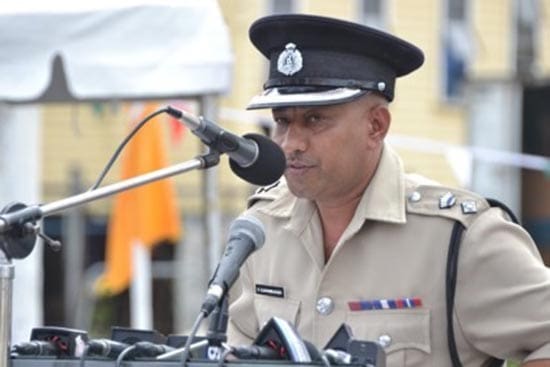
Commissioner of Police Clifton Hicken has withdrawn his October 7 letter granting Deputy Commissioner Fazil Karimbaksh leave prior to retirement, citing further consideration of the constitutional and legal powers governing the office.

The reversal is contained in an October 12 letter to Karimbaksh, Head of the Special Organised Crime Unit (SOCU). In separate correspondence bearing the same date, Karimbaksh’s attorney, Rizwaun Mohamed, protested an alleged instruction barring his client from his office and threatened urgent court proceedings.

The documents raise fresh questions about Karimbaksh’s status after the Guyana Police Force announced on October 8 that he had been sent on leave pending an investigation into allegations of rape and threatening behaviour made by a female police inspector. That announcement did not specify the type of leave, its commencement date or who would perform his duties.

In his latest letter, Hicken wrote: “I hereby rescind and withdraw my previous letter by which leave was granted to you with immediate effect.”

He said the decision followed further consideration of the constitutional and legal framework governing authority over the office of Deputy Commissioner, including the respective powers of the President, the Police Service Commission and the Commissioner of Police.

“Accordingly, the said letter shall cease to have effect, and any further action concerning the grant of leave shall be undertaken by the appropriate authority in accordance with the Constitution and applicable law,” Hicken stated.

The letter does not identify which authority would take further action or expressly address Karimbaksh’s access to his SOCU office. Nor does it explain how the withdrawal affects the force’s earlier announcement that he had been sent on leave pending the investigation.

In his October 12 correspondence, Mohamed said he had been instructed that Hicken directed a Senior Superintendent identified as Mr Singh to prevent Karimbaksh from entering his office that morning. According to the attorney, the instruction was conveyed to his client by telephone at approximately 8.40 am.

“My client protests this reported instruction in the strongest terms and disputes your authority to exclude him from the discharge of his duties on the basis presently disclosed,” Mohamed wrote.

The attorney argued that the alleged restriction went beyond the arrangements described in Hicken’s October 7 letter, which concerned 174 days of annualised vacation leave prior to retirement and stated that the leave should commence on November 8, 2026.

He said that letter did not purport to authorise Karimbaksh’s immediate exclusion from office on October 12. Both the leave calculation and the asserted authority to compel it remained disputed.

Mohamed further stated that no separate written decision placing his client on administrative leave, suspending him or defining the terms of his exclusion had been supplied. He said no applicable statutory provision authorising the measure had been furnished either.

“An instruction does not acquire legal validity merely because it emanates from the Commissioner or is implemented by a subordinate officer,” the attorney stated.

Citing the Police Act and Articles 211 and 212 of the Constitution, Mohamed argued that the Commissioner’s command powers must be exercised within the constitutional allocation of authority. He contended that any exclusion operating as a suspension or disciplinary measure required an established legal basis.

“The absence of a constituted Commission does not, without more, vest its powers in you,” he wrote, referring to the Police Service Commission.

The attorney requested a written response by 4 pm on October 12 confirming whether Hicken had issued or authorised the restriction, its precise terms and who was responsible for implementing it.

He also sought its withdrawal and restoration of Karimbaksh’s access to his office unless lawful authority and grounds for continuing the restriction were supplied. Further requests concerned the legal provision or written delegation relied upon, the duration and review of the measure, and its effect on his client’s duties, salary, allowances, benefits and accrued leave.

Mohamed said the correspondence constituted a formal request for reasons under the Judicial Review Act. He maintained that Karimbaksh remained available to perform his lawful duties and that compliance with any physical restriction would be under protest, rather than acceptance of compulsory leave or abandonment of duty.

He warned that urgent proceedings would be instituted if the exclusion continued without an established lawful foundation. The letter was copied to the Attorney General and Minister of Legal Affairs.

The latest correspondence follows an October 10 objection in which Mohamed challenged both Hicken’s authority and the calculation of Karimbaksh’s leave entitlement. As Kiskadee Watch previously reported, the lawyer said his client was scheduled to retire in April 2027 and that official records showed an entitlement of 118 days, rather than the 174 days cited by Hicken.

The leave dispute arose amid public demands for Karimbaksh to be removed from operational duties while the allegations against him were investigated.

Home Affairs Minister Oneidge Walrond had expressed support for administrative leave but referred to the absence of a constituted Police Service Commission and said she would discuss the matter with Hicken. Police subsequently announced that an investigative team had been established and that the complainant had been transferred to Regional Police Division Four ‘A’. Walrond said the transfer was made at the complainant’s request.

Red Thread’s Karen de Souza had also called for protection of the complainant and Karimbaksh’s removal from any position in which he could influence the investigation, while questioning the independence of the internal investigative arrangements.

Neither of the October 12 letters addresses the substance of the allegations. Hicken’s withdrawal letter also gives no update on the investigation or expressly confirms whether Karimbaksh is to resume his duties.


Source: Kiskadee Watch

GTUC urges continued fight for justice in tribute to Kwayana

0

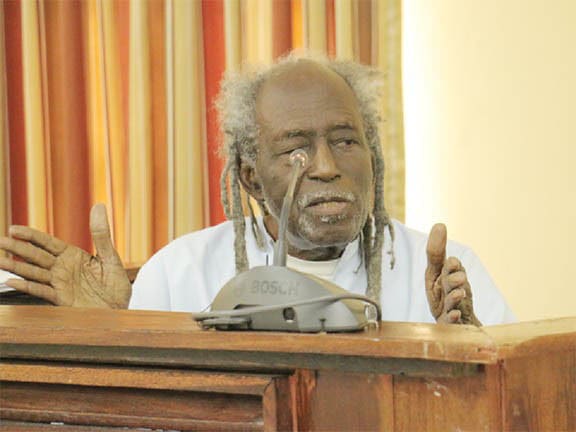
The Guyana Trades Union Congress (GTUC) today urged Guyanese to honour Eusi Kwayana by continuing his struggles for workers’ rights, democratic freedoms and racial inclusion, saying his death must not leave his causes unattended.

In a statement mourning the veteran political activist, who died on Saturday at the age of 101, the GTUC described his life as one of resistance, sacrifice and an unrelenting pursuit of a just, inclusive and united Guyana.

“His passing leaves a profound void, but it must not leave his causes unattended. The GTUC calls on Guyanese to honour Kwayana not simply with tributes, but by continuing the struggle to which he devoted his life,” the congress said.

Kwayana, formerly Sydney King and widely known as the “Sage of Buxton”, was active in public life for more than eight decades. He celebrated his 100th birthday in Buxton last year with a call for a one-day fast for justice, continuing the advocacy that had defined his political life.

The GTUC said Kwayana was among the defining figures in Guyana’s transition from colonial rule to independence and remained committed to challenging injustice and demanding accountability.

It identified him as the last surviving member of the group elected in 1953 under the constitutional arrangements arising from the Waddington Commission, which introduced universal adult suffrage.

The congress linked that democratic advance to the trade union movement’s earlier campaign for voting rights, noting that universal adult suffrage had been a central demand in 1926. It said the struggle gained further momentum with the formation of the People’s Progressive Party in 1950.

“Their sacrifices remind us that the democratic rights and freedoms we inherit were neither gifts nor accidents; they were won through organised struggle, courage and determination,” the GTUC stated.

Kwayana’s political career encompassed service in the original PPP, the PNC and the Working People’s Alliance (WPA). He was a member of the 1953 PPP government and later served as PNC General Secretary and editor of its newspaper, New Nation. He co-founded the WPA in 1974 and served it as an executive member, parliamentarian and de facto editor of its publications, Open Word and Dayclean, according to the party’s tribute carried by Kiskadee Watch.

The GTUC pointed to Kwayana’s hunger strike, petitions and persistent protests as evidence of his commitment to principle. It said he refused to remain silent when he believed Guyana was falling short of its promise.

His advocacy for racial inclusion, the congress added, challenged the country to overcome division and ensure that no citizen was denied a voice or excluded from opportunities.

The congress said continuing his work required the defence of workers’ rights and democratic freedoms, demands for accountability and action against racial division. It also called for development that benefits all Guyanese.

“It means insisting that Guyana’s development benefits all its people and that independence is measured not merely by who governs, but by the justice, dignity and equality enjoyed by every citizen,” it said.

The tribute follows those from the WPA and PNCR/APNU. In its statement reported by Kiskadee Watch, the PNCR/APNU recalled Kwayana’s service as a politician, teacher and historian, and his work in preserving the country’s history for future generations.

The GTUC extended condolences to his family, friends and comrades, saying the national motto, “One People, One Nation, One Destiny”, must become a collective undertaking.

“The responsibility now rests with us to pick up where he left off and continue to fight the good fight,” it said.


Source: Kiskadee Watch

Care grants to support child, elder services; applicants must have suitable premises

0

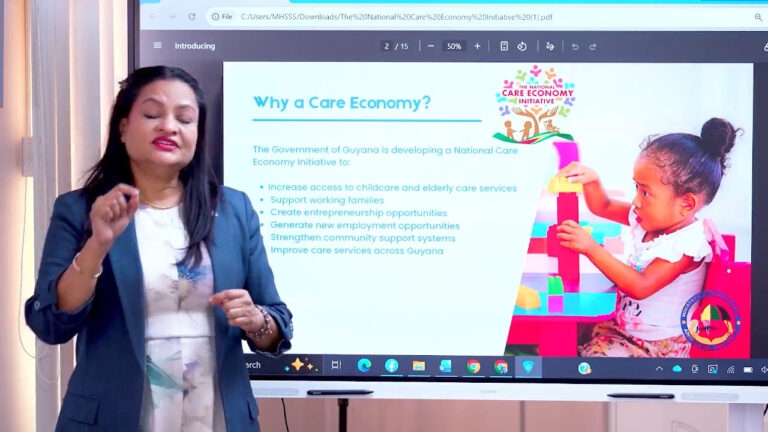
Persons seeking support under the government’s $1.2 billion National Care Economy Co-Invest Initiative must have access to suitable existing premises, Minister of Human Services and Social Security Dr Vindhya Persaud has said, explaining that the programme will fund improvements and equipment but not new buildings or property purchases.

In a video posted on the ministry’s Facebook page, Persaud outlined the requirements for individuals, community groups, religious organisations and businesses interested in providing childcare or non-medical services for elderly persons.

She said the government’s investment would extend over two years and was intended to expand access to affordable care while creating employment and business opportunities.

The assistance would take the form of grants rather than loans, she stated. However, expressing interest would not automatically secure funding.

“Not because you apply, it means you automatically get through,” Persaud said, explaining that officers would assess proposed premises and discuss applicants’ plans before an application package was provided.

Applications would be considered against the programme’s eligibility requirements, the applicant’s readiness and available resources.

The initiative will support home-based and community childcare, facilities operated by employers, and services established by non-governmental and faith-based organisations. Elder care options include community centres, home visits and meal-delivery services.

Persaud encouraged interested persons to form groups, bringing together those with relevant training and a willingness to provide care.

Applicants must have an enclosed space in a safe location and the legal right to use it, whether through ownership or an arrangement with the owner. Suitable premises could include an unused room, a separate building, a community centre, village hall or religious facility.

“We’re not building anything. We are not enclosing an open space. We are not building on an empty land,” the minister said.

Assistance could cover washroom facilities, painting and some doors and windows, but would not extend to substantial construction such as walls or roofing. Furniture, equipment, learning materials, training, certification and registration would also be supported.

Persaud said police clearance was important for caregivers, while both the premises and surrounding environment would be assessed for safety. She cautioned against locating facilities next to alcohol outlets or places where children could be exposed to unsafe behaviour.

Lack of training would not prevent persons from expressing interest, she said, as free childcare and elder care courses were available. Applicants were encouraged to begin training while pursuing their business proposals.

The training would include health and safety, child protection, safeguarding, first aid and entrepreneurship, with online instruction and practical components.

The minister stressed that elderly care under the initiative would be non-medical. Services could include companionship, supervision, assistance with mobility and recreational activities, as well as visits to ensure that seniors were not left unattended.

“This is not about medical care, giving injections and IVs and all of that. This is social support,” she said.

Meal-delivery services could also be developed for seniors, with food suited to their health needs. Childcare operators would not be required under the programme to prepare meals but would need safe arrangements for storing food brought for children.

Persaud also encouraged employers to establish care facilities on their premises or contract providers to serve their employees. She referred to corporation tax relief for companies investing in care.

Stabroek News reported during the February budget debate that Persaud had highlighted the removal of corporate tax for companies offering childcare as part of the government’s care economy programme. She also pointed then to the expansion of the Women’s Innovation and Investment Network (WIIN), which she said had trained 21,000 women.

The programme had attracted approximately 780 individual and group registrations by July, according to a ministry report. At that stage, Persaud said 459 persons were being trained to offer home-based and community care in Regions Two, Three, Four, Five, Six, Seven and Nine. Those figures relate to July rather than the latest video.

During the Facebook presentation, a programme representative acknowledged complaints from persons who had registered but had not received responses. She attributed the delays to the volume of applications and said officers were still processing submissions.

Persons awaiting contact were advised to send their telephone numbers through the ministry’s Facebook Messenger. Those seeking assistance with WIIN training were directed to WhatsApp number 618-0612.


Source: Kiskadee Watch
GGMC says no material deviations found in 2023–2024 licence awards, transfers

0

The Guyana Geology and Mines Commission (GGMC) says its review of the award and transfer of mineral and petroleum licences during 2023 and 2024 found no material departures from the applicable legal and regulatory requirements.

In an October 6 statement published on its website, the commission said it examined legislation, regulations, documented procedures and supporting records. It did not identify the individual licences reviewed, the number of transactions examined or the persons who conducted the assessment.

For mineral licences, the review included six documented application and transfer processes for medium- and large-scale properties within its ISO 9001-certified quality management system. GGMC said that system was audited and recertified in 2023.

The commission reported finding “no material deviations” in the award and transfer of mineral licences at the small, medium and large scales.

Petroleum licensing falls outside those certified processes, GGMC noted, and was assessed separately against the relevant petroleum legislation, regulations and administrative requirements. It reported the same conclusion for those transactions.

The statement did not explain what prompted the exercise or provide a detailed review report.

Its publication follows earlier recommendations for closer examination of mining licences and stronger participation by extractive companies in Guyana’s transparency reporting.

Stabroek News reported on January 1 that the 2023 Guyana Extractive Industries Transparency Initiative (GYEITI) report found limited progress in implementing recommendations from previous years. Participation by mining companies remained inadequate, with only 38% of mining-sector receipts reported by government subjected to reconciliation.

The report also drew attention to mining entities holding multiple licences and permits which, taken together, represented substantial operations. It recommended that GGMC conduct and document a review to determine whether those activities were appropriately licensed and managed.

It further recommended changes to licensing regulations to require participation in EITI reporting when requested by the Multi-Stakeholder Group.

In his January 19 Accountability Watch column in Stabroek News, Anand Goolsarran outlined additional recommendations from the 2023 report, including consideration of limits on the number of small- and medium-scale licences held by a single miner or entity, so that these did not accumulate into the equivalent of a large-scale holding.

The recommendations also called for GGMC to examine prospecting permits and licences for compliance with legislation and their conditions, and determine whether further activity was permissible in areas without a valid licence or permit.

Those recommendations concerned the classification, management and continued validity of mining operations. GGMC’s October statement addresses the processes for awarding and transferring licences and does not say whether the broader recommendations have been implemented.

The commission has also not stated whether the findings will be accompanied by publication of the underlying assessment or a schedule of the transactions examined.


Source: Kiskadee Watch

Urgent need to address challenges affecting our public spaces

0

Dear Editor,

As a public analyst and community advocate, I am increasingly concerned about the cultural impact of negligence and the behavioural patterns of citizens and visitors who use our public and private spaces. There appears to be a growing perception that, because sanitation workers and maintenance personnel are employed to keep our surroundings clean, individuals can dispose of unwanted items wherever they please without considering the consequences.

This attitude is unacceptable and undermines our collective responsibility to maintain a clean, safe, and healthy environment. The situation is becoming increasingly disturbing, particularly when reports emerge of a baby being found in a garbage bin a few weeks ago. Such incidents remind us of the importance of public awareness, social responsibility, and the protection of human life and dignity.

I have also personally witnessed individuals experiencing homelessness defecating in a drain opposite a food canteen and supermarket, while another individual was observed bathing naked in an open drain in front of a popular hotel. These observations are not intended to sensationalise human suffering or make readers uncomfortable, but rather to highlight the urgent need for greater public sensitisation and effective solutions to the challenges affecting our public spaces.

As Guyana continues to develop its tourism industry and strengthen its international reputation, greater attention must be given to public health, environmental sanitation, and the overall quality of our surroundings. Cleanliness is not merely an aesthetic concern; it is essential to public safety, environmental protection, community well-being, and the experience of visitors who come to explore our country.

Government agencies and organisations, including the Environmental Protection Agency (EPA), have important roles to play in promoting environmental responsibility and enforcing relevant regulations. However, their efforts must be supported by citizens, businesses, property owners, and visitors. We must recognise that keeping Guyana clean requires cooperation, responsible waste disposal, and respect for shared spaces.

At the same time, individuals experiencing homelessness and other forms of vulnerability must not be overlooked. Access to appropriate sanitation facilities, social support, and humane intervention should form part of a comprehensive response. Addressing these social challenges alongside public education and responsible waste management will help us create cleaner, safer, and more dignified communities.

Every citizen has a role to play in maintaining clean homes, businesses, neighbourhoods, and public spaces. We must work together to uphold appropriate sanitation standards, protect our natural environment, and mitigate the effects of climate change. National development requires more than infrastructure and economic growth; it also requires a culture of civic responsibility and respect for the environment we share.

Ultimately, a cleaner Guyana requires more than people employed to clean; it requires a population willing to take responsibility for keeping it clean. Let us work hand in hand with the relevant authorities to safeguard public health, protect our environment, and preserve our country’s image as a welcoming destination for residents and visitors alike. We are all part of this effort, and our collective actions will determine the Guyana we leave for future generations.

Sincerely,

Mr Blane R Bunbury 

Public Communications Analyst 

& community advocate 


Source: Kiskadee Watch

Education Ministry launches upgraded EDPAL+ app, media training programme

0

The Ministry of Education on Monday launched an upgraded version of its EDPAL+ application, offering free educational audio content with offline downloads and improved performance on weak internet connections.

The ministry’s Distance Education Unit also launched a Media Mentorship Programme, with practical training sessions beginning today at its Battery Road, Kingston office and studio.

According to a ministry release, EDPAL+ provides advert-free access to lessons, courses, audiobooks and stories. Its offline features and adjustments for weak connections are intended to support learners in coastal, rural and hinterland communities.

The updated application includes a redesigned home screen, simplified searches and a “Continue Learning” shortcut. It also incorporates an EdYou FM broadcast feed and a personalised “For You” section which uses listening habits to recommend relevant curriculum content.

Chief Planning Officer Mischka White-Griffith, speaking on behalf of Education Minister Sonia Parag, who was travelling, said digital tools were central to improving access to education.

“How far should a child go to access education? My answer is it should be a double click away,” White-Griffith said.

“EDPAL+ makes learning available 24/7, 365 days a year. Parents can now trust their children on a device because there is a platform that is safe and directly related to what they are learning at school.”

The accompanying mentorship programme will provide selected participants with hands-on instruction from Distance Education Unit professionals in photography, videography, pre-production, video editing, audio production and content development.

Sessions will run from October 13 to October 23. The release did not state how many persons were selected or outline the selection process.

Distance Education Unit Director Phillip Williams said the initiatives reflected the unit’s commitment to widening access.

“We operate on the philosophy that your physical address should not determine your access to educational resources,” Williams stated.

“EDPAL+ is a cornerstone of the Ministry of Education’s digital transformation in Guyana, representing our commitment to making learning more accessible and responsive to the public.”


Source: Kiskadee Watch

More action needed on the mental health front

0

Last Saturday, October 10, was World Mental Health Day and, on its website, the World Health Organisation offered the theme “Lived Experiences Heard: Real Voices, Real Change”; aspirational, but not often translated into action. People whose experiences should help inform policies, services and decisions tend to be treated as recipients of care rather than participants who can identify shortcomings in the system, challenge stigma and ensure that services respond to actual needs. Those who do speak up risk being labelled as problematic or having their diagnoses used against them.

Another problem is that designated observances have, for the most part, been losing their impact. There are the usual calls to break the stigma, encourage people to seek help and remind those who are struggling that they are not alone. And while these are important messages, they are not enough. There is a need to take a deeper look at the social conditions, cultural changes and institutional failures that contribute to psychological distress.

In a recent interview with Kiskadee Watch, clinical and educational psychologist Wil Campbell spoke of the pressures confronting children, the diminishing involvement of parents in their lives, the demands placed on teachers and the weakening of community relationships. These are issues that have been raised before, but they bear reiterating, particularly as they have implications for the mental well-being of both children and adults.

He referenced the National Grade Six Assessment and Caribbean Secondary Education Certificate examinations; academic milestones around which family routines and children’s lives are organised. In fact, the pressure to secure places at prestigious schools or accumulate impressive numbers of passes has taken the form of a millstone. So much so that children’s mental well-being can be compromised in the pursuit of academic success.

This is a sad state of affairs because while academic achievement matters, it is not the only measure of a child’s potential or worth. When children are sacrificed at the altar of examination results, we risk producing adults who are academically accomplished on paper, but insufficiently equipped to cope with the complexities of life. Play, social interaction and the opportunity to develop relationships are not distractions from a child’s education. They are essential to the development of resilience, emotional maturity and the ability to navigate challenges. Yet these are often the very things sacrificed to make room for extra lessons, homework and intensive preparation for examinations.

If data from the past decade were collected as research, the recommendation would be for parents, educators and those in authority to reconsider what constitutes success. This is not to suggest that children should be discouraged from striving for excellence, but achieving that accomplishment should not be narrowed down to examination results at the expense of other aspects of their development. A society that is concerned about the mental health of its young people must be willing to question the expectations it places on them.

Mr Campbell also raised concerns about children’s burgeoning dependence on electronic devices. He noted that these cannot replace meaningful engagement or the emotional support that comes from face-to-face interaction. It is also well known that the erosion of community ties has weakened the informal networks through which families once received practical assistance. The ‘villages’ that helped raise the current generation are disappearing as individualism and the pursuit of material possessions take precedence. The resulting isolation is a cause for concern, particularly since meaningful social connections are essential to mental well-being.

Referring to research he and a colleague conducted two years ago, Mr Campbell told this newspaper that more than 40 percent of the local teachers studied were experiencing burnout. These are the people who are expected to educate, discipline, motivate and provide emotional support to children, often while working with limited resources and insufficient recognition. Can their own well-being really be treated as an afterthought when the quality of education depends so heavily on them?

It stands to reason that mental health initiatives must move beyond platitudes and into schools, workplaces, families and communities. Teachers need adequate resources, practical support and opportunities to protect their own mental health. Parents need guidance on responding to the pressures confronting children. Schools, indeed, the entire education administration should examine whether the current expectations and workloads allow children sufficient time for rest, play and social development.

At the national level, there has been some expansion and decentralisation of mental health services and this is welcome, along with the growing willingness to discuss mental illnesses and normalise treatment. However, more comprehensive and preemptive measures are necessary now to address, where pertinent, the underlying causes of psychological distress. Common sense and history both tell us that it would be better to confront contributory factors at the source, rather than wait until a crisis forces intervention.

Suicide prevention is a case in point. Efforts must be sustained and broadened to ensure that it is not reduced to annual awareness campaigns and emergency responses to self-harm. This would include, but not be limited to, addressing the circumstances that leave people feeling overwhelmed or without options and making support readily accessible, necessitating coordination among health professionals, educators, social services, families and communities.

Suffice to say that the real measure of commitment to this cause will not be the speeches, campaigns or annual observances, but whether we can build a society in which people are less likely to be pushed into crisis and where they can readily access support when they need it. In short, beyond preaching resilience, the government through its agencies must demonstrate its commitment through sustained action and ensure that those responsible are held accountable.


Source: Kiskadee Watch