Home Blog Page 46

US-sanctioned LOO among 3 arrested after gunfire at home of key extradition witness

0

…illegal gun, spent shell found in tinted car carrying Azruddin Mohamed – Police

The United States (US)-sanctioned and indicated Opposition Leader Azruddin Mohamed was among three men arrested after a shooting incident at the residence of Senior Superintendent of Police Prem Narine, Head of the Guyana Police Force’s (GPF) Special Branch Unit, at Barr Street, Kitty, Georgetown, on Monday night. Narine is a key witness in ongoing extradition proceedings involving Mohamed and his father, Nazar Mohamed.
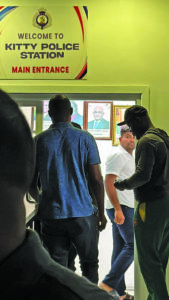
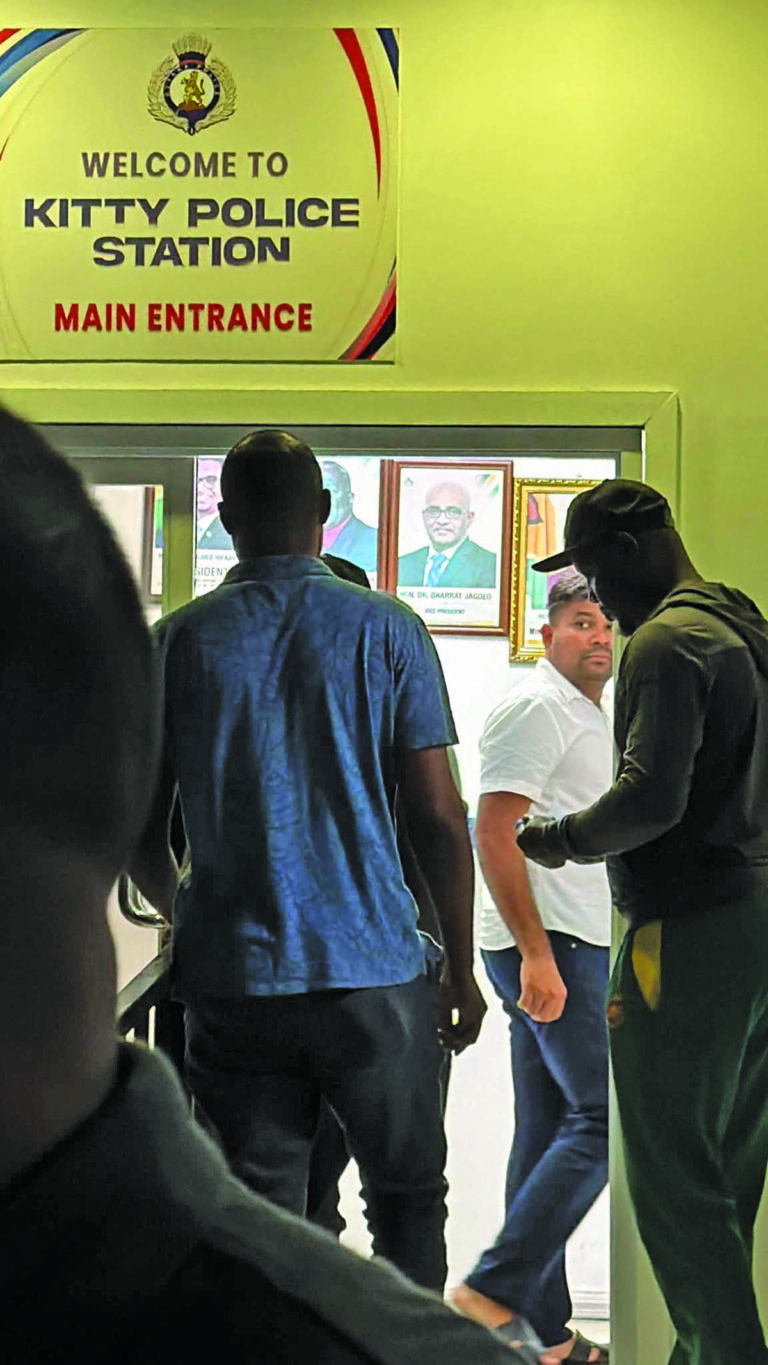
US-sanctioned and indicated Azruddin Mohamed at the Kitty Police Station following the shooting

Police said on Tuesday that they are investigating the discharge of a loaded firearm with intent and the possession of a firearm and ammunition without a licence following the incident, which occurred at about 23:45h on October 12.
According to preliminary investigations, Narine was at home when he observed a black Toyota Allion motor car, registration number PXX 5300, travelling slowly along Barr Street, Kitty. The vehicle passed his residence before returning to the area a short while later.
Police said that as the car approached his residence on the second occasion, Narine heard what appeared to be a gunshot. He took cover and discharged several rounds from his service firearm in the direction of the vehicle, which subsequently drove away.
The car was later intercepted at the junction of Vlissengen Road and Sandy Babb Street, Kitty.
The occupants were identified as Azruddin Mohamed, 39, of Houston, East Bank Demerara; Mario Mohamed, 25, of Timehri, East Bank Demerara; and Eugene Thorne, 35, a driver, also of Timehri.
The three men were arrested and taken to the Kitty Police Station.
Police said that a search of the vehicle, conducted in their presence, led to the discovery of a .32 Taurus pistol without a serial number and three live rounds of .32 ammunition. The men were subsequently arrested.
Police also recovered one .32 spent shell on the southern side of Barr Street, obliquely opposite Narine’s residence, and four spent 9mm shells.
The firearm, ammunition, and spent shells were lodged, pending ballistic examination. Investigators said that they are also reviewing CCTV footage from the area as they continue their probe.
The three men remain in Police custody.

Magistrate’s warning
The incident comes against the backdrop of ongoing extradition proceedings involving Mohamed and his father, Nazar Mohamed, in which Narine has been a witness.
On September 30, Guyana Times reported that Chief Magistrate Judy Latchman had warned those involved in the proceedings against drawing children and spouses into social media exchanges surrounding the case.
The warning followed testimony from Narine, who told the court that a photograph featuring him, President Dr Irfaan Ali, his wife, and his 11-year-old son had been circulated on social media with what he described as a derogatory comment.
Narine said he believed the publication was intended to intimidate him because of his testimony, and expressed particular concern that his son’s face was visible in the photograph.
The post was made from the “Hana Khamelia” Facebook account, which has been publicly associated with Hana Mohamed, the sister of Azruddin Mohamed and daughter of Nazar Mohamed. A similar post was subsequently shared on a Facebook page bearing the name “Azruddin Mohamed, Leader of the Opposition – Guyana”.
Defence Attorney Siand Dhurjon told the court that he had no knowledge of the publication and said it would be unfortunate for children or spouses to become involved in the political fray.
The Magistrate had previously warned Hana Mohamed against making social media posts concerning the extradition case after Narine and prosecutor Glenn Hanoman raised concerns about material published from the same account.

Narine’s testimony
Narine’s role in the extradition proceedings has also been examined during cross-examination by the defence.
During the extradition proceedings, Narine testified that, based on information available to him, he considered Opposition Leader Azruddin Mohamed a threat to society and national security.
Narine made the assessment during cross-examination in September, while rejecting suggestions by defence counsel that his involvement in the extradition case was politically motivated. He also denied receiving instructions from President Dr Irfaan Ali to ensure the arrests of Mohamed and his father, Nazar Mohamed, in October 2025.
The US is seeking the extradition of Azruddin Mohamed and his father over allegations including wire and mail fraud, money laundering, conspiracy, and customs violations linked to an alleged US$50 million gold export and tax-evasion scheme.
They were each granted $150,000 bail pending the outcome of the extradition proceedings and were ordered to surrender their passports and report to the Ruimveldt Police Station as directed by the court.


Discover more from Guyana Times

Subscribe to get the latest posts sent to your email.


Source: Guyana Times

Gunfire incident at home of key extradition witness: Guyana must never become a country where witnesses fear to speak – Minister

0

Culture, Youth and Sport Minister Charles Ramson, who is an attorney-at-law, has warned that Guyana must never become a country where witnesses are afraid to speak, as he called for the protection of the justice system amid concerns surrounding a gunfire incident at the home of a senior Police Officer involved in ongoing extradition proceedings against United States (US)-sanctioned and indicted Opposition Leader Azruddin Mohamed and his father, Nazar Mohamed.
In a statement posted on his social media page, Ramson said no amount of wealth or influence should be allowed to undermine the country’s institutions or compromise the administration of justice.

Culture, Youth and Sport Minister Charles Ramson, who is an Attorney-at-Law

His comments follow Monday night’s incident at the Barr Street, Kitty, Georgetown, residence of Senior Superintendent of Police Prem Narine, Head of the Guyana Police Force’s Special Branch Unit, who is a key witness in the extradition proceedings.
Mohamed was among three men arrested following the incident, which is being investigated by Police as the discharge of a loaded firearm with intent and the possession of a firearm and ammunition without a licence.
Ramson said the circumstances surrounding the incident raised serious concerns about the safety of witnesses participating in criminal proceedings.
According to preliminary Police investigations, Narine was at home at about 23:45h on October 12 when he observed a black Toyota Allion, registration number PXX 5300, travelling slowly along Barr Street. The vehicle reportedly passed his residence before returning to the area a short while later.
Police said that as the car approached the residence for a second time, Narine heard what appeared to be a gunshot. He took cover and discharged several rounds from his service firearm in the direction of the vehicle, which subsequently drove away.
The vehicle was later intercepted at the junction of Vlissengen Road and Sandy Babb Street, Kitty.
The occupants were identified as Azruddin Mohamed, 39, of Houston, East Bank Demerara; Mario Mohamed, 25, of Timehri, East Bank Demerara; and Eugene Thorne, 35, a driver, also of Timehri.
A search of the vehicle reportedly led to the discovery of a .32 Taurus pistol without a serial number and three live rounds of .32 ammunition. Police also recovered a .32 spent shell on the southern side of Barr Street, opposite Narine’s residence, and four spent 9mm shells.
The firearm, ammunition and spent shells were lodged for ballistic examination, while investigators are reviewing CCTV footage. The three men remain in Police custody.

Surveillance, intimidation
Ramson said no witness, particularly a Police Officer, should have to fear that their home, family or personal safety would be targeted because of their participation in criminal proceedings.
He also raised concerns about social media posts involving members of Narine’s family, including his minor children, saying the circumstances went beyond defending oneself in court or responding to allegations in the public domain.
“Where the circumstances suggest surveillance, intimidation or interference with a witness, the matter demands serious action from the relevant authorities/institutions,” Ramson stated.
The issue of social media posts involving Narine’s family had previously been raised in court. On September 30, Guyana Times reported that Chief Magistrate Judy Latchman had warned persons involved in the extradition proceedings against drawing children and spouses into social media exchanges surrounding the case.
The warning followed testimony from Narine, who told the court that a photograph featuring him, President Dr Irfaan Ali, the President’s wife. and Narine’s 11-year-old son had been circulated on social media with what he described as a derogatory comment.
Narine said he believed the publication was intended to intimidate him because of his testimony and expressed concern that his son’s face was visible in the photograph.
The post was made from the “Hana Khamelia” Facebook account, which has been publicly associated with Hana Mohamed, the sister of Azruddin Mohamed and daughter of Nazar Mohamed. Similar material was subsequently shared on a Facebook page bearing the name “Azruddin Mohamed, Leader of the Opposition – Guyana”.
Defence Attorney Siand Dhurjon told the court that he had no knowledge of the publication and said it would be unfortunate for children or spouses to become involved in the political fray.

Threat to society
During cross-examination in the extradition proceedings, Narine also testified that, based on information available to him, he considered Azruddin Mohamed a threat to society and national security. He rejected suggestions that his involvement in the case was politically motivated and denied receiving instructions from President Ali to ensure the arrests of Mohamed and his father in October 2025.
The United States is seeking the extradition of the father and son over allegations including wire and mail fraud, money laundering, conspiracy and customs violations linked to an alleged US$50 million gold export and tax-evasion scheme. Both men have been granted $150,000 bail pending the outcome of the extradition proceedings, subject to conditions including surrendering their passports and reporting to the Ruimveldt Police Station as directed by the court.

Damage to the justice system
Ramson warned that witness intimidation could damage the justice system even when it did not result in physical violence, as it could discourage witnesses from cooperating with authorities or deter others from coming forward.
“The protection of witnesses is not optional. It is fundamental to the administration of justice,” he said.
He added that public institutions must uphold the law, safeguard citizens and ensure that justice is administered fairly and independently.
“Guyana must never become a country where witnesses are afraid to speak, where wealth or influence creates a sense of impunity, or where the administration of justice can be undermined by intimidation,” Ramson stated.


Discover more from Guyana Times

Subscribe to get the latest posts sent to your email.


Source: Guyana Times

Potential US investments in Guyana hindered by energy, tax, land challenges – Ambassador

0

…as local firms urged to invest in standards to tap into global markets

While American companies have expressed significant interests in investing in Guyana, they are often hindered by issues such as energy costs, onerous tax regimes, and inaccessibility to land, United States Ambassador Nicole Theriot had said.

United States Ambassador Nicole Theriot

She made the remarks on Tuesday during a panel discussion hosted by the Guyana Manufacturing and Services Association (GMSA) at its annual business luncheon.
Ambassador Theriot explained that US firms were eager to tap into sectors in Guyana including agro-processing, agri technology, infrastructure, health care, and housing, but many are obstructed from moving forward with their ideas owing to several local realities.
“I have talked in the last month and a half with US companies who are interested in all of these sectors, so why aren’t there more here already?
“What companies tell me, time and time again, is that they struggle to find local partners who can deliver at scale. They also face potential hurdles like logistics, energy costs, an onerous and unpredictable tax regime and access to land and skilled workers,” the Ambassador noted.
Similar reasons exist for why US companies already operating here continue to import most of their goods and services, the diplomat added.
According to Ambassador Theriot, oftentimes when a US company passes over a local supplier, it is because of the firm’s inability to meet certain specifications, deliver the same quality consistently, and scale up when required.
“What international buyers want is the right product, at the right quality, delivered on time, consistently, and that requires strong quality control, safety practices and management, and a system that demonstrates you can meet international standards. These are the things that turn a local supplier into a global one,” she said.

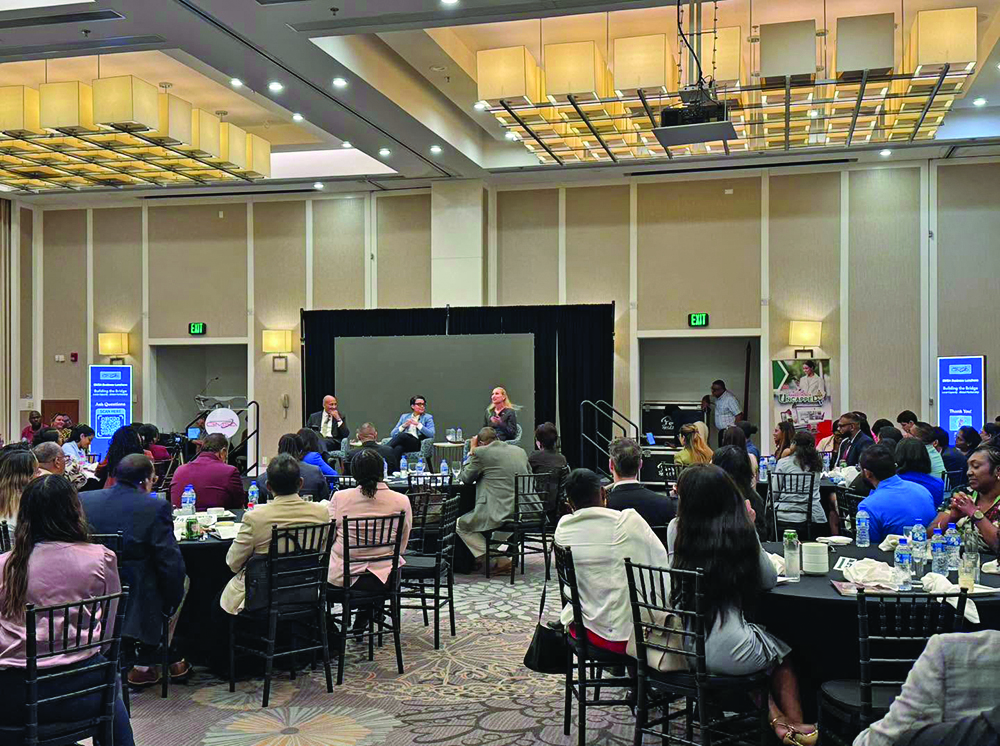
A section of the gathering at the Guyana Manufacturing and Services Association (GMSA) Business Luncheon, held under the theme, “Building the Bridge: Local Capacity, Global Partnership”

Nonetheless, she acknowledged that there are local companies that have been able to deliver on the necessary requirements to guarantee successful partnerships and tap into global markets.
“When it’s done right, that kind of partnership delivers much more than foreign capital – capital matters, of course, but if we want long-term economic transformation, what matters most is what capital creates: stronger Guyanese companies, better trained workers, new technology, internationally-recognised standards and Guyanese products that are competitive in the global market,” she emphasised.
According to the envoy, stakeholders should move past the question of “how do we do business with the US” towards a more ambitious question, “how do we work together to build Guyanese companies that the United States and the rest of the world want to do business with?”
The objective, she noted, is to make more Guyanese businesses ready for investment and export.

Investing in standards
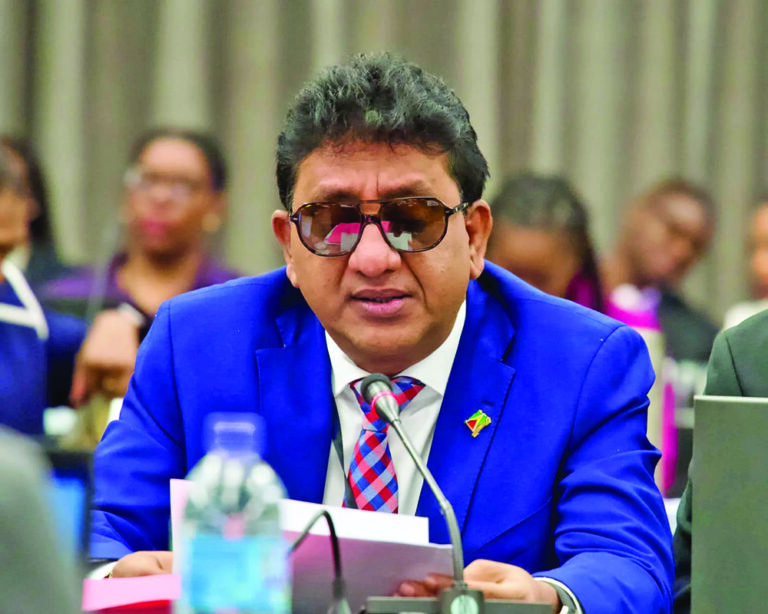
Also speaking on the panel was Tourism, Industry and Commerce Minister Susan Rodrigues, who emphasised the importance of getting local companies ready for the global market.
In this regard, she underscored the importance of businesses investing in standards and certifications.
“I would like to encourage small business owners, business owners in general, to view standards and certification as an investment in your business and not another compliance requirement. Certification and standards, incorporating quality standards in your business is an investment in your business, it’s not about fulfilling a compliance requirement from the Government or any regulatory agency, it adds value to your business; it is an investment in your business. You might see it as jumping through some hoops, getting over some hurdles, but it is an investment and it is worth it in your business,” Rodrigues noted.
However, she emphasised that meeting a national standard did not automatically satisfy every export market.
“So, there is still a lot of research that exporters need to do to understand what is the requirement for the export market, that is, the US market, EU market, regional markets, every market has their own specifications,” the Minister added.
In fact, Rodrigues encouraged new startups to invest in standards and certifications upfront – and not wait until their business grows.
“From the moment you start to think about starting up your business, whether it’s an agro-processing business, a small manufacturing business, you have to begin that journey by setting a very high standard for yourself by saying ‘I wanna prepare this product for international standards’, not first to sell to the local business community here in Guyana but regionally, internationally, and let that be in the forefront of your mind in the beginning, so you build that process and quality into your product from the beginning, rather than the end of the process, then you’re thinking ‘how do I make this product compliant with this particular market?’,” she outlined.
Moreover, Minister Rodrigues underscored the importance of local businesses, many of which are family-owned, modernising their operations. She pointed to the fact that many local businesses have owners involved in the day-to-day aspect of the firm’s operations, something which needed to change.
“…we feel like we have to be everybody, we have to be the cleaner, we have to be the accounts clerk, the accountant, the HR person, you know, just everybody for your business, the business owner, the boss, the delivery person and there was a time when your business probably went through that phase…but there is no reason you have to sit down and actually input receipts into QuickBooks for your own business, there are local companies that can help, you can outsource these things, so you can focus on growing your business, you can focus on your marketing strategy, you can focus on your certifications so you have access to new markets, you can focus on productivity. So, you must not get bogged down by the routine running of your business and think big,” she noted.

Growth
As more companies are being encouraged to embark on this journey, Minister Rodrigues pointed to successes already achieved. She highlighted that from 2020 to now, there has been an increase in exports of locally-manufactured merchandise, from US$5.2 billion in 2020 to US$20.1 billion, based on data available through the Department of Commerce.
Additionally, she noted that total cargo imports and exports have increased by 88.5 per cent from 2020 to now – a strong indicator of the increase in trade.
“Trade is happening a lot,” the Minister remarked.
Moreover, she revealed that over the past six years, some 6500 new small and medium-sized enterprises were registered at the Small Business Bureau, which pointed to an active small business sector in the country.


Discover more from Guyana Times

Subscribe to get the latest posts sent to your email.


Source: Guyana Times

Guyana targets 3-month food storage capacity for C’bean

0

…to help stabilise prices amid global market disruptions

The Government of Guyana is making significant investments in expanding the country’s food storage capacity, with the aim of establishing a three-month reserve to help safeguard regional food supplies and maintain stable prices during global market disruptions.
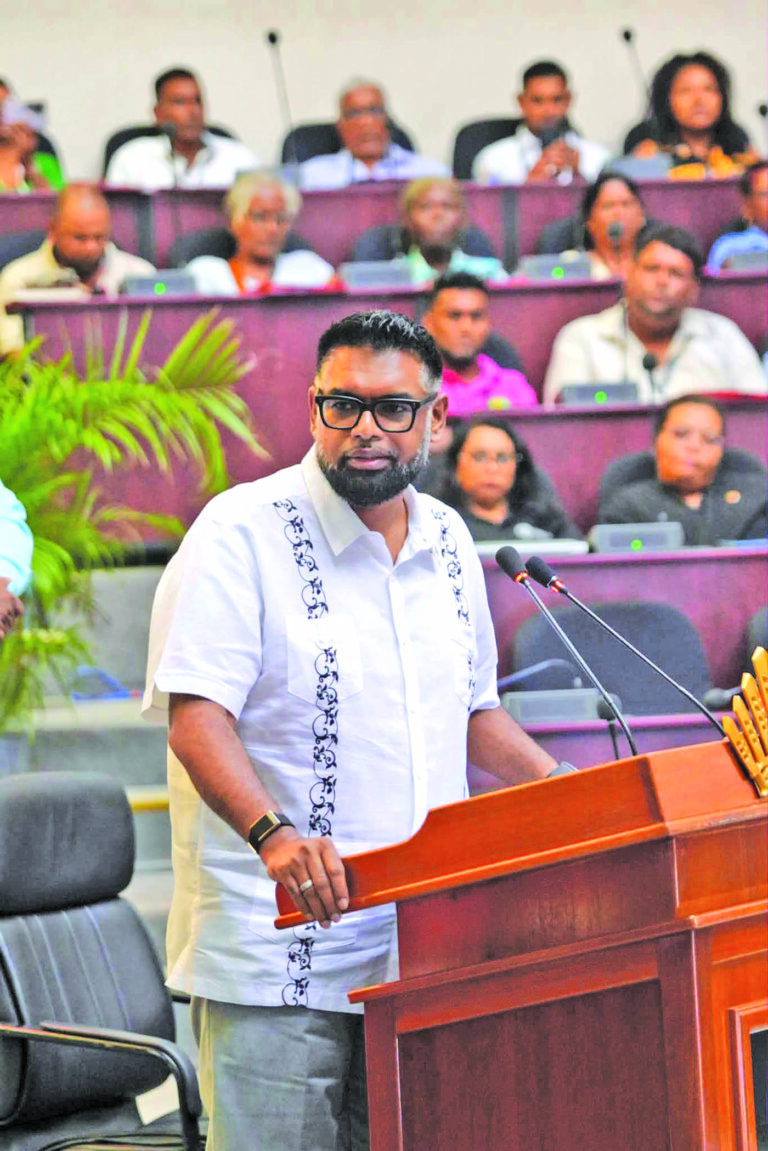
The announcement was made by President Dr Irfaan Ali on Monday during his keynote address at a Farmers’ Conference at the Arthur Chung Conference Centre (ACCC).
According to the Guyanese leader, food security demands the same level of strategic planning and foresight as the oil sector.
“Just like oil, if you have a massive storage facility for oil and you buy when oil is cheap and you can store that oil, you have a longer security period in terms of stability in your market. It’s becoming the same for food because of climate-related events. The longer storage we have for chicken, when chicken price is stable, we load up our storage so when prices go up because of something that is happening globally, a disease or something, we have a buffer, a three-month buffer of food supply to stabilise the market,” he explained.
President Ali said that the goal is to make Guyana the food storage hub for the Caribbean, noting that “that is where we are heading, and that is why we are working on an integrated plan with Northern Brazil and the Caribbean as key partners in this integrated plan.”
He pointed to local investments in rice and honey storage facilities as well as the regional food hub for vegetables. Additionally, he said the private sector is increasing investments in storage capacity for poultry.
“These facilities are going to become critical for food security for the Caribbean. Just imagine if we can have the facility in the country to hold three months of food supply for the Caribbean,” the President remarked.
Amid these plans, the Head of State stressed the need for increased local production. He posited that while there have been significant increases over the last five years, production has not yet matched demand.
Pointing to increases in rice by some 18 per cent, coconut by over 200 per cent, fruit by 10 per cent, vegetables by 21 per cent and poultry by 110 per cent, President Ali commented, “We are not matching the demand.”
“There is an increase in the consumers in Guyana, the migrants who are coming, and the workers who are coming, so while we’ve increased production, we are not matching the demand, so the only way we can match demand is to continue to increase production but also increase productivity and yield,” he emphasised.
President Ali further highlighted that increasing production will also tremendously support efforts to build out a vibrant agro-processing sector.
Using celery as an example, he explained that increasing local production could lower prices while boosting the manufacturing of the highly sought-after green seasoning.
“What we need to do is to ramp up production, but whilst we ramp up production, have a stable price that the farmers enjoy and then lead that product into agro-processing, so we have the off-taker who has a long-term off-take agreement at ‘x’ price, the farmers agree with long-term prices, so they have safeguards from mark susceptibility, and then that goes as input in agro-processing into the green seasoning that is taking the Caribbean market by storm,” the President outlined, noting that more locally manufactured agri-products are now available regionally.
President Ali also stressed the need for increased production to match the investments being made by the Government, calling on the Ministry of Agriculture to map out specific plans with farmers.
“One of the things that we have to work on today is how we increase our productivity, because the investment in infrastructure must match increases in productivity,” he emphasised.
“So, if we put a farm-to-market access road and we’re spending $300 million on that road, we must have a productivity plan along that road, how much land we’re opening, what are we going to use the land for, how many farmers are along that road, and how the farmers are going to increase the production, so every farm, every single farm, we should have a report, or a plan, a productivity plan, so when we make these investments, the Ministry of Agriculture must sit with all of the farmers along those roads, along the new drainage canals that we’re building, and sit down with them and see how we’re going to come up with that productivity plan and link the production to market,” he added.


Discover more from Guyana Times

Subscribe to get the latest posts sent to your email.


Source: Guyana Times

AG backs US Govt’s guarantee against 3rd country extradition

0

…Judges reserve ruling after 3 hours of submission, over 2000 pages on legal authority

Attorney General (AG) and Minister of Legal Affairs Anil Nandlall, SC, has defended assurances given by the United States (US) to prevent the onwards extradition of Opposition Leader Azruddin Mohamed and his father, Nazar Mohamed. He argued that the guarantees strengthen existing protections under the extradition treaty and urged the Court of Appeal to accept them.
Nandlall made the argument on Tuesday during approximately three hours of submissions in the constitutional challenge brought by the Mohameds against provisions of the Fugitive Offenders (Amendment) Act. The Court of Appeal has reserved its judgement for after hearing arguments from the parties.
Acting Chancellor of the Judiciary, Justice Roxane George-Wiltshire, SC, said the Court of Appeal must examine more than 2000 pages of legal authorities and extensive submissions before delivering its judgement. She reminded the parties of the court’s one-month deadline for issuing judgements and assured that every effort would be made to reach a decision after reviewing the extensive material. The parties will be notified once the court’s decision is available.
The panel also included Justices of Appeal Rishi Persaud and Nareshwar Harnanan.
During his submissions, Nandlall maintained that Article Seven of the 1931 Extradition Treaty between the United Kingdom and the US, which Guyana inherited at independence, governs the offences for which a person may be prosecuted following extradition.
He argued that the additional assurance was obtained as a precaution and was supplied once the issue arose in the proceedings.
He told the court that the US had confirmed it was bound by the treaty and would prosecute and punish the Mohameds only for the offences for which their extradition was requested, or offences committed after their surrender.
Addressing the question of onwards extradition, Nandlall quoted the US assurance to Guyana, which stated that Washington would not re-extradite the two men to a third country for an offence committed before their surrender without the consent of Guyana’s responsible minister.
The AG said, “While the United States is not, therefore, obliged to provide the assurance requested, in light of the Government of Guyana’s request, the United States assures the Government of Guyana that, in this particular case, it shall not re-extradite [the Mohameds] to a third state for any offence committed before their extradition without the consent of the Minister of Home Affairs of Guyana.”
He contended that the guarantee was not a new arrangement requiring separate treatment under the law but formed part of the existing extradition framework between the two countries.
He told the court, “This assurance is nothing outside our extraneous. It’s part and parcel of the arrangement.”
“Bilateral assurances, I say, with the greatest of respect, obviously, carry greater force. But even unilateral assurances have been uniformly accepted. And we have the cases; I don’t think I need to go through them. They set out the principles governing unilateral assurance. And I say, Your Honours, that bilateral assurances will be accepted a fortiori,” he submitted.
Nandlall disputed the Mohameds’ arguments that the 2009 amendments to the Fugitive Offenders Act were unconstitutional, maintaining that they had failed to clearly demonstrate how the challenged provisions violated the Constitution or infringed their fundamental rights.
He also defended Section 8(3)(B)(a), arguing that it could remain in force despite the High Court’s decision to strike down Section 8(3)(B)(b).
The AG maintained that the two provisions were severable and that the invalidation of one did not automatically render the other unconstitutional.
In February, Acting Chief Justice Navindra Singh ruled that Section 8(3)(B)(b) was unconstitutional because it required courts and executive authorities to interpret a treaty or foreign law as containing a safeguard even when that provision was not actually written into it.
The safeguard concerned protection against onwards extradition – meaning the Mohameds could not be sent by the US to a third country for an offence committed before their extradition without Guyana’s consent
However, the Chief Justice held that the protection against onwards extradition was already implicit in Article Seven of the 1931 Extradition Treaty between Guyana and the US.
Senior Counsel Roysdale Forde, who represented the Mohameds, challenged the Attorney General’s interpretation of Article Seven of the 1931 Extradition Treaty, arguing that the provision does not expressly prevent the onwards extradition of the men to a third country.
Forde submitted that Article Seven governs the offences for which a person may be held or tried after being surrendered to the requesting state but does not establish a safeguard against subsequent transfer to another jurisdiction.

“It contains no words about surrender to a third state,” Forde told the court, maintaining that the treaty’s provisions could not be interpreted as satisfying a statutory requirement that demanded an express safeguard against onwards extradition.
He said, “We respectfully submit that Article Seven regulates custody and trial in the receiving state. It contains no words about surrender to a third state. And the respondent [Attorney General] in this matter would have conceded that silence at paragraph eight of the submissions.”
He further argued that assurances subsequently provided by Washington could not substitute for a provision that must already exist within the relevant extradition arrangement.
Forde submitted, “A reassurance about an arrangement is not the provision made by it.”
The attorney also questioned the timing of the assurances, pointing out that the Mohameds were taken into custody on October 31, 2025, while the diplomatic notes containing the assurances were dated December 2025.
He argued that whether the statutory requirements had been satisfied was a matter for the court to determine, rather than the executive.
He maintained that the High Court’s finding that protection against onwards extradition was implicit in Article Seven was insufficient to satisfy the requirements of the Fugitive Offenders Act, particularly the provision requiring an express safeguard within the relevant arrangement.
Forde further argued that if the statutory provision requiring that safeguard remained applicable, the invalidation of the subsection that deemed such protection to exist could leave the requirement unsatisfied.
He urged the appellate court to distinguish between the treaty’s restrictions on prosecuting a person for offences other than those for which extradition was granted and a separate legal requirement governing onwards extradition to a third country.
The appeal flows from a February 2026 decision by Chief Justice Singh, who invalidated a provision of the Fugitive Offenders Act but determined that protection against onwards extradition was implicit in the existing treaty. The constitutional proceedings are distinct from the extradition case being heard at the Georgetown Magistrates’ Courts.
That matter, initiated following a request by the US, remains without a final determination while the Court of Appeal considers the constitutional issues.
The extradition proceedings before Chief Magistrate Judy Latchman are continuing on October 21 and 22, but she remains barred by the Court of Appeal from delivering a final decision until the constitutional challenge is determined.
The Mohameds were sanctioned by the US in 2024 over alleged gold-related tax evasion and corruption and were indicted in Florida in 2025 on 11 counts linked to an alleged US$50 million gold-export tax evasion scheme and the alleged evasion of more than US$1 million in taxes on a Lamborghini imported into Guyana.
The US is seeking the extradition of the Mohameds to face charges relating to these crimes. Azruddin Mohamed and his father, Nazar Mohamed, were each granted $150,000 bail and ordered to surrender their passports and report to the Ruimveldt Police Station as part of their bail conditions in the ongoing extradition proceedings.


Discover more from Guyana Times

Subscribe to get the latest posts sent to your email.


Source: Guyana Times
Whatever… happened to Machado?

0

Before Mad Maduro was extracted to the States, María Corina Machado was widely regarded as a shoo-in to replace him – based on her fervent support for the “American way” and her local support base. But then Devious Delcy inherited the presidency, and Machado was left waiting for the democratic dividend – Washington had someone already inside the palace with whom it could do business!!
Now Machado wants presidential elections by July 2027 and has also called for transparency over oil-sale revenues overseen by Washington. These are connected questions – who controls Venezuela’s wealth, and when will Venezuelans choose who governs them!! Polls show Machado outpolling Devious Delcy – but her electoral prospects are brighter than her July election prospects!! Her local popularity hasn’t even secured her return from exile in Panama – much less an enforceable route to the presidency!! A commanding lead is useful only when somebody opens the polling stations and honours the count!!
Devious Delcy’s advantage lies in incumbency and pliability since she provides Washington with a functioning interlocutor while they pursue energy cooperation and economic recovery!! For Washington, replacing Devious Delcy with Machado would introduce uncertainties they’d prefer to manage slowly!! The woman demanding a democratic mandate must therefore compete with the woman offering administrative continuity!!
This irony should be a lesson for us – Machado’s sympathy towards Washington doesn’t guarantee THEIR preference for her!! But she does have leverage since Devious Delcy publicly promised elections, and Secretary of State Marco Rubio agreed!! Her July ‘27 demand’s gonna force both Governments to explain how much preparation’s necessary – lest preparation become procrastination!!
Washington’s position’s gonna be decisive – so Machado’s strongest strategy would combine peaceful domestic mobilisation, opposition unity – and pressure from sympathetic American legislators!! She’s gotta make indefinite postponement politically expensive while convincing officials, businesses, and ordinary Venezuelans that an elected Government can preserve stability!!
A date alone, however, ain’t enough since she needs freedom to return and campaign – plus restoration of political rights, credible electoral Administration, independent observation and safeguards against another disputed result!! Many who are in power would fear losing everything – and have powerful reasons to obstruct change, so they’ve gotta be massaged!!
Your Eyewitness is therefore cautiously favourable about her chances in a genuinely competitive election – but guarded about a July election. Continued delay could exhaust her supporters while economic improvement could strengthen Devious Delcy’s claim that continuity’s working. Conversely, disappointed expectations could expose the weakness of a Government sustained by Gringo support – rather than electoral consent!!
Machado – who’s signalled accepting the ICJ process – remains a formidable contender, but her supporters don’t control the timetable!!
While Mad Maduro’s removal opened the succession, it didn’t settle who gets to decide it!!

…method to madness?
Now, Sanction Man was supposed to be at the Court of Appeal on Tuesday morning for a decision on his (umpteenth) appeal to escape extradition. But late Monday night, he’s involved in a shootout in front of Special Branch Head, Senior Superintendent Prem Narine’s home!! Who, not so incidentally, is at the centre of questioning by Sanction Man’s legal team in said hearing!!
Even before hearing accusations that he KNEW would emanate from Sanction Man and his handlers (including his Sissie) your Eyewitness wants to know what the heck was HE doing at the scene at that time of the night!! The Superintendent said Sanction Man passed his Kitty home once and returned as he heard a gunshot!! He took cover and returned three shots!!
Sanction Man’s vehicle was apprehended on Vlissengen, and when searched, a 32 was found inside!! He, of course, claims the gun was planted – even as a 32-shell was found on the road where his car had been!!
Curiouser and curiouser!!

…is GuySuCo doing?
Your Eyewitness had read that GuySuCo’s moving its headquarters from Ogle to Berbice, but then the Minister said he doesn’t know about this – but GuySuCo’s being restructured!! The bigwigs gonna be cutting cane in Berbice?


Discover more from Guyana Times

Subscribe to get the latest posts sent to your email.


Source: Guyana Times
Food storage, production & security

0

Food security has become an increasingly important priority for countries seeking to protect their populations from the effects of climate change, supply chain disruptions, and fluctuations in international commodity prices. For the Caribbean, where many countries depend heavily on imported food, strengthening regional production and storage capacity is essential to ensuring reliable supplies and greater stability in food markets.
Guyana’s plans to expand food storage capacity, with the objective of establishing a three-month food reserve, therefore represent an important consideration in the country’s agricultural development strategy. The initiative, outlined by President Dr Irfaan Ali during Monday’s Farmers’ Conference at the Arthur Chung Conference Centre, has implications for the wider Caribbean’s ability to withstand disruptions in global markets.
The underlying principle is straightforward: food security requires preparation before a crisis occurs, rather than a response after supplies have been affected and prices have risen. Adequate storage allows food to be purchased when prices are stable and retained for periods when production, transportation or international supply chains come under pressure. This approach can help reduce the effects of sudden shortages and price increases on consumers.
President Ali’s comparison between food and oil storage highlights the importance of treating food security as a strategic priority. Just as energy reserves provide a measure of protection against supply disruptions, sufficient food reserves can help Governments and businesses respond to unexpected challenges. Climate-related events, disease outbreaks and other disruptions can affect agricultural production and availability, making storage infrastructure an important component of national and regional resilience.
For Guyana, the opportunity to become a food storage hub for the Caribbean, supported by an integrated plan involving Northern Brazil and Caribbean partners, could strengthen the country’s role in regional food distribution. Investments in rice and honey storage, a regional vegetable hub and private-sector poultry storage capacity provide a foundation for this wider objective.
Realising this, however, will require more than the construction of storage facilities, as the infrastructure must be supported by sufficient and consistent agricultural production, efficient transportation, appropriate handling and reliable links between farmers, processors and markets. Storage capacity can provide a buffer against shortages, but it cannot permanently compensate for inadequate production.
This makes President Ali’s emphasis on increasing agricultural output particularly relevant. The production figures cited at the conference indicate significant growth in several areas over the past five years, including an 18 per cent increase in rice production, more than 200 per cent in coconut, 10 per cent in fruit, 21 per cent in vegetables and 110 per cent in poultry. Yet the president acknowledged that production has not kept pace with demand.
That gap reinforces the need to pursue higher productivity alongside expanded cultivation.
The potential for agro-processing is another important dimension of this strategy, as greater production can provide manufacturers with a dependable supply of locally grown raw materials, creating opportunities to add value to agricultural commodities before they reach the market. President Ali’s example of celery being used to produce green seasoning illustrates how increased cultivation, stable prices and long-term purchasing agreements can connect farmers to manufacturers and regional consumers.
Farmers gain greater certainty about demand and prices, while processors obtain a more reliable supply of inputs. Consumers and regional markets, in turn, can benefit from a wider range of locally manufactured products. Developing these relationships can also reduce waste by providing outlets for produce that might otherwise be lost when fresh-market demand is insufficient.
Ultimately, Guyana’s food security objectives and its ambition to serve the Caribbean are closely connected. A stronger domestic agricultural sector will provide the production base needed to support storage, processing and regional trade. At the same time, expanded storage and dependable market access can give farmers greater confidence to increase production.
The task ahead is to ensure that these elements develop together; by linking infrastructure, productivity, storage and agro-processing within a coordinated agricultural strategy, Guyana can strengthen its capacity to meet domestic demand while contributing to a more secure Caribbean food system.


Discover more from Guyana Times

Subscribe to get the latest posts sent to your email.


Source: Guyana Times
Let us celebrate our people – Distinguished Guyanese on the global stage

0

This week we sing the praise for two iconic Guyanese – David Dabydeen and Carolyn Rodrigues-Birkett. Let us not choose boorishness or ungraciousness; whether or not we love all our country’s realities, we can still love our national ideals. Out of conquest, slavery, and indentured servants, David and Carolyn remind us that our people continue to rise triumphantly.
No matter how polarised Guyanese society might be because of ethnicity and politics, we were proud of Rohan Kanhai, Alvin Kalicharran, Clive Llyod, Lance Gibbs, Carl Hooper, Shivnarine Chanderpaul, and others in cricket. No matter what our politics, race and ethnicity, we celebrated their success as if it were our own success. They made us all proud Guyanese.
As of this very moment, two Guyanese are in the spotlight on the global stage. David Dabydeen was a nominee for the 2026 Nobel Prize in Literature, and Carolyn Rodrigues-Birkett is a candidate for the Secretary General of the United Nations. Whether they win or not, they have already achieved a level that is reserved for only a handful in a world of almost eight billion people. No matter our politics, race, ethnicity, or whether we are rich or poor, no matter which part of Guyana we are from, whether we live in or out of Guyana, we must all be proud of these two iconic Guyanese sisters and brothers. They represent the very best among us.
The Nobel Prize Committee in Stockholm, Sweden, has announced their awardees for 2026. The Nobel Prize in Literature 2026 was awarded to Anne Carson “for her bold and inventive oeuvre that, in playful dialogue with the classical tradition, has created new forms for contemporary literature.” Canadians have been in full celebration since the announcement that one of their own has wo n the Nobel Prize. Even if she had not won the Nobel Prize, Canadians had already expressed their great joy that one of their own had been nominated for this prestigious award.
As it turned out, Guyanese also must be proud because among the nominees for the 2026 Nobel Prize award for Literature was one of our own – David Dabydeen. David is not a product of a rich family. Out of rural Guyana, David is one of the distinguished Guyanese and Caribbean writers. He is worthy of celebration. Just as the Canadians are proud of Anne Carson, we must be proud of David Dabydeen. Another Guyanese from humble beginnings has risen to the top and has added to Guyana’s proud legacy of outstanding achievements, particularly in literature.
David Dabydeen earned recognition among his peers in Europe, the UK and China, and they formally nominated him for the 2026 Nobel Prize. Win or not, the nomination was an acknowledgement and a recognition of his decades-long contribution to world literature. But the nomination also brought him and his country and all Guyanese into the international spotlight.
For the few Guyanese who might still not know of David, he was born in Central Corentyne, raised in New Amsterdam, and then studied and honed his skills in the UK. After leaving Guyana as a teenager, he attended Cambridge University in England, where he studied English at Selwyn College in the 1970s. He has been a fixture for decades at Warwick University, helping to shape scholarship on post-colonial literature and Caribbean cultural history. For decades now he has been one of the Caribbean’s most respected literary voices through his novels, poetry and essays. His distinguished works over decades have examined how Caribbean lives have been impacted by conquest, slavery, colonialism, and migration. His distinguished literary career must not obscure his public service, having served as Guyana’s ambassador to UNESCO and to China.
Carolyn Rodrigues is in the running for the Secretary General of the UN. This is the top public servant in the world. Imagine a Guyanese young lady born to an Arawak family in Santa Rosa in Region One could be the Secretary General and the number one and most powerful public servant in the world, coming from what used to be an obscure little village in Guyana’s hinterland. Growing up without running water, no electricity and studying with an oil lamp, she has emerged as one of the most distinguished Guyanese on the global stage. Politics, race, ethnicity and whatever other excuse we might have must not dim the light that this young Guyanese woman has brought over our country. We celebrate her achievements, whether she is elected or not. As it is with David Dabydeen, winning is a bonus. Being chosen as a possible Nobel Prize winner or the possible Secretary General of the UN are already victories that belong to all of us.
We have endured conquest, slavery, colonialism, 60 years of ups and downs, lows and highs since independence, and even periods of dictatorship, but we have always been a proud people, steadfastly refusing to bend our backs, always keeping our heads held high. Our forebears fought for freedom so that their descendants might prosper. They never imagined that one day their descendants would have made them proud beyond their own imagination and dreams. Every single day, Guyanese in their communities, some in the spotlights, some in total obscurity, make the dreams of our ancestors come true.
Whether it is a farmer in Lethem or some village somewhere producing onions that our former colonial masters told us cannot be grown in Guyana, whether it is in Black Bush Polder or Moruka or Wismar, making food security a reality in our country and in our Caribbean Region, whether it is in the global spotlight of the UN in New York or in the Home of the Nobel Prize, we can sing of our country: “Tis of thee, late land of slavery, of thee I sing.”


Discover more from Guyana Times

Subscribe to get the latest posts sent to your email.


Source: Guyana Times

ExxonMobil Guyana GSL confirmed for June 24 – July 3, 2027

0

The ExxonMobil Guyana Global Super League (GSL) will return for its fourth edition from June 24 to July 3, 2027, bringing world-class T20 franchise cricket back to the Guyana National Stadium, Providence.

The ExxonMobil Guyana Global Super League (GSL) will return for its fourth edition from June 24 to July 3, 2027

Five elite teams from around the world will compete for a US$1 million prize pool over 10 days of high-intensity cricket in one of South America’s most vibrant and fast-emerging sporting destinations. Providence, home of the Guyana Amazon Warriors, will once again host this unique international club showdown.
The 2026 edition marked a major milestone for the competition, as a sold-out Providence crowd watched the Guyana Amazon Warriors edge the San Francisco Unicorns in a tightly fought final to lift the trophy.
Now firmly established on the global T20 calendar, the GSL continues to grow in stature and competitive quality. The 2027 edition promises more thrilling contests, passionate crowds and a celebration of the global game in Guyana.
Sir Clive Lloyd, Chairman of the ExxonMobil Guyana Global Super League, said:
“It gives me immense pride to announce the dates for our fourth edition. The GSL has established itself as a truly global club competition, showcasing outstanding talent and attracting tremendous support at home and abroad, with teams from all over the world eager to take part.
“The 2026 final, played in front of a packed stadium, showed the passion for cricket in Guyana and the strength of this tournament. From June 24 to July 3, we look forward to welcoming five outstanding teams back to Providence to compete for the title and a US$1 million prize purse. The GSL is about excellence, opportunity and uniting fans around the world through the game we love.”
Further details on participating teams, fixtures and ticketing will be announced in the coming weeks.


Discover more from Guyana Times

Subscribe to get the latest posts sent to your email.


Source: Guyana Times

20 East Berbice schools benefit from CWIMA cricket outreach

0

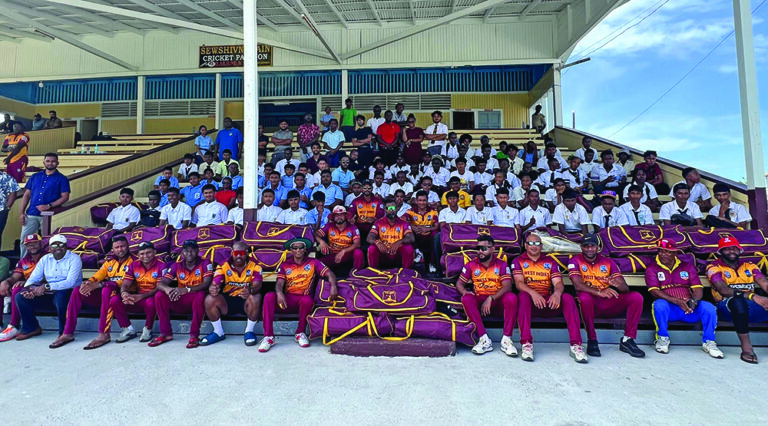
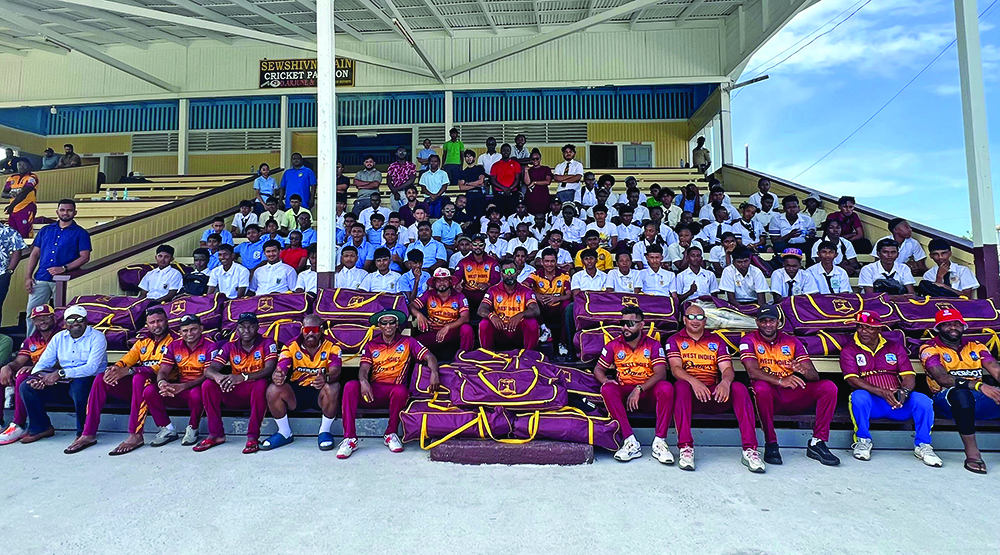
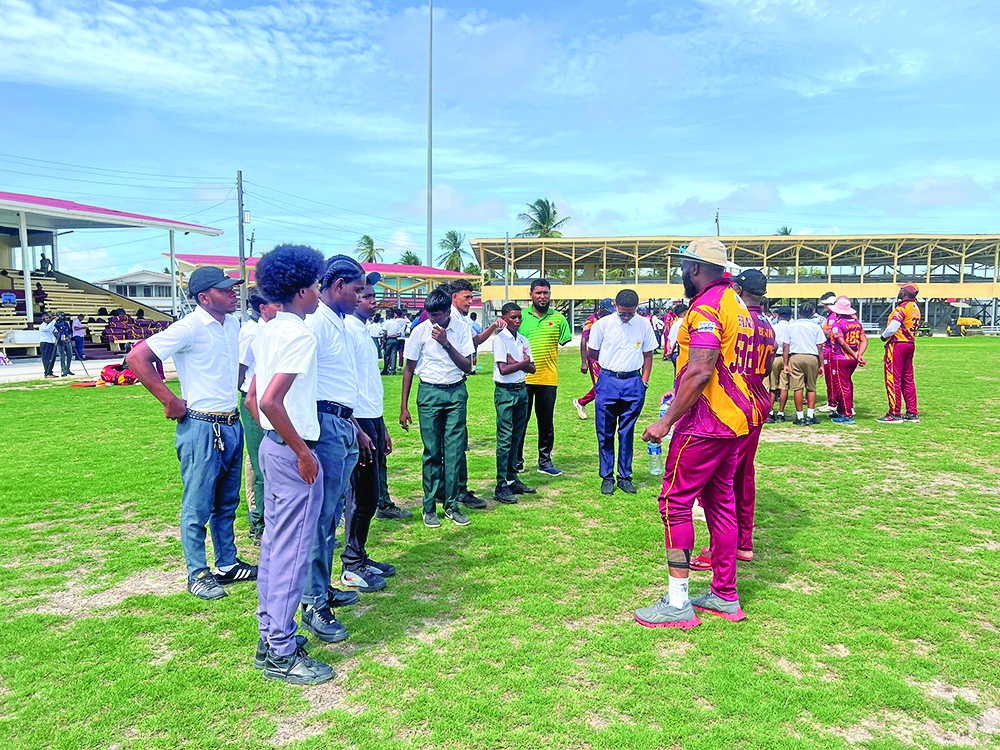
Twenty schools across East Berbice received cricket bags from the Cricket West Indies Masters Association (CWIMA) during an outreach at the Albion Community Centre, where schoolchildren also took part in drills with members of the West Indies Masters team.

Twenty schools across East Berbice received cricket bags from CWIMA) during an outreach at the Albion Community Centre

The distribution provided equipment including bats, batting gloves, batting pads, wicketkeeping pads, wicketkeeping gloves, and boxes of balls as part of CWIMA’s programme to bring cricket to young people across the country.
Former West Indies and Guyana spinner Devendra Bishoo joined West Indies Masters skipper and former West Indies Captain Denesh Ramdin in offering advice to the children.
The pair encouraged them to enjoy their childhood and have confidence in their abilities, urging them never to allow anyone to convince them that they could not achieve their goals.

Schoolchildren also took part in drills with members of the West Indies Masters team

The Albion activity was CWIMA’s second outreach, following a similar distribution and engagement at the Lusignan Community Centre on the East Coast of Demerara. The programme will next head to Essequibo, where a third outreach is scheduled for October 23 at the Anna Regina National Stadium.
Alongside their engagement with the students, the West Indies Masters players held practice sessions and familiarised themselves with the Albion ground ahead of the IMC Over-40s Masters World Cup.
Albion is one of 12 venues to be used during the tournament, which starts on October 17. West Indies will meet Australia in the opening match at the National Stadium, Providence, which will also host the final on October 31.


Discover more from Guyana Times

Subscribe to get the latest posts sent to your email.


Source: Guyana Times