Home Blog Page 228

Lotto/Let’sBet One Guyana T10 Tapeball Blast: Super Saturday set for Lusignan before Sunday’s Enmore showdown

0


(Kaieteur News) – The stage is set for a blockbuster Super Saturday at the Lusignan Ground on October 3 as eight teams locked in their spots for the quarter-finals of the Georgetown and East Coast Demerara zone in the Lotto/Let’sBet One Guyana T10 Tapeball Blast.

With three regional champions already awaiting in the national phase, local heavyweights fought through a heated Round of 16 across the Demerara Cricket Club (DCC) and Lusignan Community Centre grounds to keep their campaign alive for a place in Sunday’s zonal finals at Enmore, all eyeing the ultimate $2 million national purse on offer at the Anna Regina National Stadium on October 11.

At DCC, rapid run chases dominated the day’s play. Titans Rams routed Phantom XI by nine wickets after bowling them out for a paltry 40 in 10 overs, thanks to clinical spells from Shacin Singh (2 for 2), Derwin Christian (2 for 5), and Clinton Pestano (2 for 8).

Lotto/Let’sBet One Guyana T10 Tapeball Blast: Super Saturday set for Lusignan before Sunday's Enmore showdown

The stage is set for a blockbuster Super Saturday at the Lusignan Ground on October 3 as eight teams locked in their spots for the quarter-finals of the Georgetown and East Coast Demerara zone in the Lotto/Let’sBet One Guyana T10 Tapeball Blast.

Pernell London made short work of the target, blasting an unbeaten 31 to seal victory in just 2.5 overs. Pure Entertainment produced a similarly ruthless display, flattening Intruders by nine wickets. Mark Cumberbatch’s 4 for 20 and Travis Johnson’s 3 for 11 skittled Intruders for 63 in 10 overs, before Raphel Frank unleashed a whirlwind 44 to carry Pure Entertainment home in 3.4 overs.

SVC/AJM CC also cruised into the last eight with a dominant nine-wicket win in 4.2 overs, overhauling their 101-run target on the back of a rapid unbeaten 51 from Jonte Thomas and a brisk 30 not out from Quentin Sampson.

Meanwhile, Diamond Gunners pulled off an explosive chase against FC ER Gladiators. Chasing Gladiators’ 96 for 8—built around Jaffar Ali’s 27 and Alvin Mohabir’s 25—Diamond Gunners charged to 102 for 2 in six overs behind firepower from Josiah Lim (36), Ricardo David (34), and Seon Allen (20*).

Over at the Lusignan Community Centre Ground, the action was headlined by an extraordinary record-chase from Avinash All-Stars. Stripling Warriors appeared to be in total control after posting 124 without loss, driven by undefeated half-centuries from Brandon Jaikaran (61*) and Navindra Persaud (51*).

However, Avinash All-Stars launched an astonishing counter-attack, surging to 128 for 1 in eight overs courtesy of a blistering 62-run knock at the top, supported by Kadeem Alleyne (36) and Kevin Wickham (28*), to pull off a sensational nine-wicket win.

Team Corruption proved too strong for Team Upsetterz, overhauling a target of 106 in 8.2 overs to secure an eight-wicket win. Dejourn Charles anchored the chase with an unbeaten 59 alongside Treatlon Liverpool’s 32, after West Indies international Kevin Sinclair had earlier taken 2 for 25 to restrict Upsetterz to 105 for 6.

Housing Warriors were the only side at Lusignan to successfully defend a total, posting 122 for 4 on the back of Sachin Singh’s unbeaten 55 and Hiradeo Jailall’s 39, before limiting Dream 11 All-Stars to 77 for 7 to complete a 45-run victory.

Better Hope claimed the final quarter-final berth by navigating a tricky lower-scoring chase against VP XI, knocking off the required 72 runs in eight overs with four wickets in hand led by Azad Mohamed’s 30.

The quarter-final schedule at Lusignan on Saturday, October 3 begins at 09:30h with Titans Rams taking on Pure Entertainment, before Diamond Gunners square off against SVC/AJM CC at 11:30h.

The afternoon double-header will see Team Corruption battle Better Hope at 13:30h, followed by Avinash All-Stars clashing with Housing Warriors at 15:30h for the right to advance to the zone finals at Enmore on October 4.


Source: Kaieteur News

ASL expands with new aircraft, FBO facility, and 150 jobs

0


(Kaieteur News) – Local aviation operator Air Services Limited (ASL) announced an expansion plan on Sunday, bolstering its fleet and infrastructure to capitalise on Guyana’s rapid economic development.

The initiative includes the addition of seven new aircraft over the past two years, the creation of 150 local jobs, and the construction of the nation’s first Fixed-Base Operator (FBO) facility at the Eugene F. Correia International Airport.

Company executives attributed the aggressive growth strategy to strong commercial demand and alignment with the government’s long-term economic development agenda.

The flagship development of ASL’s expansion is the construction of Guyana’s first full-service FBO. Designed to cater to the growing volume of corporate and international business jet traffic, the proposed complex will feature dedicated VIP passenger lounges, ground handling, aircraft refuelling, flight dispatch, and specialised engineering and maintenance services.

Alongside its executive aviation plans, ASL has increased its daily flight schedules by up to 30 percent to meet demand across domestic passenger, industrial, and agricultural sectors.

The company is expanding specialised operations through its rotary-wing division, providing charter and offshore logistical support, and upgrading its agricultural fleet to support commercial farming operations.

“Our heavy investments demonstrate our complete confidence in the local economy and the administration’s policies,” said Capt. Tarick Ramnarace, Accountable Manager at Air Services Limited. “We have successfully connected our hinterland communities to the rest of Guyana. Now, as we sponsor the next generation of local pilots and mechanics, construct our new FBO, and prepare for regional charters, we are taking the next major step forward.”

 The current expansion phase is projected to increase ASL’s workforce from 300 to 450 employees, drawing personnel from Regions 1 through 10.

To support the staff increase, the company is directly funding flight and technical training programs for local pilots and mechanics through its accredited training institution.

ASL, which has operated in Guyana for over five decades, confirmed it will maintain its core hinterland supply routes. The carrier provides regular cargo, passenger transport, and emergency medical evacuation (medevac) services to remote interior communities alongside its commercial charter operations.


Source: Kaieteur News

Guyana’s more confident voice on the world stage

0


Dear Editor,

Several days ago, President Dr. Mohamed Irfaan Ali’s address to the 81st Session of the United Nations General Assembly was, in my view, an important statement of Guyana’s growing confidence and engagement on the international stage.

Editor, at a time when our world is confronted by unwanted wars, increasing humanitarian crises, geopolitical rivalry, food insecurity, climate pressures, and growing questions about the effectiveness of international institutions, President Ali used the world’s largest international platform to articulate Guyana’s perspective on several of the defining issues confronting humanity.

What stood out to me was the breadth of the address and the central principle connecting its various themes: in an increasingly fractured world, international cooperation, respect for international law, and effective multilateralism remain indispensable.

A strong defence of multilateralism was one of the most consequential aspects of the President’s address to the gathering.

The international system is undoubtedly under tremendous strain. Yet the shortcomings of institutions such as the United Nations cannot become an excuse for abandoning them. Rather, those shortcomings should strengthen the case for reform that is so desperately needed.

President Ali’s call for a Security Council that better reflects twenty-first-century geopolitical realities, including permanent representation for Africa, Latin America, and the Caribbean, speaks to a longstanding concern of developing countries: institutions created for another era must evolve if they are to retain legitimacy and relevance in this one.

For small developing states such as Guyana, this matters immensely. Multilateralism provides countries, regardless of their size or their military and economic power, with a forum in which their sovereignty, interests, and perspectives can be heard.

Speaking on the issue of peace, the President also addressed some of the most difficult conflicts facing humanity.

His reiteration of Guyana’s support for Palestinian self-determination and a two-State solution, in which Israel and Palestine can exist in peace and security, placed Guyana within the continuing international search for a just and lasting settlement.

Similarly, his call for an end to the Russia–Ukraine war emphasised an essential truth: wars ultimately require political and diplomatic solutions if sustainable peace is to be achieved.

The attention he gave to Haiti and Cuba was equally significant from a Caribbean perspective. Haiti cannot be abandoned to instability and insecurity. Its people deserve sustained regional and international engagement. Cuba, likewise, remains an issue on which Caribbean states have consistently advocated dialogue and constructive engagement.

These were not merely references to distant international issues. They demonstrated Guyana’s willingness to contribute its voice to questions affecting our Caribbean neighbourhood and the wider international community.

With respect to matters closer to home, the President addressed Venezuela, Guyana’s sovereignty, and the rule of law.

For Guyanese, few issues could be more important than the Guyana–Venezuela border controversy.

President Ali was firm and clear in presenting Guyana’s reliance on the International Court of Justice as part of a peaceful, rules-based approach to resolving the controversy.

His declaration that Guyana will respect the Court’s eventual judgment, and his expectation that Venezuela will do likewise, carries significance far beyond our borders.

For small states like ours, international law is not some abstract diplomatic concept. It is among our most important protections in a world where countries possess vastly different levels of military, economic, and geopolitical power and influence.

Guyana must therefore continue to stand resolutely and firmly for its territorial integrity while demonstrating that disputes between states should be resolved through law, diplomacy, and peaceful international mechanisms rather than coercion.

Another notable element of President Ali’s address was his deliberate advocacy for Ambassador Carolyn Rodrigues-Birkett to become the next Secretary-General of the United Nations a potentially historic opportunity for our country, the Caribbean, and developing countries around the world.

He highlighted her distinguished public-service record, which spans service as Minister of Amerindian Affairs, Minister of Foreign Affairs, and Guyana’s Permanent Representative to the United Nations, alongside her wider international experience.

But her candidature carries symbolism beyond any single résumé.

The prospect of an Indigenous woman from Guyana and the Caribbean being considered for leadership of the United Nations speaks directly to the wider conversation about representation within the international system.

President Ali situated her candidature within his broader argument about the kind of leadership the United Nations requires: leadership capable of rebuilding trust, bridging divisions, and restoring greater unity of purpose to an institution operating in an increasingly divided world.

Whatever ultimately emerges from the selection process, Guyana placing one of its own before the international community for consideration for one of the world’s most consequential diplomatic offices is itself a significant moment for our country.

His Excellency presented to the world a more confident Guyana.

There is a broader lesson that I believe all Guyanese should take from this address.

The international influence of a country is not determined solely by its geographical size, population, or military strength. Influence can also come from diplomatic credibility, consistency, ideas, and the ability to connect national interests with principles that resonate internationally.

That is where I believe President Ali’s address was particularly effective.

Guyana’s territorial integrity was connected to international law. Caribbean concerns were connected to regional stability. The conflicts in the Middle East and Ukraine were situated within a broader call for peace. United Nations reform was connected to the legitimate demand for greater representation for Africa, Latin America, and the Caribbean. And Ambassador Rodrigues-Birkett’s candidature was presented within the larger question of leadership and renewal within the multilateral system.

Taken together, these positions presented a Guyana prepared to participate in international affairs not merely as an observer, but as a sovereign state willing to articulate its interests and contribute ideas to the wider international conversation. That is an important evolution for our country.

Guyana today occupies an increasingly visible place internationally. With that visibility comes responsibility: to defend our sovereignty, maintain principled relationships, contribute constructively to international debates, and ensure that our diplomacy continues to reflect both our national interests and our commitment to peaceful international cooperation.

President Ali’s address demonstrated that Guyana intends to have a voice in those conversations and a seat at those tables. Furthermore, it is fair to say that the central proposition emerging from his speech was both simple and consequential: a fractured world does not require less cooperation; it requires better cooperation. From the podium of the United Nations General Assembly, Guyana made that case.

As a Guyanese, I believe there is value in seeing our country confidently contributing its voice to the difficult conversations shaping the future of our region and our world. In my view, President Ali delivered an excellent address, and it was a moment in which Guyanese can take pride.

Yours respectfully,

Jermaine Figueira


Source: Kaieteur News

Guyana sweep past Cayman Islands to maintain perfect Nations League start – News Room Guyana

0

Guyana produced a commanding first-half display to defeat the Cayman Islands 2-0 at Windsor Park Stadium on Sunday and preserve their flawless start to the Concacaf Nations League campaign.

Liam Gordon set the Golden Jaguars on their way early on before Osaze De Rosario continued his fine goalscoring form to double the advantage prior to the break.

The victory in Roseau, Dominica leaves Guyana firmly in control at the top of League B Group A, having taken maximum points from their opening two fixtures without conceding a goal.

Guyana wasted little time imposing themselves on Sunday’s fixture, breaking the deadlock after just 15 minutes.

Liam Gordon ventured forward from the left, cutting in toward the edge of the penalty area before driving a crisp, left-footed finish into the net to put his side ahead.

With the Cayman Islands struggling to gain a foothold in midfield, Guyana kept up the pressure and found their second in the 36th minute. A precise delivery from the left wing carved open the defence, allowing De Rosario to react quickest inside the box and turn the ball home.

Guyana controlled the tempo throughout the second period, comfortably managing the two-goal cushion to see out the win.

De Rosario’s first-half strike capped an outstanding opening week for the forward, who has quickly established himself as Guyana’s talisman in this international window.

On Thursday, he produced the game’s decisive moment late in Guyana’s group opener against Puerto Rico.

In a tight, physical affair at the same venue, De Rosario found the back of the net in the 78th minute to secure a precious 1-0 victory.

Having scored in consecutive games, his form has given Guyana the ideal platform as they target top spot in a group that also features host nation Dominica.

Under Concacaf’s centralized venue format—introduced to limit travel demands across the region—Group A opened its campaign with a week-long series of matches in Dominica.

The reward at the end of the group stage is significant. Winning Group A grants automatic promotion to League A alongside direct qualification for the 2027 Concacaf Gold Cup, avoiding the multi-team Play-In route.

Guyana now turns its focus to the October international window, when the group moves to Mayagüez, Puerto Rico.

They face Dominica on Thursday, October 1, before taking on the same opponents three days later on Sunday, October 4.


Source: NEW ROOMS SITE

Bath Plantation man, 21, dies after losing control of vehicle – News Room Guyana

0

A 21-year-old Bath Plantation man died on Sunday night after he lost control of the car he was driving while negotiating a turn along the No. 6 Public Road, West Coast Berbice.

Dead is Afridi Rahaman of Lot 39 Bath Plantation, West Coast Berbice.

Police said that around 20:00hrs, Rahaman was driving car PAB 8323 west along the southern side of the road when he lost control while negotiating a right turn. The car crossed over to the northern side, toppled several times, and eventually came to rest in a trench.

Rahaman and his 19-year-old passenger, Parveena Brijemal, also of Lot 39 Bath Settlement, were removed from the vehicle by public-spirited citizens.

Rahaman was reportedly unconscious when he was taken to the Bath Regional Hospital, where he was pronounced dead by a doctor.

Brijemal, who was conscious at the time, was admitted for observation and is said to be in stable condition.

Police are continuing their investigation into the accident.


Source: NEW ROOMS SITE

Cocaine-in-fish seized, one arrested

0

Last Updated on Monday, 28 September 2026, 20:56 by Writer

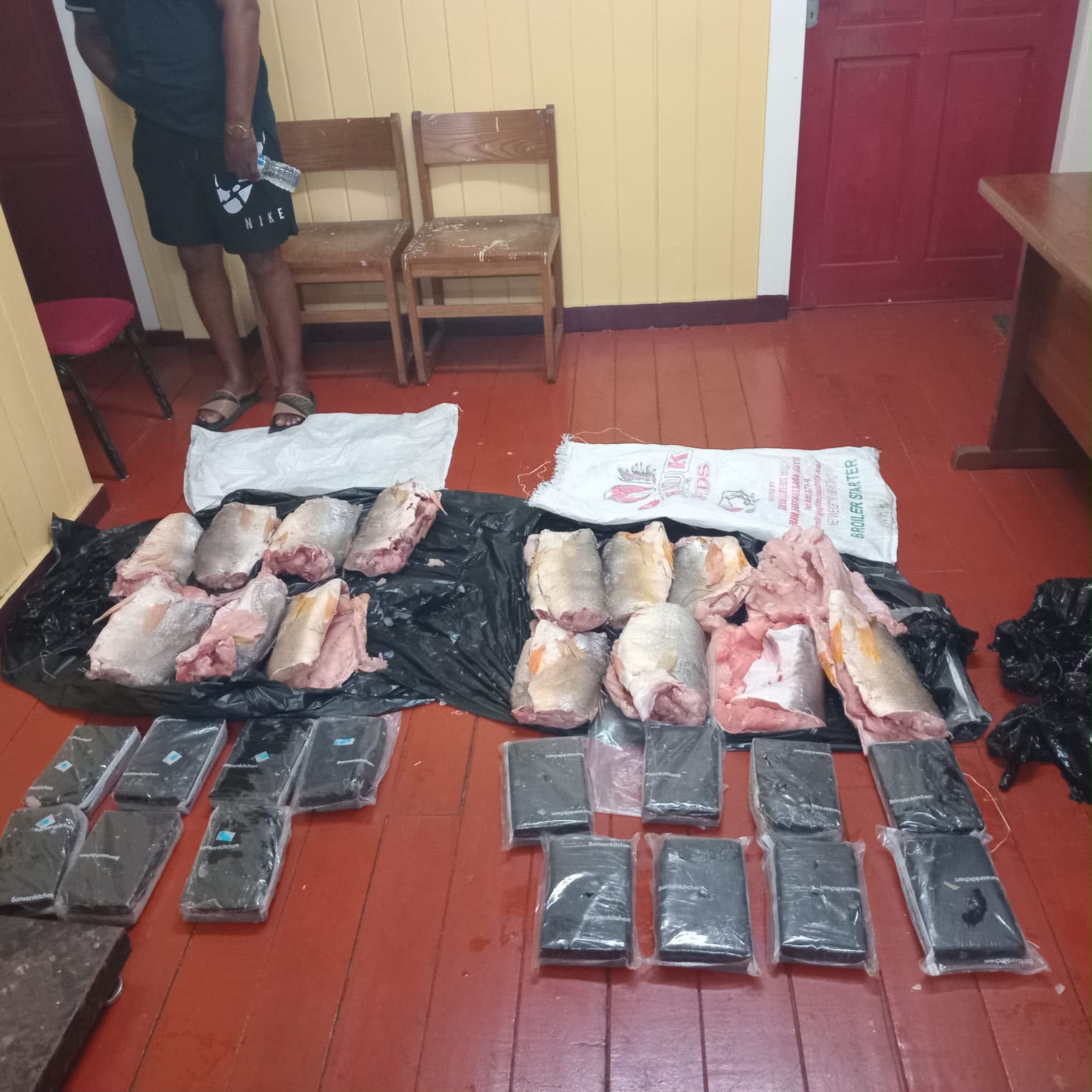
Police say they are investigating the discovery of 36 pounds of suspected cocaine at Richmondville, Providence, East Bank Demerara.

The Guyana Police Force said the seizure was made on Sunday during an operation where they say they intercepted a motor vehicle driven by a 44-year-old miner, who was the sole occupant.

“A search of the vehicle was conducted, during which ranks found two bags containing frozen fish in the trunk. Further examination revealed several parcels containing a white powdery substance suspected to be cocaine concealed inside the fish,” police said in a statement.

The man was arrested and escorted to the Criminal Investigations Department headquarters along with the suspected narcotics and motor vehicle.

A total of 15 parcels containing the suspected cocaine were recovered from the frozen fish.

The suspected cocaine was weighed and amounted to 36 pounds before being lodged, police added.

The suspect remains in police custody as investigations continue.


Source: Demerara Waves

OPINION: Can Guyana turn a UN crisis into a diplomatic opportunity?

0

Last Updated on Monday, 28 September 2026, 20:50 by Writer

by Ron Cheong
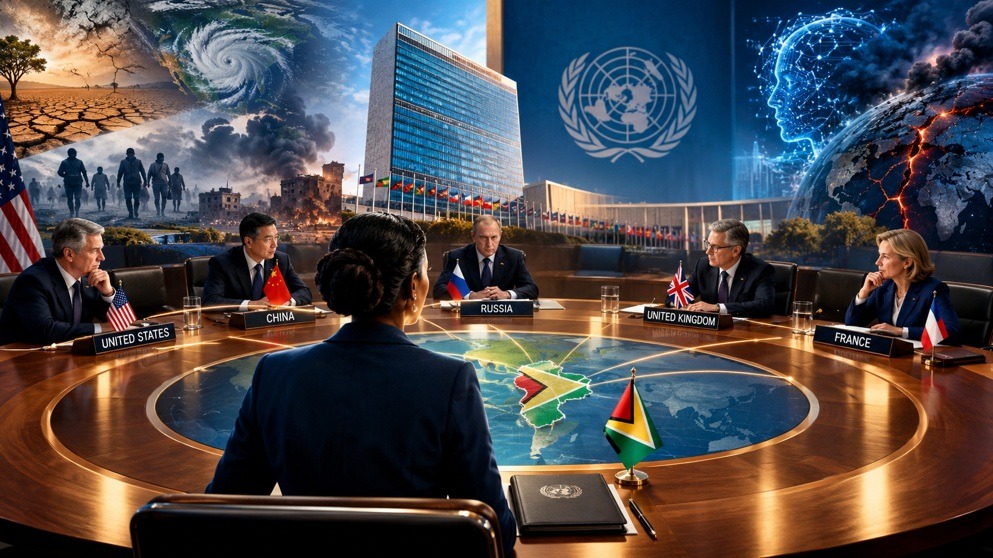
The next Secretary-General will inherit a deeply divided world. For Guyana, that may make the case for Carolyn Rodrigues-Birkett more compelling, but winning the race will require careful diplomacy among the major powers.

The next Secretary-General of the United Nations will inherit one of the most difficult international environments in the organisation’s history.

Speaking at the Munich Security Conference, outgoing Secretary-General António Guterres warned that the global community had become more fragmented and divided than at any time in the previous 75 years. He went further, arguing that the transition toward a multipolar world was taking place without sufficiently strong global institutions to manage it. The result, he warned, could be greater chaos, opportunism and transactional politics rather than structured cooperation.

Remarkably, Guterres suggested that the Cold War was, in some respects, less dangerous. The confrontation between the United States and Soviet Union carried the constant threat of nuclear war, but it also produced established mechanisms for arms control and crisis management. Today, he argued, the world faces not only nuclear danger but also the existential challenges of climate change and uncontrolled artificial intelligence without comparable mechanisms for managing them.

That is the world into which the next Secretary-General will step.

Global cooperation has become harder to sustain. Strategic competition between the United States and China is reshaping trade and supply chains. Traditional alliances are under strain as national interests increasingly take precedence over collective approaches. Regional conflicts have multiplied, while the international system faces mounting pressure over climate change, food security, migration, technology and artificial intelligence.

And the Secretary-General will have to manage a crisis of confidence within the United Nations itself: pressure for institutional reform, chronic funding difficulties and paralysis within the Security Council, where the veto powers of the five permanent members can prevent collective action.

The question, therefore, is not simply who should occupy the Secretary-General’s office. It is what kind of leadership the international system requires at a moment when the old assumptions underpinning that system are being challenged.

A race at a critical stage

Against this background, the contest to succeed António Guterres has reached a critical stage.

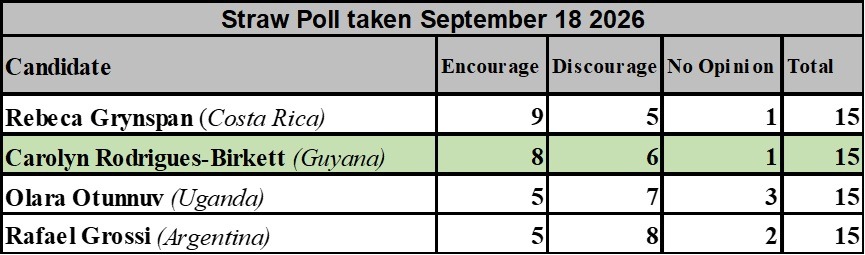
The third Security Council straw poll, conducted on September 18, put Costa Rica’s Rebeca Grynspan narrowly ahead of Guyana’s Carolyn Rodrigues-Birkett. Grynspan received nine “encourage” votes, five “discourage” votes and one “no opinion”; Rodrigues-Birkett received eight “encourage,” six “discourage” and one “no opinion.” The two have emerged as the leading candidates through the first three rounds.

The result is significant because the race remains far from settled. The eventual candidate must secure at least nine votes in the 15-member Security Council and, critically, cannot receive a veto from any of the five permanent members — China, France, Russia, the United Kingdom and the United States.

Guyana’s candidacy has the backing of CARICOM, and President Irfaan Ali used his address to the 81st session of the General Assembly to make a direct appeal for Rodrigues-Birkett. He argued that the world should look beyond the size of the country that nominated her and consider the experience and qualities she could bring to an organisation in need of renewal.

The symbolism is considerable. The Caribbean has never produced a Secretary-General. No woman has ever held the position. Rodrigues-Birkett would therefore represent not simply a Caribbean candidate, but a woman from a small developing state and an Indigenous Caribbean background seeking to lead the world’s principal multilateral institution.

But symbolism alone will not decide the contest.

How the decision is actually made

Although all 193 UN member states ultimately participate in the formal appointment process, the decisive stage takes place in the Security Council.

During the informal straw polls, the 15 Council members indicate whether they “encourage,” “discourage” or have “no opinion” on each candidate. In the early rounds, the identities of the permanent members behind individual votes are not disclosed. Later stages are designed to make the positions of the five permanent members clearer.

Under Article 97 of the UN Charter, the General Assembly appoints the Secretary-General only after receiving a recommendation from the Security Council. The General Assembly then votes on that recommendation. In practical terms, therefore, the Security Council is where the decisive bargaining occurs.

That makes the current geopolitical environment both a complication and a potential opportunity for Guyana.

Guyana’s Security Council record

Guyana has something important to bring to the table: recent experience at the centre of the very multilateral system that the next Secretary-General will be expected to repair.

Guyana served a two-year non-permanent term on the Security Council in 2024–2025 and held the Council presidency in February 2024 and June 2025. During its tenure, Guyana placed particular emphasis on climate change, food insecurity and conflict, while also highlighting peacebuilding, women and security, and youth and children in conflict.

Its February 2024 presidency was particularly notable. Guyana brought the relationship between climate change, food insecurity and conflict to the centre of a high-level Security Council debate. The UN itself subsequently highlighted the importance of the climate-food-conflict nexus.

This gives Guyana a credible argument that the concerns of small and vulnerable states are not peripheral to international security. They are increasingly central to it.

Climate change, food insecurity, poverty, environmental degradation and conflict are no longer neatly separated problems. For many developing countries, they are interconnected drivers of instability.

That perspective is particularly relevant to a UN struggling to adapt institutions created in 1945 to the realities of the twenty-first century.

The geopolitical tightrope

But there is another dimension to the campaign, and it is considerably more complicated.

Guyana’s strategic relationships intersect with the interests of all three major powers: the United States, China and Russia.

Guyana has a particularly close security relationship with the United States, especially in the context of Venezuela and wider Caribbean security. At the same time, China is an important economic partner with interests in infrastructure, trade and development throughout the region. Russia, meanwhile, maintains a close relationship with Venezuela.

Guyana therefore has to navigate a diplomatic landscape in which its national interests do not always align neatly with those of any one major power.

That makes the campaign less a matter of persuading countries to “support Guyana” than of demonstrating why a Rodrigues-Birkett Secretary-General could serve the broader interests of a divided international community.

There may also be an important regional calculation.

President Ali and Guyana’s delegation recently joined US President Donald Trump, Secretary of State Marco Rubio and other leaders of the Shield of the Americas in adopting a joint communiqué focused on economic, security and multilateral coordination. Guyana’s participation reinforces its growing role in the security and economic architecture of the Western Hemisphere.

That relationship should not be reduced to a simple quid pro quo over the Secretary-General’s appointment. But it does give Guyana a channel for making the case directly to Washington that the choice of Secretary-General matters to the future effectiveness of the multilateral system, including one in which the United States has substantial strategic interests.

The same logic applies, in different ways, to China and Russia.

The objective should not be to present a Rodrigues-Birkett candidacy as an instrument against any particular power. That could make her less acceptable, not more. The stronger diplomatic argument is that the next Secretary-General must be someone capable of working across competing geopolitical blocs without becoming the representative of any one of them.

A Caribbean moment

This is where CARICOM’s collective weight becomes important.

The Caribbean has never occupied the Secretary-General’s office. The region has a legitimate interest in greater representation within an international system in which small states often find themselves negotiating with much larger powers.

Rodrigues-Birkett’s candidacy also carries a wider representation argument: a woman from the Caribbean, from a small developing state and with Indigenous Caribbean heritage, would bring experiences that have never been represented at the highest level of the UN.

But CARICOM should be careful not to frame the contest simply as a test of whether the great powers respect small states. That risks turning a campaign for a candidate into a confrontation between blocs.

A more effective argument would be that the present crisis of multilateralism is precisely why the next Secretary-General should be someone capable of building bridges across those divisions.

That is a message that can potentially resonate in Washington, Beijing, Moscow, London and Paris, as well as among the many smaller states whose interests are often overshadowed by great-power competition.

The work ahead

The third straw poll should therefore be viewed not as a verdict but as a map.

Rodrigues-Birkett is only one vote short of the nine “encourage” votes required in the latest informal poll, but the six “discourage” votes demonstrate that significant resistance remains. More importantly, the early straw polls do not reveal which positions belong to the permanent members.
Guyana and CARICOM consequently have considerable diplomatic work ahead.

They need to identify where support for Rodrigues-Birkett is firm, where it is movable, and where resistance may be connected to particular geopolitical concerns. They need to understand not only the positions of the five permanent members but also the calculations of the elected members of the Council.

And they need to make the campaign about more than Guyana.

The central message could be much larger: the world is entering an increasingly multipolar era, but the institutions designed to manage that world have not kept pace. The next Secretary-General therefore needs to be a bridge-builder — someone able to engage great powers without becoming captive to them, while ensuring that the concerns of smaller and developing states remain part of the global conversation.

That is a difficult case to make. But it is also precisely the kind of case that a candidate from Guyana can credibly embody.

The paradox of this race is that the very fragmentation threatening the effectiveness of the United Nations may create the opening for a candidate whose principal asset is the ability to bridge divides.

For Guyana, the challenge now is to turn that possibility into a diplomatic strategy, quietly, persistently and with enough sophistication to make the major powers see Rodrigues-Birkett not merely as Guyana’s candidate, but as a potentially useful candidate for a United Nations struggling to find its way in a fractured world.

Source: Demerara Waves

Guyana joins Caribbean in mourning Mighty Sparrow’s death

0

Last Updated on Monday, 28 September 2026, 20:20 by Writer

Mighty Sparrow

President Irfaan Ali and the opposition A Partnership for National Unity (APNU) have joined the rest of the Caribbean in mourning the death of international calypso icon Slinger “Mighty Sparrow” Francisco.

“The Mighty Sparrow’s music will endure as they (sic) have for decades. His compositions – insightful, witty and at times mischievous – became the soundtrack of generations, their lyrics etched with wit, rhythm, and fearless social commentary —mirrors held up to the Caribbean’s character, its contradictions, its unbroken spirit.

“He brought recognition to our Caribbean civilization. His melodies and lyrics sailed far beyond the region’s shores,” Dr Ali said Monday morning in a statement on his Facebook page almost a day after Sparrow passed away at the age of 91.

He also credited the Grenada-born artiste, who made Trinidad and Tobago his home, with lifting calypso from mere entertainment into an art form.

“He was the peerless virtuoso of the double entendre and picong, turning sly innuendo and biting mockery into unforgettable craft,” the President said.

The People’s National Congress Reform-led APNU said Sparrow’s remarkable body of work transcended national boundaries and generations.

“Sparrow became an enduring symbol of Caribbean creativity and the immense contribution of our region to world music. His music chronicled the experiences, aspirations, struggles and triumphs of Caribbean people, while his artistry helped establish calypso as a respected and influential musical form internationally,” that political organisation said.

The Caribbean Community (CARICOM) said Sparrow’s music tapped into the rhythms and sentiments of the Region, providing insightful and incisive social and political commentary in an artform unique to the Caribbean experience.

The regional body said his rich legacy continues to inspire future generations to preserve and promote Caribbean culture to the highest standards.

“In a career spanning the Caribbean, Europe and the United States of America, for many decades the Mighty Sparrow entertained, educated and inspired audiences, promoting Caribbean culture in the global arena with lyrical brilliance,” CARICOM said in a statement.

Sparrow penned over 500 calypsos, produced upwards of 70 albums, and secured numerous titles, including 10 Calypso Monarch crowns and eight Road March victories.

Sparrow was the recipient of, among others, the Order of the Caribbean Community (OCC) in 2001, the Order of the Republic of Trinidad and Tobago (ORTT) in 2014, and an Honorary Doctor of Letters (DLitt) from The University of the West Indies in 1987.


Source: Demerara Waves

Pres Ali did not buy 182 acres of land at Onderneeming – Housing Ministry – Guyana Times

0

Pres Ali did not buy 182 acres of land at Onderneeming – Housing Ministry

…signed order in official capacity not as a private purchaser

The Housing Ministry and Central Housing and Planning Authority (CH&PA) has rejected claims that President Dr Irfaan Ali personally purchased approximately 182 acres of land at Plantation Onderneeming, describing the assertion as a misinterpretation of Order No. 180 of 2026. In a statement on Sunday, the Ministry said the lands identified in the Order are Government-owned lands held under Transport No. 130 of 1876 and that there had been no personal purchase or acquisition of the lands by the President. According to the Ministry, Order No. 180 is the first step in bringing the identified lands under the Land Registration system, which will facilitate the legal processes required for Certificates of Title to eventually be issued to beneficiaries. The Ministry explained that Ali, in his capacity as the Minister responsible for housing, is authorised to sign the Order and that his execution of the document constitutes an exercise of his statutory responsibility.
It said this should not be interpreted as evidence that the President personally purchased or acquired the lands. The two parcels covered by the Order are earmarked for separate housing purposes. Parcel 936, measuring approximately 26.85 acres, is a regularised area occupied by informal settlers. The Ministry said bringing the parcel under the Land Registration system will advance the process for eligible residents to obtain Certificates of Title and secure legal ownership of the lands they occupy. Parcel 1793, comprising approximately 155.13 acres and previously identified as Block “CHPA 3”, is intended for a new housing development. The registration process is therefore required to facilitate the eventual issuance of Certificates of Title to beneficiaries within the development. The Ministry said the combined acreage of the two parcels is approximately 182 acres, but maintained that the land remains Government-owned. It was responding to an article published by an online entity, which according to the Ministry, created the impression that Ali had personally purchased the lands. “The lands are Government-owned, the Order is part of a statutory land-registration process, and its purpose is directly connected to housing development and providing beneficiaries with secure ownership documents,” the Ministry said. The Ministry also criticised the interpretation of the Order, arguing that it turned an administrative and legal process intended to regularise land ownership and facilitate housing development into a claim of personal land acquisition by the President. It called the online entity to correct what it described as a false and misleading impression and urged greater care in interpreting statutory instruments dealing with public lands. They maintained that the President was acting in his official capacity as the responsible Minister rather than as a private purchaser of the lands.


Discover more from Guyana Times

Subscribe to get the latest posts sent to your email.


Source: Guyana Times

Next 4 years to focus on multifaceted transformation of Guyana – Pres Ali n – Guyana Times

0

Next 4 years to focus on multifaceted transformation of Guyana – Pres Ali n

…6 years of groundwork set stage for Guyana’s next phase of transformatio

President Dr Irfaan Ali believes that the work his administration has done over the past six years was to prepare for a multifaceted transformation of Guyana – one not just at the macro-economic level but also the social level as well.
Speaking during a recent interview, the Head of State reflected on his presidency over the last six years, noting that the foundation for this transformation was laid during that period.
“The last six years has been preparation… [It] has been a lot of hard work, very little sleep, enormous commitment, challenges, setbacks, some pitfalls in life, you have to deal with some pitfalls, opportunities, but also the results show that what was put in did deliver results,” President Ali noted.
With the foundation laid, the Guyanese Leader says now the focus will be delivering a wholistic development for the country and its people.
“This opportunity before me is multifaceted. It is how do we, in the next four years, build on the foundation of the last six, and bring this country together, bring people together, bring families together, bring communities together. And at the same time, at a macro level, work on those transformative projects; not only in infrastructure, not only the roads, the bridges, the ports, the schools, the health centers and hospitals – not only those things.”
“Those transformative investment projects, those economic projects that would last for generations, that will position Guyana as a food hub and food capital for the world, that would advance our biodiversity and climate services, that will position us as an energy hub, that will deliver the highest skilled human resource potential and capacity, and we’re already doing that,” the President posited.
While he noted that modern infrastructure is important to the country’s development, the Head of State emphasised that so too is a country that advances on the pillars of peace, love, understanding, patience, contentment, dignity, and honour. At the core of this is Ali’s Model Village initiative.
Inspired by his own experiences growing up, the president believes that development must not only touch urban areas.

Model Village
The Model Village initiative was launched by the President in August and is expected to be rolled out in some 23 communities across various regions in its first phase. It features enhancing roads, drainage, irrigation systems and green spaces as well as creating a safe, peaceful and comfortable living environment for residents.
So far, consultations have been held with residents of these identified villages in Regions Two (Pomeroon-Supenaam); Three (Essequibo Islands-West Demerara); Four (Demerara-Mahaica), Five (Mahaica-Berbice), and Six (East Berbice-Corentyne).
According to President Ali, this concept will eventually be executed in every community across the country. Drawing from this background in urban planning and development as well as his tenure as Housing Minister, Ali said he witnessed firsthand how investments and development can transform lives and communities into new centres of economic opportunity.
“Look at Diamond [on the East Bank of Demerara], remember how it started? …And then the [commercial] banks went, then major industries went… We also saw in those communities, how the life changed for people. Young people, people owning things, the quality of houses improved, quality of life improved, generally.”
“And so, a model village is being what we want every village to be like in Guyana. So, we are starting with these pilots. But the Model Village Initiative is to let people aspire to be what they see in that village, to let people understand what we want every village to look like. So, in 2031, when they vote again, they’ll understand that voting for the People’s Progressive Party/Civic is about voting for a government that will transform every village into what they see in that model village. And learning also, learning from the pitfalls and the challenges,” the president stated.
Moreover, the Guyanese Leader is keen on ensuring that citizens, especially young people, actively participate in this phase of development. He cited successful models such the government’s tunnel house project, the swine project, and the shade house project among initiatives that persons can also capitalise on.
“These are all emerging to be such transformative investments for these young people… We have young groups coming from all across the country, hundreds of young groups wanting to get involved in the tunnel house programme… I believe that food security and investing in agriculture is investment that can be profitable, that is investment that can be sustainable and as I did it, I encourage persons to do it,” President Ali stated.
The Guyanese Leader has been at the forefront of driving an aggressive food security agenda not only in Guyana but the Caribbean as well. In fact, over the years, heavy investments have been injected into the various regions across the country, including in the hinterland, to advance agricultural development.


Discover more from Guyana Times

Subscribe to get the latest posts sent to your email.


Source: Guyana Times