Home Blog Page 226

MV Barima tragedy still weighs heavily – Pres. Ali

0


…says govt. moving to overhaul safety, infrastructure standards

(Kaieteur News) – President Irfaan Ali said the MV Barima tragedy continues to weigh heavily on him, with the loss leaving him with sleepless nights, while his government moves to use the lessons from the tragedy to strengthen safety, infrastructure, leadership and accountability.

Speaking during an interview on Sunday, the head of state described the recurring pain and sleepless nights that have followed the tragedy, stressing that leadership requires standing firm through every circumstance.

MV tragedy still weighs heavily – Pres. Ali

President Irfaan Ali

He said the country must move forward without forgetting those who were lost, while ensuring that the tragedy leads to changes in the systems and standards designed to protect citizens.

“Our task, therefore, is to navigate the future from the harsh lessons of that tragedy and every other tragedy, and to build in the memories of those who we lost, a system, a new culture of safety, infrastructure, leadership and responsibility that would utilise the loss as a new beginning for a stronger, deeper, more efficient system, and that is what we are doing,” President Ali said.

Acknowledging the personal toll of the MV Barima tragedy, the president expressed the profound weight he continues to carry as the leader of the nation.

“That tragedy continues to be a heavyweight, still a lot of sleepless nights,” he admitted. “It is something that I wish never happened. It was something I wish the families in our country would have never had to go through. But it happened. And I’m the president. I’m the leader. And a leader must not only be a leader in the good times. You have to be a leader in every circumstances.”

Drawing on his personal values, President Ali noted that faith provides the necessary foundation to view the tragedy from different perspectives, including that of grieving families and the first responders and healthcare workers who gave their best under horrific conditions.

“Faith allows you to understand things from a different context,” he explained. He cited the heroics of first responders and healthcare workers who gave their best under horrific conditions.

“As a leader, you have to process it from a leader perspective, from a country perspective, from the family’s perspective, from every perspective.”

While praising the resilience of citizens and the dedicated response of his cabinet and support teams, the president also addressed the challenge of navigating politicised responses during the period of national mourning.

“It was an emotive time for the entire country. But to deal with those who use this emotive period, painful period, to score political points, that was also difficult because there was an agenda that was different from the national agenda of dealing with a tragedy. But that is how life is. That is how political leadership is. You have to deal with every reaction to different circumstances.”

Highlighting the long-term role of government, President Ali stated that providing material, emotional and spiritual support to surviving relatives is not a temporary task, but a permanent obligation.

He emphasised that the nation can never simply return to business as usual, committing to keep the affected families permanently integrated into the broader national community.

“If I am to understand my superior mandate through faith, I know I have a duty and responsibility to those families,” the president said.


Source: Kaieteur News

NIS cash flow looks healthy, but pensioners still waiting

0


— Ram questions administration, actuarial warnings and $10B allocation

(Kaieteur News) – The National Insurance Scheme (NIS) may have recorded a positive cash flow during the first half of 2026, but questions about its long-term sustainability, administration and treatment of contributors remain unresolved, according to Chartered Accountant Christopher Ram.

Ram, in his latest column, “2026 Mid-Year Report: Beyond the NIS Numbers,” noted that NIS collected approximately $24.5 billion during the first six months of the year while spending $21.9 billion.

But while the figures show a positive cash flow, Ram argues that they tell little about the financial health of a social-insurance scheme whose obligations stretch decades into the future.

His concerns come against the backdrop of remarks by Finance Minister and Minister responsible for NIS, Dr. Ashni Singh, at the Scheme’s 57th anniversary observance, where he said contributors must not be “pushed around” and argued that NIS should ultimately be judged by whether people receive the benefits to which they are entitled.

Singh also pointed to nearly 80,000 additional contributors since 2020 as evidence of progress.

Ram, however, said contributor growth must be viewed in context, particularly in an oil-driven economy where some workers are temporary or short-term employees who may leave Guyana before qualifying for or claiming benefits.

“Numbers without context can therefore materially overstate what the increase means,” he wrote.

Pensioners caught in the system

Two cases highlighted by Ram; those of 81-year-old Nathan Craig and Shariff Zainul — illustrate the difficulties faced by contributors who have spent years fighting for pensions they believe they are entitled to.

Craig, of 204 Cedar Street, McKenzie, Linden, worked for Kaieteur Company Limited and later Linden Mining Enterprise Limited from 1990 to 2003. During that period, he made more than the 750 contributions required to qualify for an old-age pension.

NIS cash flow looks healthy, but pensioners still waiting

Nathan Craig, 81, still awaits his NIS pension.

NIS rejected his claim, prompting him to appeal on 29th September, 2010.

The matter remained before the NIS Appeal Tribunal for 13 years before it was finally heard on 28th October, 2023. The Tribunal ruled in Craig’s favour.

NIS wrote to Craig on 18th December, 2023, informing him that he had won the appeal. In the same letter, however, the Scheme said it was dissatisfied with the decision and would take the matter to the National Insurance Commissioner.

Ram said that since then, NIS has produced no decision cancelling the Tribunal’s ruling and has not paid Craig his pension.

According to Ram, the only reason given by NIS is that some of Craig’s contributions were paid after he turned 60.

Ram argues that the responsibility for making those payments rested with Craig’s employer and that the pensioner should not be made to bear the consequences.

Craig, now 81, remains unpaid and, according to Ram, is forced to take on small manual jobs despite his age.

Zainul’s case is similarly prolonged.

Zainul worked and paid NIS contributions from 1969 to 2001 and turned 60 on 16th October, 2011.

NIS cash flow looks healthy, but pensioners still waiting

A bed-ridden Shariff Zainul.

Ram said NIS initially recorded that Zainul had 374 contributions, then 426 and later 453, without explaining the changes.

Instead of receiving a pension, Zainul was paid two one-off grants of $9,869 and $14,549.

At the centre of his case are 354 disputed contributions which, according to the evidence presented, were deducted from his wages by Toolsie Persaud Ltd. but were not remitted to NIS.

Zainul produced payslips, a letter from the company’s former Personnel Officer and sworn statements from two former co-workers whom NIS itself accepted had worked at the company.

NIS nevertheless rejected the evidence and relied on its own contribution records. Those records did not include 1994, despite NIS acknowledging that it had Zainul’s payslips for that year.

Justice Damone Younge subsequently found the records to be wrong or incomplete. She also described NIS contribution records as having become notorious for being unreliable and raised concerns about employers’ failure to remit contributions at the expense of workers.

She ordered NIS to pay Zainul’s pension from his 60th birthday.

NIS appealed, and on 26th January, 2024, the Full Court overturned that decision and sent the matter back for rehearing.

Fifteen years after reaching pension age, Zainul still has no pension and, according to Ram, is now bedridden.

Actuarial warnings ignored

Ram also questioned the Scheme’s response to repeated actuarial warnings.

He pointed to the Eighth Actuarial Review, conducted as at 31st December, 2011, which warned that NIS was approaching “crisis stage.”

By 2016, NIS had acknowledged that more than 70 recommendations had accumulated from actuarial and reform exercises, he said.

Ram argued that the accumulation of recommendations without corresponding implementation represents one of the Scheme’s central problems.

“Over the past two decades, the Scheme would be hard-pressed to identify even one significant actuarial recommendation implemented for each year that has passed,” he wrote.

He stressed that responsibility does not rest solely with Singh, but extends to successive Governments, Boards and NIS managements.

“The reviews were done and the warnings given. The failure was to act,” Ram stated.

CLICO exposure raises further questions

Ram also revisited NIS’s controversial exposure to CLICO.

He recalled that Singh, while serving as Finance Minister in 2009, told Parliament that NIS had approximately $5.6 billion invested in CLICO — about 20% of the Scheme’s assets.

That exposure was subsequently addressed through a government debenture arrangement under the then APNU+AFC administration.

Ram said the episode should have strengthened calls for improved investment governance, risk management and institutional reform at NIS.

He also criticised the Scheme’s infrastructure and record-keeping systems, arguing that an institution established in 1969 has not modernised sufficiently to meet the demands of a rapidly changing economy.

He cited NIS’s own acknowledgement in 2016 that employees were working in “less than acceptable conditions,” while the Scheme was pursuing electronic contribution schedules, online contribution checking and efforts to clean its contribution records.

“Defective contribution records are not merely untidy files; they can determine whether a person receives a pension,” Ram wrote.

Minimum pension gap questioned

Ram also questioned the relationship between the NIS minimum pension and the public service minimum wage.

He noted that NIS states that the old-age pension must not be less than 50% of the existing public service minimum wage.

According to figures cited by Ram, the published minimum NIS pension is $43,075, while the current public service minimum wage is $102,346. Half of the latter is $51,173.

On that basis, Ram calculated a monthly difference of $8,098 for each pensioner receiving the minimum pension.

He said the latest published Annual Report does not indicate how many pensioners receive the minimum, making it impossible to determine the overall financial impact.

Questions over $10B NIS injection

Ram also raised questions about the Government’s previously announced $10 billion allocation for one-off grants to contributors who fell short of the 750 contributions required for a pension.

He noted that Singh, in the 2025 Budget, said Government would be “injecting $10 billion into the scheme” to finance full-and-final grants, subject to claimants relinquishing their legal rights.

Ram said NIS subsequently indicated that it received reimbursements for grants actually paid and that total payments under the programme fell well short of $10 billion.

Yet, he pointed out, the 2026 Estimates showed virtually the entire $10 billion provision as revised expenditure for 2025.

Ram is therefore calling for an accounting of the funds.

“How much was actually paid in grants, how much was reimbursed to NIS, how much is owed to minimum pensioners under the 50% rule and, if virtually the whole $10 billion was recorded as spent, where did the balance go?” he asked.

NIS reports years behind

Ram further criticised the absence of recent annual reports from the NIS website.

He noted that the latest annual report currently published is for 2023, with no 2024 or 2025 reports listed.

“For an institution whose solvency depends on contributions, investments, demographics and future benefit obligations, reporting years behind is unacceptable,” he wrote.

Ram argued that public accountability should also include reliable contribution records, functioning statutory offices and transparent reconciliation of the $10 billion allocation.

He said Guyana’s transformation through the oil economy makes reform of NIS even more urgent.

A modernised Scheme, he suggested, should consider issues such as gender-neutral parental benefits, unemployment protection and medical support for elderly pensioners.

Ram concluded that the warnings have repeatedly been made by actuaries, former NIS officials and others, but sustained action has been lacking.

“The voices have therefore not been absent. Nor have the diagnoses. What has been missing is sustained action,” he wrote.

He described that as “the true tragedy of the NIS.”


Source: Kaieteur News

Calypso titan Mighty Sparrow dies at 91

0


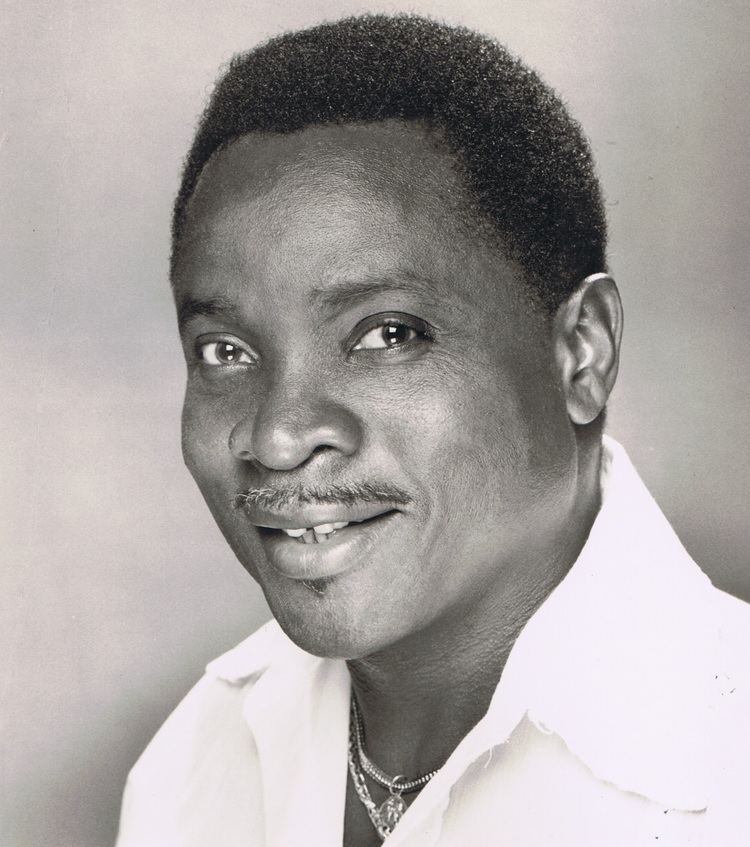
(Kaieteur News) – Trinidad and Tobago and the global Caribbean diaspora are in mourning following the loss of one of the region’s most formidable cultural titans. Slinger Francisco, the internationally acclaimed performer revered across generations as the “Calypso King of the World” and known universally as The Mighty Sparrow, died peacefully on Sunday, 27th September, 2026, at a hospital in New York. He was 91 years old.

Calypso titan Mighty Sparrow dies at 91

The Mighty Sparrow

In an official public announcement, his daughter Karen Francisco, shared that the legendary musician succumbed to a brief illness while surrounded by his immediate family and loved ones in his final moments.

“It is with great sadness that we announce the passing of Trinidad and Tobago’s Calypso icon, Slinger Francisco, known to the world as ‘The Mighty Sparrow’,” Karen Francisco stated. “He was an institution in the entertainment industry, well admired for his skill and finesse as a singer, songwriter and mentor; beloved by many. He was also a husband, father, grandfather, great-grandfather, life partner and friend.”

In her statement, she also revealed a deeply personal spiritual milestone from his final days, noting that “before his transition, he was able to make his election sure by giving his heart to the Most High, Jesus Christ where he was baptised in the Seventh-day Adventist faith.” The family encouraged friends and fans to pay tribute on social media by tagging `@therealmightysparrow` while asking for privacy as they grieve and prepare for a proper gathering to celebrate his life.

Tributes immediately began pouring in from institutions across the region. In a public post, the National Archives of Trinidad and Tobago extended its “deepest condolences to the family, friends, and global Caribbean community on the passing of the world-renowned calypsonian and Caribbean icon, Slinger Francisco, also known as The Mighty Sparrow.”

Calypso titan Mighty Sparrow dies at 91

The Mighty Sparrow

Born on 9th July , 1935, in Grand Roi Village, Grenada, Sparrow was taken to Trinidad by his migrant parents in 1937. He received his early vocal grounding in the St. Patrick’s Roman Catholic Church Choir and through school performances at Newtown Boys’ Roman Catholic School, before singing ballads by Nat King Cole, Sarah Vaughan, and Frankie Laine at private gatherings.

Sparrow made his historic calypso debut during the 1955 Carnival season at the Old Brigade Tent on South Quay in Port of Spain, performing “The High Cost of Living.” Following a transformative tour of Guyana later that year, he emerged in 1956 to capture both the Calypso King and Road March titles with his breakthrough hit “Jean and Dinah.” Over his illustrious career, he was crowned Calypso King twice and won eight Calypso Monarch titles, eight Road March titles, and the Calypso King of Kings title.

Sparrow’s vast catalog, including iconic tracks such as “Education,” “Capitalism Gone Mad,” “Congo Man,” “Melda (Obeah Wedding),” “Drunk and Disorderly,” “Saltfish,” and “No Money No Love”, served as a vibrant chronicle of the post-colonial Caribbean experience. His songwriting fearlessly dissected political scandals, social inequality, gender dynamics, and everyday island life, balancing poignant satire, humor, and infectious rhythm.

Calypso titan Mighty Sparrow dies at 91

His artistry resonated globally as he toured extensively across the Caribbean, Africa, the United States, Canada, and Europe. His international impact was recognised worldwide; notably, in 1977, the Government of Nigeria honored him with traditional Chieftaincy status.

Throughout his lifetime, Sparrow accumulated the region’s highest academic and civic accolades. He received honors across the United States, the Bahamas, the Virgin Islands, Barbados, and Jamaica. In Trinidad and Tobago, he was awarded an Honorary Doctor of Letters by the University of the West Indies in 1987 and the Chaconia Medal (Gold) by the Government of Trinidad and Tobago in 1993. In 2001, CARICOM presented him with the Order of the Caribbean Community (OCC) Award, hailing him as “the Caribbean’s most celebrated and renowned entertainer, social commentator and ambassador extraordinaire.”

The archival tribute highlighted historical visual records of his career, noting photographs courtesy of the Carnival Magazine Collection at the National Archives of Trinidad and Tobago, including features in So Yu Going To…Carnival: Summer/Fall 2000 and 1972 Calypsoes: With Notes For Tourists, as well as foundational scholarship by Professor Gordon Rohlehr titled “A Little Bird, A Mighty Song.”

The passing of Slinger Francisco marks the closing chapter of a golden era in Caribbean history. His monumental artistic legacy, commanding wit, and timeless music will continue to define the cultural hear tbeat of the region for generations to come.


Source: Kaieteur News

Strait of Hormuz tensions linger as Iran and U.S. move further from a deal

0


(AL-JAZEERA) Hours after U.S. President Donald Trump rejected a diplomatic solution put forward by Iran to reopen the Strait of Hormuz, explosions were heard in the waterway, according to Iranian media.

Reports of blasts near southern Iran’s Qeshm Island in the Strait of Hormuz suggested that multiple antiship missiles and drones were fired at vessels transiting the waterway against Tehran’s wishes.

While Iranian authorities did not confirm any attacks in the Strait of Hormuz that day, shipping continues to be attacked in the waters, including an Indian cargo ship last week, which killed a sailor.

The Islamic Revolutionary Guard Corps (IRGC) maintains that the strait is closed to any ship that does not coordinate with Iranian authorities. On Sunday afternoon, it released video of what it said was a second U.S. underwater drone seized this month.

Tehran has issued instructions to shipping companies transiting the Strait of Hormuz to use a temporary route approved by Iranian authorities and pay relevant fees. But it has also said the strait will not fully reopen until the U.S. blockade on Iranian ports ends.

Strait of Hormuz tensions linger as Iran and U.S. move further from a deal

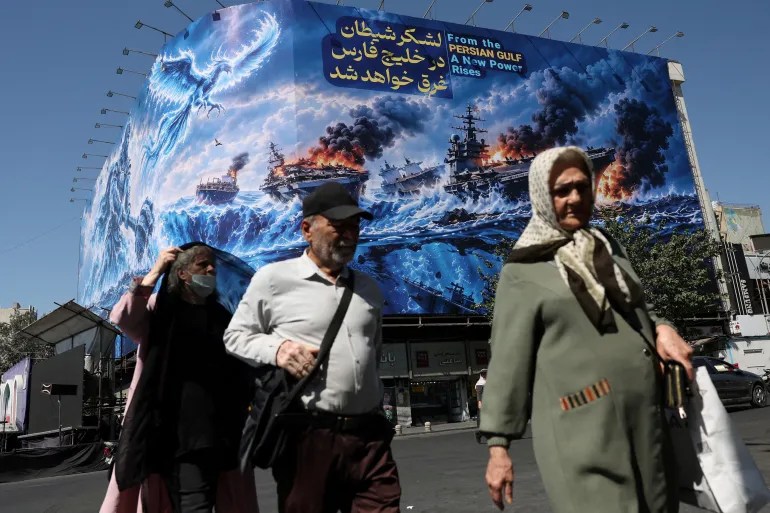
A billboard about the Strait of Hormuz on a building in Tehran, September 16, 2026 [Majid Asgaripour/West Asia News Agency]

Iran’s Persian Gulf Strait Authority announced on Saturday that it would blacklist any shipping charterer company which orders crews to use routes it considers to be unauthorised.

It also published what it described as an apology from an unnamed shipowner blaming commercial pressure from its charterer for trying to pass through the strait.

Washington still insists that its warships are successfully guiding oil tankers out of the strait via a different route. U.S. Energy Secretary Chris Wright told Fox News on Sunday that the “running average” of crude oil in transit was nearly 13 million barrels per day.

A September 19 operational update by U.S. Central Command claimed that its forces had helped move more than one billion barrels of crude out of the Gulf over roughly two months.

The U.S. military also says its forces have redirected 122 commercial vessels to enforce the naval blockade of Iran’s ports, halting all Iranian crude exports.

Tehran has claimed that the U.S. is providing false information regarding Strait of Hormuz traffic to project control over the key waterway. Shipping has been severely disrupted since the U.S. and Israel started their war on Iran on 28th February.

Andreas Krieg, associate professor at King’s College London, said Iran’s strategy of launching maritime attacks has spread the economic costs of the conflict beyond its borders.

While Iran has suffered economically from war damages, the U.S. naval blockade and sanctions, it would be a mistake “to assume that reaching that threshold produces submission”.

“The next Iranian move is therefore likely to be an attempt to increase the pain experienced by the Gulf rather than simply absorb further American pressure,” Krieg said.

“That could mean more aggressive vessel interdictions in Hormuz, attacks on energy infrastructure, greater Houthi pressure around Bab al-Mandeb and pressure from Iranian-aligned groups against alternative Saudi export routes. We are already seeing how pressure on Hormuz, the Red Sea and Saudi infrastructure can interact.”

More escalation on the way

At the United Nations General Assembly in New York, Iran projected a message of defiance while also proposing to reopen the Strait of Hormuz within a week if its seven conditions were met.

They included lifting the blockade on Iran, the release of frozen Iranian funds and an end to attacks on all fronts, including Israel’s assault on Lebanon. The demands mostly amounted to a return to the June memorandum of understanding between the U.S. and Israel.

Tehran has added that reopening the strait must be undertaken through a bilateral arrangement already finalised with Oman, the only other country with territorial waters in Hormuz.

U.S. President Donald Trump told reporters he rejected the offer, but Iran’s Foreign Minister Abbas Araghchi said on Sunday they were adamant about the conditions and would await an official response through mediators, such as Pakistan, Qatar and Oman.

Abolfazl Shekarchi, chief spokesman of the Iranian armed forces, warned that if the U.S. further intervenes in the Strait of Hormuz, “it will get slapped”.

“The Americans have no way out other than withdrawing from the West Asia region. The sooner they leave, the fewer losses they will incur and the region will certainly become safe after that,” he said.

Iranian army spokesman Mohammad Akraminia  said conditions were deteriorating so badly for the U.S. that it might launch another “military aggression” on Iran.

Krieg said that as the U.S. moves to isolate Iran via sanctions, Tehran, unable to respond with mutual financial measures against Washington, will be forced to rely on continued coercion in the Strait of Hormuz.

“The most likely level remains controlled attrition rather than an immediate return to the massive air campaign of the opening months,” Krieg said.

“Over the coming weeks, I would expect further attacks or attempted attacks on tankers, U.S-enabled shipping and regional infrastructure, followed by limited U.S. strikes against IRGC maritime assets, coastal missile positions, drones or vessels involved in those operations. That tit-for-tat cycle has already re-emerged around Hormuz.”


Source: Kaieteur News
Three missing from West Bank Demerara in three days

0


— police search ongoing for teens, pensioner

(Kaieteur News) – Three people, including a 14-year-old schoolgirl, a 17-year-old girl along with a 77-year-old man, have been reported missing from communities along the West Bank Demerara within a three-day period, prompting ongoing searches by the Guyana Police Force.

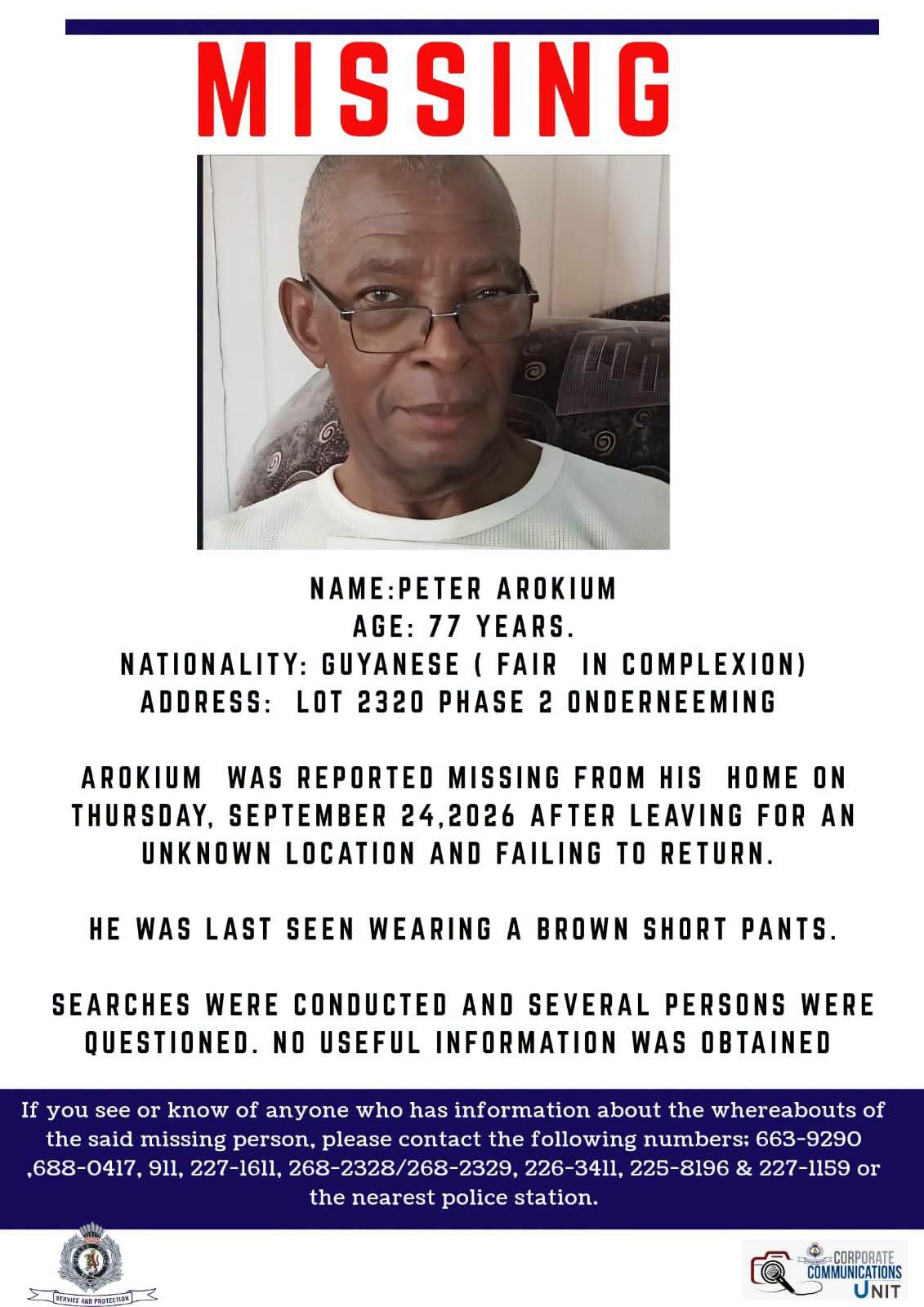
The three cases involve Elizabeth Persaud, 17, of Onderneeming; Peter Arokium, 77, of Onderneeming; and 14-year-old Serina Harris of Long Pond, Patentia.

While the disappearances were reported on consecutive days, there is no indication at this stage that the cases are connected.

Persaud was reported missing on Wednesday, 23rd September, after leaving her Onderneeming home for an unknown destination. She is described as slim, about five feet four inches tall, with short black hair and a brown complexion. She was last seen wearing a red sleeveless shirt, black and red track pants and green and black slippers.

The following day, 24th September, Arokium was reported missing after leaving his residence at Phase 2, Onderneeming, for an unknown destination.

The 77-year-old is described as fair in complexion and was last seen wearing brown short pants.

On Friday, 26th September, Harris failed to return home after leaving for school.

The 14-year-old is described as slim, about five feet six inches tall, with short black hair and a brown complexion. At the time, she was wearing her Patentia Secondary School uniform—a green uniform with a white shirt, black boots and white socks and was carrying a black haversack.

The Guyana Police Force has launched searches in the respective cases, while several persons have been questioned by investigators.

However, up to press time, investigators had not obtained information that could establish the whereabouts of any of the three.

The Police are appealing to anyone with information that may assist in locating Persaud, Arokium or Harris to contact the nearest police station or call 911.

As the searches continue, families and communities remain anxiously awaiting information on the whereabouts of the three missing persons.


Source: Kaieteur News

Fesupo 2026, Chile… Tremel King sets new 105kg M1 DL and Total records

0


…Williams also dominates

(Kaieteur News) – Guyana ended their 2026 South American Powerlifting Championships campaign with a bang on Saturday evening in Santiago, Chile when the nation’s 105kg Masters 1 duo of Tremel King and Bjorn Williams powered to the overall gold and silver medals.

It was a fabulous international debut for Tremel King who set new deadlift and total records in the process. King’s second deadlift attempt of 300kg and the total of 747.5kg erased the old Fesupo records on a cold Saturday evening at the Estadio Nacional.

Fesupo 2026, Chile… Tremel King sets new 105kg M1 DL and Total records

Tremel King (gold), Bjorn Williams (silver) during the playing of Guyana’s national anthem following the medal presentation.

King and Williams (total 692.5kg) were first and second from the first squat as neither of their rivals from Uruguay, Chile, Brazil and Argentina were able to challenge for the top two spots overall; Brazil’s Aparecido Alves had to settle for the overall bronze with a total of 675kg.

Williams attempted to break the 300kg deadlift record when he tried 302.5kg on his final lift but he was not successful, his best being 287.5kg for a total of 692.5kg which earned him the overall silver.

Fesupo 2026, Chile… Tremel King sets new 105kg M1 DL and Total records

Tremel King’s total of 747.5kg erased the old Fesupo record

King felt he had enough left in the tank to add on a few more kgs to the record, he too was unable to up the ante but left his first international championship pleased as he inked his name into the record books twice; gold medals in the squat (272.5kg), deadlift (300kg), total (747.5kg) along with a silver in the benchpress (175kg). King nailed eight (8) of his nine (9) attempts, only missing the final deadlift.

Williams was also fantastic on the platform as he took silver medals in the overall (692.5kg) and deadlift (287.5kg) and bronze in the benchpress (162.5kg); combining with King to grab seven (7) medals for Guyana which has taken the overall tally to a satisfying, 21 (6 gold; 10 silver; 5 bronze). Williams made good on seven (7) of his nine (9) lifts.

Fesupo 2026, Chile… Tremel King sets new 105kg M1 DL and Total records

King and Williams alongside other top performers of the event.

There were three other lifters on the day, all making their international debuts, and while they did not medal, they all left the championship stronger than they came earning valuable experience that will serve then in good stead going forward.

Sereste King who competed in the 105kg Open category achieved a best squat of 240kg, benchpress 145kg, deadlift 277.5kg and total of 662.5kg to end 6th in his category. Also pleasing was the fact that he made eight (8) of his nine (9) attempts which was fantastic.

The duo of Joshua John and Omali Vancooten were welcomed to the international stage in a baptism of intensity in the 93kg Open category. They ended in the 8th and 9th position, respectively.

Fesupo 2026, Chile… Tremel King sets new 105kg M1 DL and Total records

Omali Vancooten was successful at 235kg after failing his first few attempts.

John experienced a torrid time as he only got three (3) of his nine (9) attempts, one in each lift. His best squat was 230kg, benchpress 145kg, deadlift 235kg and total 610kg.

Vancooten also missed his first squat but made good on the second. He ended with six (6) out of his nine (9) lifts. Best squat of 235kg, benchpress 137.5kg, deadlift 232.5kg for a total of 605kg.

The Guyana Amateur Powerlifting Federation would like to express profound gratitude to the Ministry of Culture, Youth and Sport, National Sports Commission, Ministry of natural Resources, Guyana Olympic Association, Industrial Safety Supply, and Space Gym for partnering with the Federation to ensure our team of athletes, officials were able to compete and do so with pride.


Source: Kaieteur News

Our Caribbean sense of life: Why it is the elixir in the temperament of the next UN Chief – News Room Guyana

0

By I. Rhonda King

Republished from Envoy Magazine

Ahead of a fourth Security Council straw poll, a former Caribbean ambassador argues that the next secretary-general should come not simply from Latin America and the Caribbean, but from the Caribbean itself.

The selection of a secretary-general is usually discussed in terms of regional rotation and professional experience. Much less is said about outlook. Yet outlook determines how a Secretary-General reads a crisis, whom she listens to, and when she chooses to act. The General Assembly should now ask what outlook this moment requires.

I coined the phrase Caribbean Sense of Life in 2008. I needed a name for the outlook our history has given us. Every person lives by a sense of life, whether or not it is examined. Ours was shaped in small places, where many origins, faiths, and languages share limited space. In such places, accommodation is a daily necessity. Neighbors depend on one another. The village ethic holds that obligation extends beyond the family. Resourcefulness is expected, because means are always limited.

In practice, this outlook shows itself in particular habits. Caribbean people are accustomed to attending to others whose histories differ from their own. We tend to listen before we speak. We regard compromise as ordinary rather than as defeat. We know that persuasion is the only instrument available to those without power.

These habits are scarce in international affairs today. Suspicion between states has deepened. Multilateral institutions face financial strain and declining confidence. Conflicts continue that the Security Council has been unable to resolve. Governments increasingly speak past one another.

The secretary-general cannot command. The office has limited resources and no army. Its influence depends on attention, patience, and the confidence of governments that distrust one another. These are the habits the Caribbean Sense of Life cultivates. This is why it may be the elixir in the temperament of the next secretary-general. Every serious candidate is competent. What distinguishes candidates is temperament, and temperament is formed over a lifetime.

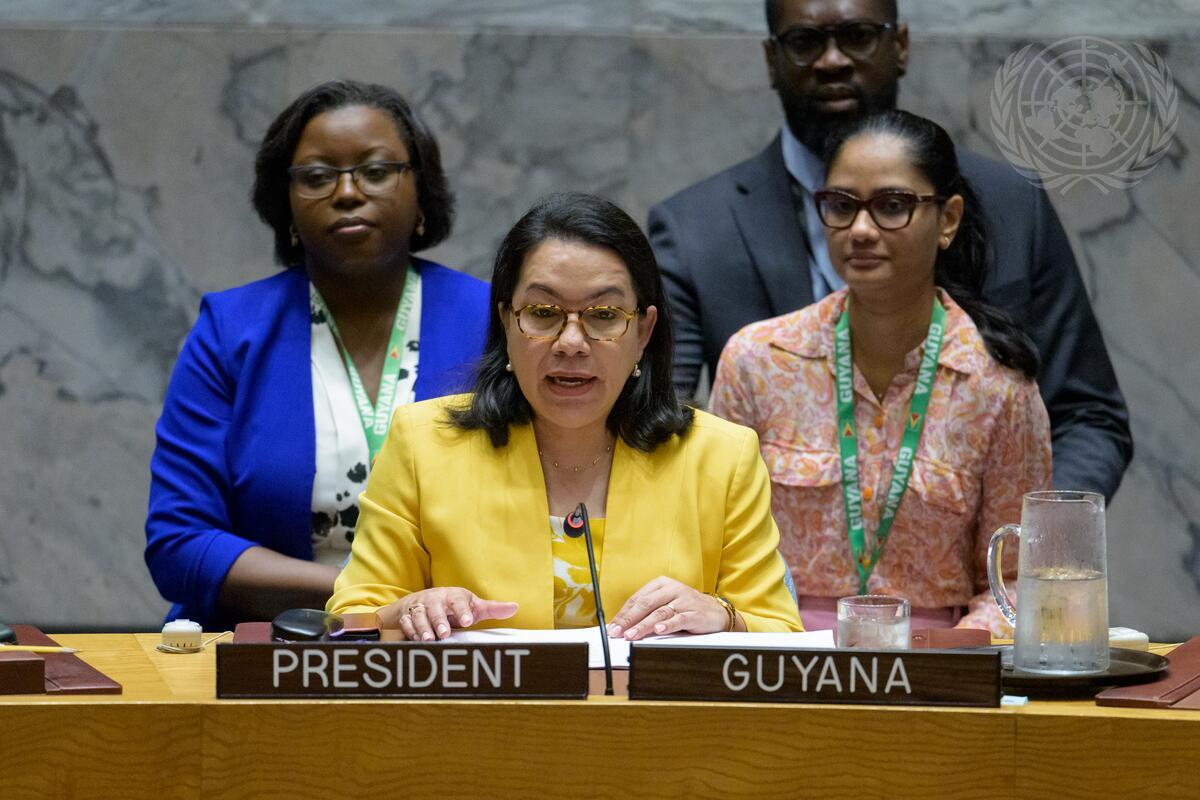
Carolyn Rodrigues-Birkett, Permanent Representative of the Cooperative Republic of Guyana to the United Nations and President of the Security Council for the month of June, chairs the Security Council meeting on threats to international peace and security.

Why the Caribbean now

Latin America and the Caribbean share the hope that the next secretary-general will come from our region. Latin America has held the office. The Caribbean has not. In Carolyn Rodrigues-Birkett of Guyana, the Caribbean now offers a candidate whose outlook was formed by this sense of life. She has served as Guyana’s foreign minister and as its Permanent Representative to the United Nations.

The General Assembly appoints the Secretary-General. Its members have worked for a more open and transparent selection. They secured public dialogues with candidates and published candidacies. The Assembly should now use the voice it has earned. Its members should state clearly the qualities this moment demands. They should ask the Council to recommend a candidate who possesses them.

A record bigger than its size

The Caribbean’s claim rests on its record as well as its outlook. Caribbean states have given the multilateral system more than their size would suggest. In 1989, Trinidad and Tobago revived the proposal for an international criminal court at the General Assembly. Shridath Ramphal of Guyana led the Commonwealth through the final years of the struggle against apartheid. Caribbean governments were early and consistent opponents of that regime. In the climate negotiations, Caribbean members of the Alliance of Small Island States helped secure the 1.5-degree goal in the Paris Agreement. Barbados has since led the case for reform of the international financial system through the Bridgetown Initiative.

This pattern is consistent. Caribbean states advance ideas that serve the wider membership. They build coalitions across regions. They carry their arguments on principle, because they lack the means to carry them by force.

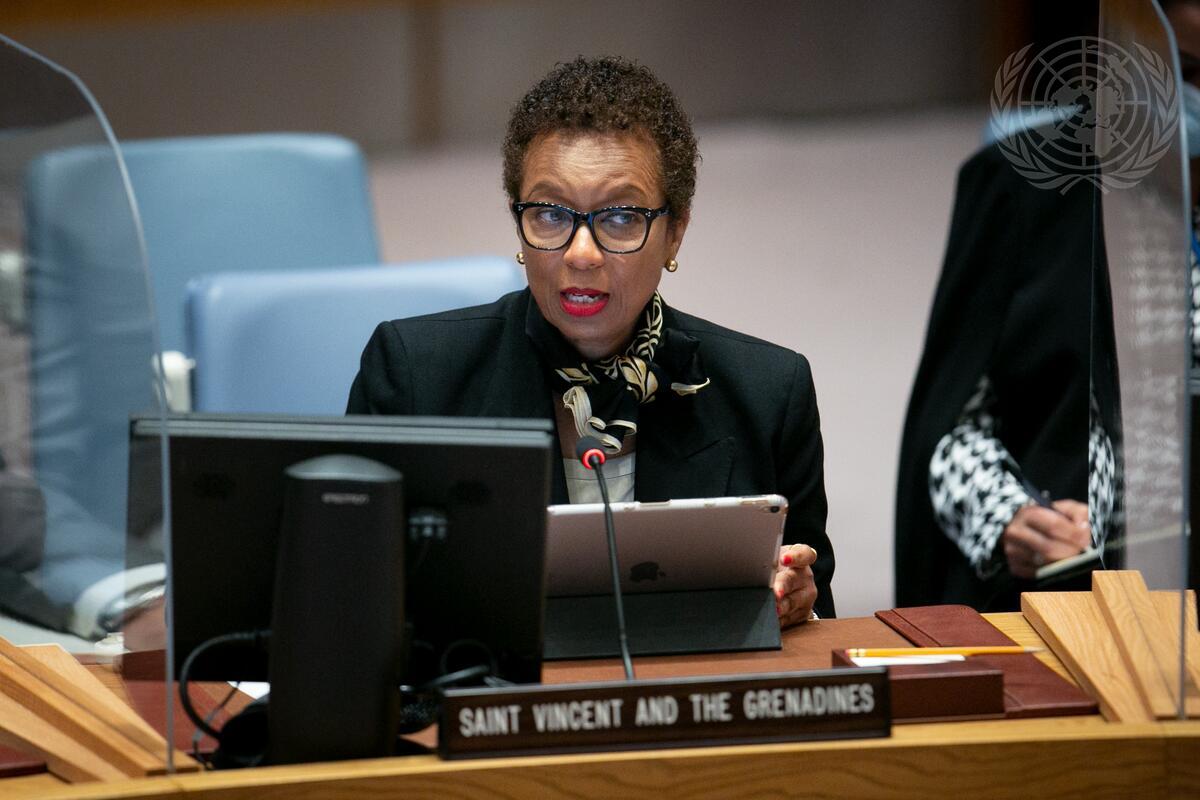
Inga Rhonda King, former Permanent Representative of Saint Vincent and the Grenadines to the United Nations, addresses the Security Council meeting on maintenance of international peace and security on the theme Climate and Security.

What the Security Council already knows

The same pattern appeared on the Security Council. In 2020 and 2021, Saint Vincent and the Grenadines served as the smallest state ever elected to the Council. I represented my country during that term. We joined the three African members in the A3+1 arrangement, which gave Africa and the Caribbean a common voice on matters affecting both. Guyana carried that arrangement into its second edition during its Council term in 2024 and 2025. Carolyn Rodrigues-Birkett led Guyana’s delegation throughout. She sat at the Council table with each permanent member. She negotiated on the most difficult files of the period, including the situation in Haiti. She is therefore a candidate who knows the Council from within.

The permanent members of the Council hold a particular responsibility. They will shape the recommendation. They also have the most to gain from a secretary-general able to mediate among them. The Caribbean is well placed to provide one. It carries no great-power ambitions. It threatens no permanent member’s interests. Its states maintain working relations with each of the five. The United Kingdom and France share long histories with the region, and France remains present in it today. The United States is its closest neighbor. China and Russia are partners in its development. A secretary-general from the Caribbean would owe no permanent member a particular debt. The permanent members have also worked directly with this candidate, and they know her conduct at the Council table. I ask them to weigh that carefully.

The Organization is now eighty years old. It has had nine Secretaries-General. None has come from the Caribbean. The region has given the Organization its ideas and a steady commitment to multilateral cooperation. It now offers a candidate prepared by that tradition for the demands of this moment. The General Assembly should say so clearly, and the permanent members should heed it. It is time to ask the Caribbean to lead the Organization.

 I. Rhonda King is the former Permanent Representative of Saint Vincent and the Grenadines to the United Nations (2013 to 2026) 


Source: NEW ROOMS SITE

Abary farmers fear new Hope-like canal could cripple farming

0


…demand govt. consultation

(Kaieteur News) – Several rice and cattle farmers in Abary, Region Five, are up in arms over ongoing excavation works on their lands, claiming they were not properly consulted before works began on a new canal.

The farmers said excavators moved onto the lands about a week ago, leaving them concerned about how the project will affect their farming operations, access to their lands and drainage.

Abary farmers fear new Hope-like canal could cripple farming

Farmers of Abary, Region Five are concerned about the construction of a canal they believe will disrupt their livelihood.

The ongoing works appear to be part of the construction of the Hope-like canal planned for the left bank of the Abary.

The government has said the Hope-like canal programme in Region Five is intended to improve drainage and irrigation, benefit existing agricultural lands and open up new lands for farmers.

However, farmers at Abary said the current works could create more problems for those already cultivating rice and rearing cattle in the area.

A 72-year-old farmer, who said he holds a 50-year lease for the land, said he became concerned after noticing the excavators about a week ago and sought answers from the relevant authorities.

Abary farmers fear new Hope-like canal could cripple farming

Excavators at work at the location for the Hope-like Canal.

Abary farmers fear new Hope-like canal could cripple farming


He said he attempted to meet with officials of the Mahaica-Mahaicony-Abary (MMA) but was unable to get clear answers about the project.

“After this thing happened, I go into the authority and tried to see the general manager, they said he ain’t deh. They said the chairman (of the Mahaica-Mahaicony-Abary [MMA]) gon’ come. I said ‘Mr. chairman, something is going on there’, he said he knows nothing about it. I said ‘who we gon’ go to? Any problem that happen, we does go to MMA, now you know nothing?’” he said.

The farmer said he later contacted a female engineer attached to the agency and questioned whether the proposed works would allow water to pass from the backlands to the main creek, but claimed she was unable to provide an answer.

Another farmer said his main concern was access to his produce once the canal is constructed.

“All me concern is, how I gon’ reach over from there to over here with my produce, and then I have to cross another creek. How will I do that?” he asked.

He also complained that farmers were not being given an opportunity to provide input before projects were implemented.

“Even if you tell them, them does tell you what they done plan. It doesn’t make sense you tell them anything, they already planned it,” he said.

“We are being bullied and victimised. This is not right. We are here for decades. You should have come and let us know what is going on.”

Another farmer, who said he has been planting at the location for more than 15 years, feared the project could make it difficult for farmers to continue operating.

“This what they are doing here, we gon’ can’t plant. All the lands will be abandoned, because this dam, we gon’ can’t travel with we paddy. How you gon’ travel with your paddy on the dam? And then the dam gon’ block the water. We won’t get drainage,” he said.

A farmer involved in both rice cultivation and cattle rearing also questioned the location selected for the canal.

“This trench dig at the wrong place. Meet with the people and let us put it at the right place. Come with the people and let us suggest where it got to dig. It can’t dig there; it will block everybody. The cattle farmer and the rice farmer,” he said.

One farmer also criticised the government’s 2026 National Budget, pointing to its stated commitment to “putting people first.”

“We have to repeat what the 2026 big document has: “putting people first.” This is a demonstration of not even considering people’s view and their livelihood.” he said.

Some of the farmers said they have been occupying or cultivating their lands for decades and that recent developments have already caused some to slow down their operations.

Regional Chairman of Region Five, Recardo Phillips, confirmed to Kaieteur News on Sunday that the site is earmarked for the Hope-like canal.

Asked whether consultations had been held with the affected farmers, Phillips said that since he assumed office as regional chairman, comprehensive consultations had been conducted by the National Drainage and Irrigation Authority (NDIA).

The canal forms part of a wider government drainage and irrigation programme in Region Five. In January, President Irfaan Ali said the Hope-like canal investment would improve drainage across approximately 186,000 acres between Mahaica and Abary, while opening up additional agricultural lands.

Opposition Leader Azruddin Mohamed, who visited the area on Sunday, said the works could affect hundreds of farmers who have cultivated rice and reared cattle there for decades.

“What you see happening here, this will affect hundreds of people that plant rice, that have their cattle in here for over forty, fifty years. And these lands belong to the people. It’s not state lands,” Mohamed said.

He accused the PPP/C administration of bullying farmers and linked the situation to a wider attempt to take control of privately occupied lands.

WIN Member of Parliament Natasha Singh-Lewis, who accompanied Mohamed, also questioned the positioning of the canal.

“Everybody is asking where their cattle will get water from, and when the water come up, how will you move your cattle, and where will the cattle sleep, in the water?” she said.

The farmers are calling either for the works to be halted or for further engagement with those who could be affected, with the aim of finding an alternative location that would not disrupt their farming activities.

Mohamed also urged the farmers to remain vigilant.

“That is what this government wants to do, force you off of your own land, and then they are gonna move in and take the lands away,” he said.


Source: Kaieteur News

Cuban national stabbed to death at Land of Canaan Shipyard

0


(Kaieteur News) – Police are investigating the alleged murder of a 37-year-old Cuban national who was fatally stabbed during an argument at a shipyard at Land of Canaan, East Bank Demerara, on Saturday night.

Dead is Luis Angel Rodriguez Guillen, who was employed at the shipyard.

According to preliminary investigations, Guillen and a 32-year-old Cuban national, also employed at the shipyard, were involved in an argument at about 23:00hrs which escalated into a physical altercation.

During the altercation, the 32-year-old allegedly armed himself with a knife and stabbed Guillen once to his chest.

Guillen subsequently collapsed in the hallway of the workers’ quarters.

Other workers at the location reportedly restrained the suspect and handed him over to the police. He was arrested and remains in custody.

A knife suspected to have been used in the incident was recovered and lodged as evidence.

Guillen was taken to the Diamond Regional Hospital, where he was pronounced dead by a doctor.

His body was subsequently taken to the Memorial Gardens Funeral Home, where it awaits a post-mortem examination.

The suspect remains in police custody as investigations continue.


Source: Kaieteur News

GFF and Aspire Zone Foundation sign MOU to advance Football Development in Guyana

0


Doha, Qatar – The Guyana Football Federation (GFF) and Aspire Zone Foundation (AZF) have signed a Memorandum of Understanding (MoU) aimed at strengthening football development in Guyana across several key areas, including: Youth national team development, Grassroots football programmes, Football infrastructure development, Technical and coaching development, Player development and performance assessment, Knowledge and expertise exchange and Commercial partnership opportunities.

The agreement was signed at Aspire Zone Foundation headquarters in Doha by GFF President Wayne Forde and Aspire Zone Foundation Acting Chief Executive Officer Abdulla Nasser Al-Naimi.

GFF and Aspire Zone Foundation sign MOU to advance Football Development in Guyana

GFF President, Wayne Forde, with Aspire Zone Foundation Acting CEO, Abdulla Nasser Al-Naimi (Photo: GFF Facebook)

A major focus of the partnership will be the development of Guyana’s Under-14 and Under-17 national teams, with Aspire providing technical and coaching support, player development expertise and performance assessment. The two organisations will also explore opportunities for both teams to participate in training camps at Aspire’s facilities in Doha, in line with agreed programmes and facility availability.

GFF President Wayne Forde said: “Youth development is at the heart of the Guyana Football Federation’s mission, and following the historic success of our Under-14 Boys in the CFU Challenge Series, we are eager to work with Aspire Zone Foundation to ensure these young players continue to develop and gain exposure to professional football development programmes.”

“We are deeply grateful for the friendship and goodwill we have developed with our colleagues at Aspire, and we look forward to working closely together to advance the spirit of this partnership and create meaningful pathways for the next generation of Guyanese footballers.”

GFF and Aspire Zone Foundation sign MOU to advance Football Development in Guyana

GFF President, Wayne Forde, and Aspire Zone Foundation Acting CEO, Abdulla Nasser Al-Naimi, were observed inking the agreement (Photo: GFF Facebook)

Aspire Zone Foundation Acting Chief Executive Officer Abdulla Nasser Al-Naimi said: “Aspire Zone Foundation is committed to playing an active role in supporting our partners in their pursuit of sporting excellence.”

“We are delighted to collaborate with the Guyana Football Federation to help advance the game, exchange knowledge and expertise, identify emerging talent, and support the development of everyone involved in Guyana’s football ecosystem.”

“At Aspire, we take pride in helping shape high performance standards, ensuring they are sustained over time, as we support our partners in reaching new levels of excellence.”

As part of the MoU, Kotinos (Aspire Sports Consulting and Management) will lead advisory services, including an assessment of Guyana’s football ecosystem, the identification of development opportunities and the preparation of a roadmap to support the agreed areas of cooperation.

The partnership reflects the shared commitment of the GFF and Aspire Zone Foundation to strengthening youth pathways, football infrastructure, technical capacity and long-term development opportunities for the advancement of football in Guyana. (GFF)


Source: Kaieteur News