The Republican Gym’s return to competitive boxing ended in championship glory, as the prisoners captured the overall team title at the Guyana Boxing Association’s (GBA) Andrew Lewis National Novices Championship, which concluded Sunday evening at the Cliff Anderson Sports Hall.
Republican Boxing Gym accumulated 32 points to finish as champion gym, finishing ahead of the Guyana Police Force Boxing Gym on 25 points.
The victory ended decades of dominance by the Guyana Defence Force at the tournament. The army surprisingly did not participate.
The overall win marked a significant return to the amateur boxing scene for Republican Gym under veteran coach Wincell Thomas, whose fighters produced a series of strong performances throughout the three-day tournament, which ran from September 25-27.
Adding further distinction to Republican’s successful campaign, Ezekiel Gordon was named the tournament’s Best Boxer, while Thomas was rewarded for his coaching performance with the Best Coach award.
Gordon justified his individual honour with a composed and impressive run through the middleweight division.
He stopped Police boxer Elijah Burrows in the second round in their opening encounter before advancing by walkover against fellow Republican fighter Noah Beaton.
Republican Coach Wincel ‘Naka B’ Thomas (right) receives his Best Coach trophy from GBA president Steve Ninvalle
In the championship bout, Gordon, in the presence of prison top brass that included Director Nicklon Elliot and Deputy Director Kevin Pilgrim, produced perhaps his most significant performance of the tournament, defeating Police standout Shakeel Cox on points to claim the gold medal.
His success was emblematic of Republican’s overall showing, with the returning gym producing winners across several divisions.
Among the other Republican gold medallists were Mark Joseph, who stopped Jason Hardy in the second round at bantamweight; Rodwell Fraser, who scored a first-round victory over Police’s Sunil Parasram at lightweight; Helton Gibson, who defeated teammate Lerone Albert on points at welterweight; and Kennard Smith, who captured the light-middleweight crown after defeating Christian Joseph when the referee stopped the contest in the second round.
Republican also dominated several of the contests involving its own fighters, while its female boxers contributed valuable points.
Ezeliel Gordon (right) receives his best boxer trophy from former national champion Dexter Marques
Shania Benjamin defeated Debra Williams on points in the female light-heavyweight division, while Veronica Gordon earned a points victory over Oriomna Silva in the female super-heavyweight category.
The Police Force, meanwhile, produced a strong challenge and finished just seven points behind the champions.
Their gold-medal haul included victories from Shakeel Cox, Daquan Williams, Anthony Wills, Carl Ramsey and Colin Williams.
Cox was particularly active throughout the tournament. After stopping Jason George in the opening round of their middleweight bout, he advanced to the final against Gordon, where the Republican boxer secured the points decision.
The championship also featured a strong showing from the younger generation during the opening night, with fighters from Harpy Eagles Boxing Gym, New Amsterdam Boxing Academy, Andrew Lewis Boxing Gym and Pace and Power Gym battling for honours.
GBA President Steve Ninvalle (extreme left) shares a moment with some of the boxers
Harpy Eagles enjoyed success in the junior divisions, including victories from Natham Sugrim, Kayden Corlette and Ryan Cornette, while Andrew Lewis boxing gym boxers Imhotep Vanderstoop, Junior Madray and Josh Chester also captured titles.
Pace and Power’s Akeem Quintin took the victory in the U-13 38-41kg division.
The competition brought together boxers from Andrew Lewis Gym, Pace and Power Gym, New Amsterdam Boxing Academy, Harpy Eagle Boxing Gym, Forgotten Youth Foundation Gym, Guyana Police Force Boxing Gym and Republican Boxing Gym, providing an important platform for emerging talent to gain competitive experience.
For Republican Gym, however, the championship carried significance beyond the medals and points.
The gym’s return to the ring was made possible through a collaboration involving the Ministry of Home Affairs, the Guyana Prison Service and the Guyana Boxing Association, paving the way for prisoners to once again participate in organised boxing competition.
The initiative gave the returning Republican squad an opportunity to test itself against established boxing programmes while also demonstrating the potential of sport as a vehicle for discipline, rehabilitation and personal development.
The Guyana Football Federation (GFF) and Aspire Zone Foundation (AZF) have signed a Memorandum of Understanding (MoU) aimed at strengthening football development in Guyana across several key areas, including:
– Youth national team development
– Grassroots football programmes
– Football infrastructure development
– Technical and coaching development
– Player development and performance assessment
– Knowledge and expertise exchange
– Commercial partnership opportunities
Officials of GFF and AZF at the MoU signing (Photo: GFF)
The agreement was signed at AZF headquarters in Doha by GFF President Wayne Forde and AZF Acting Chief Executive Officer Abdulla Nasser Al-Naimi.
A major focus of the partnership will be the development of Guyana’s Under-14 and Under-17 national teams, with Aspire providing technical and coaching support, player development expertise and performance assessment.
The two organisations will also explore opportunities for both teams to participate in training camps at Aspire’s facilities in Doha, in line with agreed programmes and facility availability.
GFF President Wayne Forde said: “Youth development is at the heart of the Guyana Football Federation’s mission, and following the historic success of our Under-14 Boys in the CFU Challenge Series, we are eager to work with Aspire Zone Foundation to ensure these young players continue to develop and gain exposure to professional football development programmes.
“We are deeply grateful for the friendship and goodwill we have developed with our colleagues at Aspire, and we look forward to working closely together to advance the spirit of this partnership and create meaningful pathways for the next generation of Guyanese footballers.”
Aspire Zone Foundation Acting Chief Executive Officer Abdulla Nasser Al-Naimi said: “Aspire Zone Foundation is committed to playing an active role in supporting our partners in their pursuit of sporting excellence. We are delighted to collaborate with the Guyana Football Federation to help advance the game, exchange knowledge and expertise, identify emerging talent, and support the development of everyone involved in Guyana’s football ecosystem.
“At Aspire, we take pride in helping shape high performance standards, ensuring they are sustained over time, as we support our partners in reaching new levels of excellence.”
As part of the MoU, Kotinos (Aspire Sports Consulting and Management) will lead advisory services, including an assessment of Guyana’s football ecosystem, the identification of development opportunities and the preparation of a roadmap to support the agreed areas of cooperation.
The partnership reflects the shared commitment of the GFF and AZF to strengthening youth pathways, football infrastructure, technical capacity and long-term development opportunities for the advancement of football in Guyana.
Chief Magistrate Judy Latchman on Monday said the court will not suppress valid questions in the extradition proceedings involving Opposition Leader Azruddin Mohamed, as defence attorney Siand Dhurjon continued pressing Special Branch head Prem Narine over surveillance, the circumstances of Mohamed’s arrest and the police investigation.
Latchman made the point after the morning session of cross-examination, when prosecutors Terrence Williams and Herbert McKenzie sought clarity on when Dhurjon expected to conclude his questioning of Narine.
Dhurjon indicated that he expects to finish by the end of Tuesday, while cautioning that objections, arguments and other issues arising during the proceedings could affect that timeline.
The Magistrate said that while the court has been managing the cross-examination, legitimate questions would not be suppressed simply to bring the hearing to an earlier end, stressing that the evidence being tested could have consequences “for generations to come.”
Dhurjon continued his questioning in the afternoon, focusing heavily on how police located Mohamed shortly before his arrest and what information led Narine to the area where he was eventually detained.
Narine testified that after obtaining warrants, he had several locations checked because Mohamed was not at the locations initially being monitored.
Dhurjon questioned him about how he came to know that Mohamed was on Smyth Street and suggested that a Special Branch vehicle had followed Mohamed after he left his home.
Narine said he recalled having someone stationed at Mohamed’s home after receiving information about where he was expected to be, but indicated that the matter had been stood down.
He said he subsequently caused a search to be made for Mohamed and confirmed that he had been informed that Mohamed was on Smyth Street before he went to effect the arrest.
Dhurjon also questioned Narine about what he knew concerning the extradition request before Mohamed’s arrest.
He suggested that the police activity surrounding Mohamed had intensified from the night before October 1 and that government agencies had been working together in connection with the proceedings.
Narine rejected the suggestion that he had been aware of an extradition request the night before Mohamed’s arrest.
The defence also sought to establish whether Special Branch officers had previously arrested anyone in connection with extradition proceedings in Guyana.
Narine said he could neither agree nor disagree when asked whether he was aware of former Special Branch officers having carried out such arrests.
Dhurjon then turned to the circumstances surrounding Mohamed’s arrest, suggesting that the deployment of multiple police vehicles and heavily armed officers created a public spectacle.
The prosecution objected to those questions, and the Magistrate ruled that she did not see their relevance to the proceedings and would not allow the line of questioning to continue.
Earlier in the day, Dhurjon had questioned Narine about alleged Special Branch surveillance of Mohamed, his family and associates.
Narine acknowledged that surveillance of Mohamed had begun before the extradition request, with his recollection placing its start in early 2024.
He rejected the suggestion that anyone had instructed him to surveil Mohamed, including President Irfaan Ali.
Dhurjon had also questioned Narine about his contact with Ali at police functions and at a mosque, as well as Mohamed’s reported difficulties renewing mining rights covering more than 80,000 acres and issues surrounding licences for his vessels.
The Magistrate earlier ruled that questions concerning Narine’s professional promotions and career progression were irrelevant to the extradition proceedings.
The cross-examination was ultimately deferred, with the matter adjourned until 9 a.m. Tuesday.
Students at North Ruimveldt Secondary School now have greater access to technology-based training through a newly-established AutoCAD Laboratory that was launched on Monday.
Education Minister Sonia Parag commissioned the new laboratory at the school, stating that the lab will allow students to move beyond traditional technical drawing and gain practical experience using computer-based design technology.
She said students are now being introduced to 3D design, giving them the opportunity to develop skills that can be applied in fields such as architecture and engineering.
Education Minister, Sonia Parag during the commissioning ceremony. (Photo: News Room)
“It means for you in Grades 10 and 11, you are no longer just doing [Technical Drawing], you are also now doing 3D designs via the computers, which means you can become a very, very good architect,” the minister said.
Parag said the technology allows students to work with dimensions, improve accuracy and use their creativity to develop designs digitally. It is preparing students with knowledge and skills that reassures them the ability to become employable after graduating secondary school.
The AutoCAD lab forms part of a wider effort to expand technical and vocational education in schools. The Government plans to extend the use of the technology to other schools.
AutoCAD Lab commissioned at North Ruimveldt Secondary School. (Photo: News Room)
The minister also commissioned an AutoCAD lab at the Hope Secondary School on Monday.
“The idea is that you get the benefit of learning from technology on your own home and your own school system,” the minister said.
Dr Ritesh Tularam, the Deputy Chief Education Office (Technical), said the investment also forms part of efforts to strengthen technical education across the school system.
“For those of us who were teaching Technical Drawing way back, we were accustomed to delivering Technical Drawing using traditional methodology, our students were exposed to a drawing board and a pair of set squares…we recognise that regionally, globally, technology is now playing a critical role in the development of our students,” he said.
Dr Ritesh Tularam, the Deputy Chief Education Office (Technical)
He said the Ministry of Education is developing and retooling technical curricula, including a Grades 7 to 9 curriculum, while also working on assessment tools and training technical practitioners. Tularam said the wider objective is to ensure students can leave the school system with technical skills that can contribute to recognised qualifications, including CXC and CVQ certification.
The principal of North Ruimveldt Secondary, Coretta Dundass-Inniss, urged students and teachers to maximise the opportunity, saying the lab should be viewed not simply as a place to learn software but as a space where students can develop problem-solving and design skills and turn ideas into reality.
See below the full release from the Ministry of Human Services and Social Security:
The Ministry of Human Services and Social Security confirms that a fire at the children’s home in Plum Park has been contained by the Guyana Fire Service.
All children housed at the Plum Park location have been accounted for and evacuated. Those who experienced health issues have been taken to the Georgetown Public Hospital Corporation for medical attention. The other children have been relocated to a safe space.
The Ministry continues to monitor the situation closely. The safety, health, and welfare of the children remain our immediate priority.
We thank the Guyana Fire Service for its response and all those assisting with the evacuation, care and protection of the children.
Further updates will be provided as verified information becomes available. We ask members of the public to respect the privacy of the children and refrain from sharing unverified information or images that could identify them.
The Ministry reiterates that all children housed at the Plum Park location have been accounted for.
The Guyana Fire Service says firefighters have managed to extinguish the Monday night blaze at the Children and Family Home, Plum Park, Sophia, Greater Georgetown.
In a release, the GFS said firefighters observed the fire on the top floor of the female dormitory.
“Through swift, coordinated efforts, they brought the blaze under control and extinguished it, preventing further spread,” the GFS said on Monday night.
The firefighters are currently conducting mop-up operations, which include checking for hidden pockets of fire and ensuring the building is safe from possible reignition.
It was also noted that all of the residents are accounted for; however, nine of the children suffered from smoke inhalation and were treated by the EMTs and were transported to the Georgetown Hospital for further treatment.
Investigations have commenced to determine the origin and cause of the fire.
In a separate release, the Ministry of Human Services and Social Security said it is monitoring the situation closely.
“The safety, health and welfare of the children remain our immediate priority.
“Further updates will be provided as verified information becomes available. We ask members of the public to respect the privacy of the children and refrain from sharing unverified information or images that could identify them,” the ministry said.
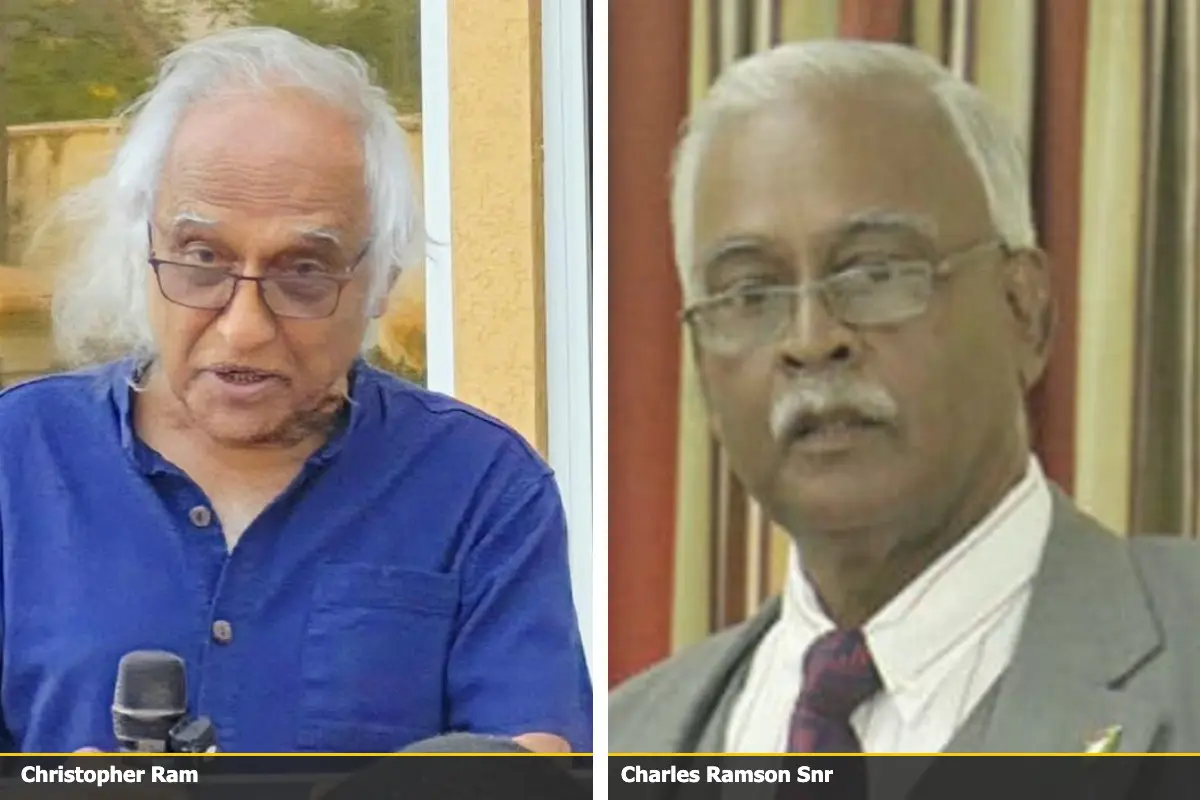
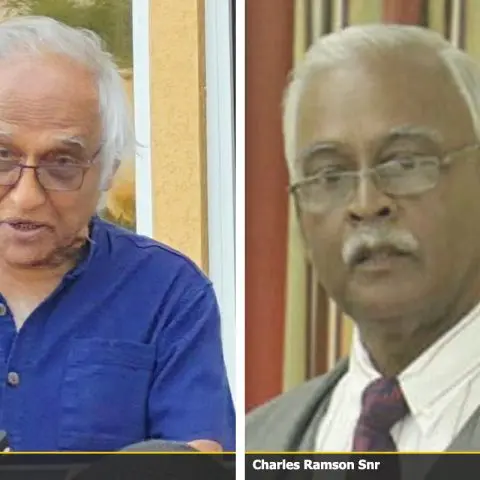
Justice Nicola Pierre yesterday ordered the Commissioner of Information Charles Ramson Snr. to process and determine within 60 days three requests for information by commentator Christopher Ram.
The judge’s ruling following a judicial review application on 19 June 2025 by Ram in relation to the functioning of Ramson’s office will be seen as a major victory for civil society. Ram had led a series of protests for Ramson to comply with requests for information on ExxonMobil’s tax affairs and other areas. Ramson had resisted these requests and Ram then filed a judicial review application.
Justice Pierre ordered that Ramson shall process and determine each of the three requests in accordance with the Access to Information Act 2011, including sections 18 to 26 insofar
as applicable, and in accordance with the interpretation of the Act contained in her judgment.
The determinations shall be made and communicated to Ram within sixty days of yesterday’s order.
If access to any requested document is granted, the Commissioner shall provide access in accordance with the Act. If access is refused, or if the Commissioner determines that a requested document does not exist or cannot, after a thorough and diligent search, be located, the judge said that the Commissioner shall comply with section 23 of the Act and provide the Applicant with the written notice and reasons required by that section, including the Applicant’s right to apply to the High Court for judicial review.
The judge said that the declaration sought by Ram that the Commissioner failed to comply with section 23 by failing to provide reasons for a substantive refusal is refused, there being no
evidence of an actual substantive refusal decision to which section 23 applied at the relevant time.
Ram also won costs which are to be assessed.
In her ruling Justice Pierre found a lack of candour on the part of Ramson on the question as to whether he had received the requests for information from Ram and said that this was “particularly ironic and lamentable in proceedings concerning the Access to Information Act and the Commissioner of Information”.
Another of Ram’s requests had related to the statutory annual report that Ramson was supposed to submit to Parliament listing the various requests received for information among other things. Such reports have never been submitted to Parliament by the long-serving Commissioner of Information.
Adverting to casuistry in one of Ramson’s rejoinders, the judge said that the section 44 annual report is not a document which Ram has asked the Commissioner to create or to compile for the purposes of answering the request.
“It is a document which the statute itself requires the Minister to prepare and lay before the National Assembly. Its subject matter is the operation of the very Act under which the request for access
is made. The Act itself prescribes that the report is to contain information concerning requests made to the Commissioner and other matters concerning the administration of the statutory
access regime.
“The March 12 request therefore was not, as the Commissioner characterized it in his letter of 24 March 2025, an ‘absurdity’ by which the Commissioner was being asked to ‘self-oversee!’
“Nor was it an attempt to place the Commissioner in the position of determining the propriety of his own conduct. That is not the Commissioner’s role under the Act in any event, his is not
the power to ‘oversee’ public authorities but to be ‘a clearing house for processing requests’ for information made under the Act [s.5(2)]”, the judge said.
The judge said that the request sought existing records and information concerning the operation of a statutory scheme, information which the Act specifies must be collected, compiled and given to the Minister and must be included in reports which the Act itself requires to be prepared and laid before the National Assembly.
Ramson’s argument in court was that his office fell outside of the definition of a “public authority”. Justice Pierre disagreed.
She said that she did “not accept the respondent’s argument that the Commissioner falls outside the definition of “public authority”. In my view the Commissioner of Information falls within the
statutory conception of a public authority. The office exercises statutory functions on behalf of the State, is financially and administratively supported through Government, and operates
within a statutory reporting structure for which the Minister bears responsibility to the National Assembly.
“I find that the Commissioner of Information is a public authority within the meaning of section 2 of the Access to Information Act 2011”.
The judge also disagreed with Ramson’s argument that the Access to Information Act required Ram, as a precondition to invoking
the statutory process, to first apply to the public authority believed to hold the information and obtain a refusal.
“I find no such requirement in the Act. The Commissioner mandated that the applicant prove he had applied for the information at its source, and referred to section 15 as
imposing that requirement. The commissioner clearly misunderstood the statutory scheme”, the judge found.
Ram last night welcomed the judge’s ruling.
“I welcome Justice Pierre’s ruling, which I believe is the first court test of the Access to Information Act since it was passed in 2011.
Because of the conduct of the Office of the Commissioner of Information, many Guyanese had come to believe that the office was beyond reach. The Court has now made clear that the Commissioner is a public authority, bound by the Act and answerable to the courts. He cannot send applicants away to ask the very ministries that hold the information.
This matter concerns disclosure of the taxes paid by the Government of Guyana on behalf of ExxonMobil and its partners, matters of the highest public interest. The Commissioner must now decide my requests within sixty days and, if he refuses, give his reasons in writing, which I can challenge.
“Whatever the Commissioner’s earlier conduct and reservations, I hope he will now perform his statutory functions and help create the space for information on public affairs to flow freely. Democracy depends on it”, he said.
He thanked his attorneys Khemraj Ramjattan and Andriska Thorington for their representation.
Ramson, a former attorney general, was represented by attorney Pauline Chase.
For years, a number of persons have complained about the flippant and dismissive attitude of Ramson to requests for information. There had been an attempt to remove him during the APNU+AFC administration but this failed and he was restored to his position in 2020 by the PPP/C government. The government has not sought to hold him accountable for his annual reports and in this year’s budget voted funds again for him without addressing why he was not complying with the requirements of the Act.
You reached the end of this article without encountering a paywall.
That is deliberate. We believe reliable journalism about Guyana should be available to everyone from the hinterland to the coast, including those who cannot afford to pay for it. But investigating, reporting and publishing every story takes time, energy and resources. Keeping our journalism open depends on the commitment of readers who can chip in and contribute to help cover the cost for everyone.
Please join the Kiskadee family by taking a subscription. Every contribution counts to our commitment to our journalists, to our readers, and to independent, public-interest journalism.
And please spread the word. One one dutty build dam!
For the second year in a row, two leading Caribbean voices laid bare disparate paradigms on international cooperation and multilateralism. Speaking with an eye toward their respective countries’ and the region’s most pressing transnational challenges, they shared their visions for all the world to see.
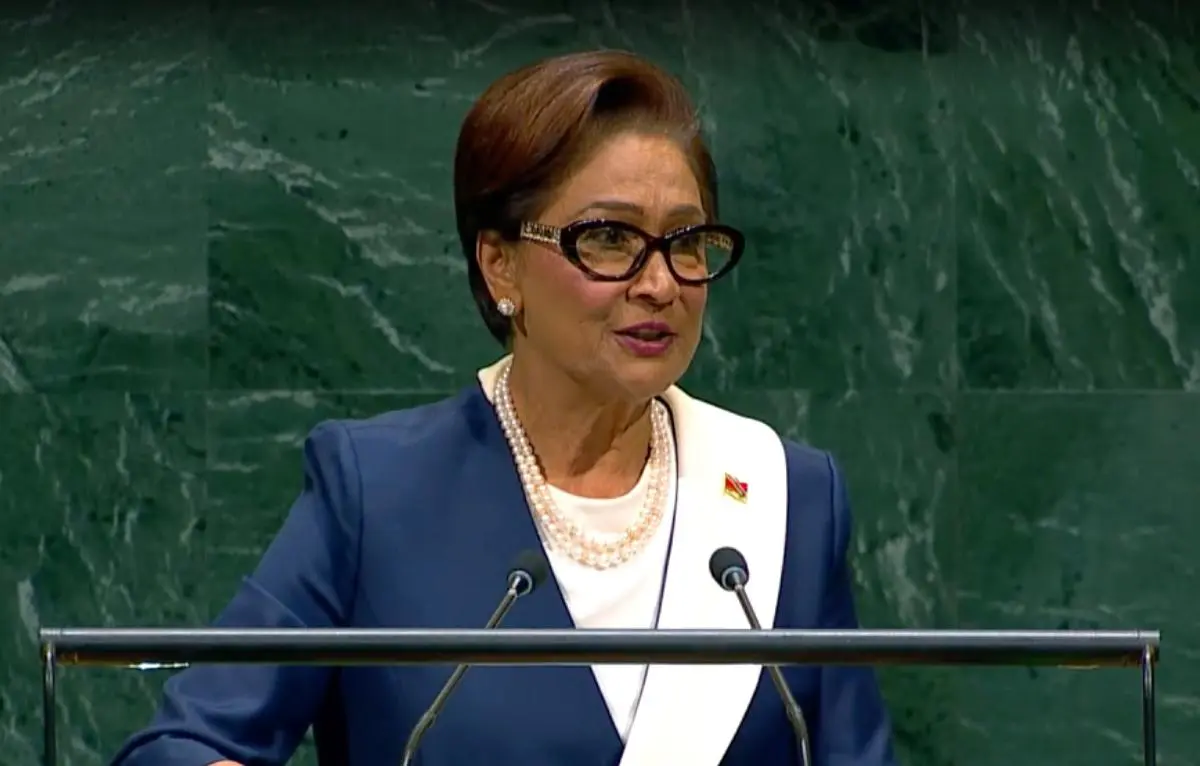
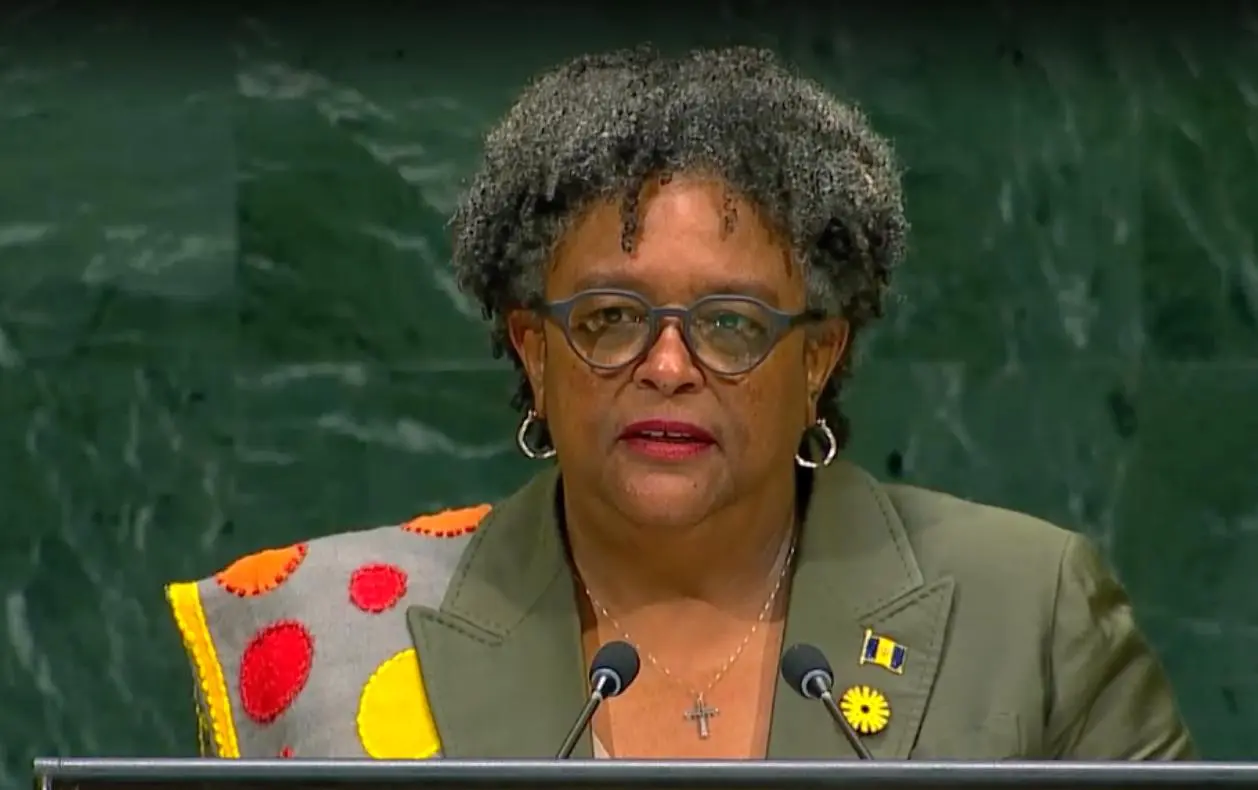
Trinidad and Tobago‘s Prime Minister Kamla Persad-Bissessar addressed the United Nations (UN) on September 22, followed by Barbados‘ Prime Minister Mia Mottley two days later. Together, these speeches offer a direct window into their countries’ foreign policy priorities and global stances.
Each address was used to different effect to help establish this picture.
Persad-Bissessar framed the world ‘as it is’, building out a transactional narrative for the conduct of international relations that is at once attuned to the existing structures and dynamics of global power.
For her part, Mottley critiqued the historical forces that shaped our current world. By drawing attention to unequal power relations throughout history, she illuminated her country’s ambitious foreign policy.This agenda centers on an emancipatory narrative, which targets a rigged multilateral system, highlighting how major international institutions consistently fail vulnerable nations.
Persad-Bissessar has provided little to no backing for this narrative. This suggests a disagreement between Port of Spain and Bridgetown over how small states — specifically Small Island Developing States (SIDS) and low-lying coastal nations — ought to wield agency in international politics.
No wonder, then, there is little basis in reality for the expectation that Bridgetown and Port of Spain could take a clear position on the roots of — and the way out of — the current crisis of multilateralism.
Growing foreign policy-related rifts
Bridgetown and Port of Spain are thus worlds apart on the multilateral system’s prospects for a turnaround, highlighting a powerful new foreign policy-related cleavage between the 14-strong sovereign member states that comprise the Caribbean Community (CARICOM).
As leading members of this bloc, Barbados and Trinidad and Tobago have fundamentally altered global perceptions of how this regional grouping of small states (as SIDS) can practically carve out a collective path to navigate international economic and/or security policy shifts.
The bloc’s constituent treaty enshrines the coordination of member states’ foreign policies as a core pillar. Yet, by aligning with the Donroe Doctrine, Trinidad and Tobago has drawn the ire of virtually all its sister CARICOM member states, fueling friction with the bloc.
A recently issued CARICOM Secretariat news release that references the 26th Special Meeting of the bloc’s Council for Foreign and Community Relations (COFCOR), held on September 21, downplays the true complexity of holding such a meeting at this juncture, let alone the likelihood that it can work through policy areas of contention. (An organ of CARICOM, COFCOR is the primary vehicle for the coordination of its member states’ foreign policies.)
Competing national interests are now the order of the day. CARICOM’s divisions over Cuba are especially telling of this reality, which has eroded traditional regional consensus regarding this largest island in the Caribbean Sea.
A long-standing friendly nation to this bloc, Cuba is in the grips of one of its most severe multi-dimensional crises in decades.
With Cuba currently in Washington’s crosshairs, Trinidad and Tobago has repeatedly kept its distance from CARICOM statements criticizing the tightening economic and commercial restrictions imposed on this republic.
Trinidad and Tobago has solidified its position as one of Washington’s most pivotal strategic allies in the Latin America and Caribbean region, aligning tightly with the United States across major security, trade and energy policy spaces. It has emerged as a critical component in Washington’s rollout of the Donroe Doctrine, which hinges on the U.S. 2025 National Security Strategy and 2026 National Defense Strategy.
A tale of two UNGA speeches
Speaking at the 2026 UN General Assembly High-level Week, Persad-Bissessar announced a major foreign policy shift: Trinidad and Tobago is tightening its strategic alliance with the United States to fight transnational organized crime. To address such a shared threat, she strongly endorsed U.S. military and counter-narcotics operations in the wider region.
Kamla Persad-Bissessar (Photo courtesy of the UN Secretariat)
Trinidad and Tobago’s securitized approach to multilateral cooperation prompted the Trump administration to invite the nation into key U.S.-led security initiatives, including the Shield of the Americas and the Americas Counter Cartel Coalition (ACCC).
Trinidad and Tobago views its participation as vital to dismantling the sophisticated weapon- and drug-trafficking syndicates that directly threaten its citizens and state institutions.
For Port of Spain, then, national security (specifically, a law-and-order-driven domestic policy agenda) and geopolitical rent-seeking are the driving forces for its foreign policy positioning and security cooperation with Washington.
Looking ahead to Trinidad and Tobago’s 2027–2028 UN Security Council (UNSC) term, Persad-Bissessar pledged that her administration would push for stronger global cooperation to curb illicit arms flows and counter emerging technological threats.
By securing a non-permanent UNSC seat for only the second time, Trinidad and Tobago elevates its global profile.
During her UNGA speech, Persad-Bissessar also stated, “We will approach our tenure with an independent and practical outlook, working constructively with all members of the Council and seeking common ground wherever possible.” Trinidad and Tobago’s milestone UNSC seat naturally invites closer scrutiny of its foreign policy, Security Council chamber conduct and behind-closed-doors consultations. Ultimately, this spotlight ties the nation’s strategic alignment with the U.S. directly to prevailing concerns.
Mottley’s most urgent priority at the aforesaid High-level Week was to place the crisis of multilateralism in a deeper context: amplify calls to protect and fairly manage the global commons, not least because small states are disproportionately affected by decisions they have little hand in making. Barbados’ national statement, therefore, pressed for meaningful and impactful changes within the UN — including restructuring the UNSC — to make it more responsive to such calls, underscoring collective responsibility.
Mottley is urging global reforms to ensure small island nations do not lose their voice amidst today’s geopolitical power shifts.
Lacking a seat at the proverbial table, such nations ultimately suffer from opaque decision-making.
Connecting UN reform to power and representation, Mottley argued that current international structures must evolve. She noted that these systems still reflect outdated post-World War II dynamics and priorities, leaving them ill-equipped for modern existential threats.
Through the Barbados-spearheaded Bridgetown Initiative, Mottley has called for the World Bank to expand its mandate in three key areas: explicitly funding climate adaptation, widening access to concessional finance for vulnerable nations and expanding natural disaster clauses to pause debt repayment. She argues that this institutional evolution is vital for positioning vulnerable nations against the climate crisis — an issue UN Secretary-General António Guterres calls the “most profound intergenerational power imbalance.”
Mottley’s wide-ranging speech also underscored the risks of artificial intelligence, while reaffirming Barbados’ call for reparatory justice, among other matters in which it has a stake.
Mia Mottley (Photo courtesy of the UN Secretariat)
She also emphasized that small states depend on a rules-based international order. Rejecting geopolitical power plays that threaten to turn the Caribbean into “a theatre for confrontation or for the unilateral and unjustified use of force,” she insisted that the region must remain a ‘Zone of Peace’.
This is a direct, strategic counter-narrative to Persad-Bissessar’s speech from the same General Assembly rostrum last year, when she put the boot into the bloc’s long-standing foreign and security policy consensus on the region’s positioning as a ‘Zone of Peace’.
In short, Mottley views heavy U.S. security and military expansion in the region with serious concern. Out of concern for Caribbean nations, she has openly criticized Washington’s unilateralism. Mottley and some other CARICOM leaders argue that the rise of unilateralism poses high and very real risks to small states, significantly compounding the challenges currently faced by multilateralism.
While co-hosting the inaugural Partners for Multilateralism, International Law, Peace and Prosperity (P4M) summit on September 21, Mottley offered a sneak peek of this viewpoint. (Co-sponsored by Barbados, this high-level meeting culminated in a joint declaration reaffirming a shared commitment to multilateralism, international law, peace and prosperity amid rising global polarization.)
Such a perspective also found expression in some other CARICOM member states’ national statements, which place an emphasis on the vital role of a rules-based international order for such small states.
Jamaica’s Foreign Minister Kamina Johnson Smith captured this perfectly during her September 26 UN address, stating: “For small states like ours, a rules-based international order is not an abstract diplomatic preference. It is fundamental to our sovereignty, our security and our development.”
A study in contrasts
For all its diplomatic unity on climate change and sustainable development, along with other focal areas of global governance, CARICOM remains sharply divided on matters of security.
Having rocked the boat, but for altogether different reasons, the respective High-level Week diplomacies of Barbados and Trinidad and Tobago have borne this out.
These two CARICOM member states differ widely in their foreign policy focus and how they garner support for their priorities.
While both leaders made the case for a more responsive multilateral system, Mottley is seeking to make her mark through a focus on the need to overhaul this superstructure’s institutional apparatus and, by extension, deal with associated global power dynamics. Whereas Mottley focuses on systemic overhauls, Persad-Bissessar emphasizes institutional optimization, linked to increased accountability, as well as advancing security cooperation.
The elephant in the room
Along the way, Persad-Bissessar has launched broadsides at regional leaders who questioned Trinidad and Tobago’s diplomatic actions. One clear example is Trinidad and Tobago’s recent foreign policy choices regarding regional security and Venezuela, which gave a distinct fillip to the Trump administration’s Donroe Doctrine.
Policy disagreements over the Caribbean’s designation as a ‘Zone of Peace’ have further fractured CARICOM. This was especially apparent at the height of a months-long U.S. military buildup and naval campaign in the Caribbean Sea known as Operation Southern Spear, which drew a range of reactions from the bloc’s membership.
Over the past few months, the rapid consolidation of operational military and security ties between the United States and Trinidad and Tobago has fundamentally reshaped the regional security landscape.
While regional leaders debate the broader implications of this development, Trinidad and Tobago shows little, if any, regard for repeated calls for member states to “advance foreign policy collectively in [the] uncertain global climate” — especially when such cooperation conflicts with its national interest.
Since returning as Prime Minister of Trinidad and Tobago in May 2025, following a general election victory by her political party, Persad-Bissessar has distanced her administration from several regional foreign policy and security consensuses.
This state of affairs severely undermines decades of cooperative diplomacy among CARICOM member states, interrupting a strong, if occasionally imperfect, history of presenting a common front.
Member states of the Organisation of Eastern Caribbean States (OECS) — a like-minded, close-knit sub-regional grouping whose Protocol Members also belong to CARICOM — are undoubtedly concerned about CARICOM’s troubles.
This collective is now even more committed to harmonizing foreign policy across key OECS priorities. Meeting on September 20, on the margins of the High-level Week in question, the sub-region’s foreign ministers “reaffirmed the OECS’s commitment to a unified, forward-looking foreign policy agenda and to strengthening the region’s collective capacity to advance and protect the interests of its Member States in an increasingly complex international environment.”
Port of Spain is happy to cut its own path by focusing on the ACCC, which Trinidad and Tobago joined earlier this year, raising a host of questions.
At the Shield of the Americas summit on September 22, held on the sidelines of UNGA, U.S. Secretary of State Marco Rubio said the coalition is not just about targeting “cartels and transnational crime in the Western Hemisphere.” Athough the latter focus is its “cornerstone,” Rubio characterized this coalition as also constituting “opportunities to partner up on the economic front and the diplomatic front to speak in one voice, in unison, on issues that unite us and to be able to in international forums, as an example, potentially vote together and pool … our diplomatic resources as well to act in concert in the common interests that we share.”
This summit‘sJoint Statement on Defending Hemispheric Sovereignty, reportedly “designat[ed] 24 cartels, prison gangs, and drug trafficking groups as foreign terrorist organizations (FTOs), laying the groundwork for potential U.S. military involvement in operations across the Western Hemisphere.”
Persad-Bissessar strongly defended Trinidad and Tobago’s involvement in the coalition, framing U.S. military power as a necessary tool against asymmetric threats from transnational criminal networks.
But there is a larger story: Guyana, a CARICOM member state, is a founding member of the Shield of the Americas alongside Trinidad and Tobago. In his September 24 address to the UN, Guyana’s President Mohamed Irfaan Ali pointed out that his country partners with the U.S. and 13 other nations to secure regional peace and prosperity while jointly fighting transnational criminal networks.
A few more CARICOM member states have joined the Shield of the Americas.
In late August, Jamaican authorities advised of this northern Caribbean country’s participation in the Shield.
Belize and The Bahamas are also reportedly participating. Like Jamaica, these two CARICOM member states recently joined.
Reports also indicate that a few Shield members — mostly these three CARICOM member states — did not sign the referenced summit Joint Statement.
Furthermore, it has since come to light that rogue U.S. Drug Enforcement Administration agents were operating illegally in The Bahamas.
Guyana and Trinidad and Tobago were the only CARICOM member states to sign the aforementioned statement. They were on board with the Shield from the outset, requiring no convincing to align with this facet of Washington’s Donroe Doctrine strategy.
The exact motivations driving the new wave of CARICOM nations to join the Shield remain unclear. Some observers suggest that certain CARICOM member states may have chosen to go along to get along with the United States.
Final reflection
Deep divisions over global cooperation have fractured CARICOM. The United States, which increasingly demands painful diplomatic concessions, dominates this dynamic.
In the circumstances, for the most part, CARICOM member states are on the defensive. But there are notable exceptions that freely exert foreign policy independence.
In sum, the underlying reality is that CARICOM’s current diplomatic environment serves simultaneously as a strategic opportunity for select member states and a source of disruption for the rest. This crossroads may come at a steep long-term price for this bloc.
_____
Nand C. Bardouille, Ph.D., is the outgoing manager of The Diplomatic Academy of the Caribbean in the Institute of International Relations at The University of the West Indies (The UWI) St. Augustine Campus, Republic of Trinidad and Tobago. The views expressed here are his own.
You reached the end of this article without encountering a paywall.
That is deliberate. We believe reliable journalism about Guyana should be available to everyone from the hinterland to the coast, including those who cannot afford to pay for it. But investigating, reporting and publishing every story takes time, energy and resources. Keeping our journalism open depends on the commitment of readers who can chip in and contribute to help cover the cost for everyone.
Please join the Kiskadee family by taking a subscription. Every contribution counts to our commitment to our journalists, to our readers, and to independent, public-interest journalism.
And please spread the word. One one dutty build dam!
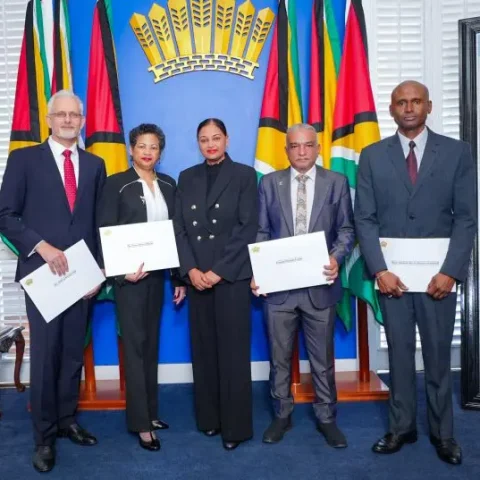
From left are Polish forensic naval architect and marine engineer Dr. Andrzej Jasionowski, Nyree Dawn Alfonso of Trinidad, Chief Magistrate Judy Latchman, Captain Hamada Fouda of Jamaica and Rear Admiral (Ret’d) Hayden Pritchard of Trinidad and Tobago after the swearing in for the Commission of Inquiry into the MV Barima disaster.
Survivors and relatives of those who died in the MV Barima tragedy may apply to participate in the Commission of Inquiry, while anyone who could face significant criticism in its report must first be warned and given an opportunity to respond, under procedural rules published in the Official Gazette.
The rules also provide for public hearings, access for the media, witness summonses and the publication of transcripts and exhibits. Issued by the five commissioners on September 9, they appeared in the September 19 Gazette and took effect on publication. They do not announce a date for the first public hearing or extend the September 30 deadline initially set for the commission’s report.
According to the rules, the inquiry has already begun its “investigative phase”. The commission is gathering and reviewing documents, inspecting physical evidence, and consulting and interviewing people with relevant information. A principal purpose of that work is to identify witnesses for the evidentiary hearings. Anyone holding original documents or physical evidence relevant to the inquiry must preserve them until the commissioners direct otherwise.
The rules permit the commission to require documents from individuals, agencies, departments and other bodies. It can issue summonses or subpoenas requiring a person to attend an interview, produce material or give evidence at a hearing. Its definition of a document extends beyond paper records to photographs, maps, plans, audio and video recordings, electronic records and other stored information.
Public hearings and access
Hearings will ordinarily be held at the Arthur Chung Conference Centre, Liliendaal, where the commission’s secretariat is also to be based. Unless the commissioners direct otherwise, sittings will be from Monday to Friday, 9 am to 4 pm. The secretary is to give notice of hearing dates, times and places, with as much notice as practicable.
Public hearings are the default. The commission may, however, hear part of the proceedings in private if it considers this necessary to maintain order, protect confidentiality or privilege, ensure fairness, serve the proper administration of justice, or for another sufficient reason consistent with its mandate. A hearing can be conducted in person, virtually or through a combination of both.
The commission is required to take reasonable steps to allow the public and media to attend or see and hear a simultaneous transmission of the proceedings. The press and broadcasters may attend, subject to directions governing the conduct of hearings. Transcripts and exhibits from public sessions are to be made available for viewing as soon as practicable through a commission website or another means it designates. Material from a private session may be released if the commission considers that to be in the public interest. It may redact records before publication to protect fairness, confidentiality, privilege, security or the inquiry itself.
Kiskadee Watch reported on September 2 that the commission was developing a website intended to serve as the public record of its work.
Participation by families and others
The Gazette rules allow people to apply for ‘standing’, which means permission to participate in the inquiry on terms determined by the commissioners. The grounds include having played a significant role in events under investigation; having a substantial personal or direct interest as a survivor, witness or victim’s relative; being at risk of significant criticism; or being able to assist the commission.
An applicant must write to the secretary, provide contact details and those of any lawyer, explain the request in no more than three pages, and include relevant documents. The commission will decide both whether to grant standing and the extent of that person’s participation. The rules set no fixed closing date for these applications.
A witness does not need standing to have an attorney present while giving evidence. A lawyer may also attend an investigative interview. The rules say counsel for a witness may intervene over inappropriate questioning or where the witness becomes distressed and needs a break.
There is no automatic right for lawyers representing participants to question other witnesses. The commission may permit cross-examination by a person with standing, or that person’s counsel, to the extent of their interest and subject to time limits.
How evidence will be handled
The commissioners can receive evidence they consider useful even if it would not be admissible in a court of law. A witness may testify in person or by video or audio link. Before someone called to testify gives evidence, the commission may prepare a statement, summary or transcript of the expected testimony and give the witness a reasonable opportunity to review it.
A signed statement can, with the commission’s permission, be adopted under oath or affirmation as the witness’s initial evidence. The commissioners may also place a written statement in the inquiry record without calling its author to testify. A witness may be recalled.
Documents received by the commission will initially be treated as confidential while it decides whether to disclose them or admit them into evidence. Relevant documents are to be disclosed to participants within a reasonable time before interviews or hearings, subject to privilege, confidentiality restrictions and commission orders. Disclosure may be staged or accompanied by redactions and other protective conditions. Anyone receiving confidential material must undertake to use it only for the inquiry and preserve its confidentiality unless the commission makes it public.
A person claiming privilege over a requested document must give the grounds for the claim, which the commission will decide. The disputed document is not to be disclosed to another party while that decision is pending.
Warning before adverse findings
The commission may send a warning letter to a person who has faced, or could face, criticism during the proceedings or in a report. It cannot include explicit or significant criticism of that person in an interim or final report without first sending a warning letter and allowing a reasonable opportunity to respond.
Commission counsel will lead much of the legal and procedural work, deal with witnesses and lawyers, question witnesses at oral hearings and assist the commissioners in bringing matters of public interest within the inquiry’s mandate to their attention. The rules describe commission counsel as appointed to assist the commission and retained by the government.
The commissioners may change hearing dates, adjust procedural time limits and amend the rules if they consider that necessary for a fair inquiry. They may also decide how to deal with a failure to comply with a rule or direction; such a failure does not automatically invalidate a step already taken.
The publication follows calls for clearer information about the inquiry’s progress. Kiskadee Watch reported in August that secretary Javed Shadick described the commission as still completing preparatory work. On September 2, the commission said it had established a secretariat, surveyed the area of the sinking, begun obtaining records from state agencies, compiled a list of potential witnesses and started preparing interviews. It invited survivors, families and others with information to contact it.
The commission is chaired by Godfrey Phillip Smith of Belize. Its other members are Captain Hamada Fouda, attorney Nyree Dawn Alfonso, retired Rear Admiral Hayden Pritchard and forensic naval architect Dr Andrzej Jasionowski. It was appointed on July 30 to investigate the July 18 sinking of the state-operated ferry while travelling from Georgetown to Port Kaituma, including the vessel’s condition and loading, the conduct of its voyage, and the search, rescue and recovery response. Seventy-three deaths have been confirmed, 76 people were rescued and others remain unaccounted for.
You reached the end of this article without encountering a paywall.
That is deliberate. We believe reliable journalism about Guyana should be available to everyone from the hinterland to the coast, including those who cannot afford to pay for it. But investigating, reporting and publishing every story takes time, energy and resources. Keeping our journalism open depends on the commitment of readers who can chip in and contribute to help cover the cost for everyone.
Please join the Kiskadee family by taking a subscription. Every contribution counts to our commitment to our journalists, to our readers, and to independent, public-interest journalism.
And please spread the word. One one dutty build dam!
The recent edition of Sources had an interview with survivors/ family members of the MV Barima tragedy, and it was heartbreaking to see the tears, hurt and trauma that were being expressed on the show. Our people continue to suffer from this national tragedy, which is the worst in the country’s history, while the government remains slow to act to help bring accountability and justice. A mother had just spoken of losing her two children and broke down in tears and I paused the recording of the show because of the heartbreak felt when some birds in the backyard began to make lots of noise. Three birds arrived and two smaller ones flew towards me and disappeared above the roof, while the larger bird sat on a perch angrily awaiting something to happen. Even the birds in the backyard could feel what the members of the current administration do not. There was so much restlessness in the air at a time when birds would have already settled in for the evening. Nature has not ignored the pain of our people. Our politicians should not. The people are losing confidence in the current administration. All Guyanese lives must matter!
Money and handouts can never replace love for our loved ones. The Ali administration has lost credibility, and they appear to have lost their moral compass. It is time to make amends by holding senior officials and ministers accountable and by ensuring that no future tragedies occur. So many tragedies in such a short period of time is unacceptable. Safety is an Achilles heel for this administration. The evidence hidden on the sea floor must be presented. There is no good reason to delay further. Those who must be held accountable cannot hide from the long arm of the law. Families are getting angry, communities are getting angry, and the Guyanese people are getting angry. Enough is enough!
If the magnitude and depth of hurt caused by this preventable tragedy does not motivate the Ali administration to act swiftly and in the best interest of our fellow Guyanese, nothing will. Where is the humanity, where is the sense of justice and urgency? The Ali administration will continue to lose face until the bodies trapped in the MV Barima wreckage have been laid to rest. This is more urgent than a new road. It is more urgent than an additional power ship. It is more urgent than travel overseas by the president. The passage of time cannot be used to distract our people from what has occurred and what is pending. A forced celebration of heritage will not cast a shadow on this national tragedy. It will not cause us to forget the pain felt and the continual hurt being experienced by our fellow citizens. Corrupt political strategy will not succeed. Our humanity demands that we continue to care and that we continue to demand justice. The Ali administration must stand with we the people and not against us.
Do what is correct, timely, urgent, and desperately needed. Act now or lose our support for and confidence in your leadership. No government can be successful without the support of the people. If the Ali administration cannot support us in a time of need how can they expect we the people to support them when they need us. Be wise and delay no further.
With sympathy for those who continue to suffer,
Mr. Jamil Changlee
Chairman
The Cooperative Republicans of Guyana
You reached the end of this article without encountering a paywall.
That is deliberate. We believe reliable journalism about Guyana should be available to everyone from the hinterland to the coast, including those who cannot afford to pay for it. But investigating, reporting and publishing every story takes time, energy and resources. Keeping our journalism open depends on the commitment of readers who can chip in and contribute to help cover the cost for everyone.
Please join the Kiskadee family by taking a subscription. Every contribution counts to our commitment to our journalists, to our readers, and to independent, public-interest journalism.
And please spread the word. One one dutty build dam!











Discussion