Efforts are being made to advance Guyana’s coconut industry to increase production, improve productivity and ensure farmers have access to more planting materials and modern cultivation practices.
Minister of Agriculture Zulfikar Mustapha is examining opportunities for greater technical collaboration as part of these efforts, including partnerships that can introduce new technologies and expertise to Guyana’s coconut farmers.
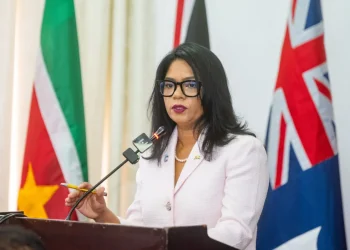
Minister of Agriculture, Zulfikar Mustapha, second from left, flanked by representatives from COHIBRA
Minister Mustapha recently met with representatives of COHIBRA, a Brazilian company specialising in technology and solutions for coconut palm production, to explore areas of collaboration that could support the continued expansion and modernisation of the local industry.
Discussions were centred on how COHIBRA’s expertise and technology could complement Guyana’s ongoing coconut development programme, particularly in strengthening production practices and improving coconut farmers’ productivity.
The agriculture minister highlighted the importance of providing farmers with improved coconut varieties and modern cultivation techniques that can help increase yields and strengthen the sector’s sustainability.
The discussions also considered the wider opportunities that can emerge from a stronger coconut industry, including increased production, the development of value-added products and expanded access to export markets.
For farmers, the focus is on increasing the number of coconut trees being cultivated, as well as building a more productive and modern industry that can create greater opportunities along the value chain, from production and processing to marketing and exports.
The engagement with COHIBRA stands as part of the government’s broader efforts to bring additional technical expertise and investment opportunities into the agriculture sector, while supporting farmers to improve productivity and benefit from new markets.
Grade 11 students preparing to sit the 2027 Caribbean Secondary Education Certificate (CSEC) examinations must complete all prescribed School-Based Assessment (SBA) requirements. The Ministry of Education today issued these instructions to all secondary schools following an advisory from the Caribbean Examinations Council (CXC).
The Ministry emphasised that Paper 3 is strictly not authorised as an SBA substitute for secondary school students for the 2027 examination cycle. Secondary schools are therefore prohibited from directing or permitting students to undertake Paper 3 in lieu of an SBA, or communicating to parents and students that such a replacement is permitted.
All Grade 11 students enrolled in CSEC subjects requiring an SBA are directed to resume or continue their assessment tasks immediately to meet the prescribed March 2027 submission deadline. Schools must allocate sufficient instructional time, guidance and supervision to ensure students refine and complete their work on schedule.
Headteachers are required to oversee the immediate resumption of SBA activities across all departments, monitor progress towards completion and provide targeted interventions for students who may need additional support. Moreover, Education Officers will be required to conduct regional school visits, review SBA progress records and engage school administration to ensure that all of our candidates are on track.
These directives clarify local requirements following advice from the CXC regarding plans to discontinue SBAs for thirteen subjects starting in 2028, with conditional implementation beginning in 2027.
The Ministry confirms that for Guyana’s 2027 CSEC cohort, all existing SBA requirements remain fully in effect.
Grade 11 students preparing to sit the 2027 Caribbean Secondary Education Certificate (CSEC) examinations must complete all prescribed School-Based Assessment (SBA) requirements. The Ministry of Education today issued these instructions to all secondary schools following an advisory from the Caribbean Examinations Council (CXC).
The Ministry emphasised that Paper 3 is strictly not authorised as an SBA substitute for secondary school students for the 2027 examination cycle. Secondary schools are therefore prohibited from directing or permitting students to undertake Paper 3 in lieu of an SBA, or communicating to parents and students that such a replacement is permitted.
All Grade 11 students enrolled in CSEC subjects requiring an SBA are directed to resume or continue their assessment tasks immediately to meet the prescribed March 2027 submission deadline. Schools must allocate sufficient instructional time, guidance and supervision to ensure students refine and complete their work on schedule.
Headteachers are required to oversee the immediate resumption of SBA activities across all departments, monitor progress towards completion and provide targeted interventions for students who may need additional support. Moreover, Education Officers will be required to conduct regional school visits, review SBA progress records and engage school administration to ensure that all of our candidates are on track.
These directives clarify local requirements following advice from the CXC regarding plans to discontinue SBAs for thirteen subjects starting in 2028, with conditional implementation beginning in 2027. The Ministry confirms that for Guyana’s 2027 CSEC cohort, all existing SBA requirements remain fully in effect.
Long before the maroon, the World Cups and the franchise contracts, there was a young girl in Ocho Rios, Jamaica chasing a ball around with five siblings and not much else. Chinelle Henry was one of six children in the household, not filled with fortune, but instead, with fun as the currency of her childhood.
“It was more boys than girls, so it was just more about having fun than anything else,”
Henry recalls. At that age, with little to go around, she found herself gravitating toward whatever kept her moving. Track and field came first, she was born in Jamaica, after all, a nation that runs before it walks.
Inspiration
If you ask Chinelle who lit the spark of her cricket ambitions, she will proudly name her father.
He wasn’t a professional by any means but played community league cricket for the love of it and never missed a chance to bring his daughter along.
“I guess that’s where the love for cricket started with him, and it’s still there to this day,” she says.
In an era when girls weren’t taken seriously in sport, cricket or otherwise, her father never wavered. Whether it was track, football, or cricket, he backed her fully. That unconditional support became the foundation on which her dreams became a reality.
Journey to International Cricket
The path to a West Indies cap was never going to be simple. Henry came up during a golden generation of Caribbean talent. The likes of Merissa Aguilleira, Anisa Mohammed, Shemaine Campbelle, and the Knight twins among them. Earning a look in with that line up, meant outworking a queue of established stars.
That call came in 2013, when she made her senior West Indies debut as a teenager in WT20I cricket vs England. Her first match did not disappoint, as she helped anchor the innings with Stafanie Taylor to take the Windies to a competitive total. England went on to level the score, forcing a super over where the Maroon Warriors turned to power-hitter Dottin who delivered back-to-back fours off the first two balls, with the third delivery called a no-ball. How about that for a debut game?!
The Hardest Opponent: Her Own Body
By her own admission, one obstacle Henry names above all others is not a bowling attack or a batting lineup, it has been injury.
Coming in as a teenager desperate to prove herself, she pushed relentlessly, unaware of what her body actually needed to sustain that level of competition. The toll was significant.
“I was kind of putting a lot on myself that led to a lot of injuries,”
she admits, reflecting that the years since have taught her lessons she wishes she had learned sooner.
Love for family
Success in international cricket comes at a cost, and for Henry, that cost was family, specifically, her grandmother.
Raised in a tight-knit household where her grandmother played a massive role in her upbringing, Henry describes herself as the sheltered grandchild, and the “favourite” her cousins teased her about being. Stepping away from that support system, for weeks, sometimes months at a time remains, in her words, the hardest sacrifice she’s made for West Indies cricket. Even now, years into her career, that distance hasn’t gotten easier.
Rebuilding Around Her Strengths
The last three years mark a turning point for Chinelle, not through reinvention, but through refinement. Rather than reshaping herself to fit a system, she turned inward: studying her own game, identifying her genuine assets with bat and ball, and doubling down on them.
“It’s about strengthening my ability, my strengths,” she explains. “I think over the last three years I’ve been able to do that.”
Understanding herself as an individual meant putting in real mental work alongside the physical. The freedom to simply go out and “be me”, she said.
Outside of the maroon, Chinelle has joined a very small group of West Indian Women to play in franchise cricket. With her franchise deals around the world, it provides a marker of just how far her game has come since those early days.
Every innings carries her grandmother’s pride and the passion her family first showed her at community league games all those years ago. Time and again, Henry keeps proving that a little girl from Parry Town can create magic on the big stage.
“Well it’s definitely getting closer and closer to landing at the stadium and playing straight.” Fewer statements sum up the demands of modern-day scheduling as well as Virat Kohli’s did in 2020, after the Indian team landed in Auckland for a T20I scheduled five days after an ODI against Australia in Bengaluru. The current T20I setup led by Shreyas Iyer could perhaps relate to that thought, for three days after clinching the Asian Games gold in Japan, they will embark upon a five-match rubber against West Indies at home. And there’s a sense of deja vu to what’s next: five days after wrapping up this series – in Bengaluru – India will face New Zealand in Christchurch. The challenges that a short turnaround between travel, recovery and the match itself present are not new, however. And on the back of a gold-medal triumph in Nisshin that extended India’s winning run in the format to nine in completed fixtures, there is enough reason to believe that the reigning world champions would be eager to keep the juggernaut rolling. New Zealand might present the bigger challenge – and increased scrutiny too after the disappointment of the UK tour. But India will know just as well the competitiveness that West Indies bring in the shortest format – something that the visitors displayed at various stages of the one-day leg as well. Despite the core of India’s World Cup winning-team kept intact, individual consistency has proved to be fledging. Rectifying that will make for a good start, while they will be desperate to tidy up on the field after 14 misfields across the semifinal and final of the Asian Games. Consistency is precisely what has deserted West Indian cricket for long. But considering the pedigree of players who have arrived for the T20 leg, there is little to doubt their ability to win matches. West Indies’ most recent T20 series culminated in triumph over Sri Lanka, prior to which they enjoyed a largely respectable World Cup campaign until India, inspired by Sanju Samson, delivered the knockout punch in Kolkata. A good showing in this series will not necessarily settle scores, but it will contribute significantly to the cause of re-establishing themselves as one of the premier powerhouses in the format. When: India vs West Indies, 1st T20I, October 6, 2026, 7 PM IST Where: BRSABV Ekana Cricket Stadium, Lucknow What to expect: A few spells of rain are forecast for the day, but the weather is expected to be clear during match hours. The Ekana wicket has been a curiosity over time: India took 19.5 overs to chase 100 against New Zealand in the last completed T20I at the venue in 2023, but that was before the surfaces were re-laid. It was a tale of two halves in IPL 2026. Unlike the featherbeds across most other venues, Lucknow was one of the more bowler-friendly wickets in the first half with considerable movement and bounce aiding the pacers, before the pitches flattened out considerably in the second half. The rain on the radar could leave some moisture in the surface, so expect some assistance for the seamers early on. Team news India India’s strategy of including the extra batter in Vaibhav Sooryavanshi over Arshdeep Singh’s pace proved to be a masterstroke on Nisshin’s slower decks that made batting difficult in large swathes. But expect the hosts to revert to a familiar combination at home, with Arshdeep set to lead the attack in place of a rested Jasprit Bumrah. Despite Samson’s lacklustre returns in Japan, he is expected to keep his spot at the top after consecutive fifties against Afghanistan. Kuldeep Yadav could pip Ravi Bishnoi as the frontline wrist-spinner, following the latter’s struggles in the Asian Games final against Pakistan. One of Prince Yadav and Mayank Yadav could partner Arshdeep in the pace department, with Nitish Kumar Reddy also expected to slot into the XI. Tactics & Matchups: Shai Hope and uncapped opener Kamil Pooran have respectively struck at 118.73 and 122.07 against spin in 2026. Despite Hope’s prowess against the tweakers, the numbers open up the option of Axar Patel with the new ball. Probable XI: Abhishek Sharma, Sanju Samson (wk), Ishan Kishan, Shreyas Iyer (c), Tilak Varma, Shivam Dube, Nitish Kumar Reddy, Axar Patel, Kuldeep Yadav, Arshdeep Singh, Prince Yadav/Mayank Yadav West Indies Reinforcements are in place for the T20Is with the arrival of Shimron Hetmyer, Romario Shepherd, Rovman Powell and Akeal Hosein. The new Pooran in town, Kamil, broke through with a strike-rate a shade under 160 in the CPL and is expected to slot in at the top. With Jason Holder rested, Keemo Paul could take his place. Tactics & Matchups: Considering the damage that Abhishek and Samson inflicted on the Afghan spinners, West Indies might want to take the opposite route and opt for pace at either end. That said, Hosein has dismissed Abhishek twice in as many T20 innings and his expertise with the new ball could yet see the visitors start with him at one end. Probable XI: Kamil Pooran, Shai Hope (c & wk), Shimron Hetmyer, Roston Chase, Rovman Powell, Sherfane Rutherford, Keemo Paul, Romario Shepherd, Matthew Forde, Akeal Hosein, Shamar Joseph Did you know?
West Indies have lost three of the four T20Is they have played at this venue.
Ishan Kishan has scored 1005 runs in T20Is in 2026. He is the third batter overall, among players from full-member teams, to tally 1000+ T20I runs in a calendar year after Mohammad Rizwan (2021) and Suryakumar Yadav (2022).
17 of Abhishek’s 29 T20I innings this year have produced sub-20 scores. The corresponding number for Samson reads 11 in 20 – all of which have been single-digit outcomes.
India have dropped 51 catches in 29 T20Is this year. Among full-member teams, only Pakistan have a worse catching efficiency in 2026 than India (74.3%), while West Indies are just above them at 75.2%.
The government is strengthening its forensic laboratory to process more evidence and improve criminal investigations and prosecutions locally.
Minister of Home Affairs Oneidge Walrond spoke of the plans during the ‘Starting Point’ podcast on Sunday.
She said it will reduce the need to send samples overseas for testing.
“We are also building up capacity of the forensic lab so that we are able to process our own evidence right here in Guyana, so our samples don’t have to be sent abroad, which can be problematic,” she said.
The improvements include building capacity for ballistics testing and toxicology analysis, which can help investigators examine firearms evidence and identify drugs and other substances.
She said, “Many times, in some cases, because we didn’t have the capacity to test a particular ballistic, a particular weapon, or to test for a specific drug, the cases have all faltered.”
Police Officers
Minister Walrond added that the undertaking is part of a broader effort to strengthen the handling of cases from investigation through to prosecution. Some 500 police officers have also been trained in evidence processing to date.
The government is also supporting legal training for police prosecutors, with assistance from the Attorney General’s Chambers. Some police prosecutors are already lawyers, while other officers are receiving government scholarships to pursue legal qualifications, including the Legal Education Certificate (LEC).
Training is intended to improve their ability to present cases in court and secure successful prosecutions.
Promotion within the Guyana Police Force (GPF) must be based on officers’ service, leadership abilities and disciplinary records, rather than simply their years on the job.
Minister of Home Affairs Oneidge Walrond said on Sunday that clear promotion standards are key to strengthening integrity and professionalism within the force.
“Every police officer should conduct their job with integrity and professionalism,” she said on the ‘Starting Point’ podcast.
Police officers conduct patrols in Georgetown
The minister explained that officers seeking promotion should be assessed on their performance and conduct, with their records demonstrating whether they were suited for leadership.
Any infraction should be documented and placed on an officer’s file so it could be considered when decisions are made about career advancement.
The force, she said, is creating career pathways for professionals, including engineers, lawyers, doctors, psychologists and mechanics. However, advancement should not be automatic.
“It should come on the basis of merit,” the minister emphasised. “There are many, many hardworking and dedicated men and women in uniform, and the misconduct of a few should not overshadow the sacrifice of so many other officers.“
Former Region Four Chairman and National Border Patrol Director Daniel Seeram will remain in custody until his sentencing next month after the High Court today rejected his bid to overturn a Magistrate’s decision to remand him following his conviction for assaulting his former wife.
The conviction was handed down on October 2, 2026, at the Sparendaam Magistrate’s Court, bringing to an end a criminal case that had been before the court for almost three years. Magistrate Gibbs found that the prosecution had proven its case beyond reasonable doubt and rejected Seeram’s claim that he had acted in self-defence.
The charge arose from an incident on September 11, 2023, at a Cummings Lodge apartment the couple shared at the time. Seeram’s former wife, Farzana Hamid, reported that she was physically assaulted during an early-morning confrontation.
According to evidence reported from the trial, Hamid sustained injuries to her left thigh, upper arm, breast, wrist and eye. The court also heard that her mobile phone was damaged during the incident and that the apartment was damaged. Seeram denied assaulting her and maintained that he had merely pushed her while leaving the apartment.
Magistrate Gibbs, however, found inconsistencies in Seeram’s account and concluded that his explanation for Hamid’s injuries was inconsistent with the evidence. She also found that the injuries could not have resulted from a single push and that Hamid was a credible witness.
The case has highlighted the serious consequences of domestic violence, particularly where allegations involve physical injury and a relationship marked by a significant personal and social history.
Seeram had initially pleaded not guilty and was granted $50,000 bail while the trial proceeded. Following his conviction, Hughes asked Magistrate Gibbs to reconsider the decision to remand his client, pointing to Seeram’s current responsibilities as National Coordinator of the Border Patrol Protection Unit and his attendance at every court hearing.
The Magistrate was not persuaded and ordered that he remain in custody pending sentencing.
Hughes subsequently took the matter to the High Court, arguing that Seeram should be granted bail pending sentencing. Justice Persaud-Singh, however, ruled today that the application did not meet the requirements for judicial review and upheld the Magistrate’s decision.
Seeram is scheduled to return to the Sparendaam Magistrate’s Court on November 2, 2026, at 10:30 a.m. for sentencing.
At the time of the 2023 incident, Seeram was Chairman of Region Four and an executive member of the People’s National Congress Reform. He subsequently switched political allegiance to the People’s Progressive Party/Civic (PPP/C) and was later appointed to head the National Border Patrol Unit.
The High Court ruling means he will remain in custody as the court prepares to determine the sentence arising from his conviction.
As Guyana observes World Teachers’ Day, the country should move beyond the annual tributes to teachers and confront a more fundamental question: what kind of teaching profession is Guyana building, and what conditions are being created for teachers to educate effectively?
There has been significant investment in education over the years, including teacher training, infrastructure, technology and salary adjustments. The Government has also highlighted progress in expanding the number of trained teachers, particularly in hinterland communities. But persistent concerns over learning outcomes, teacher shortages, classroom conditions, professional development and industrial relations suggest that investment alone is not enough.
Minister of Education Sonia Parag
A World Bank assessment found that more than half of Guyanese students were not achieving 50 per cent in core subjects, while classroom-observation research found that only 7 per cent of teachers initially met the assessed standard for instructional practices.
Subsequent programmes improved that figure to 22 per cent, showing that professional development can make a difference—but also how much work remains.
The quality of teaching cannot, however, be separated from the quality of conditions under which teachers work.
Minister of Education Sonia Parag, marking World Teachers’ Day today, described teachers as having responsibilities extending beyond instruction to shaping confidence, character and the nation’s future.
“I have always believed that when a teacher enters a classroom, that teacher is not just an instructor,”
That recognition must extend to how the State treats teachers as workers and professionals.
Respect for teachers must include respect for their right to freedom of association and collective bargaining. The Guyana Teachers’ Union (GTU) is the recognised organisation representing teachers, and meaningful collective bargaining should not be treated as an inconvenience to be managed but as an essential part of a functioning education system.
The 2024 teachers’ strike and the ensuing court battle exposed serious tensions in that relationship. High Court Justice Sandil Kissoon found that the Government had substantially interfered with the constitutional right to collective bargaining and freedom of association. He also ruled that the decision to stop deducting and remitting union dues violated teachers’ constitutional rights.
Dr. Karen Abrams AA, Co-Founder and Director StemGuyana
In January 2025, the Court of Appeal refused the Government’s application for a stay of the order requiring the continuation of the deduction and remittance of GTU dues. The substantive legal dispute has continued, with the GTU maintaining in 2026 that the dues have still not been remitted.
Whatever one’s view of the 2024 strike, teachers should not have to surrender their right to organise in order to be heard. A strong education system requires an independent teachers’ union capable of representing its members, negotiating collectively and holding the employer accountable.
The same principle applies to wages.
The Government and GTU signed a 2024–2026 agreement providing for salary increases of 10 per cent in 2024, eight per cent in 2025 and nine per cent in 2026. President Irfaan Ali described the agreement as providing a 27 per cent direct salary increase over the three years, alongside improvements in allowances and other benefits.
Paying teachers decent and predictable wages is not merely a labour issue. It is an education policy. A profession that demands university qualifications, continuous preparation, classroom management, marking, administration and responsibility for children’s development must be sufficiently attractive to retain experienced educators and recruit talented young people.
Dr. Karen Abrams, educator, founder and Executive Director of STEMGuyana, has captured the broader importance of teachers:
That is precisely why conditions conducive to teaching and learning must be treated as seriously as curriculum reform.
Teachers need functioning classrooms, adequate instructional materials, electricity and connectivity, manageable workloads, professional development, safe schools and meaningful support when dealing with difficult student behaviour. They also need a promotion system that rewards competence and experience and a professional environment in which they can raise concerns without fear.
What Guyana should do
Guyana should establish a national teacher-development framework built around continuous training, mentoring and classroom support; provide stronger incentives for teachers in hard-to-staff hinterland communities and shortage subjects; strengthen school-based support services; ensure transparent promotion and evaluation systems; and institutionalise regular, good-faith consultation between the Ministry and GTU.
Most importantly, the Government should respect collective bargaining, honour agreements it signs, comply with court orders and ensure that teachers’ union dues are handled in accordance with the law.
World Teachers’ Day 2026 is being observed under the theme “Standing with teachers: 60 years of protecting the profession, advancing its status and shaping our futures.”
Standing with teachers must mean more than ceremonies, speeches and appreciation messages. If teachers are expected to shape Guyana’s future, the nation must create the conditions in which teachers can do their best work—and treat their professional rights, dignity and voice as fundamental to the education system itself.
A 30-year-old mother of two has said she continues to live in fear after allegedly being threatened with death by her estranged husband, even as he was taken into police custody on Friday in connection with an investigation into a fire that destroyed their Mibicuri, Black Bush Polder, Region Six (East Berbice-Corentyne) home.
Mohaini Manaroo said her husband was subsequently released on station bail as investigators await a report from the Guyana Fire Service (GFS) into the September 27 fire. He has not been charged.
Manaroo said she and her husband had been separated for about three months following what she described as a troubled relationship during which she alleges she was repeatedly abused. She said the matter had previously reached the court and that she had obtained a restraining order.
According to Manaroo, her husband went to Number 54 Village, Corentyne, where she was staying at her mother’s home, on the Saturday before the fire. “He say he gon kill me,” Manaroo alleged, adding, “but I didn’t take that as serious, because me never expect him to do that.”
Manaroo also recounted another incident at about 19:00h before the fire, during which she alleged that her husband damaged part of the property and continued behaving in a threatening manner.
A few hours later, at about 12:15h on September 27, neighbours called to inform her that the Mibicuri house was on fire. She went to the area at about 07:00h the following morning and made a report at the Mibicuri Police Station.
According to Manaroo, ranks contacted the fire service and Whim Police, after which investigators examined the property. “They come and look at the place, measure and do whatever they had to do,” she said.
Manaroo later provided a statement at the Whim Police Station. She said her husband was taken into custody on Friday and later released on station bail as investigators await the fire report.
The cause of the fire has not been officially established, and Manaroo’s allegation against her husband remains unproven. The mother said the events have also affected her ability to carry out her normal routine with her children. “I’m not feeling safe at all. Me can’t take me children them to school because me scared, me mother take them to school every day,” she said.
Her two sons are aged five and 11.
Manaroo said her marriage had not always been troubled as she recalled that things were initially very good, but alleged that her husband’s behaviour later changed.
She alleged that he became abusive and said she made several reports at the Mibicuri Police Station earlier this year. On a previous occasion, however, she said she chose not to pursue the matters. “Because I was looking at my children. Try to stay because, you know, children to grow without a father is very hard,” she explained.
Manaroo is now awaiting the findings of the fire investigation. “I’m hoping to get jus