Discreet describes someone who is careful about not allowing something to be known or noticed by many people. It can also describe something that is not likely to be seen or noticed by many people.
// She was always very discreet about her personal life.
// A photographer followed the singer at a discreet distance.
EXAMPLE OF DISCREET
“Expectations surrounding their nuptials were high. But the couple opted for a discreet ceremony that took place in Cascais, Portugal, in complete privacy.” — Ahad Sanwari, Hello Magazine, 13 Aug. 2026
DID YOU KNOW?
If you’ve ever mixed up discreet and discrete, you’re not alone. Which to use when writing is tricky to discern, given their identical pronunciation and shared etymology; both terms (and their relatives discern and certain) ultimately trace back to the Latin verb cernere, meaning “to sift, discern, decide, determine.” Yet despite these similarities, the words have separate—one might even say discrete—meanings. Something or someone described as discreet, with double e’s, is unlikely to be known, seen, or noticed by many people (as in “found a discreet way to handle the problem”). Discrete, with its separate e’s, describes things that are separate and different from each other (as in “a process broken down into a number of discrete steps”). A handy mnemonic for remembering which is which can be found in those e’s: the t in discrete separates the two e’s.
Families of victims of the MV Barima disaster are continuing their demand for the sunken vessel to be salvaged, arguing that the wreck may contain critical evidence needed to determine what happened when the vessel capsized.
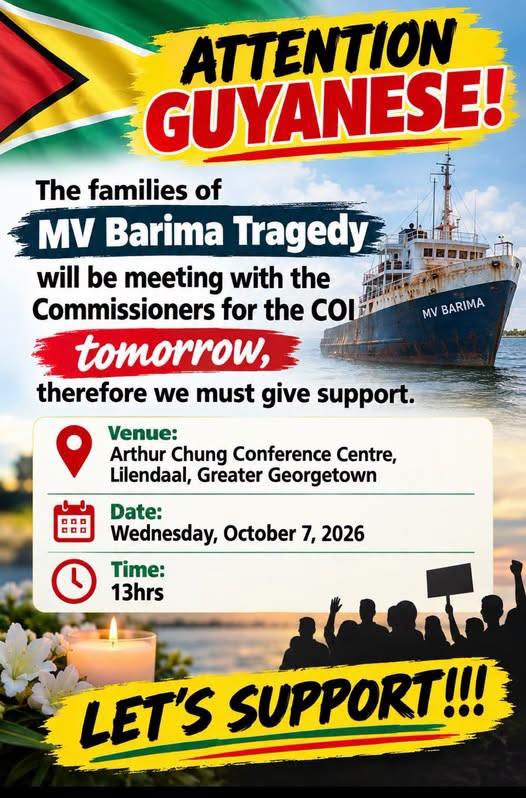
The issue takes on added significance today, as the Commission of Inquiry into the disaster is scheduled to meet with relatives of those who died, as well as persons who were aboard the vessel when it capsized, at the Arthur Chung Convention Centre.
A protest in support of the affected families is also planned for 1 p.m. today, as relatives continue to press for accountability, answers and the recovery of those who remain missing.
Among those protesting outside the Office of the President on Tuesday was Jasmine, who lost two relatives, Neil Cort and Henry Cort, in the disaster. One of the men was her father.
Five-member MV Barima COI
Jasmine said she and other family members will attend today’s meeting with the commissioners to hear how the inquiry intends to proceed.
“Yes, we are going to attend the meeting to hear what they have to say, to hear what they will be presenting to us, so how this commission is going to function.”
She said relatives have been protesting outside the Office of the President for approximately five weeks, with the salvage of the MV Barima remaining one of their principal demands.
“One of our main cry is that the MV Barima be salvaged, that the boat is floated. And we are asking for that because we still have loved ones that never came home. Those mortal bodies we have not recovered.”
For Jasmine and other relatives, raising the vessel is also critical to establishing the facts surrounding the disaster.
“The boat possesses evidence that needs to be brought to light so that the commission can work properly.”
Her concerns come as several processes related to the disaster are unfolding simultaneously.
Three MV Barima workers are facing murder charges stemming from the sinking, while the Government has been pursuing a process to identify a contractor to salvage the vessel. At the same time, the Commission of Inquiry is moving ahead with its work.
Jasmine questioned whether the inquiry can reach a complete understanding of the disaster without the wreck being recovered and examined.
“There are so many moving parts, and to me, it’s distracting. It’s distracting. There is no cohesiveness.”
The MV Barima capsized on July 18 while travelling from Georgetown to Port Kaituma, triggering a major search-and-rescue operation. Dozens of bodies have since been recovered, while other victims remain unaccounted for.
The families have repeatedly called for greater transparency regarding the vessel’s condition, the circumstances surrounding the sinking, the response to distress signals and the Government’s handling of the wreck.
Jasmine said the families remain caught between grieving their loved ones and having to campaign publicly for answers.
The mother of one of the three men charged with murder is also expected to meet with the commissioners today, according to Jasmine.
The families are expected to meet with the Commission of Inquiry today at the Arthur Chung Convention Centre, while a support protest is scheduled to begin at 1 p.m. Relatives continue to call for the MV Barima to be salvaged and for the recovery of those who remain missing.
Guyana is set to break new ground on the international cue sports stage as Andre Boyce and Anthony Xavier prepare to represent the nation at the 2026 Commonwealth Cue Sports Championship in Ahmedabad, India.
Running from October 8 to 10, 2026, the tournament marks a historic milestone: the first time Guyana has had representatives compete internationally in pool.
The landmark selection reflects years of dedication, discipline, and commitment from both athletes, who will proudly carry the Golden Arrowhead against top competitors from across the Commonwealth.
Cue Sports Association Guyana (CSAG) President Steven Persaud hailed the achievement as a defining moment for the sport locally.
“This is a proud and historic moment for cue sports in Guyana,” Persaud said, emphasising that Boyce and Xavier represent every local player who dreams of one day competing for their country. He encouraged the pair to embrace the opportunity with confidence, respect, and sportsmanship.
CSAG believes this breakthrough appearance will inspire a new generation of emerging players and bolster ongoing efforts to build structured competitions, training programs, and international opportunities in Guyana.
Regardless of the final results in India, the association notes that the players have already written a brand-new chapter in the history of Guyanese cue sports. (Modified Press Release)
The inaugural ExxonMobil Under-18 Schools Football Tournament is gathering serious momentum across Guyana as regional fixtures ramp up following an explosive opening start.
Organised by the Vurlon Mills Football Academy, the nationwide youth competition saw Three Mile Secondary lay down an early marker in Region Seven with an emphatic 4-0 victory over Bartica Secondary in the opening boys’ encounter.
Attention now shifts to the female competition in Region Seven, where Bartica Secondary and Three Mile Secondary are set to lock horns on Wednesday afternoon at the Bartica Community Centre Ground.
That fixture serves as the prelude to a massive wave of regional kick-offs scheduled for later in the week.
From October 9, hostilities expand significantly across the country. On the East Bank of Demerara, Dora Secondary meets Covent Garden Secondary at Providence, while the East Coast Demerara leg gets underway in Plaisance with Bladen Hall Secondary facing Annandale Secondary in the girls’ division before Plaisance Secondary takes on Beterverwagting Secondary in the boys’ category.
Meanwhile, Region Six springs into action as New Amsterdam Secondary squares off against Tutorial Academy at All Saints.
The capital is also bracing for a busy schedule across its northern and southern zones starting October 9.
In Georgetown North, Queen’s College hosts Tutorial High in both female and male fixtures, alongside a meeting between Campbellville Secondary and North Georgetown Secondary.
Over in Georgetown South, East Ruimveldt Secondary battles Lodge Secondary at the West Ruimveldt ground, and Tucville Secondary locks horns with Charlestown Secondary.
Both Georgetown zones continue into October 10 with further matchups involving Brickdam Secondary, North Ruimveldt Secondary, The New Central High, and Dolphin Secondary.
Region Three joins the party on October 10 with a quartet of boys’ matches at Friendship Park, featuring Westminster Secondary against DeWillem Secondary, Leonora Secondary versus Stewartville Secondary, West Demerara Secondary meeting Uitvlugt Secondary, and Vreed-en-Hoop Secondary facing Patentia Secondary.
Region Six will also see an expanded slate on October 10, highlighted by Lower Corentyne Secondary playing Canje Secondary in both divisions, Corentyne Comprehensive meeting Vryman’s Erven, and Port Mourant Secondary facing Tutorial Academy.
The nationwide tournament will continue to roll out deeper into October, with the Mabaruma and Moruca legs in Region One kicking off on October 15 and 16, Region Ten starting at Wisburg on October 16, Region Five launching at the No. 5 Ground on October 17, and Region Two concluding the initial wave of regional openers at the Richmond Ground on October 23.
With schools across the country battling for zonal supremacy and a shot at the latter stages, youth football in Guyana has entered an exciting new era.
The countdown to high-speed acceleration is well underway as the Guyana Motor Racing and Sports Club (GMR&SC) prepares to host the Berbice Drags Invasion 2026 at Rose Hall Canje Airstrip this Sunday, October 11.
Scheduled to commence at 10:00 local time, the event will transform the ancient county of Berbice into the epicentre of motorsport, featuring a diverse grid of high-performance and modified vehicles.
Backed by a high-profile roster of commercial partners including ENet, Tropical Shipping, Castrol, GuyOil, and KFC, the fixture promises a rigorous test of machinery and driver reaction times.
Ahead of the flag drop, race control has emphasised strict adherence to sporting regulations and safety protocols.
A mandatory Competitors’ Meeting has been scheduled for Wednesday, October 7, at 18:00 local time at the GMR&SC Headquarters in Thomas Lands, Georgetown.
All registered entrants are strongly urged to attend this crucial briefing, where officials will outline vital parameters concerning race procedures, safety standards, vehicle classifications, staging protocols, and event-day scheduling.
Administrative checks are tightening as organisers remind competitors that official driver registration closes on Thursday, October 8, 2026.
The standard entry fee is set at G$20,000, with a strict penalty enforcement policy: any late registrations submitted past the deadline will incur an additional G$10,000 fine, bringing the total administrative cost to G$30,000.
Competitors are therefore urged to finalise their documentation promptly to secure their place on the official entry list.
Away from the paddock, motorsport enthusiasts are preparing for a massive turnout. General admission for spectators is set at G$3,000 for adults and G$1,000 for children, ensuring accessibility for families and fans alike.
For those seeking an elevated race-day experience, the J’s Supermarket VIP section offers premium hospitality, featuring unlimited food and beverages priced at G$25,000.
With performance racing continuing to capture a passionate following across Guyana, Sunday’s showdown at the Rose Hall Canje Airstrip is set to deliver another unforgettable chapter in the country’s motorsport calendar. (Modified Press Release)
Guyana Sugar Corporation Inc. – Invitation for Bids – Provision of Manpower/Machinery to Clean and Maintain Drainage and irrigation Channels, Operators to Operate Excavators
Guyana records rapid, sustained GDP growth since 2020 – World Bank
…says oil boom sets country apart as Caribbean growth gap widens
Guyana’s oil-driven economic expansion continues to set it apart from other Caribbean economies, with the country recording exceptionally rapid and sustained gross domestic product (GDP) growth since 2020 as offshore oil production scales up, according to the World Bank’s latest Latin America and the Caribbean (LAC) Economic Update.
The report, released on Tuesday, said Guyana’s expansion has been accompanied by rising fiscal revenues, improved external balances and a declining public debt-to-GDP ratio.
However, it noted that the pace of growth also underscores the need for stronger public investment management, increased institutional capacity and policies to ensure that oil wealth translates into broad-based and inclusive development.
The World Bank described the Caribbean as having a “dual-track” economic outlook, with Guyana and Suriname benefiting from commodity-driven expansion while tourism-dependent island economies face more moderate growth amid high energy and transportation costs.
“Guyana’s unprecedented oil-driven expansion continues to pull up the subregional averages,” the report stated, noting that the country’s performance contrasts with the more tempered post-pandemic recovery of tourism-dependent economies.
The report said the widening gap reflects a structural divide between resource-abundant commodity exporters and service-reliant economies across the Caribbean.
Among commodity exporters, Trinidad and Tobago experienced a sharp contraction during the pandemic amid weaker energy prices, while Suriname also recorded a significant decline in economic activity despite favourable gold prices. Both economies have since recovered as the effects of the pandemic eased and commodity prices strengthened.
Guyana, however, has recorded a stronger trajectory following the expansion of offshore oil production. The World Bank cautioned that countries such as Guyana face the parallel challenge of managing revenue volatility and avoiding procyclical fiscal policies as public finances expand rapidly.
Across Latin America and the Caribbean, the World Bank projects economic growth of 2.2 per cent in 2026, broadly in line with the 2.4 per cent recorded in 2025.
The report said regional growth remains modest, although countries pursuing sound and durable policy choices are recording stronger performances, including growth consistently above 3 to 4 per cent, increased investment and greater market confidence.
El Salvador and Paraguay are among those outperforming the regional average, supported by improved security conditions, fiscal consolidation and private investment. Panama and the Dominican Republic have also sustained strong growth.
Argentina is projected to expand for three consecutive years from 2025 to 2027, which the World Bank said would be the first such period in nearly two decades, supported by fiscal adjustment, tax reforms and a more open economy.
“Latin America and the Caribbean has the potential to achieve stronger and more ambitious growth,” World Bank Vice President (VP) for LAC Susana Cordeiro Guerra said.
She said countries that have maintained sound macroeconomic frameworks, strengthened institutions and advanced reforms are demonstrating that stronger growth is possible.
The report warned that risks to the region remain tilted to the downside, with energy price volatility capable of slowing disinflation and keeping central banks cautious. High real interest rates, meanwhile, continue to constrain credit and investment, while high debt and interest burdens limit fiscal space and public investment.
For Caribbean economies that depend heavily on tourism, transport and logistics, changes in global demand, air travel costs and the broader international economic environment remain key vulnerabilities.
The report also highlighted the potential impact of artificial intelligence (AI) on productivity and employment across the region.
Firms are increasingly adopting AI, although the technology is rarely being integrated into core business processes. Across the region, a median of 17 per cent of working-age adults report using generative AI tools, roughly half the rate recorded in the United States (US) and Canada.
The World Bank said the main barriers to productive AI use are not necessarily cost or access, but managerial know-how, workforce skills and the ability of firms to reorganise around the technology.
“A powerful tool is less relevant if workers and firms lack the capacity to act on what it produces,” World Bank Acting Chief Economist for Latin America and the Caribbean Carlos Rodriguez-Castelan said.
The report estimates that about eight per cent of the region’s workforce is employed in high-skill, knowledge-intensive occupations that could be enhanced by AI, while approximately 10 per cent work in routine cognitive occupations more exposed to automation.
A further wave of technological change could eventually affect physical work as automation hardware becomes less expensive, with about a quarter of workers employed in routine manual occupations that may be exposed.
The World Bank recommended expanding technical and short-cycle training, strengthening firms’ capabilities, and modernising digital Government and data systems.
It also pointed to the potential of low-cost, locally adapted AI applications, or “small AI”, in areas including education, telemedicine, public service delivery, agriculture and support for small and medium-sized businesses.
Discover more from Guyana Times
Subscribe to get the latest posts sent to your email.
COI into MV Barima tragedy: Commission to begin work today; over 100 witnesses expected to testify
…only 1 survivor steps forward so far to give evidence
The Commission of Inquiry (CoI) into the MV Barima tragedy is set to commence its work on Wednesday, with the Commissioners expected to gather evidence and hear from witnesses as they seek to determine what led to the deadly incident.
This was revealed by Attorney-at-Law and Secretary to the MV Barima CoI, Javid Shadick, during a press briefing held on Tuesday.
He outlined the schedule for the commencement of the inquiry, which is set to begin on Wednesday at the Arthur Chung Conference Centre (ACCC) at Liliendaal, where the Commission Secretariat is based.
Proceedings will run from Mondays to Fridays, between 09:00h and 16:00h. Interpreters and counsellors will be available where necessary. The Commission has also announced the following schedule for its opening and family consultation sessions:
On October 6, 2026, the CoI officially announced its commencement via a press conference.
Today, October 7, the formal opening session of the Commission will take place, and, in the afternoon, consultation and meeting sessions will be held for families from Regions Three (Essequibo Islands-West Demerara), Four (Demerara-Mahaica), Five (Mahaica-Berbice) and Six (East Berbice-Corentyne) to meet directly with the Commission team at the ACCC at 13:00h.
On October 12, the Commission team will travel to Region One to meet with families at the Kumaka Waterfront at 10:00h. On October 13, the Commission team will continue its engagements in Region One, meeting with families at the Port Kaituma Waterfront.
At the press conference, it was also outlined that the Secretariat remains committed to providing support, guidance and logistical assistance to all families throughout the process.
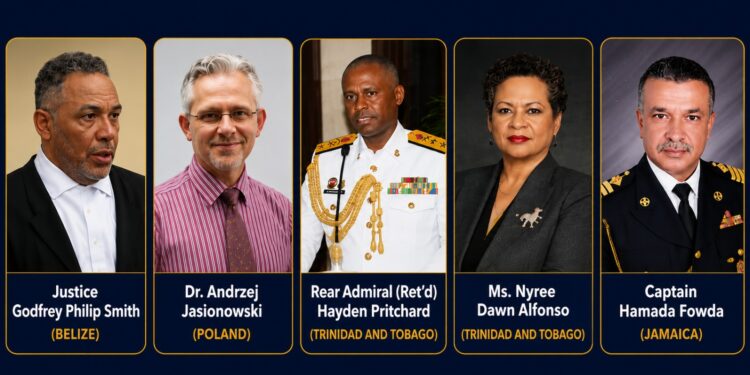
The five-member Commission is chaired by Belizean Justice Godfrey Phillip Smith. Its other members are Captain Hamada Fouda, Nyree Dawn Alfonso, Rear Admiral (Ret’d) Hayden Pritchard, and Dr Andrzej Jasionowski.
Witnesses
Meanwhile, Shadick informed us that only one survivor has so far contacted the Secretariat, expressing an intention to come forward to give evidence.
“I would say now that not many persons have stepped forward. In fact, only one person has made contact with the Secretariat informing us of their intent to step forward,” he stated.
However, more than 100 witnesses are expected to give evidence under the terms of reference, including first responders, officials, survivors, and families of those who perished.
According to the Commission, the terms of reference have broadly categorised potential witnesses into three groups: first responders and officials, survivors, and families of those who perished.
When asked by Journalists about the Terms of Reference (TOR), including the evaluation of the team of doctors assessing the group and how the Commission would address persons who are currently incarcerated, Shadick said those matters would be addressed by the commissioners.
He noted that, as Secretary to the Commission, his role differs from that of the commissioners, adding that the TOR speaks specifically to the work of the commissioners. He said the questions raised would ultimately be addressed in the Commission’s report.
“…so based so far on the TORs, we have kind of divided up types of witnesses. So we’re looking at persons who would have been first responders, officials, and survivors and families of those who would have perished. That is a very broad categorisation. The number of persons, I cannot say how much would be in each one, but our initial count, we’re looking at more than 100 witnesses.”
More than 2 months
Meanwhile, Shadick was also asked about the timeframe President Dr Irfaan Ali had given for the CoI, which was expected to span two months. However, he said the inquiry would likely have to extend beyond the two-month period.
The MV Barima capsized on Saturday, July 18, 2026, approximately 9.3 nautical miles off Devonshire Castle on the Essequibo Coast.
The passenger and cargo ferry had departed the Kingston Goods Wharf in Georgetown at about 15:15h on its scheduled voyage to Port Kaituma.
However, at about 23:01h, the vessel transmitted a distress signal after encountering difficulties off the Essequibo Coast near the mouth of the Pomeroon River.
A total of 179 people, including 18 crew members, were onboard. The disaster claimed 73 lives, while 76 people survived, and approximately 30 remain unaccounted for.
Three Transport and Harbours Department (T&HD) employees have since been charged with murder over the tragedy. The accused were all members of the MV Barima’s crew on July 18, the day of the fatal incident. They are captain Kevin Price, called “KP”, 40, of Melanie Damishana, East Coast Demerara (ECD); chief mate Rondell Dwayne Roberts, 42, of Grove Public Road, East Bank Demerara (EBD); and goods superintendent Delon Granderson, 33, of Fellowship, West Coast Demerara (WCB).
Discover more from Guyana Times
Subscribe to get the latest posts sent to your email.
The Education Ministry has expanded access to specialised education in Region One (Barima-Waini) with the opening of the region’s first Special Education Needs and Disabilities (SEND) school in Mabaruma.
The facility is the 57th SEND school nationally and has the capacity to accommodate up to 30 learners. It currently has two learners enrolled and four staff members, all trained in Special Education Needs and Disabilities.
According to the Ministry, the establishment of the Mabaruma SEND School is aimed to strengthen inclusive education and provide learners with special educational needs and disabilities with access to specialised support and learning opportunities within their communities.
The Ministry said the facility will allow learners and their families in the region to access specialised educational services without having to travel outside their communities to receive the assistance required.
The school is also expected to provide personalised educational support and resources to help learners with special educational needs and disabilities participate more fully in the education system.
Similar schools, the Ministry said on Tuesday, are planned for the region’s other two sub-districts, Moruca and Matarkai, as the it works to bring specialised educational support closer to learners and their families across the country.