| Player | Wkts | Ave | SR |
|---|---|---|---|
| Dwayne Bravo | 173 | 30.13 | 33.50 |
| Alzarri Joseph | 142 | 29.28 | 31.60 |
| Jason Holder | 140 | 37.23 | 40.10 |
| Curtly Ambrose | 139 | 20.51 | 35.60 |
| Mervyn Dillon | 122 | 32.96 | 43.00 |
© Cricbuzz
Source: Village Voice News
| Player | Wkts | Ave | SR |
|---|---|---|---|
| Dwayne Bravo | 173 | 30.13 | 33.50 |
| Alzarri Joseph | 142 | 29.28 | 31.60 |
| Jason Holder | 140 | 37.23 | 40.10 |
| Curtly Ambrose | 139 | 20.51 | 35.60 |
| Mervyn Dillon | 122 | 32.96 | 43.00 |
© Cricbuzz
Source: Village Voice News
Haiti has set new fees for citizens applying for passports at Haitian diplomatic missions and consular posts abroad, while banning additional charges and expedited processing services.
The Ministry of Foreign Affairs and Religious Affairs announced the new measures in a circular dated Oct. 1, with the changes taking effect Oct. 5.
Under the new fee structure, passport applications will cost US$150 for adults and US$125 for minors.
The ministry said any additional fees charged for passport applications are illegal and prohibited.
It also ordered Haitian diplomatic missions and consular posts to stop offering emergency and extreme-emergency passport services. All applications are to receive the same treatment, in keeping with what the ministry described as a commitment to serving taxpayers.
The ministry also instructed heads of Haitian diplomatic missions and consular posts to transfer any remaining funds from passport fees already collected to the Haitian Treasury.
The transfers are to be made by check payable to TRÉSOR PUBLIC-DGI, according to the circular.
Diplomatic and consular officials were instructed to take all necessary steps to ensure the measures are strictly implemented and to submit a complete report to the Foreign Ministry detailing how the new rules have been applied.
caribbeannationalweekly.com
Source: Village Voice News
Jamaica has recorded a 24 per cent decline in murders this year, with 407 homicides reported up to Tuesday, October 6.
National Security and Peace Minister Dr Horace Chang provided the update during a ministerial statement in the House of Representatives on Tuesday.
The 407 homicides recorded so far this year compare with 534 murders during the corresponding period in 2025.
Chang said the decline was particularly notable during the third quarter, when Jamaica recorded 123 murders between July and September. He said this was the lowest quarterly total recorded in more than three decades.
September accounted for 36 murders, making it the lowest monthly total in more than 30 years. It was also the fourth month this year in which the country recorded 40 or fewer murders.
“Five of the first nine months of 2026 are among the lowest monthly murder totals recorded in more than three decades. Additionally, the first three quarters of 2026 are the lowest quarterly murder totals recorded over that period,” Chang told Parliament.
Jamaica has recorded a steady decline in murders in recent years, from 1,515 in 2022 to 1,406 in 2023, 1,148 in 2024 and 674 in 2025.
Chang said the latest figures represented a significant shift in the country’s murder rate, noting that 123 murders could previously have been recorded in a single month.
“In May 2024, Jamaica recorded 134 murders. In 2017, the monthly average was 137 murders. Today, 123 murders represent an entire quarter,” he said.
Despite the decline, Chang cautioned against complacency and said the government would continue its efforts to address violent crime.
“While we recognise these gains, we will not become complacent. Our responsibility now is to protect and deepen them,” he said.
Chang said the government had increased the strength of the Jamaica Constabulary Force and invested in personnel, infrastructure, technology, equipment and mobility.
He also highlighted investments in the training and professional development of security personnel through the Caribbean Military Academy, the National Police College of Jamaica and the Caribbean Correctional Academy.
The minister called for greater attention to public order and said police engagement with citizens should be professional, proportionate and respectful.
“Our objective is to improve compliance while reducing unnecessary confrontation. Enforcement must be fair, efficient and transparent. This will allow our police officers to concentrate more of their resources on the most serious threats to life and property,” Chang said.
Chang, who is also deputy prime minister, said violence remained a concern in sections of Jamaican society and called for a broader cultural shift.
“For decades, high levels of murder and violence became tragically normalised in our society. We are now seeing a sustained reversal of that trend,” he said.
He said the government remained committed to its crime-fighting policies despite criticism and commended the leadership and members of the Jamaica Constabulary Force, particularly officers working on the front line.
“Their courage, professionalism and sacrifice continue to drive these gains,” Chang said.
caribbeannationalweekly.com
Source: Village Voice News

The Guyana Human Rights Association (GHRA) has restated calls for a full-fledge investigation into the operations of the Guyana Police Force, pointing out that a number of issues that have come to light in recent years warrant a thorough investigation into the law enforcement agency.
In a statement overnight, the organisation said the latest scandal involving Deputy Commissioner of Police, Faizal Karimbaksh, who is facing rape allegations, is another reason for the Force to be placed under the microscope.
The Organization said the recent explanation given by Home Affairs Minister Oneidge Walrond, in relation to disciplinary proceedings against Mr. Karimbaksh is laughable.
The Minister had stated that while she believes the Deputy Commissioner should be sent on administrative leave, the Police Service Commission is still to be reconstituted.
But the Human Rights Association is reminding the Minister that it is the President that is responsible for the appointment of the Police Service Commission.
“Who is responsible for appointing the Police Service Commission? The President of Guyana. Is the Minister calling on the President to appoint the Commission? No, she is going to consult the Commissioner of Police – whose continued occupancy in this post can be terminated at any time because he is beyond retirement age,” the Organisation said.
The GHRA said ten days after the allegations were made no official statement was made over the investigative process to be adopted, other than a special investigation team is probing the claims.
“The Karimbaksh case also prompts a reminder of the public outrage in November 2021when a teen-aged girl committed suicide two hours after her claims of rape were investigated by officers at Cove & John Police station. The suicide was then used to justify closing any further official investigation into her rape claim. The culture of the current ruling party embraces similar bizarre directives to protect ‘their own’ in too many instances of sexual assault,” the GHRA said.
The GHRA said while it also welcomes the statement of the Women & Gender Rights Commission calling for a genuine investigation of the Karimbaksh allegations, it remains hopeful that it will prompt similar calls from the female MPs of the ruling party, particularly the Minister of Human Services, who is primarily responsible for promoting the sexual safety of women.
The Association said longstanding issues of corruption and money laundering within the Police Force must all be addressed.
Source: News Source Guyana
Minister of Health, Dr. Frank Anthony, on Tuesday, visited children recovering in the Paediatric High Dependency Unit at the Georgetown Public Hospital Corporation (GPHC), following the recent paediatric cardiac surgeries performed at the hospital.
The children recently received cardiac care through a Government of Guyana initiative to expand access to specialised treatment for children with congenital heart defects.
From September 28 to October 2, a team consisting of 18 members from Apollo Hospitals in India, worked alongside over 50 GPHC’s local healthcare professionals to perform complex paediatric cardiac procedures.

A total of 16 procedures were performed, including 10 complex open-heart surgeries, three device closures performed through catheterisation, and three diagnostic catheterisations. These procedures benefited 13 patients in total, as some patients underwent catheterisation before their corrective surgery.
All 16 procedures were successfully completed. Of the 13 patients who benefited, three remain hospitalised for continued care, while the remaining patients have been discharged.
For the children and their families, the procedures mean a chance to receive specialised care closer to home. The collaboration also gave local healthcare professionals the opportunity to work with visiting specialists and build their experience in paediatric cardiac care.
During his visit, Minister Anthony spent time with the children and their families, asking about their recovery and sharing a few encouraging moments with them.
The initiative is part of ongoing efforts to strengthen specialised healthcare in Guyana through international partnerships, while building local expertise and expanding the services available at GPHC. [Georgetown Public Hospital Corporation]
Source: NEW ROOMS SITE
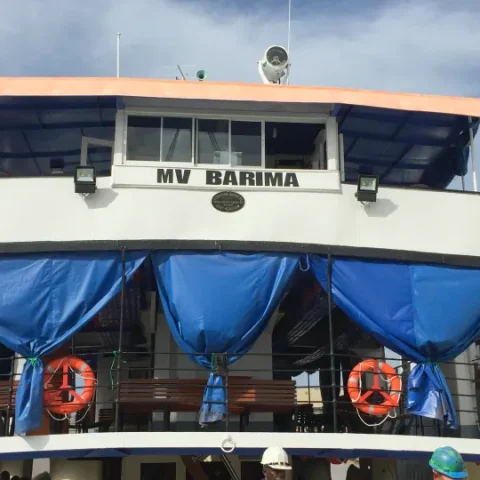
Plans to salvage the sunken MV Barima are nearing finalisation, with a salvage operation possibly set to begin this month, according to members of the Commission of Inquiry (COI) established following the vessel’s sinking.
Speaking during the Commission’s first public engagement since being sworn in, Chairman Godfrey Smith said the process of raising the vessel is already being examined.
“Our understanding is that the process of raising the vessel is in process, meaning it is being examined and looked at,” Smith said, adding that one of the Commission’s members had participated in a related process the previous day.
Commissioner Dr. Andrzej Jasionowski provided further details, saying he had already met with a potential salvage team to discuss both the removal of the wreck and the preservation of evidence.
“I have met with a potential salvage team. We discussed the process of salvaging and the process of evidence preservation,” Dr Jasionowski said.
He said negotiations surrounding the salvage operation were still ongoing but suggested that an agreement could be reached within days.
“I understand that the negotiations of that undertaken is still ongoing, but I was made to understand that in a matter of days this will be completed and that the salvage operation will commence possibly in this month,” he said.
Dr Jasionowski added that the Commission would be kept informed of developments and could potentially observe the salvage operation.
“We will be informed of the progress and of the steps… possibly we will also witness the operations,” he said, stressing that “it is very close to finalising the plans.”
The MV Barima has remained underwater since it sank on July 18, 2026, during the tragedy involving the passenger and cargo vessel, which operated between Georgetown and Port Kaituma.
The tragedy claimed the lives of 73 people. Another 30 people remain unaccounted for, while 76 passengers survived.
The latest comments come as the government advances the procurement process for a contractor to remove the wreck from the waters off the Essequibo Coast.
Three companies submitted bids for the salvage contract. The bidders are Guyanese companies Industrial Fabrication Inc. and B.K. International Inc., and KMS B.V., a Netherlands-based marine salvage company.
The tender was issued by the Maritime Administration Department for the salvage of the MV Barima on a “no cure, no pay” basis.
Industrial Fabrication submitted a bid of G$1.895 billion, with a G$28.5 million bid security through Premier. B.K. International submitted the lowest bid at G$1.034 billion, backed by a G$15.6 million bid security through Nafico.
KMS B.V. submitted a bid of G$2.0351 billion, with bid security of US$136,691 through KBC Bank.
For the Commission, the eventual salvage of the vessel is expected to be significant not only for removing the wreck, but also for the preservation and examination of evidence surrounding the tragedy.
The COI will commence public hearing on Wednesday, October 14.
Source: NEW ROOMS SITE
Last Updated on Wednesday, 7 October 2026, 20:18 by Writer
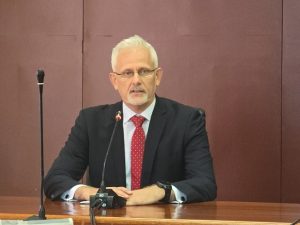
The Commission of Inquiry (CoI) into the sinking of the MV Barima ferry has been consulted as part of the government’s evaluation of the bidders for salvaging the vessel, one of the five-member team said Wednesday.
Inquiry Commissioner Dr. Andrzej Jasionowski of Poland, who is a naval architect and marine engineer, told a press briefing after the formal opening of public hearings that he met with a preferred salvage team to discuss the salving and “process of evidence preservation.”
Dr Jasionowski said he was informed that negotiations and conclusion of that undertaking were ongoing, but that would be concluded in a few days to make way for salvaging to begin in October.
“The salvage operations will commence, possibly this month and we will be informed of the progress and all the steps along the way,” he said.
The bidders are Industrial Fabrications Inc. (InFab), BK International Inc and the Netherlands-headquartered KMS B.V.
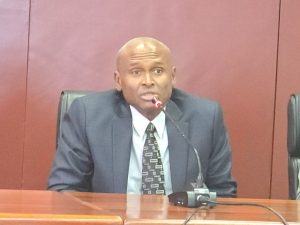
The Polish marine engineer also sought to assure that although the wreck was on the seabed since it sank on July 18 about 10 miles off Essequibo Coast, the evidence would still be of forensic value to the inquiry.
“Regarding the forensic value of salvage, notwithstanding the few months, two, three months that has (sic) passed, will be, if I may use a quantification, near 100 percent. The ship will give us clues that we seek on its state as it sank. It is made of steel. The cargo is still within the confines or most of it, so the forensic value will be there almost in its entirety. The time will have very little effect on any degradation, in my view,” he said.
Another inquiry commissioner, retired Rear Admiral (Ret’d) Hayden A. Pritchard added that not all of the commission’s work was “hinged on whether this vessel is retrieved or not.”
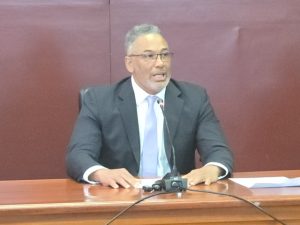
The Chairman of the MV Barima Commission of Inquiry, Justice Godfrey Smith, says the probe will examine the seaworthiness of the vessel relating to its physical condition, stability, machinery, maintenance, certification, inspection, operational condition and compliance with safety and other regulatory requirements.
The probe would also focus on the circumstances and methodology by which passengers boarded the vessel and cargo was loaded.
Questions concerning passenger numbers, manifests, cargo quantities, cargo placement, loading procedures, stability, carriage of potentially hazardous material, availability and adequacy of life-saving equipment, and compliance with regulations will all be inquired into, he said.
Justice Smith says its recommendations will not be legally binding but the commission was not mandated to deal with compensation. “That is not part of our terms of reference. I can say to you that we certainly have no power to make any awards, to order any compensation,” he said.
“Our recommendations are not legally binding, and it will be for the government or other relevant public bodies and organisations to decide what action will be taken in response to our report,” he said in a statement to the first public sitting of the five-member CoI.
Justice Smith, a former judge of the Eastern Caribbean Supreme Court, said the report of a commission of inquiry may be the “catalyst for civil and criminal proceedings to follow.”
Potentially, the CoI will recommend a massive overhaul of the regulatory, legal, technological and human resource functioning of Guyana’s maritime sector.
Justice Smith, who is also Belizean journalist, said the recommendations for reforms will be for strengthening maritime safety and preventing a recurrence.
The MV Barima sank on July 18, en route from Georgetown to Port Kaituma with 179 passengers and crew members.
He said when the inquiry is complete, Guyana should know more than simply what happened when the vessel went down off the Essequibo Coast.
“We will, therefore, be looking at identifying and recommending legislation and regulations that may require amendment and strengthening, instiutional responsibilities that require clear delineation and enforcement, policy changes that must be implemented, training and certification that may be needed and how emergency response arrangements can be improved and any infrastructure and systems that may, over time, need to be put in place,” he said.
He did not rule out making certain recommendations “in the interest of public safety”, ahead of its final report to President Irfaan Ali.
“If, through this inquiry, we can identify the causes of this tragedy, expose the weaknesses that permitted it to happen, recognise the failures that contributed to it, and recommend measures aimed at making Guyana’s maritime transportation system safer, then we will have discharged an important part of our responsibility entrusted to us,” he added.
Source: Demerara Waves
Minister of Tourism, Industry and Commerce Susan Rodrigues has called for stronger regional cooperation among Caribbean nations to advance the region’s tourism industry.
She stressed that individual destinations cannot achieve this alone.
Minister Rodrigues said the region’s diversity should be a collective strength rather than a basis for competition.

She made the remarks while addressing tourism stakeholders from across the Caribbean and beyond, as the State of the Tourism Industry Conference (SOTIC) 2026 got underway at the Atlantic Suites by Hyatt in Kingston, Georgetown.
“The future of Caribbean tourism is collaborative. Our countries and territories each bring something unique to the table. So, it gives us the opportunity to determine how we combine those strengths,” Minister Rodrigues stated.
She highlighted strong regional air connectivity, tourism knowledge and intelligence sharing, stronger linkages between destinations and joint marketing as some key areas for greater collaboration.
The tourism minister called for a regional ecosystem that is built around unity, competition and a shared identity.
The Caribbean Tourism Organisation (CTO), she emphasised, must play an important role in advancing this collaborative approach, as Caribbean destinations work together to shape the future.

With the conference being held on local shores, Guyana has the opportunity to participate in the regional conversation, while sharing its experiences, learning from other destinations and building partnerships to advance Caribbean tourism.
Themed “Tourism Futures: Smart, Sustainable and Inclusive,” the session brings together tourism ministers, industry leaders, regional and international partners and other stakeholders to examine the future direction of Caribbean tourism and identify opportunities for greater cooperation and development.
As Guyana reflects on the life and contributions of former PNCR Leader Robert Herman Orlando Corbin, who passed away on October 4, 2026, Dr. Henry Jeffrey revisits Corbin’s contribution to Guyana’s political and national development. Among the documents being highlighted, below, is Corbin’s 2003 address to the nation and the April 2003 “Constructive Engagement” agreement with then President Bharrat Jagdeo, which outlined proposals for political dialogue, democratic reform, equitable development and greater inclusion.
Part 1. ‘The future is now: bad governance!’
ADDRESS TO THE NATION BY MR. ROBERT H. O. CORBIN, M.P. LEADER OF THE PNCR on 17th August 2003
‘Fellow Guyanese: On 6th May 2003 last, many Guyanese breathed a sigh of relief and there was a new mood of optimism and expectancy when President Jagdeo and I finally signed the Communique that brought an end to the long political impasse. …
During that period the economic crisis continued and was characterized by the spiraling cost of living; unemployment; the closure of major businesses; rising levels of poverty; the flight of capital and Guyanese entrepreneurs and the decline of the social and economic conditions in many depressed and marginalized communities. Young people continued to lose hope in the future of our country. …
The frightening security situation witnessed a significant increase in violent crimes, murder, kidnapping, daring robberies, gangland style executions, and finally the shooting and killing of our policemen. This situation was preceded by other troubling developments such as the years of unabated extra judicial killings of hundreds of young people who were exterminated by the Black Clothes and other out-of-control elements in the Guyana Police Force and a highly suspicious and unexplained jailbreak by dangerous criminals.…
My Party and I contended then, as we do now, that the economic crisis was not a result of the political impasse, but a direct result of ill thought out, lopsided, incoherent and discriminatory policies. In short, bad governance…’
———————————————
‘Constructive Engagement’
Meeting between Mr. Bharrat Jagdeo, President of the Republic of Guyana and Mr. Robert Corbin, MP, the Leader of the People’s National Congress Reform on the
April 16th, 2003, at the Office of the President.
The President and Leader of the People’s National Congress Reform met at the Office of the President on April 16, 2003, and discussed a number of issues of national importance. Accordingly, all of the issues in question were discussed in an atmosphere of seriousness born of the recognition that there must be a determination to find solutions to them. Both parties understand that these issues go to the heart of Guyana’s socio development and must be urgently solved. They concluded that a ‘constructive engagement’ between the two Leaders can lead to timely resolution of difficulties and thus be of tremendous benefit to the political and economic development of Guyana. The Parties have therefore agreed to the following decisions.
Appointment of the Seven new Standing Committees of the National Assembly
The Parliamentary Management Committee:
President Jagdeo and the Leader of the PNCR have agreed to the composition and the appointment of the Parliamentary Management Committee. Accordingly, they took note of the fact that the Parties have named their representatives to this Committee and that a Motion has been placed on the Order Paper of the National Assembly. This Motion will be moved and debated at the next sitting of the National Assembly.
The Four Sector Committees:
The two Leaders had discussions and agreed on the composition and functioning of these Committees. They agreed that they are important to the effective functioning of Parliament, the overall democratic system, and the potential for the positive effect on the national economy, that their composition should not be delayed but should be agreed to with a minimum of delay. They took account of the fact that the PNCR has already submitted the names of its representatives to these Committees.
The two Leaders also noted that the Terms of Reference (TOR) for their appointment and composition of these Committees have been accepted by the representatives of the government, pending agreement on the question of non-Ministerial representation on the Committees.
1.1.2.2 Allocation of Ministerial Responsibilities on the four
Sector Committees:
The two Leaders reached agreement on the allocation of responsibilities on the Ministers of government on the Four Sector Committees. They further agreed that with the allocation of Ministerial responsibilities on these Committees, in conjunction with the appointment of representatives of other parties to the Committees, the ground will be lead for their effective functioning, given the expected understanding, mutual respect, national orientation and mature consideration in the context of the various issues that will be presented before the respective Committees.
Appointments Committee:
The two Leaders have agreed to the appointment of an Appointments Committee. They regard this as an important step as it is necessary that the Service Commissions be established so that important Public Service Appointments can be effected, including and especially that of a new Commissioner of Police.
1.1.3.2 Constitutional Reform Committee:
The names of the representatives of this Committee, having been agreed, the two Leaders stated their views that it can play an important role in the acceleration of the constitutional reform process, which is necessary for the strengthening and deepened of the democratic process in Guyana.
1.2 Strengthening the Capacity of the Parliament Office to Service Committees
Recognizing that the establishment and appointment of the seven Parliamentary Standing Committees can only function effectively if they are provided with the necessary human and other resources, the two Leaders noted that the provision of such resources will be the responsibility of the government. They also took account of the fact that budgetary provisions will be made to enable Parliament Office to service the needs of all of the Committees.
1.2.2 Research and Documentation Support
Research and documentation support are also essential to the work of the Committees concerned and the two Leaders therefore agreed that, supported by the requisite provision by the Parliament Office, there should be qualified and competent research staff, including a senior professional researcher, who would function as “Research Co-ordinator”, and who would be supported by two professional researchers. This arrangement should be subject to early review after the Committees have begun their work.
The two Leaders also agreed that with regard to the Foreign Relations Committee, and where necessary other Committees, the Opposition Parties will have access to information which might be in the possession of government Ministries and Agencies, so that they can execute their responsibilities with efficiency.
Remuneration of MPs
The two Leaders recognized that Members of Parliament, including Regional MPs, must be adequately remunerated for their services rendered in respect of servicing on the Committees under consideration and stated that existing statutory provisions which are in existence must accommodate this need.
1.3 Establishment of the Ethnic Relations Commission
The Leader of the PNCR and President Bharrat Jagdeo considered the question of the Ethnic Relations Commission in the context of the perceived need to remove the taint of racial discrimination and ethnic insecurity and to create the conditions that can endure harmonious relations among the races of Guyana and thereby remove a factor which makes for instability and tension.
They considered the establishment of this Commission as an important matter and declared that its work must at all times be professional, sensitive and conducted in the national interests of the nation.
1.4.1 Public Procurement Commission
The efficient conduct of the work of the Tender Board was discussed by the two Leaders and they examined the matter in the context of the requirement for the appointment of members to the Public Procurement Commission, the creation of which was recommended by the Constitution Reform Commission.
They expressed their satisfaction that the members have now been appointed and that its composition and work could remove a source of irritation between the various stakeholders in society. Equally, they were of the view that this Commission, by its work and its sensitive performance of its duties, can have an improving effect on the political climate and the economic position of this society.
The Rights Commissions
Both Leaders took note of the fact that to effect the operations of these Commissions by way of nomination and appointment must be realized by a Consensual Mechanism, which has to be determined by the National Assembly.
They therefore urged Members of the National Assembly to approve such a mechanism so that the work of these Committees can begin without any further delay. In this regard, they stated their views that a strengthening of the rights of the citizens of Guyana in every respect can strengthen the social bases of the society.
Implementation of Decisions of the Joint Committees
The two Leaders passed in review the decisions outstanding from the six joint committees established in the context of the dialogue between former Leader of the PNCR, Mr. Hugh Desmond Hoyte, and Mr. Bharrat Jagdeo and agreed that the actions inherent in the submissions made by the relevant Government functionaries should be expedited.
National Policy on Land and House Lots Distribution
The discussions on the question of the distribution of house lots was given extensive treatment and the two Leaders concluded that the Policy Paper needs to undergo revision in order to accommodate the concerns of the People’s National Congress Reform that such distribution must be done according to clear, transparent and equitable criteria.
They also agreed that there must be monitoring of the distribution of land to ensure compliance with such criteria and the investigation of complaints based on discrimination.
They further agreed that there should be a freeze on the distribution of land until the stated criteria and other mechanisms specified by the National Assembly are in place according to the law.
They finally agreed that the Joint Committee should be re-established to, among other things, supervise the implementation of the system specified by the National Assembly for the transparent and equitable distribution of land and house lots.
Local Government Reform
The Leader of the PNCR, Mr. Robert Corbin, and President Jagdeo examined the question of Local Government Reform and noted that the Joint Committee established in this regard had been unable to complete its work and submit a final report before the stated deadline.
In the circumstances, they agreed that the committee should be re-established and provided with adequate support and resources, so that it can complete all of the tasks and responsibilities assigned to it.
The two Leaders were of the view that the Joint Committee should consider that the electoral system for future Local Government Elections must be a priority and that the committee must develop a suitable system and appropriate procedures for compulsory annual fiscal transfers to underwrite the autonomy of Local Government Organs.
The committee would also determine the Terms of Reference for an independent constitutional Local Government Commission. Legislation for the implementation of all agreed Local Government Reforms should be prepared and presented to the National Assembly within six months.
2.3 Depressed Communities
Having examined this matter, which was first given consideration by the committee established during the dialogue between Mr. Hugh Desmond Hoyte and Mr. Bharrat Jagdeo, the two Leaders concluded that all projects agreed for the Phase I communities should be completed within one month.
The allocation of G$608 million for the implementation of projects already identified and agreed for the Phase II communities must be released immediately.
The two Leaders also agreed that there must be, within a period of six months, a comprehensive programme, including the necessary financial requirements, for addressing the problems of all depressed communities in Guyana.
2.4 Radio Monopoly and Non-Partisan Boards
On examination of this matter, the two Leaders concluded that the non-partisan management of the state-owned media, using guidelines agreed by the Joint Committee, should be implemented immediately.
They also considered the draft legislation for comprehensive Media Reform, including the establishment of a National Broadcast Authority, and agreed that it should be submitted to the Joint Committee within one month for agreement prior to being laid in the National Assembly.
The two Leaders also came to the agreement that equitable access to the state-owned media should be established immediately and an independent National Broadcast Authority should be realized within three months.
Private radio broadcast licences should be issued immediately after consideration and approval by the Joint Committee pending the establishment of the independent National Broadcast Authority.
With regard to the National Frequency Management Unit, the two Leaders agreed that this body should be brought under the control and supervision of the National Broadcast Authority as soon as it is established.
Accordingly, there should be a freeze on the grant of all frequencies by the NFMU until such time as it comes under the control of the NBA.
The NBA, the Leaders also agreed, should be asked to give priority to arrangements for the granting of radio broadcast licences on the basis of statutorily determined criteria.
Finally, on this question, the two Leaders decided that the Interim Broadcast Committee should be disbanded immediately.
Border and National Security Issues, Including the Recapitalization of the GDF
In examining this question, the two Leaders noted that the Joint Committee’s report was submitted as long ago as July 2002 to the Ministry of Foreign Affairs for editing prior to being laid in the National Assembly, and concluded in the circumstances that the committee’s report should be laid in the National Assembly forthwith.
They also concluded that the Joint Committee should be re-established to oversee the implementation of the recommendations contained in the report.
2.6 Bauxite Industry and Communities Resuscitation
The rapidly deteriorating social and economic conditions in Region 10 claimed the attention of the two Leaders and they accordingly reached agreement on the need for a comprehensive development programme that would address in that Region such matters as the creation of new employment opportunities; rehabilitation and satisfactory functioning of all public utilities; the establishment of an incentives regime for the attraction of inward investment to the Region; the creation of a fully supportive institutional environment for small and medium-scale business development by the inhabitants of the Region; and the immediate establishment of transparent and equitable criteria for the Regional Administration to distribute land and house lots; and any other areas considered critical.
The Appointment of PNCR Nominees to State Boards and Committees
This matter was examined by the two Leaders, and it was agreed that the following principles would apply:
2.8 Commission of Inquiry into the Operations of the Guyana Police Force
The two Leaders investigated the question of the appointment of a Commission of Inquiry into the operations of the Guyana Police Force and concluded that the power to do so vests in the President in accordance with the Commission of Inquiry Act, Cap. 19:03.
It was also noted that Article 197(5) gives the President such powers. It was therefore agreed that the required Commission of Inquiry could be facilitated by way of a constitutional amendment to the former Article and this would obviate unnecessary and undesirable delays in creating such a Commission of Inquiry.
The Leaders also agreed that Terms of Reference (TOR) for such an inquiry should be developed with a minimum of delay.
2.9 Public Service Commission
The two Leaders found that it is an acceptable proposition that in the interest of efficiency the Public Service should be depoliticised, as previously agreed in the dialogue between Mr. Hugh Desmond Hoyte and Mr. Bharrat Jagdeo, and that this can only eventuate by the removal of identified political Permanent Secretaries and appointment to these positions by professionally qualified career public servants.
The two Leaders took note of the fact that the practice of recruiting persons on contract to fill establishment posts in the Public Service was detrimental to efficiency and unfair to career public servants who expect to benefit from the service in terms of expectation of upward mobility within the structure of the service.
Georgetown
15th April 2003
Source: Village Voice News
https://kiskadeewatch.com/guyana/rodrigues-birkett-falls-to-third-in-5th-straw-poll-for-un-sg/
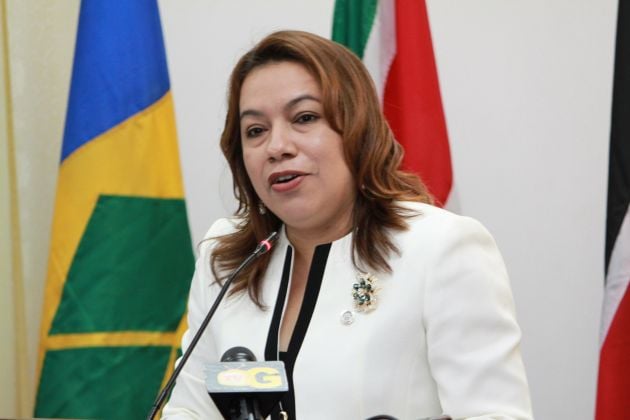
Carolyn Rodrigues-Birkett, Guyana’s candidate to be the next UN Secretary General fell to third position in the fifth straw poll held today while Costa Rica’s candidate Rebeca Grynspan maintained the lead she has kept for most of the race.
According to Pass Blue which has been a reliable source of information on the votes, Grynspan picked up 9 encourage votes, six discourage votes and zero in the no opinion category.
In the second position for the first time was Argentina’s Rafael Grossi who polled six encourage votes, seven discourage votes and two in the no opinion category.
Rodrigues-Birkett who had come out ahead in one of the polls scored five encourage votes, nine discourage votes and one in the no opinion category.
In the fourth round of voting, Grynspan received 10 encourage votes, three discourage and two no opinion. Rodrigues-Birkett received eight encourage votes, six discourage and one no opinion. Grossi, the director general of the UN nuclear watchdog, received eight encourage and seven discourage votes.
The next vote on October 16th will be crucial as the five permanent members of the UN Security Council will indicate whether they will wield the veto against any of the candidates. A veto against any of the candidates will automatically bring their campaign to an end.
There have been suggestions that the US may oppose Rodrigues-Birkett’s candidacy on the basis of her declaration of Israel’s war in Gaza as genocidal. Today’s fifth straw poll coincided with the third anniversary of the horrific attack by Hamas militants against Israel.
Reuters said today that the fifth secret poll by the 15-member Security Council followed days of intense negotiations among diplomats in New York, after the past four ballots have not resulted in the emergence of one candidate with overwhelming backing.
Although Grynspan is still leading the pack of seven contenders, the support for her weakened slightly compared to the poll last week, suggesting ongoing gridlock, a result that may prompt other senior figures to join the race, Reuters added.
Source: Kiskadee Watch









Discussion