Tournament organisers FL Sport have promised an unmissable spectacle for cricket enthusiasts as the Lotto/Let’sBet One Guyana T10 Tapeball Blast reaches its national finale on Sunday, October 11, at the Anna Regina National Stadium in Essequibo.
Four elite contenders—GrillMaster Sip N Play All-Stars, Mahdia (Movements Family), Lusignan Bulls DTP II and SVC/AJM CC—will clash for national supremacy and a lucrative $2 million top prize after navigating through high-stakes zonal qualifiers across the country.
Reflecting on the extraordinary standard of play throughout the preliminary legs, FL Sport Director John Ramsingh emphasised that the competitive intensity witnessed so far has laid the groundwork for an unforgettable final day.
“This is the culmination of hard-fought competition across every zone in Guyana,” Ramsingh said.
“From the very first bowl of the tournament, the rivalries have been intense, the quality of tapeball on display has been outstanding, and the energy from the communities has been electric. We have saved the absolute best for last, and Sunday at Anna Regina is going to be a grand time for everyone.”
The blockbuster schedule at Anna Regina bowls off at 14:30h local time with the opening semi-final between GrillMaster Sip N Play All-Stars and Mahdia (Movements Family).
Kemol Savory’s SVC/AJM CC will then take center stage at 16:30h against Lusignan Bulls DTP II for the second spot in the showpiece event.
Adding further excitement to the evening, a fast-paced six-over women’s exhibition fixture between Tapakuma (Elite Warriors) and Capoey United will light up the venue at 18:30h, paving the way for the grand final under lights at 19:30.
Beyond regional bragging rights, substantial cash incentives are on the line. The tournament runners-up will pocket $1 million, while both losing semi-finalists will take home $500,000 each.
Individual impact will also be rewarded with life-changing stakes. The tournament’s Most Valuable Player will drive away on a brand-new motorbike alongside a $150,000 cash prize.
The leading run-scorer and top wicket-taker will each receive $100,000 and a television set, while the Player of the Final will earn $75,000. Additionally, players finishing with the Super Strike Rate and Best Economy Rate (minimum 12 balls) will each pocket $50,000.
Organisers have confirmed free admission for all spectators to ensure a roaring home crowd, though a strict no-cooler policy will be enforced at the gates as Essequibo prepares to host a landmark day of grassroots cricket entertainment.
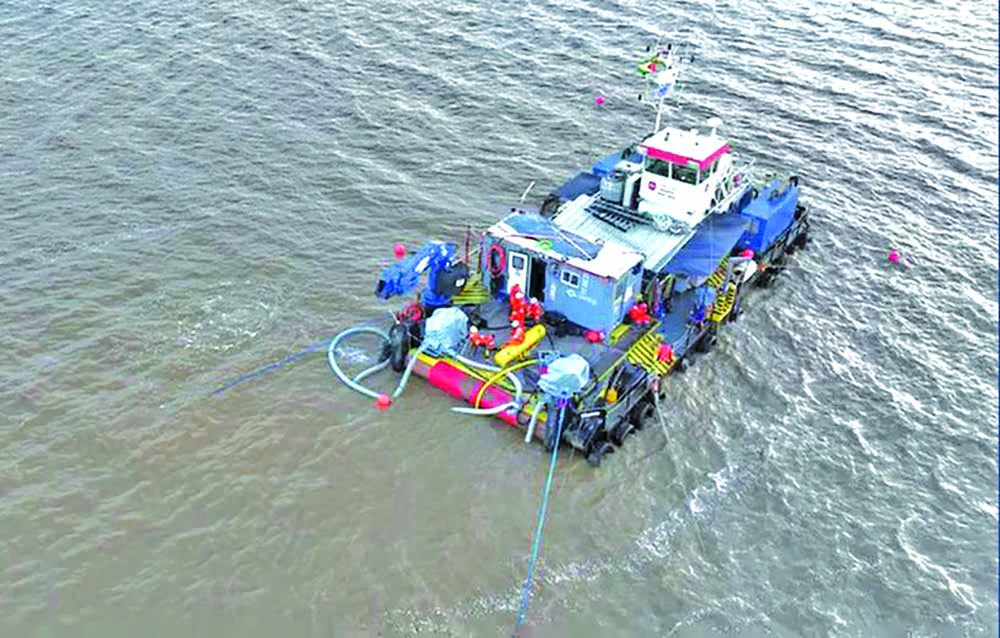
I extend personal congratulations to the BK Group for nabbing that $1.034 billion MV Barima salvage award. Great job, guys! Amid those congratulations, there’s personal consternation. Did this really happen? Is this flesh-and-bones real, or am I hallucinating? In a PPP Guyana, a country where Sinbad the sailor fantasies reign unchecked, it is all too real, and that’s part of my troubles. I speak for no one, but myself. Families may disagree. The PPP may be up in arms. I call, as I see.
First up, I think that the BK Group was the winning bidder from the get-go. All the other noise (thanks for those lyrical symphonies Field Marshall Phillips and Cardinal Edghill) about foreign salvage boats, secret dealings, and backdoor conversations, those were decoys. To throw Guyanese off the track. The BK Group came with an edge. It was the stealth candidate, a sleeper so to speak, a bidder biding its time. Knowing how the territory is mapped and laid out in Guyana. No hustle, no sweat. Most of all, no calling attention to itself and its own interest in floating the boat. I like a group that knows how to keep its mouth shut, how not make any waves, and how to play along to achieve its objectives. Calls for a ton of corporate smarts. Now this brings me to a touchy place.
For there is this second strain of consternation. With every regard for the winning MV Barima salvage bidder, can this team bring this boat back to the surface in one piece? At a fundamental level, and in a crude description, some placement of holes, and the boring of them are going to have to be a part of the lifting the Barima exercise. This may be done to the best of available local knowhow, but is it enough? More pointedly, can the MV Barima be dragged up as gently and skillfully as possible (almost like a neurosurgeon) to the sea top and then to shore, with all of its contents intact? I repeat so that this point registers with my fellow Guyanese. Considering the breadth of local expertise available to the winning bidder, can the MV Barima be hauled up with all of its lifeless human cargo still fastened in place, and not one body falling overboard, lost forever in the fathomless depths? Can all of its other physical cargo, without one big or small sack of materials, or one piece of heavy-duty machinery slipping unexpectedly out of its hold, and not available for some form of scrutiny by the MV Barima Commission of Inquiry?
There is concern about these elements in the MV Barima tragedy, part of an ongoing national mystery. No question that the salvage award ran contrary to the expectations of the families who lost loved ones, and now live with that grimness and distress. Their reactions alone give more than a hint of where they stand, and what they think of the direction in which the COI is heading. The BK Group may do the best salvaging job possible that it is capable of, and considering the challenges of the circumstances. But this fact must not be ignored: the table of dispute and disagreement is already set, and it promises to lengthen as the days go by.
Try as I may, and in the full moon of hindsight, I cannot help but come to this conclusion. The MV Barima tragedy was preordained to give Guyanese a glimpse of what and how and who the PPP Govt is. Then, the MV Barima procurement raising exercise was also preordained, with the outcome part of some unwritten and still unknown will. The issue before all Guyanese has two parts: divine preordination or something of a novel kind. And, heavenly will in action, or the way that the earth spins on its axis. Especially close to the Equator where Guyana is balanced rather uncomfortably.
By Professor Mark Kirton- Director, Center for International and Border Studeis
Professor Mark Kirton.
As widely predicted, the 2026 Brazilian presidential election goes to a second round – a runoff election- on 25th October, since neither of the two leading candidates received 50% +1 of the votes cast, with Flavio Bolsonaro, son of imprisoned former president Jair Bolsonaro receiving 47.03 % of the votes cast and incumbent President Lula Da Silva gaining 45.16% of the votes. Under the 1988 Constitution of Brazil, if no candidate receives 50 %+1 of the total votes, a runoff between the top two candidates takes place. It is interesting to note that 21.04 % (33.4 million) of eligible electors did not vote at Sunday’s elections and 2.2 million blank ballots and 3.6 million invalid ballots were recorded. The eliminated candidates collectively totaled 7.82% of the votes cast. Of equal significance is that no candidate who has placed second in the initial round of a Brazilian election has ever won in a second/runoff round since it was introduced under the country’s 1988 Constitution. These statistics indicate a crucial test for President Lula, who at 80 years old, and facing an emboldened opposition, has already witnessed anti-incumbent voting and changes in government in Bolivia, Chile, Colombia, Costa Rica, Honduras, and Peru over the last year. On the other hand, Flavio Bolsonaro won the Southeast Brazilian state of Minas Gerais in the first round and his victory in this state carries added significance , since in every election since the return to direct elections in 1989, the candidate who won this state has become Brazil ‘s president. Analysts now posit that a fresh round of mobilization must now be initiated to receive support from the voters who supported the eliminated candidates in the first round and, at the same time, bring to the polling places, a significant number of voters who abstained from Sunday’s first round.
It has been observed while his right-wing political orientation remains strong, like most of the new Latin American presidents, Flavio Bolsonaro has campaigned on issues mainly articulated by frustrated citizens, and on a platform centered around fiscal conservatism, and a return to economic growth through reduced federal spending and lower taxes . Additionally, Bolsonaro has pledged aggressive policies aimed at reducing crime through the ‘mano dura’ or ‘iron fist’ approach to criminal gangs and drug traffickers, along with the construction of new prisons, following the popular model initiated by El Salvador. In relation to foreign policy, apart from being seen as a triumph for President Trump’s hemispheric policy, a Bolsonaro presidency would bring close alignment with US foreign policy positions including participation in the US-led Shield of the Americas and, in stark contrast to the Lula administration, a potential retreat from multilateralism and reduced engagement with the BRICS group.
President Lula , on the other hand, framed his campaign around the maintenance of social protection, higher minimum wages, the strengthening of national institutions, border security and the protection of state sovereignty. Additionally, in relation to foreign policy, President Lula ‘s campaign included the maintenance of multilateralism as a priority area of focus , continued alignment with the Global South and sustained engagement with the BRICs group. A new government under Lula may seek to enhance South American relations through a reengineered regional integration effort and a reconfigured UNASUR which can serve to provide mutual benefits in areas such as trade, security and energy security
As a neighbouring state, with more than five decades of formal diplomatic relations, Guyana must seek to strategically analyse the potential outcomes of the elections in that country. As previously, noted, Brazil, a reliable partner, which has settled borders with Guyana for more than a century, has consistently supported the sanctity of juridically- established borders and provided support as a counterweight to potential aggression and, irrespective of the government holding office, has continued to actively pursue the enhancement of bilateral ties.
In Sunday’s elections, in the border state of Roraima, Flavio Bolsonaro received 71.1% of the votes cast, while Lula Da Silva received 21.1 % of the votes. In the state of Amazonas, Bolsonaro received 45.1% and Lula received 48.1 % of the votes cast. In Georgetown, the only polling centre in Guyana, where there was a low voter turnout, Flavio Bolsonaro received 81.13 % and Lula garnered 13.21 % of the 53 votes cast. This turnout could be attributed to the location of the singular polling place in the capital, while large numbers of Brazilians are located in the hinterland and interior regions of Guyana. Irrespective of the political configuration in both states of Northern Brazil, Guyana-Brazil trade and economic relations as well as people- contact continue to grow and it can be expected that these ties wi8ll continue to grow as development on both sides of the border increases.
As analysis of the potential impact on Guyana of the results of the second round of Brazil’s presidential elections unfolds, there are several issues which must be interrogated. While that country’s support for Guyana’s sovereignty and territorial integrity will undoubtedly remain unhindered, Brazil must be consistently engaged , as the middle-power state in South America, irrespective of the government in place, to play a leading role in supporting compliance with the judgment of the International Court of Justice (ICJ) , in the post-adjudication period , extending its influence to ensure that South America is maintained as a zone of peace. A government led by Flavio Bolsonaro, given its alignment with US policy positions, and with membership of the US-led Shield of the Americas early in the life of that government, can join Guyana which is already an active participant in the Shield’s activities, and this can lead to a more robust and coordinated defence and security engagement. On the other hand, while there are those who posit that the presence of a m regional power as a neighbour with close alignment to the United States can bring about a more predictable geopolitical environment geopolitical and can yield mutual benefits, the current transactionalist approach of the US government has to be considered, given its current moves to engage Venezuela, especially in the oil and gas sector and its implications for smaller regional states like Guyana.. A new Lula-led government will be expected to continue its policy focused on the maintenance of Guyana’s sovereignty and its borders settled, and on the diversification of Guyana’s linkages to reduce reliance on a singular distant security alliance. In relation to trade and infrastructure development, any new Brazilian government, led by Bolsonaro or Lula, will seek to accelerate the development of surface, air and maritime connectivity as priorities to maximize the potential benefits of increased trade and people-contact through the completion of the Linden -Lethem roadway and the proposed deepwater harbour, as well as new airline connectivity, given the fact that Guyana is the only South American country that does not currently have direct airline connectivity with any Brazilian city. Additionally, Guyana’s emerging oil and gas sector has attracted serious interest globally, will also see additional focus being placed on the energy corridor in the Guiana Shield, which includes Guyana, Suriname, French Guiana, Brazil, Colombia and Venezuela.
A new government in Brazil in early 2027, led by left-wing Lula Da Silva or right -wing Flavio Bolsonaro must continue to receive close attention from the government and other Guyanese stakeholders including the private sector and civil society. Issues related to environmental protection, the Amazon rainforest and its contribution to the global community, border security, irregular migration and energy and food security must continue to be priorities on the bilateral agenda for sustained engagement.
There is a saying that “it ain’t over ‘til the fat lady sings’. In other words, we should not assume an outcome until the event is completed. Both Lula and Flavio Bolsonaro must now be saying ‘Let’s get ready to rumble’, as they start this new abbreviated but competitive and complex phase of campaign activity. The first verse was sung by the proverbial ‘fat lady’ last Sunday and the second or last verse will be sung in three weeks’ time. Guyana must however be prepared and strategically positioned to join the chorus of engagement with a new government in Brazil that leads to sustained bilateral cooperation, greater understanding, enhanced mutual trust and greater benefit to citizens of both states.
At a time when more and more countries around the world are seeking closer ties with Guyana, including making access more efficient, President Dr Irfaan Ali on Wednesday rapped the European Union (EU), saying that it needed to modernise its visa application process to make the process easier for Guyanese travellers.
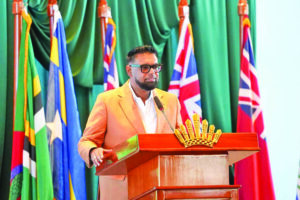
Speaking at the Caribbean Tourism Organization’s State of the Tourism Industry Conference (SOTIC) 2026, being held in Georgetown, the Head of State lamented the continued troubles Guyanese are forced to endure in order to travel to European countries, especially the Schengen region.
President Dr Irfaan Ali
“We can’t build partnerships and friendships like that, where people have to spend four days to get a visa before they travel to your country. And you want to host international conferences, so you invite us to all of the beautiful conferences that we want to attend, but we have to invest four days before we get the visa to attend… The modern world can’t be that complicated,” President Ali declared.
For years, Guyana has been pushing for visa-free access to Europe’s Schengen area, thus allowing for seamless travel across 29 European countries – 25 of which are Member States of the EU.
Currently, Schengen visas are being processed at the French Embassy in Georgetown but only for travellers heading to France. Guyanese travelling to other Schengen countries have to go to Suriname to obtain a visa – something which President Ali believes should no longer be the case.
“We have to travel to Trinidad and Suriname to get biometrics to do [the visa]. In a day of digitisation and AI, we have the EU that is operating from a Stone Age kind of operation, and they’re our friends, we can tell them frankly… You can get the biometrics of anybody and know if they’re a criminal or if they’re a good person in a couple of seconds,” he asserted.
At the time, the Guyanese Head of State was outlining to Caribbean stakeholders the importance of easy access to travel between countries, noting that other regions around the world have already moved in this direction.
“You can move to Greece, India, Bangladesh, Pakistan, China, and the Philippines, then within the GCC (Gulf Cooperation Council) – Qatar, Oman, Saudi Arabia, and the UAE (United Arab Emirates). That entire circuit [has] flights almost every hour, between one hour and two and a half, three hours. That is how connected, and they have built the infrastructure to create that ecosystem.”
“The same thing is happening in Latin America: an ecosystem through infrastructure is being created with connectivity. It’s the same thing with the European Union, the ecosystem that is being created. [But] the Middle East is ahead of them because you have the electronic visas that are easy to get. Here, the European Union is still backward in this region,” the Guyanese leader posited.
Just last week, Guyana’s Foreign Affairs and International Cooperation Ministry announced that Guyanese passport holders travelling to Saudi Arabia will now benefit from a visa on arrival or an electronic visa (e-visa).
Previously, Guyanese were required to go through an embassy or agent to obtain a visa before travelling to the Middle Eastern country or have a valid United States (US), United Kingdom (UK) or Schengen visa in order to qualify for a visa on arrival or electronic visa (e-visa).
But through intensified bilateral relations between Guyana and the Kingdom of Saudi Arabia, Guyanese will no longer need to obtain the visa beforehand.
This is one of a series of countries around the world that have lifted visa requirements for Guyanese passport holders in recent years.
Back in November 2022, the United Kingdom lifted the visa requirement for Guyanese travellers.
At the time, President Ali had disclosed that at least five European countries have agreed to support Guyana’s bid for visa-free travel to the Schengen region, but no further progress on this has been reported.
However, the opening of the French Embassy in Georgetown in September last year has resulted in the number of Schengen visas issued being doubled, moving from about 150 to more than 350.
In May, French Ambassador to Guyana, Olivier Plançon, had assured that his office is working to enhance the visa application and issuance process here, which he says comes with a lot of diplomatic complexity.
“Please also be mindful of the fact that the Schengen visa is a gateway to no less than 27 countries, and our visa policy has to be coordinated with all of them actually. That being said, we are constantly striving to streamline the visa issuance process, and we are well aware that improvements are needed and expected,” Ambassador Plançon noted.
Previously, the French diplomat had explained that the long-term goal is visa-free travel between the two countries and the wider European Union.
Discover more from Guyana Times
Subscribe to get the latest posts sent to your email.
SOTIC 2026: “We have to go bigger” – Pres Ali urges Caribbean to pursue luxury tourism
…says region needs to work together to attract major intl events
With luxury tourism fast becoming a preferred attraction, Caribbean nations are being encouraged to leverage resources to create luxury resorts and unique hospitality products to tap into this niche market.
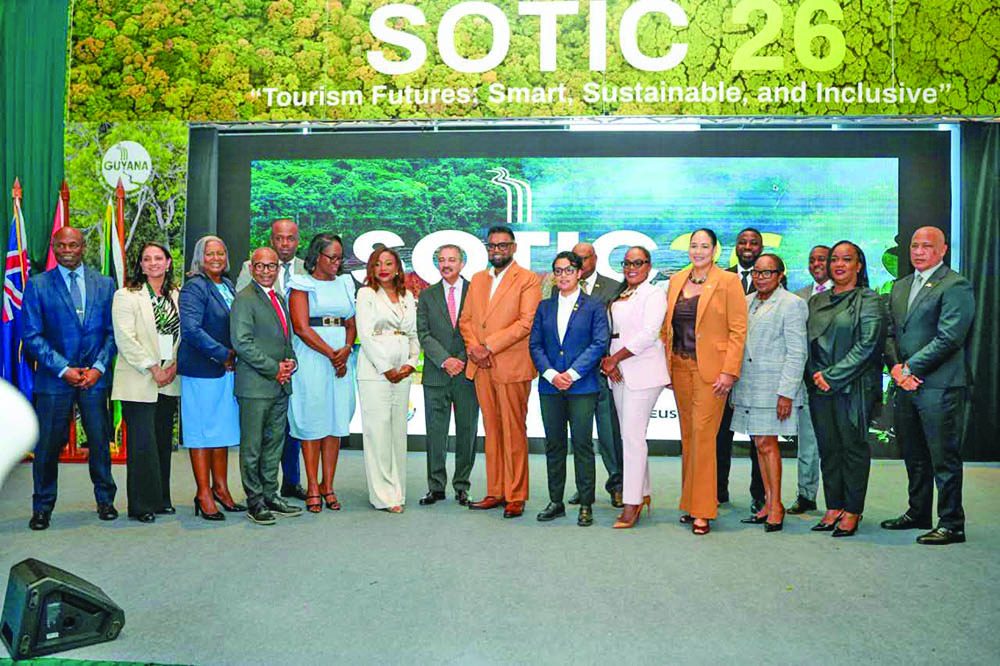
President Dr Irfaan Ali declared the CTO’s State of the Tourism Industry Conference (SOTIC) 2026 open on Wednesday at the Atlantic Suites by Hyatt in Georgetown
The Caribbean Tourism Organization (CTO) is hosting its State of the Tourism Industry Conference (SOTIC) in Georgetown this week. Under the theme “Tourism Futures: Smart, Sustainable, and Inclusive”, the event brings together Caribbean Governments, investors, and tourism businesses to examine the opportunities and challenges shaping the future of the region’s tourism.
Delivering the featured address at the opening ceremony on Wednesday at Atlantic Suites by Hyatt in Kingston, Georgetown, President Dr Irfaan Ali emphasised the need for Caribbean countries to “scale up” their thinking and make bold investments on the tourism products being demanded around the world.
One such area he pointed out that is attracting growing interest is luxury tourism – something in which the Middle East is already leading.
“They’re concentrating on luxury resorts and hospitality. Luxury resorts and hospitality, and luxury resorts and hospitality that are not overpriced,” the President stated, adding that the Middle East is also grabbing all the major international events such as sports and entertainment.
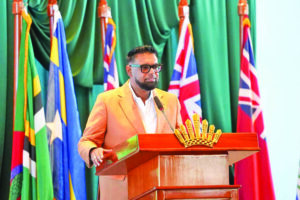
President Dr Irfaan Ali
“Almost all the global events the Middle East is going for and winning those events… luxury entertainment and high-class sporting events. Today, most of the world’s best sporting rehab centres are in the Middle East. Most of the global athletes are establishing their home or footprint in the Middle East. So, they are bringing that natural branding with the star power to their shores… They’re going after every single major concert and festival. And I’m saying this because you must understand this is all part of our market also – concerts, festivals, sports.”
Scale our thinking
The Guyanese leader acknowledged, however, that Caribbean nations do not have the resources, as the Middle East does, to invest at such a scale. Citing that countries like Mexico, Brazil, and the Dominican Republic are already making the move to build out the infrastructure to capitalise on the luxury tourism market, Ali believes that the Caribbean do the same if countries come together.
“We can’t individually go for some of these events, but collectively we can decide that by 2035, there are 10 events that we want to bring to the region, and how do we create the infrastructure to bring those events… And that is why I like the idea of Barbados also, of bringing a development with the marina – an upscale, high-end luxury resort. That is the thinking. We have to go bigger. We have to scale the thinking because that is where the market is going to be, because that is the only way we can go there and bring in the luxury type of shopping and other things that the market segmentation is demanding,” Ali contended.
In fact, he noted that Guyana is already leading the charge with its Global Biodiversity Alliance (GBA) initiative. Launched in June 2025, this alliance crafted by President Ali seeks to accelerate biodiversity conservation and expanding financing. The second GBA summit will be held in Georgetown at the end of this month, bringing together world leaders and stakeholders.
Another area in which Guyana is demonstrating such bold thinking and leadership, according to the Head of State, is its ambitious bid to secure the hosting rights of the 35th United Nations annual Climate Change meeting, Conference of the Parties (COP35), in 2030 – something which the Caribbean Community (CARICOM) is already backing.
Complacency
According to President Ali, there are many more such opportunities Guyana is ready and willing to go after but needs the financial backing of investors and support of organisations like the CTO to push them.
However, he pointed out that the region, including investors, has become complacent with the natural resources within the Caribbean; hence, they do not think about capitalising on the vast opportunities out there.
“Maybe in Guyana, for example, [we can have] the first night safari, tropical forest night safari. The country is willing to put together the land and the scale to have the first world-class night safari, and this is where investors are missing. This is where our investors are too laid-back. They are complacent. They are satisfied with the product that nature has given them, but the future is going to be completely different,” the Guyanese leader emphasised.
To this end, President Ali challenged the CTO and stakeholders at SOTIC to look at the trends in other regions around the world and where the market is and come up with a strategic plan that would ensure the long-term viability and competitiveness of tourism in the Caribbean. However, this, he pointed out, must be done within a set timeframe.
“We need this conference to deliver to the people of the region a vision to 2035, in which CTO places itself central to that vision, connecting to new partnerships and new markets, and integrating into those new partnerships and markets. That is what is important in this critical period of our tourism transformation… And the only way we can succeed is if we challenge ourselves with a time frame and work backwards in putting the systems in place to meet that time frame, because culturally we like to be pressed by time. That’s just reality… We have to be realistic. We are a people in this region; we have a different approach to life, and unless we can find an approach that pushes our traditional approach to life, we will not be able to make the changes,” the Head of State noted.
Discover more from Guyana Times
Subscribe to get the latest posts sent to your email.
Overloading outlets, overcharging devices can cause fires – Fire Officer warns
The Guyana Fire Service (GFS) is urging members of the public to practise safe charging of electronic devices as Guyana observes its 52nd Fire Prevention Month, with electrical fires remaining a concern.
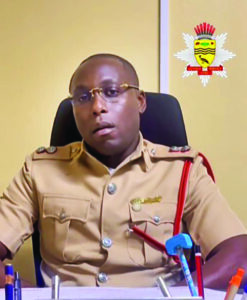
Fire Prevention Officer Sheldon Sauns, in a message marking Fire Prevention Month 2026, said the theme, “Charged into Fire Safety: Safe Charging is a Superpower,” highlights the shared responsibility of the Fire Service and the public in preventing fires.
Fire Prevention Officer, Sheldon Sauns
Sauns said the advancement of technology has created new fire hazards, requiring people to pay greater attention to how they charge and use electronic devices.
He pointed to cellular phones, laptops, power banks, e-scooters, and electric vehicles as some of the devices that require proper charging practices.
“As we’re seeing the advancement of technology, especially in our country, it then tells us that we need to advance in the way we approach fire and fire safety,” Sauns said.
He cautioned that overloading electrical outlets and overcharging devices can create serious fire hazards.
“It is our responsibility not to overload our outlets; it is our responsibility not to overcharge our devices, because if we do, of course, it can lead to serious fires,” he said.
According to Sauns, electrical fires have been prevalent in Guyana in recent years, with some linked to overloaded electrical circuits and unsafe charging practices.
He also identified electricity theft as another concern, noting that the Fire Service is strongly opposed to the practice because of the associated risks.
Sauns said fire prevention should not be viewed solely as the responsibility of the GFS but as a collective responsibility involving households, workplaces and communities.
He said members of the public can contribute to fire prevention by charging devices safely and educating others about fire safety.
“Not all heroes wear capes. You and I can become heroes,” Sauns said, encouraging the public to make fire prevention and safe charging part of their daily practices.
The Fire Prevention Officer called on the public to work with the GFS to reduce the risk of fires and safeguard lives and property.
“As we celebrate our 52nd fire prevention anniversary in Guyana, the Guyana Fire Service will be urging members of the general public to come on board with us. Let us practise fire safety and fire prevention together,” Sauns said.
Discover more from Guyana Times
Subscribe to get the latest posts sent to your email.
ExxonMobil to undertake pipeline maintenance ahead of GtE start-up
ExxonMobil Guyana is set to begin maintenance work on a near-shore section of its pipeline offshore of Crane, West Coast Demerara, as part of efforts to ensure the infrastructure is ready for the planned start-up of the Gas-to-Energy operations.
File photo: One of the five vessels being used by ExxonMobil during the ongoing safety inspection of the subsea pipeline
The maintenance activities are scheduled to begin on October 14 and are expected to continue until around December 1, 2026.
According to ExxonMobil Guyana, the work will address a finding on the near-shore section of the pipeline that was identified during inspection activities earlier this year.
The company said the maintenance is being undertaken to maintain the safety, integrity, and reliability of the pipeline, and is being conducted in accordance with international standards.
On Wednesday, ExxonMobil said the pipeline is currently pressurised with inert nitrogen gas and is not yet in operation. As a result, the company said the pipeline does not pose a risk to the public or the environment.
The company said it intends to complete the maintenance before the start-up of Gas-to-Energy operations to minimise the potential for maintenance interruptions after operations begin.
“ExxonMobil Guyana is coordinating with relevant stakeholders regarding the activities,” the company said in a press release.
The Maritime Administration Department (MARAD) is also expected to issue a marine notice providing information to mariners operating in the area.
ExxonMobil said it remains committed to conducting its operations safely and in compliance with applicable regulatory requirements.
In July, the Environmental Protection Agency (EPA) and Maritime Administration Department (MARAD) rejected claims that the pipeline being used for Guyana’s Gas-to-Energy (GtE) Project had ruptured offshore of the West Coast of Demerara.
The agencies said the 250-kilometre subsea and onshore pipeline, installed by ExxonMobil Guyana in 2024, was not in operation and had been filled with nitrogen and sealed pending the start-up of the GtE Project.
The EPA and MARAD confirmed, however, that an anomaly had been detected during a scheduled safety inspection of the pipeline that began in May. They said the matter was investigated and determined to be a slight anomaly, with additional inspections undertaken as a precaution to verify the pipeline’s integrity.
The pipeline is designed to transport natural gas from the Stabroek Block offshore to the GtE facilities at Wales, West Bank, and Demerara. Phase One of the project includes a 300-megawatt power plant and a natural gas liquids facility.
Discover more from Guyana Times
Subscribe to get the latest posts sent to your email.
BV Barima CoI: No assumptions about responsibility before examining evidence – commissioner
…says budget available to cover transportation, accommodation for witnesses
Government Ministers responsible for the maritime sector could be called to testify before the Commission of Inquiry (COI) into the July 18 capsizing and sinking of the MV Barima if their evidence is considered necessary.
Commission Chairman Justice Godfrey Smith made the position clear on Wednesday during the inquiry’s preliminary public hearing, while stressing that commissioners would first have to assess the evidence before determining who should be called.
Commission Chairman, Justice Godfrey Smith
Asked whether Ministers would be required to testify, Smith said, “And if it becomes clear that we require the evidence of a Minister, they will be asked to come before the Commission.”
Smith said the commission would not make assumptions about responsibility before examining the available evidence.
The inquiry is expected to examine the roles of the Maritime Administration Department (MARAD) and the Transport and Harbours Department, including vessel inspection, certification, maintenance, supervision and regulatory enforcement.
It will also consider whether the country’s maritime safety framework was adequate and whether existing requirements were properly implemented.
Charged crew members
The commission also intends to hear from three crew members, including the vessel’s Captain, who are facing murder charges in connection with the tragedy.
Asked whether the commission intended to obtain their testimony, Smith said, “We definitely will want to hear from them.”
However, he acknowledged that the ongoing criminal proceedings could affect their ability or willingness to provide evidence.
“If their lawyers advise them, you cannot speak, or you should not speak on pain of incriminating yourself, and they choose to act on that, it is beyond the powers of this commission of enquiry to do anything about that particular situation,” Smith explained.
He said the commission must respect the legal rights of persons appearing before it, including protections against self-incrimination.
Nevertheless, Smith said the inquiry could continue its work through documentary evidence, technical assessments and testimony from other witnesses.
The commission will examine the qualifications, training and experience of the Captain, officers and crew, as well as their conduct before and during the voyage.
Investigators will seek to establish what information was available to the crew, what decisions were taken and whether alternative actions were available when the emergency developed.
Smith also reminded the public that the commission is a fact-finding body and not a criminal court.
It will not determine criminal guilt or civil liability but will identify the causes, contributing factors and possible failures within its mandate.
Six-month timeframe
Meanwhile, the commission is targeting approximately six months to complete its work, despite an earlier two-month timeframe having been mentioned publicly.
Smith said the commission’s terms of reference were extensive and complex and that commissioners did not want to compromise the investigation by attempting to meet an unrealistic deadline.
The inquiry will examine six broad areas: the vessel’s seaworthiness and safety; passenger and cargo operations; crew qualifications and conduct; search, rescue and recovery efforts; regulatory and institutional oversight; and human factors and emergency decision-making.
The response following the sinking will also come under scrutiny, including the actions of public authorities, emergency services and maritime agencies.
The commission will examine available resources, communications received and transmitted, and decisions taken during rescue and recovery operations.
Smith said more than 100 potential witnesses had been referred to during the proceedings, although the commission has not confirmed a final number.
He also stressed the commission’s independence, noting that although it was appointed by President Dr Irfaan Ali and will submit its report to him, it is not an arm of the Government or any other institution.
The commission could recommend legislative amendments, stronger regulatory enforcement, improved training and certification requirements and better emergency response arrangements.
Smith said interim recommendations could also be submitted to the President if commissioners identify measures requiring urgent attention.
However, he clarified that the commission’s recommendations would not be legally binding and that it does not have the authority to award compensation to survivors or relatives of those who died.
Visit communities
As part of its investigation, the commission is scheduled to visit the Kingston Goods Wharf, MARAD, the Transport and Harbours Department and dry dock facilities on Thursday and Friday.
Commissioners are also expected to travel to Mabaruma and Port Kaituma on Monday and Tuesday next week.
Smith identified the two communities as among those severely affected by the sinking.
The visits are expected to assist commissioners in understanding the circumstances surrounding the tragedy and engaging persons affected by it.
Substantive hearings, during which witnesses will give oral evidence, are expected to begin following the visits.
The commission is also considering arrangements to facilitate survivors and relatives of victims who may have to travel to Georgetown to testify.
Smith said the commission’s secretariat has a budget for transportation, accommodation and other expenses.
Commissioner Nairi Alphonso said the visits to affected communities would also help the commission and its secretariat determine the logistical arrangements needed to facilitate witnesses.
Meanwhile, Smith disclosed that a website intended to provide public access to the commission’s proceedings, hearing schedules, evidence and other documents was not yet operational.
He said efforts were being made to have it available as soon as possible.
Discover more from Guyana Times
Subscribe to get the latest posts sent to your email.