Home Blog Page 130

East Coast Youth to Attorney-at-Law: Elton Bollers Joins the Bar

0

Elton Bollers grew up on the East Coast of Demerara, first in Plaisance and later in Paradise. On September 7, 2026, he took the oath as an Attorney-at-Law before the High Court. He told the Court that those communities “shaped much of who I am.”

The son of Lloyd Bollers and Enid Smith, he brings to the legal profession a résumé few new attorneys can match. He is a farmer, a former national athlete, and an economist who spent years in international development at the Inter-American Development Bank and the World Bank. He has also been a university lecturer and has published peer-reviewed research.

His petition was moved by Attorney-at-Law Ronald Daniels and Ms. Shaunella Glen, and granted by Justice Nigel Niles.

“Deliberate effort, discipline and determination”

In his address, Bollers said his reasons for choosing the law were “not only academic. They are deeply personal.” Growing up, he saw how “circumstances, decisions and systems could change the trajectory of a person’s life,” sometimes “closing doors, narrowing futures and leaving scars.” He declined to tell those stories because “those are not my stories to tell,” but said he carries them with him.

“There were times when I did what I could, but what I could do was not enough,” he said. Over time, that feeling became resolve: “I wanted to be in a position to do more than watch. I wanted to be able to stand up and represent.”

He also spoke about the pressure young people in his community face to take easier paths with quicker rewards. “I chose the straight and narrow, even when it was harder and the rewards seemed further away,” he said. He described the road that brought him to the Bar as one of deliberate effort, discipline and determination.

Farming taught him patience. “As a farmer, and the land has a way of teaching you patience,” he said. “You cannot rush a harvest. You prepare the ground, you plant, you tend it through good seasons and bad, and you trust that the work will bear fruit. The law, I have learned, is no different.”

From economist to advocate

His education began at North Georgetown Primary and St. Rose’s High School. He earned a B.Sc. in Economics at the University of Guyana and an M.Sc. in Economics with Distinction at The University of the West Indies, St. Augustine. He then went back to school, which he described as “learning to be a beginner.” He completed a Bachelor of Laws through the University of London and a Legal Education Certificate at the Eugene Dupuch Law School in The Bahamas. There he won the Joseph B. Lewis Prize and the HLB Acme Advisers Prize for Law Office Management, Accounting & Technology.

He has lectured at the University of Guyana, the University of the West Indies, the Bertram Collins College of the Public Service and the JTW Management Institute. He has also published peer-reviewed articles in local and international journals. His legal training included an internship at the Office of the Public Defender in The Bahamas and supervised family-law work at the Eugene Dupuch Legal Aid Clinic.

Explaining how these strands came together, Bollers told the Court: “Economics taught me to analyse systems. Academia taught me to question them. My experiences taught me to care about the people affected by them. And the law gives me the means to act.”

Sport and service have also been part of his life. He served as General Secretary and Assistant Treasurer of the Athletics Association of Guyana and as President of the Police Progressive Youth Club.

Gratitude and sacrifice

Bollers said the hardest cost of his studies was time away from his daughter, “time I cannot get back.” He told her: “I want you to grow up in a country where the law protects everyone equally, and I hope to help build it.”

He thanked his parents for his first legal training, drawing laughter: “From Dad, I learned how to argue a case. From you [Mom], I learned how to resolve one. An advocate needs both.” He also thanked his partner, his siblings, the Chief Public Defender and staff of the Public Defender’s Office, his lecturers at the Eugene Dupuch Law School, and his friends and colleagues.

He said he hopes his journey shows young people from communities like his “that their beginnings do not have to define their future.” They can go further than they once imagined, he said, “without ever having to forget, or be ashamed of, where you came from.”

Looking ahead

“Being called to the Bar is not an arrival at the end of a journey,” Bollers said. “It is an invitation to begin serving in a new way.” He closed with a farmer’s image: “You reap what you patiently sow. Today, I begin a new season.”

He plans to set up his own law firm and to add legal scholarship to his research on the Caribbean.


Source: Village Voice News

BV Barima CoI: No assumptions about responsibility before examining evidence – Commissioner

0


…says budget available to cover transportation, accommodation for witnesses

Government Ministers responsible for the maritime sector could be called to testify before the Commission of Inquiry (COI) into the July 18 capsizing and sinking of the MV Barima if their evidence is considered necessary.

Commission Chairman Justice Godfrey Smith made the position clear on Wednesday during the inquiry’s preliminary public hearing, while stressing that commissioners would first have to assess the evidence before determining who should be called.

Asked whether Ministers would be required to testify, Smith said, “And if it becomes clear that we require the evidence of a Minister, they will be asked to come before the Commission.”

Smith said the commission would not make assumptions about responsibility before examining the available evidence.

The inquiry is expected to examine the roles of the Maritime Administration Department (MARAD) and the Transport and Harbours Department, including vessel inspection, certification, maintenance, supervision and regulatory enforcement.

It will also consider whether the country’s maritime safety framework was adequate and whether existing requirements were properly implemented.

Charged crew members

The commission also intends to hear from three crew members, including the vessel’s Captain, who are facing murder charges in connection with the tragedy. Asked whether the commission intended to obtain their testimony, Smith said, “We definitely will want to hear from them.”

However, he acknowledged that the ongoing criminal proceedings could affect their ability or willingness to provide evidence. “If their lawyers advise them, you cannot speak, or you should not speak on pain of incriminating yourself, and they choose to act on that, it is beyond the powers of this commission of enquiry to do anything about that particular situation,” Smith explained.

He said the commission must respect the legal rights of persons appearing before it, including protections against self-incrimination.

Nevertheless, Smith said the inquiry could continue its work through documentary evidence, technical assessments and testimony from other witnesses. The commission will examine the qualifications, training and experience of the Captain, officers and crew, as well as their conduct before and during the voyage.

Investigators will seek to establish what information was available to the crew, what decisions were taken and whether alternative actions were available when the emergency developed. Smith also reminded the public that the commission is a fact-finding body and not a criminal court.

It will not determine criminal guilt or civil liability but will identify the causes, contributing factors and possible failures within its mandate.

Six-month timeframe

Meanwhile, the commission is targeting approximately six months to complete its work, despite an earlier two-month timeframe having been mentioned publicly.

Smith said the commission’s terms of reference were extensive and complex and that commissioners did not want to compromise the investigation by attempting to meet an unrealistic deadline.

The inquiry will examine six broad areas: the vessel’s seaworthiness and safety; passenger and cargo operations; crew qualifications and conduct; search, rescue and recovery efforts; regulatory and institutional oversight; and human factors and emergency decision-making.

The response following the sinking will also come under scrutiny, including the actions of public authorities, emergency services and maritime agencies.

The commission will examine available resources, communications received and transmitted, and decisions taken during rescue and recovery operations. Smith said more than 100 potential witnesses had been referred to during the proceedings, although the commission has not confirmed a final number.

He also stressed the commission’s independence, noting that although it was appointed by President Dr Irfaan Ali and will submit its report to him, it is not an arm of the Government or any other institution. The commission could recommend legislative amendments, stronger regulatory enforcement, improved training and certification requirements and better emergency response arrangements.

Smith said interim recommendations could also be submitted to the President if commissioners identify measures requiring urgent attention. However, he clarified that the commission’s recommendations would not be legally binding and that it does not have the authority to award compensation to survivors or relatives of those who died.

Visit communities

As part of its investigation, the commission is scheduled to visit the Kingston Goods Wharf, MARAD, the Transport and Harbours Department and dry dock facilities on Thursday and Friday. Commissioners are also expected to travel to Mabaruma and Port Kaituma on Monday and Tuesday next week.

Smith identified the two communities as among those severely affected by the sinking. The visits are expected to assist commissioners in understanding the circumstances surrounding the tragedy and engaging persons affected by it.

Substantive hearings, during which witnesses will give oral evidence, are expected to begin following the visits. The commission is also considering arrangements to facilitate survivors and relatives of victims who may have to travel to Georgetown to testify. Smith said the commission’s secretariat has a budget for transportation, accommodation and other expenses.

Commissioner Nairi Alphonso said the visits to affected communities would also help the commission and its secretariat determine the logistical arrangements needed to facilitate witnesses.

Meanwhile, Smith disclosed that a website intended to provide public access to the commission’s proceedings, hearing schedules, evidence and other documents was not yet operational. He said efforts were being made to have it available as soon as possible.


Source: INews Guyana

Construction of Timehri roundabout to commence soon

0


The Public Works Ministry is advising motorists, local businesses, residents and the commuting public that construction works will soon commence on the new roundabout in the vicinity of the Timehri Police Station.

Prior to the commencement of the works, a comprehensive public consultation process was conducted, engaging a total of 44 key stakeholders within the project zone.

These included major institutional stakeholders — the Cheddi Jagan International Airport (CJIA), Laparkan, the Guyana Prison Service, the Guyana Fire Service, the Guyana Defence Force (GDF), Marriott and Phoenix LTB — alongside 15 small businesses, two schools and 20 local residents.

To ensure minimal inconvenience to road users and maintain safety throughout the construction phase, the Ministry has established the following traffic management protocol:

  • Initial Lane Closure: Construction will begin on the roadside drain at the north-eastern section of the junction, adjacent to the Timehri Police Station. During this phase, one lane will be temporarily closed.
  • Two-Way Traffic Flow: As works progress onto the main roundabout structure, two-way traffic will be maintained along the western carriageway.
  • Emergency Vehicle Access: A dedicated emergency access lane will be maintained at the Timehri Police Station entrance to facilitate uninterrupted entry and exit for emergency vehicles under police guidance.
  • Traffic Control & Signage: Traffic cones, barriers, high-visibility warning devices and directional signs will be deployed across the work zone. Officers from the Guyana Police Force Traffic Department will be on-site to assist with traffic coordination.

Motorists traveling through the Timehri Junction are urged to exercise extreme caution, reduce speed to 30 km/h and strictly obey all posted traffic signs and police directions.

The Public Works Ministry expressed thanks the public for their patience and cooperation as we work to deliver critical infrastructure improvements.


Source: INews Guyana

Guyana Champions Smart, Sustainable And Inclusive Future For Caribbean Tourism At 2026 Sotic Opening – HGPTV – Guyana’s Nightly News and Entertainment Channel

0

By Antonio Dey | HGP Nightly News |

KINGSTON, GEORGETOWN — Positioning ecotourism and community-led hospitality as primary drivers of diversified economic growth, environmental preservation, and regional integration, Guyana officially welcomed regional tourism ministers, policy directors, and industry executives for the opening of the Caribbean Tourism Organization’s (CTO) State of the Tourism Industry Conference (SOTIC) 2026.

The flagship regional summit opened at the Atlantic Conference Centre, Pegasus Suites and Corporate Centre, Kingston, Georgetown, convened under the theme: “Tourism Futures: Smart, Sustainable, and Inclusive.”

Addressing delegates, both President Dr. Irfaan Ali and Minister of Tourism, Industry and Commerce Susan Rodrigues outlined a forward-looking paradigm for the Caribbean hospitality sector, urging the region to transition away from traditional sun-and-sand marketing toward high-value digital integration, cross-border intelligence sharing, and community wealth generation.

Minister Susan Rodrigues: Tourism Intelligence and Grassroots Value Retention

Opening the policy discussions, Minister Susan Rodrigues stated that the expansion of the regional visitor economy must be anchored in the rigorous protection of natural ecosystems while ensuring that revenues flow directly into indigenous and rural settlements:

  • Smarter Planning and Technology: Rodrigues called for Caribbean destinations to deploy modern data analytics and “tourism intelligence” to inform policy decisions, destination management, and cross-border marketing.
  • Community-Level Value Retention: Emphasizing that economic inclusivity must be tangible, Rodrigues stressed that when an international traveler books an indigenous eco-lodge, purchases local arts and crafts, consumes indigenous agricultural produce, or hires a resident guide, the economic surplus must remain anchored within that village economy.
  • Capitalizing Eco-Enterprises via GDB: Highlighting the newly operationalized Guyana Development Bank (GDB), Minister Rodrigues pointed to the state development lender’s zero-interest, zero-collateral lending windows as a structural catalyst designed to convert grassroots tourism concepts into commercially viable ventures.

“The bigger question is how do we collaborate better… tourism intelligence,” Minister Rodrigues emphasized.

“Tourism is constantly championed… the Guyana Development Bank is our response to that challenge and provides support that can help turn viable ideas into sustainable businesses.”

President Ali: ‘Go Bigger’ and Adopt Arabian-Style Digital Tourism

In his keynote address to Caribbean leaders and international partners, including Inter-American Development Bank (IDB) Chief of Operations Ivan Alonso, President Dr. Irfaan Ali challenged the sector to radically disrupt conventional Caribbean tourism products:

  • Expanding Regional Vision: Ali warned that incremental shifts will leave the Caribbean vulnerable to global competition, insisting that regional destinations must adopt bold, high-scale thinking that empowers young creatives and micro-enterprises.
  • Benchmarking Against Global Digital Models: The Head of State pointed directly to the innovative strategies deployed by Arabian Gulf states such as Qatar, which utilize cutting-edge digital tourism portals, immersive virtual reality previews, and hyper-curated marketing to stimulate global traveler demand before they even board a flight.
  • Showcasing Authenticity: Ali noted that digital packaging must be designed to excite international consumers while centering authentic Caribbean culture, culinary traditions, and heritage.

“Unless we find an approach that pushes… the thinking is that we have to go bigger,” President Ali declared.

“You can experience Qatar… the market and product is designed in a way to excite you.”

Regional Blueprint for SOTIC 2026

The opening day reinforced a collective regional consensus that Caribbean growth can no longer rely on enclave tourism models. With the conference running through October 9, 2026, plenary sessions will examine collaborative aviation connectivity, regional visa harmonization, and joint marketing campaigns across CARICOM territories.


  • Source: HGP Nightly News / HGPTV

    Woman nabbed while attempting to smuggle ganja to Mazaruni prisoner

    0


    A Sophia, Georgetown, woman is in Police custody after prison officers found a quantity of cannabis concealed in a box, she intended to send to a prisoner at the Mazaruni location.

    Tachanna Henry, a resident of C Field, Sophia, Georgetown, was arrested around 10:15h on Wednesday during a visit to the Georgetown Prison.

    According to the Guyana Prison Service, Henry was subjected to a search upon arrival at the facility. During the search, prison officers found several plastic bags containing leaves, seeds and stems hidden inside a box intended for a prisoner, who is stationed at Mazaruni. Henry was informed of the discovery and subsequently arrested. She was taken to the Alberttown Police Station along with the narcotics.

    Director of Prisons Nicklon Elliot warned that attempting to smuggle contraband into a correctional facility is a felony that can carry serious consequences.

    Elliot urged members of the public to recognise the risks associated with attempting to introduce illegal items into prisons, noting that such activities can pose risks to civilians, inmates and prison officers.

    He also commended the prison officers for their vigilance and prompt action in detecting the suspected smuggling attempt.


    Source: INews Guyana

    Overloading outlets, overcharging devices can cause fires – Fire Officer warns

    0


    The Guyana Fire Service (GFS) is urging members of the public to practise safe charging of electronic devices as Guyana observes its 52nd Fire Prevention Month, with electrical fires remaining a concern.

    Fire Prevention Officer Sheldon Sauns, in a message marking Fire Prevention Month 2026, said the theme, “Charged into Fire Safety: Safe Charging is a Superpower,” highlights the shared responsibility of the Fire Service and the public in preventing fires.

    Sauns said the advancement of technology has created new fire hazards, requiring people to pay greater attention to how they charge and use electronic devices.

    He pointed to cellular phones, laptops, power banks, e-scooters, and electric vehicles as some of the devices that require proper charging practices. “As we’re seeing the advancement of technology, especially in our country, it then tells us that we need to advance in the way we approach fire and fire safety,” Sauns said.

    He cautioned that overloading electrical outlets and overcharging devices can create serious fire hazards. “It is our responsibility not to overload our outlets; it is our responsibility not to overcharge our devices, because if we do, of course, it can lead to serious fires,” he said.

    According to Sauns, electrical fires have been prevalent in Guyana in recent years, with some linked to overloaded electrical circuits and unsafe charging practices.

    Fire Prevention Officer, Sheldon Sauns

    He also identified electricity theft as another concern, noting that the Fire Service is strongly opposed to the practice because of the associated risks.

    Sauns said fire prevention should not be viewed solely as the responsibility of the GFS but as a collective responsibility involving households, workplaces and communities.

    He said members of the public can contribute to fire prevention by charging devices safely and educating others about fire safety. “Not all heroes wear capes. You and I can become heroes,” Sauns said, encouraging the public to make fire prevention and safe charging part of their daily practices.

    The Fire Prevention Officer called on the public to work with the GFS to reduce the risk of fires and safeguard lives and property. “As we celebrate our 52nd fire prevention anniversary in Guyana, the Guyana Fire Service will be urging members of the general public to come on board with us. Let us practise fire safety and fire prevention together,” Sauns said.


    Source: INews Guyana

    Families Told BK Intl to Salvage MV Barima as Commission Vows to Find Answers

    0

    The families of those killed and survivors of the MV Barima tragedy were told Wednesday that BK International is being lined up by the Government to salvage the sunken vessel, a development that came as the Commission of Inquiry met face-to-face with relatives for the first time.

    The disclosure was made during the Commission’s meeting with affected families at the Arthur Chung Conference Centre, almost three months after the vessel sank on July 18 with more than 170 people aboard. The wreck remains underwater off the Essequibo Coast and is considered a potentially critical source of evidence in determining what caused the disaster.

    Commissioner Dr. Andrzej Jasionowski, a Polish naval architect and marine engineer, said he met the prospective salvage team on Tuesday to discuss how the vessel could be recovered while protecting its evidentiary value. He said negotiations were still being finalised but indicated that salvage operations could begin this month.

    Families and many Guyanese only learned on Wednesday, at the Commission’s meeting at the Arthur Chung Conference Centre, that the Government was moving to have BK International salvage the Barima.

    The disclosure came nearly three months after the vessel sank and as relatives continue to seek answers about the disaster and the recovery of those still believed to be inside the wreck.

    Three companies submitted bids for the salvage operation—BK International, Industrial Fabrication Inc. and Netherlands-based KMS B.V. BK International submitted the lowest bid, approximately G$1.034 billion, under a “no cure, no pay” arrangement.

    Jasionowski stressed that the wreck must not simply be dragged from the seabed in a manner that could destroy evidence.

    “The plan will be careful because if you lash it, it’s very easy to break it and what happens is the recovery becomes cut and scrap metal.”

    He said the vessel retains substantial forensic value despite having remained underwater for nearly three months.

    “Near 100%, the ship will give us clues that we seek on its state as it sank.”

    The significance of the disclosure was heightened by the fact that the vessel is believed to still contain bodies and cargo, making the recovery potentially crucial to both families seeking closure and the Commission seeking answers.

    Commission Chairman Justice Godfrey Smith of Belize told relatives that the inquiry had undertaken considerable preparatory work since its appointment, including developing rules, identifying witnesses and examining documentation, particularly records relating to the vessel’s certification.

    “Of course, for something this serious and complex, we have to do preparatory work.”

    Smith said the Commission would examine the circumstances surrounding the sinking without beginning with predetermined conclusions.

    “There is no wrong question. We would have no answer. That is why we are starting from this point.”

    He said the commissioners intended to be thorough in examining the evidence and determine, as far as possible, how and why the tragedy occurred.

    “I believe we can know how and why it has happened.”

    Commissioner Nyree Dawn Alfonso, a Trinidadian attorney with expertise in admiralty and maritime law, also assured families that she would bring her experience to the investigation.

    The Commission has been tasked with examining the vessel’s seaworthiness, passenger and cargo operations, crew qualifications and conduct, regulatory oversight, search-and-rescue efforts and other factors that may have contributed to the disaster.

    The July 18 tragedy claimed 73 lives, while 30 people remain unaccounted for and 76 survived, according to the latest figures reported by the Goverment.

    Formal public hearings are scheduled to begin on October 14, with more than 100 witnesses expected to testify.


    Source: Village Voice News

    Heritage Society to Spotlight Balgobin Tales, Raises Questions About Inclusive Representation

    0

    The Guyana Heritage Society is set to launch a new mixed-format presentation series on Guyanese heritage and culture, beginning with a focus on Balgobin tales and their place in the country’s oral tradition.

    The inaugural presentation, titled “BALGOBIN: A Missing Dimension in Our Oral Tradition,” will be delivered by Society member Petamber Persaud on Thursday, October 22, 2026. The series is intended to provide a platform for members, researchers, practitioners and invited presenters to share knowledge and deepen appreciation of the people, traditions, places and stories that form Guyana’s diverse heritage.

    Persaud’s presentation will examine the Balgobin tales as expressions of the resilience, wit and coping mechanisms of early Indian indentured immigrants as they confronted hardship, displacement and the challenges of adapting to a new society.

    The decision to place Balgobin at the centre of the inaugural presentation is significant, given the importance of oral traditions in preserving the experiences of communities whose histories were not always adequately recorded in formal accounts of Guyana.

    The Society says the presentation will also underscore the need to recognise and preserve such stories as part of Guyana’s wider oral and cultural heritage.

    That initiative, however, also raises a broader question about how Guyana chooses to present its heritage in a society made up of different ethnic and cultural traditions.

    Guyana is commonly described as a multi-ethnic nation comprising six major races—Indians, Africans, Amerindians, Portuguese, Chinese and Europeans. Each has contributed to the development of the country, while their experiences, traditions, struggles and achievements have helped shape Guyana’s national identity.

    The hope is that the format being used to highlight Balgobin will also create space for the traditions and histories of the other races and communities, allowing their contributions to be presented with the same seriousness and respect.

    Such an approach would be particularly important in a country where historical narratives can sometimes become politically or ethnically charged, with the achievements of one community elevated while those of another are minimised, questioned or denigrated.

    A genuine national heritage programme should not become a competition over which community suffered more, contributed more or deserves greater recognition. Instead, it should provide room for the different strands of Guyana’s history to be examined honestly, including the hardships, achievements, cultural practices and contributions of each community.

    The Balgobin presentation therefore has the potential to go beyond the preservation of a particular oral tradition. It can contribute to a broader understanding of how Guyanese society was formed and how stories passed from generation to generation helped communities survive and retain aspects of their identity.

    The Heritage Society has not yet announced the time or arrangements for online participation. Further details are expected shortly.

    The October 22 presentation will mark the beginning of what could become an important platform for documenting and discussing Guyana’s heritage—provided that the same principle of recognition is extended across the country’s diverse communities and that no race or its achievements are diminished in the process.


    Source: Village Voice News

    ‘Pull Up the Boat’ — Brown’s Mother Demands Action as Families Confront MV Barima Commissioners

    0

    The mother of MV Barima victim Kyon Brown delivered an emotional appeal Wednesday as grieving relatives and survivors confronted members of the Commission of Inquiry, demanding that the sunken vessel be raised and accusing the Government of moving too slowly on an issue that has left families without answers.

    Speaking at the meeting with the commissioners at the Arthur Chung Conference Centre, Brown’s mother said families should not have to endure prolonged delays while political considerations appear to overshadow their demand for answers and justice.

    Her remarks came as the meeting produced a major development in the long-running controversy over the wreck. Guyanese learned for the first time that BK International, a local company, had been selected as the preferred contractor to salvage the MV Barima. The National Procurement and Tender Administration Board subsequently announced that the contract had been awarded to BK International on a “no cure, no pay” basis.

    Brown’s mother said she was grateful for the commissioners’ involvement and indicated that her respect for them had restrained some of the stronger criticisms she wanted to make.

    “From my heart, what I see here, I’m grateful to the involvement of the commissioners. I have respect for the commissioners, so I would refrain from saying some of the things that I want to say.”

    But she was unapologetic about her frustration with the Government’s handling of the wreck.

    “The government is keeping us back and wasting our time. They’re crawling like snail on us.”

    She questioned why it had taken so long to move decisively to recover the vessel, arguing that the tragedy should transcend politics.

    “Everybody needs help to raise the boat. I am sorry, but I know it could be solved.”

    Her plea was blunt: raise the Barima.

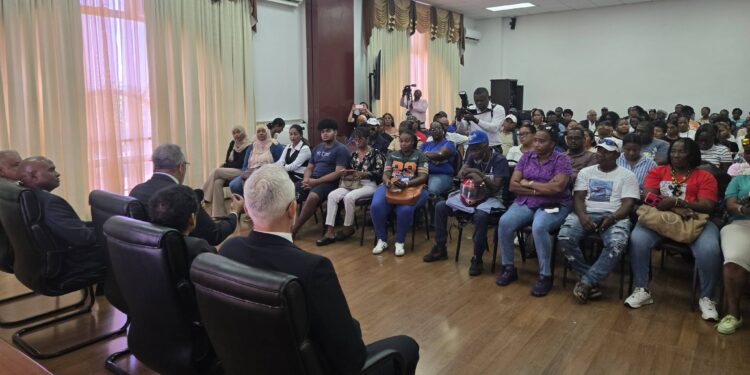
    Families and supporters of the MV Barima tragedy attending the Commissioners COI meeting October 7, 2026 at Arthur Chung Convention (Kyon Brown’s mother sitting in front row in red t-shirt)

    She recalled appealing directly to President Irfaan Ali to have the vessel recovered.

    “I asked the President, ‘Are you going to pull the boat up?’ I said, ‘Pull the boat up.’ He said no.”

    The mother said the Government and Opposition should put aside their political differences and work together to recover the vessel and provide the families with answers.

    “If you can’t pull the boat up and the Opposition need to pull the boat up, come together. Don’t put political this and this.”

    She said the families were not interested in political arguments.

    “When I’m doing political, everybody got to be one. One blood.”

    Her concerns echoed those of several relatives and survivors who questioned whether the Commission would ultimately deliver justice. Some family members expressed anger and scepticism about the inquiry, while others said recovering the vessel remained essential to understanding what happened.

    The MV Barima sank on July 18, 2026, while travelling from Georgetown to Port Kaituma. The vessel was carrying an estimated 179 people. Seventy-six survivors were rescued, 73 bodies were recovered, while dozens of people remained unaccounted for.

    The 87-year-old vessel has remained on the seabed since the disaster.

    The revelation concerning BK International came from Commissioner Dr Andrzej Jasionowski, who said he had met members of the prospective salvage team to discuss how the vessel could be raised while preserving evidence that may be crucial to the inquiry.

    Three companies had submitted bids: BK International, Industrial Fabrication Inc. and Netherlands-based KMS B.V. BK International submitted the lowest bid at approximately G$1.034 billion, compared with G$1.895 billion from Industrial Fabrication and G$2.035 billion from KMS.

    Jasionowski said the salvage operation must be undertaken carefully because improper handling could damage or destroy evidence.

    The commissioners have stressed that recovering the vessel is important but that the inquiry will not depend solely on the wreck. The Commission is examining the vessel’s seaworthiness, maintenance, passenger and cargo operations, crew, regulatory oversight, search-and-rescue response and other circumstances surrounding the disaster.

    Brown’s mother and the other grieving families say their patience is running out. They are demanding that the MV Barima be raised without further delay, the evidence preserved, and those responsible for the tragedy held to account. After months of waiting, they say they do not want more promises, political arguments or bureaucratic delays—they want answers, accountability and justice for the lives lost.


    Source: Village Voice News

    An Open Letter to ExxonMobil

    0

    Dear Mr. Routledge:

    Your reported declaration that “it’s not our job” to help build Guyana because Guyanese “didn’t vote for us” and ExxonMobil officials “are not representatives of the people” was inhumane, insensitive, ungrateful and beneath the standard expected from the head of a corporation extracting extraordinary wealth from a developing country.

    Guyana is an exceptionally profitable asset on ExxonMobil’s balance sheet, but, more so, it is our homeland, our mother. Your home country, the great USA, cannot, and does not, come close to such largesse and hospitality. After all, our oil belongs to the Guyanese people, and our national territory, institutions, workers and sovereign protections made, and continue to make, ExxonMobil’s success, and all those connected thereto, like yourself, and others, possible.

    Whereas, you may be correct in one narrow respect, that the primary constitutional duty to govern and build Guyana belongs to its elected government, political representatives and people, and cannot be delegated to ExxonMobil, your perverse attempt to detach ExxonMobil’s enormous profits from any meaningful commitment to the Guyanese people that make your success possible, is morally indefensible.

    ExxonMobil repeatedly describes itself as Guyana’s “partner.” Partnership cannot mean that Guyana supplies the petroleum, territory, legal protection and generous fiscal concessions while ExxonMobil takes the dominant benefits and disclaims responsibility for the country’s development.

    If ExxonMobil does not consider itself a partner in Guyana’s progress, you should candidly describe yourself as an extractor and profit-taker operating under an extraordinarily favourable contract. You reported approximately US$4.67 billion in profit from Guyana during 2025 alone, and reportedly recovered approximately US$55 billion in development investment two years earlier than expected, while projecting that your Guyana free cash flow could double by 2030 compared with 2025.

    Those staggering gains did not materialize in a vacuum. They came from resources belonging to our country where our developing nation is trying, concurrently, to rise above poverty, blackouts, inadequate infrastructure, unemployment, high living costs and unequal access to quality healthcare, education, housing and clean water.

    Against that background, your words did not sound like a technical explanation of corporate and governmental responsibilities, but more like contempt for the people whose patrimony is substantially enriching your company.

    ExxonMobil’s privileged position rests substantially upon the deeply unequal 2016 Production Sharing Agreement, including its two-percent royalty, provision allowing up to 75 percent of production for cost recovery, extensive tax concessions and Article 32 stability provisions.

    Article 32 purports to prevent Guyana from altering the agreement without the contractors’ consent and seeks to protect the consortium against additional fiscal burdens, which constitute exceptional restraints created by that provision.

    But “sanctity of contract” must not be transformed into an unlawful doctrine of corporate supremacy. No private agreement should be treated as though it stands above Guyana’s Constitution, Parliament, environmental laws, public policy, sovereign regulatory authority or the fundamental rights and welfare of the Guyanese people. Contractual stability is not perpetual immunity from transparency, accountability, lawful regulation or mutually negotiated reform. A decent partner would voluntarily return to the negotiating table when it becomes undeniable that an agreement produces an unconscionably imbalanced result, as here.

    Your company should not bask in the false glow of permanent immunity from political pressure, financial demands, lawful taxation, regulatory enforcement, renegotiation or national sovereign action. ExxonMobil’s own history in Venezuela demonstrates that neither contracts nor corporate size can eliminate geopolitical and sovereign risk.

    We reserve arbitrary nationalization, confiscation or unlawful financial punishment, and advocate lawful, peaceful and good-faith renegotiation so that Guyana receives a fairer share of its patrimony, for now. Even President Donald Trump-hardly an opponent of the petroleum industry-publicly rebuked ExxonMobil and Chevron in August 2026 for making “too much money” and demanded relief for consumers.

    Earlier, after ExxonMobil CEO Darren Woods described Venezuela as “uninvestable,” President Trump called the company’s position “too cute” and said he was inclined to exclude ExxonMobil from future Venezuelan opportunities.

    The lesson is plain: corporations do not vote, but governments and citizens retain the authority to demand responsibility, fairness and respect. No oil company is more sovereign than the country whose resources it extracts.

    Your observation that Guyanese did not vote for ExxonMobil is moot, and we did not invite ExxonMobil to behave as though the company’s only obligations are to its shareholders. Corporate responsibility does not arise from an election. It arises from law, contract, social license, environmental duty, moral responsibility and the immense benefits a corporation receives from its host country.

    ExxonMobil uses Guyana’s natural resources, benefits from its laws and institutions, depends upon its security and political stability, and earns billions from assets belonging to its people. Those benefits carry reciprocal responsibilities.

    A genuine partner should:

    1. Support a voluntary and transparent review of the 2016 agreement to achieve a fairer sharing of future benefits;
    2. Publish comprehensive production, cost-recovery, audit, insurance and environmental-liability information;
    3. Increase investment in Guyanese education, healthcare, technical training, infrastructure and community development;
    4. Expand genuine local ownership, procurement, employment and management opportunities-not merely statistical local-content compliance;
    5. Provide enforceable protection against oil spills and environmental destruction;
    6. Respect workers, fishermen, Indigenous communities and citizens affected by petroleum operations;
    7. Refrain from exploiting political division or governmental weakness; and
    8. Speak about Guyana and Guyanese people with humility, gratitude and respect.

    These measures would not make ExxonMobil the elected government, but a more responsible corporate citizen. Every foreign investor operating in Guyana must understand that our country is not merely a market, concession, mineral deposit, timber reserve or oilfield. Guyanese are human beings entitled to dignity, justice and a fair share of the wealth extracted from their homeland. Investors are welcome, profits are expected, but exploitation is not.

    We call upon ExxonMobil, Chevron, CNOOC and every overseas investor to treat Guyanese more fairly, humanely and compassionately, to respect our sovereignty, to contribute meaningfully to national development, and to recognize that corporate prosperity cannot be sustainably built upon public deprivation.

    “Partnership” is more than a public-relations slogan. Return to the negotiating table, share more fairly, disclose more fully, invest more deeply in the people and communities whose resources have enriched your corporation, Mr. Routledge.

    Anyone extracting billions from Guyana has no moral right to wash his hands of Guyana’s future. Overseas investors were not elected to govern us, but were permitted to operate among us, which must never be mistaken for ownership of our sovereignty, permanent immunity from accountability or freedom from the human duty to give back.

    Respectfully,
    Hon. Albert Baldeo
    Former Magistrate, Senior State Counsel and State Prosecutor of Guyana
    President, Guyana Beyond Borders


    Source: Village Voice News