Home Blog Page 11

Guyana’s leadership role in the commonwealth and global fight against cancer

0

The Cancer in the Commonwealth: a Lancet Oncology Commission report is scheduled to be officially launched on November 4, 2026, at the Commonwealth Heads of Government Meeting (CHOGM 2026), according to announcements by The Lancet Oncology on the social media platform X. The report culminates a study that has lasted three years. The decision to launch the report in Antigua and Barbuda during the Commonwealth Heads of Government Meeting 2026 was made during the 2026 Inaugural Commonwealth Health Coordination Forum in Geneva. The Chair of that first Forum was Guyana’s Ambassador in Geneva, Dr Leslie Ramsammy.
At that first forum, President Irfaan Ali made a virtual appearance. He stated, “Guyana applauds the Commonwealth for leading the fight against Non-Communicable Diseases (NCDs), especially the bold, necessary goal to eliminate cervical cancer by 2050. Guyana is also clear that no one country can end this form of cancer alone. This is why Guyana welcomes deeper collaboration across the Commonwealth and beyond.”
Minister Frank Anthony will be a panellist when the report is launched today (November 3) at the side-lines of the Commonwealth Heads Meeting. The First Lady of Guyana will be part of the launching. One of the strategies that will be implemented to ensure a more comprehensive cancer response around the world is the mobilisation of First Ladies as champions in the fight against cancer. Guyana’s First Lady will be among the pioneering group of First Ladies that will champion an expanded response to the cancer crisis around the Commonwealth and the world. Ambassador Leslie Ramsammy will make an opening address at the launch. We reproduce part of his address in this week’s Rumination column.
I’m truly sorry that I cannot join you in person today, but I’m with you completely in purpose.
That cancer control is on the very packed agenda at the Commonwealth Heads of Government Meeting, in front of Heads of Government, Ministers, First Ladies, and spouses, tells us something important: cancer is not just a matter for Health Ministries but for leaders too.
I was privileged to chair the inaugural Commonwealth Health Coordination Forum last May in Geneva. Ministers of Health, Ambassadors, High Commissioners, and more than 60 partner organisations came together under one theme: Shaping the Future of Cancer Across the Commonwealth.
We wanted to find where Commonwealth cooperation could add practical value on diagnosis, treatment, palliative care, and on the data we need to plan and hold ourselves accountable. The reason we could ask those questions with confidence was that the Commission produced the evidence which was the foundation for all our discussions.
So, today’s launch completes a long journey that we have all taken together, that Geneva helped to shape, and I could not be prouder to see it arrive at the Commonwealth Heads of Government Meeting in Antigua and Barbuda.
Excellencies, let me say it as simply as I can: Cancer is a test of the whole health system. A woman cannot be screened for cervical cancer if there is no primary care clinic near her home. A child’s leukaemia cannot be diagnosed without a working laboratory. A man with prostate cancer cannot be treated without trained staff, essential medicines, and functioning referral pathways. And no one should face the end of life without palliative care. Each of those components also serves people with diabetes, heart disease, maternal health, and infectious disease. That is why cancer control is not a separate, vertical programme.
When we strengthen services for cancer, we strengthen services for everyone. When we invest in primary care, workforce, diagnostics, and data, we also strengthen our response to cancer.
As a former Minister of Health, I know how difficult choices are when budgets are tight and every investment seems to compete with another. That’s why the Commission’s evidence matters so much. By demonstrating that every dollar invested in scaling up cancer control returns between 16 and 24 dollars in health and economic benefits, it shows that investments in cancer control are among the best that Governments can make.
And for the first time, through the Commonwealth Observatory for Health Systems and Cancer Control, our policymakers will have contextual information across some 800 health-system and cancer-control variables. Good data allow us to make good policy. So let me make three requests.
First, let’s make cancer control part of our national plans for universal health coverage. Prevention, early detection, treatment and palliative care belong in the essential package.
Second, let’s learn from one another. The Commonwealth allows a small island state and a large country to sit together as equals. Antigua and Barbuda’s work on cervical cancer elimination is exactly the kind of experience we must share. Third, let’s keep our promises. The Commission has given us the evidence, and the Coordination Forum in Geneva has a shared direction. The Commonwealth Heads of Government Meeting 2026 must now give us the political will to deliver. CARICOM in 2007 in the Port of Spain and the Commonwealth in 2008 in Geneva gave political leadership and issued a call for action on the NCDs that led to the first UN high-level meeting on the NCDs. Let CHOGM 2026 do the same for cancer.


Discover more from Guyana Times

Subscribe to get the latest posts sent to your email.


Source: Guyana Times

A new door to educational opportunity

0

Education does not end when the school over in the afternoon. For some children, additional time and guidance are needed to understand lessons, particularly in subjects such as Mathematics and literacy. While private extra lessons have become a common way for parents to address learning gaps, the cost can be difficult for many households to manage.
The expansion of the Guyana Digital School (GDS) to provide free live reinforcement classes for students from Grades One to Eleven is therefore a welcome development. Apart offering additional lessons, the initiative provides an opportunity to make academic support more accessible, regardless of a family’s financial circumstances.
The response from parents who have already registered their children suggests that the programme is addressing a genuine need. Parents have welcomed the opportunity to strengthen their children’s understanding of subjects in which they may require additional help. That response should encourage the Education Ministry to continue developing the platform and ensuring that it delivers meaningful results.
Mathematics and literacy are important because they form the foundation for learning across the curriculum. When children struggle with basic concepts, the difficulties can follow them into higher grades. Additional instruction can help address those weaknesses before they become more difficult to overcome.
Not every parent can afford private tuition, despite recognising that a child needs extra assistance. The availability of free reinforcement classes helps narrow that gap. A child’s opportunity to improve academically should not be determined by whether parents can meet the additional expense of private lessons.
This is where the Guyana Digital School can make a meaningful contribution and launched in December 2025 under the Education Ministry, the platform was designed to complement traditional classroom teaching through technology and a blended learning approach.
The introduction of live reinforcement sessions builds on that objective as students now have another opportunity to revisit lessons, seek clarification and receive guidance from trained educators outside regular school hours. Importantly, the initiative is intended to support classroom learning, not replace the role of teachers or the formal education system.
While digital libraries and recorded lessons provide useful resources, students also need opportunities to interact with teachers and ask questions when they encounter difficulties. Effective online instruction must therefore go beyond making educational material available. It must engage students and help them understand what is being taught.
There will inevitably be some challenges as the programme gets underway as one parent has already pointed to difficulties managing participation among younger students during live sessions. Such concerns should not be dismissed, but neither should they overshadow the value of the initiative. They offer an opportunity to identify weaknesses and make the necessary adjustments.
Parents have a role to play as well and by linking their email addresses to children’s accounts, as encouraged by the GDS Director, allows them to monitor progress and remain involved. Younger students, in particular, may need supervision and encouragement to stay focused during online sessions. The benefits will be greater when support from educators is reinforced at home.
The resources available through the Guyana Digital School should also be recognised. Its digital library, CXC examination materials, skills programmes and practical learning activities provide opportunities for students to develop beyond the traditional curriculum. The platform’s reach into the wider Caribbean Community also creates possibilities for educational access beyond Guyana.
The number of students registered and attending classes will provide an indication of interest, but participation alone cannot establish whether the programme is achieving its purpose. Regular monitoring, assessments and feedback will be necessary to determine whether students are making progress in subjects where additional support is needed.
The expansion of free reinforcement classes is a step towards reducing any inequalities in access to supplementary education. Its value will depend on the consistency of delivery, the quality of instruction and the willingness to address problems as they arise.
For many families, the cost of extra lessons has long been an added pressure and providing a free alternative through the Guyana Digital School gives more children an opportunity to receive assistance without adding to that burden.


Discover more from Guyana Times

Subscribe to get the latest posts sent to your email.


Source: Guyana Times

Collateral damage: two words that cannot be walked back

0

Dear Editor,
In my last letter, I asked readers to remember two words: “collateral damage”. Hana Mohamed has now given us every reason to. Asked by the media today to explain what she meant when she used those words about Constable Ryan Greene and his family, she first denied saying them. The video says otherwise. She then offered a new version: what she really meant, she said, is that everyone will become collateral damage in the Government’s pursuit of her brother, the Leader of the Opposition. A denial followed by a reinterpretation is not a clarification. It is damage control. And the new version, read carefully, is not a retreat. It is a confession.
Start with the denial. The remark was made to the face of a family whose son sits on remand and whose mother had been detained, and it was recorded. Ms Mohamed’s word against a recording would be a weak hand at the best of times, and her record this year makes it weaker. In February, Glenn Hanoman, counsel for the requesting state, described her Facebook claims of a “bombshell revelation” in the extradition hearing as “entirely false, misleading, and without factual foundation”. In April, the Supreme Court of Judicature itself had to correct a post of hers that named the judiciary’s own research counsel as members of a state legal team. In September, the Chief Magistrate warned her, in open court, to stop posting about the proceedings after a key witness said he feared for his family’s safety. When a prosecutor, a court, and a Magistrate have all had to correct your version of events in the same year, the public is entitled to believe the video.
Now the clarification. Its premise is that the Government is pursuing her brother. It is not. The law is, and on several fronts, none of them were invented in Georgetown. In June 2024, the United States Treasury sanctioned Azruddin Mohamed and his father for public corruption, alleging that their company omitted more than 10,000 kilograms of gold from its declarations and avoided more than US$50 million in duties owed to the people of Guyana. A federal grand jury in Florida has since indicted both men on 11 counts, including wire fraud and money laundering, and the US has requested their extradition. At home, he and two staff members face firearm charges and a charge of attempting to obstruct the course of justice arising from the October 12 incident outside the home of Senior Superintendent Prem Narine, the key witness against him. On October 30, he was jointly charged with the Constable under the Cybercrime Act and remanded by a Magistrate applying the Bail Act. Every one of these matters arises from conduct alleged against him, brought by law enforcement and placed before a court. None of them is a Government press release.
So consider who the “everyone” in her revised sentence actually is. A 20-year-old Constable, remanded to prison on the same charge as her brother. His mother, Nikita Greene, detained until the High Court ordered her release. His father, Randy Greene, left to file habeas corpus proceedings on his own. Two of Mr Mohamed’s employees were charged alongside him. A company that bears a family member’s name, designated by the US Treasury. And, by Nazar Mohamed’s own public account in March 2025, people connected to the Administration lost their US visas because of their association with him. Collateral damage implies a strike. In every one of these cases, the strike came from inside the Mohamed camp, not from the state.
Strip the new version of its packaging, and the meaning is plainer than the original. If he goes down, everyone goes down with him. That was always the message. The Constable was simply the first name on the list. The party, its supporters, his staff, the Office of Leader of the Opposition, the reputation of the Magistracy and, last week, even a state reception for a visiting Monarch have all been drafted into one man’s defence. That is not the language of a political leader. It is the logic of someone holding the room hostage.
Why would anyone think this way? The answer is entitlement, and it predates WIN. When the sanctions landed in June 2024, the family expected the Government to stand between them and Washington. It could not, and it should not have. Guyana’s banks depend on correspondent relationships with United States institutions. Its oil economy earns and settles in US dollars. Its security partnership with the US is no small matter with Venezuela at the border. No responsible Government would put every depositor, importer, remitter, and public servant at risk to shield one family’s fortune from the US Treasury. The Government cut its ties and put the country first. By March 2025, Nazar Mohamed was on Facebook declaring, “The Constitution protects me,” complaining about denied vessel approvals and withheld mining permits, and hinting at legal action. The grievance born in that moment is the grievance driving the Opposition today. If the state would not protect them, the state would be made to pay. A political party was the instrument.
None of this is new. It is a familiar pattern among the very wealthy whose fortunes, on the allegations of the authorities, were built in the shadow of the rules. Money is mistaken for immunity. Philanthropy becomes a shield. Accountability is rebranded as persecution. And the people around them, staff, supporters, and a young policeman with a career ahead of him, become expendable the moment the law comes knocking. Real leaders absorb the cost to protect others. Here, others are made to absorb the cost to protect the leader. If Constable Greene did nothing wrong, the Mohamed camp should have been the first to stand beside him. Instead, Mr Mohamed’s attorney said his client “does not know this young man,” and his sister called him collateral damage.
The presumption of innocence stands, and the courts will settle the criminal questions. But words spoken in public belong to the public, and no amount of reinterpretation can unsay them. Ms Mohamed did not misspeak. She told a family fighting for its son the truth about how her household sees everyone outside it. Today’s “clarification” only widened the circle. Guyanese should take her at her word, both versions of it.

Yours faithfully,
Concerned citizen


Discover more from Guyana Times

Subscribe to get the latest posts sent to your email.


Source: Guyana Times

Destroying Guyana to save wealth and empire

0

Dear Editor,
When you have a spoilt and entitled billionaire with a delusional ego and no competency or foresight on how to run a country, then you will end up with a party that attracts a segment of our population that are easily “bought out”, resulting in the violent and unsightly protests we saw recently, because “wanna-be” politicians like Azruddin.
It is becoming clear that the WIN party is not for the people of this country but an attempt at a desperate bid to protect one man and his family’s empire. The Mohameds have compounded their wealth for decades, yet it is only within the few years the country learned of Azruddin Mohamed that he was placed under investigation, indicted, sanctioned and is now facing extradition, yet his supporters wouldn’t pick up on that. Where was he before 2020? Why didn’t he start his political career earlier if he cared for Guyanese? Because picture this: prior to the investigation, the Mohameds were PPP supporters; in fact, his father, Nazar Mohamed, was a PPP councillor. What changed is the fact that their money could not have bought their freedom, because (theoretically) had the PPP thrown their support behind Azruddin in 2020, then the empty barrels in front of the courts would not have been protesting. The reality of that would’ve also meant there would not have been a PPP Government today because the opportunistic PNC and their several fake parties would’ve used that to attack the PPP.
Azruddin and his father were indicted via a grand jury in Florida. This body usually comprises 20+ ordinary Americans that have no connections to the case; in fact, these types of cases are usually brought by state prosecutors that take months (even years) to build a case with merit. They gather every and any single form of proof, evidence, record, etc. to determine whether the case is valid or not. The US federal investigation into Azruddin Mohamed spanned from 2017 to June 2024 (covering a scheme involving gold exports and tax evasion), and the indictment in the US District Court for the Southern District of Florida was unsealed on October 6, 2025 (with the court filing dated October 3, 2025). If these prosecutors misrepresent a case, the consequences they face are severe, and they can do irreparable damage to their careers and reputation.
That is why Azruddin Mohamed is fearful of the evidence in the extradition being made public because it is factual; to date he has not contested the evidence, despite his claims of innocence. In fact, he is actively trying to stop the process through legal challenges like bias and fears of being sent to a third-world country, none of which can be considered contesting the evidence, yet his supporters wouldn’t question it.
His entire family that claims to lead a life of devotion to Islamic teachings is actively engaging in deceit, bribery and lies. If they truly did nothing wrong, why go to all these measures? Including stating “peaceful protest” that resulted in Stabroek square up in flames, all in the Mohameds’ name? Why lie about an assassination when they invited themselves to the scene of the incident? These are not smart tactics; they are clear desperation attempts against a shrinking timeframe and an inevitable reality they themselves CANNOT run from without bribing people. like “headless chickens” running around the place.
At this point his only hope is to create as much distrust between the population and the Government. They have shifted the attention of claiming innocence in the extradition proceedings (tax fraud, mail fraud, wire fraud, smuggling, etc.) and are now directing attention to fabricated attempts to overexaggerate claims of persecution by the Government through deliberate rage baiting and provocation. The precedent this sets is a catalyst for societal collapse; eventually, it destroys the unity we strive to achieve. How shallow is it to bribe less academically inclined Guyanese and the intellectual bunch with nothing but hate and arrogance in their hearts to fight for a billionaire who built his wealth by evading taxes? Further, how hypocritical it is for WIN supporters to say people are suffering yet their ulterior political agenda is not for the people of this country but one singular objective (to free Azruddin). It is a shame the things some Guyanese do for money, without thinking about the consequences down the road. God help this country!

Kind regards,
Dev Harry


Discover more from Guyana Times

Subscribe to get the latest posts sent to your email.


Source: Guyana Times

Democrats capture Congress in sweeping setback for Trump

0

WASHINGTON,  (Reuters) – Democrats captured majorities in both the Senate and House yesterday, scoring sweeping victories that reached deep into Republican strongholds as tens of millions of voters delivered a scathing rebuke to President Donald Trump.

The size and breadth of the Democratic wave were still coming into focus, but the party prevailed in states long thought to ‌be out of reach, including conservative bastions like South Carolina, Texas and Iowa.

The Democratic wave underscored voters’ deep frustration with Trump’s stewardship of the economy and his decision to launch a war against Iran in February, which drove gas prices up sharply. In poll after poll, voters expressed anxiety about the cost of living and anger at the way Trump has handled the issue.

In Kansas, Adam Hamilton, a megachurch pastor, became the first Democrat to win a Senate seat since the Great Depression nearly a century ago.

In Ohio, Democrat Sherrod Brown claimed a seat that belonged to Vice President JD Vance two years ago, while Texas Democratic state Representative James Talarico withstood a barrage of outside spending to defeat ⁠scandal-plagued Republican Attorney General Ken Paxton. Both Ohio and Texas voted for Trump by a double-digit margin in 2024.

In South Carolina, a state that Trump carried by nearly 18 points in 2024, pediatrician Annie Andrews triumphed over Republican Senator Darline Graham, who was appointed to the seat after the death of her brother, Senator Lindsey Graham.

Trump elevated Paxton and Graham ahead of more established candidates despite clear liabilities. Paxton has been at the center of a litany of controversies, including his 2023 impeachment and securities fraud charges, while Graham’s admitted inexperience drew negative headlines.

Trump campaigned heavily for Paxton, Graham and Ohio’s Jon Husted as part of a late election blitz that included more than two dozen rallies, and the president told his supporters repeatedly to “pretend I’m on the ballot” in an effort to fire up his base.

On Tuesday night, as it grew clear Republicans were in danger of losing their congressional majorities, Trump wrote on social media, “I wasn’t on the Ballot and if I was, we would have won IN A LANDSLIDE! Thank you for your attention to this matter.”

Democrats had flipped six Republican Senate seats in all, ensuring a majority ‌even if they ⁠don’t manage to hold their own seats in competitive Michigan and Minnesota.

Democrats were also on track to take control of the US House of Representatives after flipping at least eight Republican seats in states including Kentucky, New Jersey and North Carolina and showing strength even in solidly conservative districts.

The party’s dominance extended to other races as well. Texas Governor Greg Abbott, a three-term incumbent, lost to Democrat Gina Hinojosa, while Democrats also captured governorships in conservative Iowa and Ohio.

A REBUKE TO TRUMP, WINNER SAYS

“In sweeping and decisive victories, the American people have rebuked the depravity, corruption and incompetence of the man named President Donald J. ⁠Trump,” incumbent Democratic Senator Jon Ossoff, the projected winner in Georgia, told supporters at a victory party.

In Florida, Republican Senator Ashley Moody fended off Democrat Angie Nixon but was ahead by only about 3 percentage points in a state Trump carried by 13 points in 2024, according to a vote count compiled by Reuters and USA Today, further evidence that even solidly Republican states were shifting dramatically toward Democrats.

Democrats held onto ⁠three House districts in Florida that Republican lawmakers had redrawn earlier this year, all of which backed Trump by at least 9 percentage points.

According to exit polls conducted by SSRS on behalf of a consortium of US media outlets including major television networks and the Associated Press, half of voters nationwide said they saw the 2026 midterm elections as an opportunity to rebuke the ⁠president, and three-quarters said they are “angry” or “dissatisfied” with the way the country is headed.

In addition, 70% of voters surveyed said they want Congress to provide more checks and balances on the president.


Source: Kiskadee Watch

Prosecution, defence in fierce clashes over alleged Mohamed crimes, Chief Magistrate again refuses to revoke extradition bail

0

-Hanoman raises prospect of murder charge in Fagundes case

Following strong opposition from defence lawyers to prosecution arguments that included the prospect of further criminal charges, Chief Magistrate Judy Latchman on Tuesday declined for a second consecutive day to revoke Opposition Leader Azruddin Mohamed’s bail in his extradition proceedings.

Magistrate Latchman ruled that breaches of his bail conditions had not been established and that there were no substantial grounds to justify revocation. She also found no evidence that Mohamed was a flight risk or had supplied the court with an incorrect address.

The hearing at the Georgetown Magistrate’s Court featured sharp exchanges between prosecutor Glen Hanoman and defence attorneys Siand Dhurjon and Roysdale Forde over allegations of witness interference, evidence tampering and political victimisation.

As the prosecution presented its arguments, Mohamed’s father and co-defendant, Nazar Mohamed, broke into tears. At one point, he called out in defence of his son: “He is being victimized, he is innocent of all these charges!”

Magistrate Latchman asked the elder Mohamed to try to control himself during the proceedings.

Hanoman, seeking to have the magistrate revisit her decision of the previous day, argued that Azruddin Mohamed had committed further offences while on bail and subject to conditions.

He alleged that within hours of conditions being imposed, Mohamed had appeared outside the United States Embassy and described prosecution witness Senior Superintendent Prem Narine as a murderer and an assassin. He also referred to calls for Narine’s visa to be revoked and for his deportation, characterising the conduct as witness tampering.

Hanoman contended that Mohamed had repeatedly been afforded bail and suggested that this had encouraged a belief that he was above the law.

He told the court that further charges were being contemplated in connection with the 2021 Main Street murder of Ricardo Fagundes, witness tampering, obstruction of justice and cybercrime-related offences. He said persons he described as co-conspirators had already given statements to police.

Those assertions were challenged by the defence. Dhurjon said Mohamed had never been arrested or contacted by police in relation to a murder investigation. If investigators had uncovered serious evidence, he argued, Mohamed was already in custody and available to be questioned.

Dhurjon maintained that there must be proper grounds for revisiting bail and that Hanoman’s assertions could not be treated as the equivalent of sworn affidavit evidence. He also questioned whether the prosecutor was involved in the investigations to which he referred. 

Accusing Hanoman of malicious intent, Dhurjon argued that the prosecutor was making allegations as the hearing progressed.

Hanoman also alleged that Mohamed had tampered with evidence by releasing footage of the shooting incident outside Narine’s residence with a false narration and by cropping the video to misrepresent what had occurred.

Dhurjon disputed that characterisation, questioning how the cropping of footage, by itself, amounted to evidence tampering.

“Must Mr Mohamed show the entire 24 hour footage?” he asked.

Hanoman clarified that the prosecution was seeking revocation of Azruddin Mohamed’s bail alone, rather than that of his father. He argued that the cumulative effect of charges brought since bail was granted justified revocation, even if individual charges were not considered serious.

Dhurjon urged the court to take account of what he described as extraordinary allegations by the prosecutor.

Hanoman maintained that the charges had been thoroughly investigated and alleged that Mohamed’s conduct involved bribery and corruption. He further alleged that the Mohameds had bribed governments over decades and argued that the proceedings reflected the loss of protection rather than victimisation.

It was during these submissions that Nazar Mohamed interjected in defence of his son.

Befall

Responding to the allegations concerning Narine, Dhurjon said Mohamed had attended a protest days after the court proceedings relating to the shooting incident. Those present had demanded justice, he said, and had not called for harm to befall Narine.

Dhurjon also alleged that Narine had assaulted Mohamed on the road and said photographs showed his client’s injuries. He argued that the matter illustrated institutional failures.

“Our institutions do not function as they should,” he told the court.

Forde similarly argued that the charges were politically motivated and accused Hanoman of diverting attention from the issues the court had to determine.

He pointed to Mohamed’s position as Opposition Leader and the police’s placement under the Ministry of Home Affairs, questioning whether an ordinary citizen would have been repeatedly charged in similar circumstances.

Addressing the firearm-related allegations, Forde said Mohamed had been recording the use of state resources at Narine’s property and had driven past without stopping.

Hanoman also questioned the address Mohamed had supplied to the court, alleging that police had found him hiding at a relative’s residence.

Magistrate Latchman asked whether a person who gave an address to the court was thereby prohibited from visiting another address.

Dhurjon said no wanted bulletin had been issued for Mohamed and questioned how he was to know police were seeking him. He added that police had not visited Mohamed’s Republic Park address between October 12 and 14.

Hanoman further argued that Mohamed posed a flight risk because he had access to fast helicopters and speedboats.

After hearing the submissions, Magistrate Latchman ruled that the existence of charges did not, by itself, satisfy the court that Mohamed had committed or was likely to commit an offence. Breaches of his bail conditions had to be established, she said.

She found no evidence supporting the allegations that he was a flight risk or had given an incorrect address.

The ruling leaves Mohamed’s bail in the extradition proceedings intact, subject to the existing conditions. It does not determine his custody status in separate criminal proceedings.

Mohamed and his father are contesting extradition to the United States. Their extradition proceedings are scheduled to resume before Magistrate Latchman on November 23.

Meanwhile, a bail application filed by Mohamed’s mother, Bonita Mohamed, is expected to be heard before Justice Priscilla Chandra-Hanif at 9 am today. The application seeks to quash Magistrate Abigail Gibbs’ October 30 decision refusing bail in the surveillance footage case and secure his release on reasonable terms. It alleges apparent bias arising from a connection between Gibbs and an officer involved in investigating the underlying shooting incident, challenges the length of remand and argues that insufficient weight was given to Mohamed’s previous compliance with bail conditions, family responsibilities and established ties to Guyana. 


Source: Kiskadee Watch

‘This looks like malice or vengeance’ – sister of man who died at Vreed-en-Hoop police station

0

“This looks like malice or some kind of vengeance they took out,” the sister of 32-year-old Gavin Kennard Douglas said, as the family continues to demand answers following his death while in police custody at the Vreed-en-Hoop Police Station.

Reanna Douglas said the family was still waiting to establish exactly what happened to her brother, whose post-mortem examination reportedly revealed injuries to his head and abdomen.

“I don’t know why they had to go to this length,” she said, questioning the circumstances surrounding his death and the injuries found on his body.

Speaking with Kiskadee Watch yesterday, Reanna said the family had been informed that some police ranks were in custody and were awaiting further developments in the investigation. She said the post-mortem findings had not provided the family with all the answers they wanted, although they were told that Douglas died as a result of bruises to his head and abdomen.

The family also raised concerns about the circumstances surrounding his detention, particularly the clothes he was wearing when they saw him at the hospital.

According to Reanna, her brother was wearing his own clothes when he was detained, but when relatives subsequently visited him at the hospital, he was dressed in a different set of clothes and underwear.

She also questioned the robbery allegations against him, saying that while he had been accused of involvement in the crime, evidence had not been presented to the family to substantiate the allegations.

She said there were four charges in connection with the robbery and that a wanted bulletin had been issued several weeks earlier. Reanna further said Douglas had been restrained by police ranks, with his hands secured, as they attempted to place him in the lock-ups.

The family has since announced plans for a  candlelight vigil at Vreed-en-Hoop at 6 p.m. today to remember Douglas and call for justice. “They’re armed and ready for us, but we are going peaceful,” Reanna said.

Douglas, of Lot 416 Crane Housing Scheme, West Coast Demerara, was reportedly stopped by police at a roadblock while driving motorcar PAL 2278 and taken to the Vreed-en-Hoop Police Station in connection with an alleged robbery.

His mother, Colette Jones, an inspector attached to the Special Constabulary Department, previously told Kiskadee Watch that she went to the station and found her son already lying there.

Jones said she received no notification from the police about what had happened to her son. She also said the commander was not present at the time and that she had to depend on information relayed to him by other ranks.

She subsequently heard at the West Demerara Regional Hospital that her son had allegedly been tasered three times.

Describing what she observed, Jones said the left side of his neck was swollen, his veins appeared swollen and he was foaming at the mouth. She questioned how much resistance her son could have offered if, as she understood, his hands had been handcuffed behind his back.

Douglas’ father, Gavin Douglas Snr, also expressed dissatisfaction with the information provided by the police. “The police is not telling me what I need to hear,” he said, adding that, to his knowledge, marks of violence were found on his son’s body.

The death has prompted calls from political parties for accountability and an investigation independent of the police force.

The Office of Professional Responsibility (OPR), in its latest update, confirmed that six police ranks had been placed under close arrest and questioned in connection with the death.

According to the OPR, on November 2, three ranks attached to the Vreed-en-Hoop Police Station and one from the La Parfaite Harmonie Police Station were placed under close arrest and questioned.

Two additional ranks from the La Parfaite Harmonie Police Station were subsequently placed under close arrest and are also being questioned.

The OPR said investigators were widening their probe and that other ranks were likely to be arrested as the investigation continued.

The Alliance For Change (AFC) yesterday called for the findings of the investigation to be made public, warning against any attempt to cover up the circumstances surrounding Douglas’ death.

The party said the post-mortem examination showed that Douglas died from blunt force trauma to the head and that he had sustained severe injuries to other parts of his body.

The AFC described the death as part of a pattern of alleged police abuse and deaths in custody, arguing that citizens must be protected from mistreatment while detained. It also called on citizens to advocate for accountability and urged opposition parties and concerned citizens to unite in demanding action.

Meanwhile, WIN Member of Parliament Gordon Barker said he was disturbed by reports surrounding Douglas’ death and called for an urgent, independent and transparent investigation.

Barker referred to allegations that Douglas had been tortured before his death, saying accounts from his father, along with videos and images circulating about the incident, raised serious concerns.

He stressed that detention did not remove a person’s right to life, dignity and protection from torture or cruel treatment. “If these allegations are substantiated, those responsible must be held accountable to the fullest extent of the law,” Barker said, while cautioning against reaching conclusions prematurely.

The Forward Guyana Movement (FGM) also called for an independent investigation, arguing that the police should not be left to investigate themselves.

In a statement yesterday, the movement referenced the Guyana Police Force’s initial account that Douglas became aggressive, was restrained and was subsequently found frothing at the mouth in the lock-ups.

It said the post-mortem examination found that Douglas died from a brain haemorrhage due to blunt trauma and that two Taser studs were removed from his body.

The movement further said Douglas’ family, who witnessed the post-mortem examination, reported that his intestines were ruptured.

FGM also raised concerns about allegations that recordings from the police station may have been tampered with before senior officers arrived, although these claims have not been independently established.

The movement said the investigation should be referred to the Police Complaints Authority, citing the handling of the 2022 fatal shooting of Quindon Bacchus as an example of an investigation involving that authority.

It urged President Irfaan Ali to ensure an independent process, arguing that public confidence in the investigation could be undermined if the police force is responsible for investigating its own ranks.

FGM also stressed that every person in state custody, regardless of the allegations against them, is entitled to humane treatment and protection of their life and dignity.

Douglas, who was a father of one, worked as a taxi driver and also undertook construction work.


Source: Kiskadee Watch

Gov’t must explain why Guyanese are repeatedly learning about their own resources from ExxonMobil

0

Dear Editor,

The recent Rockhead-1 discovery is another example of the Government’s failure to keep Guyanese informed about their own resources. ExxonMobil’s Vice President of Global Exploration, John Ardill, disclosed the discovery in London during the Energy Intelligence Forum on October 5-6, 2026. Only afterwards did the Minister of Natural Resources confirm it publicly.

This is not the first time. In June 2026, ExxonMobil announced to investors that its estimated resource base in Guyana was just under 11 billion oil-equivalent barrels. The company’s public statements on cost recovery and the progress of its operations have also preceded the Government’s explanations to Guyanese.

The same pattern was evident with the oil audits. ExxonMobil’s disclosures to its shareholders and investors provided information about the recovery of costs and the financial arrangements governing its operations, while Guyanese were left waiting for the Government to explain what was being recovered, what was disputed and what the country stood to receive.

The Government must explain why Guyanese are repeatedly learning about their own resources from ExxonMobil. Guyanese must not have to depend on a foreign company to tell them what is happening with their inheritance.

The reserve base has not moved from 11 billion barrels since 2022, despite several announcements of new wells. ExxonMobil is now telling us that its estimate is just under 11 billion oil-equivalent barrels. The Government must explain how these resources are assessed, why the figures have not grown as expected, and what the latest discoveries mean for Guyana’s future.

This is also why I continue to advocate for a Verified Natural Resources Revenue and Evidence Bank, bringing together reliable information on discoveries, production, cost recovery, audits, contracts and revenues. Guyanese must be able to understand how their resources are managed and how the wealth is being used for national development.

The late release of information is not merely disrespectful. It prevents proper national planning. Guyana cannot determine the investments needed in education, healthcare, infrastructure and public services if the people are kept in the dark about the resources available to finance them.

The Government must stop treating Guyanese as spectators in the management of their own wealth. The people of Guyana are the owners of these resources. They have a right to know, and they have a right to know first.

Yours faithfully,

Hon. K. Sharma Solomon

Member of Parliament


Source: Kiskadee Watch

King Charles III urges action to address slavery’s legacy

0

—calls for investment in education, jobs and climate resilience

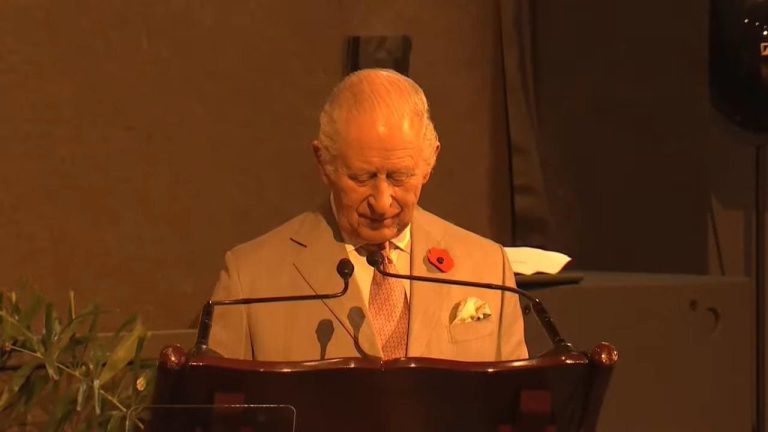
King Charles III has called for action to address the wrongs of the past through education, employment, trade and climate resilience, telling Commonwealth leaders that the transatlantic slave trade continues to cast a shadow over the Caribbean and other member countries.

Addressing the opening of the 28th Commonwealth Heads of Government Meeting in St John’s, Antigua and Barbuda, the King said that while history could not be changed, its consequences remained powerful.

“The transatlantic trade in enslaved persons still casts a shadow over these islands and other members of our Commonwealth,” he said.

“As I have said before, that shameful chapter of history is one that fills my heart with horror and my soul with the most profound sorrow.”

The King did not offer a formal apology or explicitly address reparations in the speech. He instead outlined areas in which he believed cooperation could help address historical disadvantage.

He said listening and learning had strengthened his commitment to finding ways to address past wrongs through present-day action, including improving access to education, investing in jobs and opportunities, encouraging trade between Commonwealth countries and supporting climate resilience.

“Our inheritance includes both their achievements and their failures, the good they did, as well as the wrong,” he said of earlier generations.

The King also pointed to efforts to end the international trade in enslaved people, highlighting the Royal Navy’s role. History, he said, demonstrated that courage and determination could overcome injustice.

“For, as any sailor navigating the seas knows, we cannot command the winds, least of all where the winds of yesterday have delivered us. But we can choose how we set our sails.”

Turning to the Commonwealth’s contemporary role, Charles said the organisation offered an opportunity for countries to work together at a time when international trust was under strain, conflicts were destroying lives and technological change was transforming societies with uncertain consequences.

He described climate change, damage to nature and the inability of many people to fulfil their potential as interconnected challenges.

“Together they comprise the crisis of our time,” he said. 

The Commonwealth could not provide every solution, he acknowledged, but its businesses, institutions, communities and governments could draw on the ingenuity of a third of humanity.

He urged leaders to uphold democracy, the rule of law, human rights, equal dignity, sustainable development, peace and security, saying those values were being contested on many fronts.

Speaking to the summit’s theme, “Accelerating Partnerships and Investment for a Prosperous Commonwealth”, the King called for investment in renewable energy, resilient infrastructure, sustainable agriculture, agroforestry and the protection of oceans and forests.

He said the Caribbean was already experiencing the consequences of climate change, despite its limited contribution to the problem.

“As we know, large ocean states have contributed little to the causes of climate change, and yet they are among those bearing the greatest cost,” he said.

Mobilising private finance alongside public-sector support could help direct investment towards resilience, he argued.

“To restore nature is therefore not to choose our environment over our economy. It is to invest in the very foundation of our economy, not to mention our security.”

The King welcomed proposals announced by Commonwealth Secretary-General Shirley Botchwey for leaders’ consideration. These included funding to restore habitats, a proposed Commonwealth-backed mutual insurance mechanism to provide rapid payments following disasters, and a proposed net-zero fund to improve access to credit for renewable energy.

He said governments, businesses and civil society should work together to develop such initiatives, particularly for countries most vulnerable to climate change.

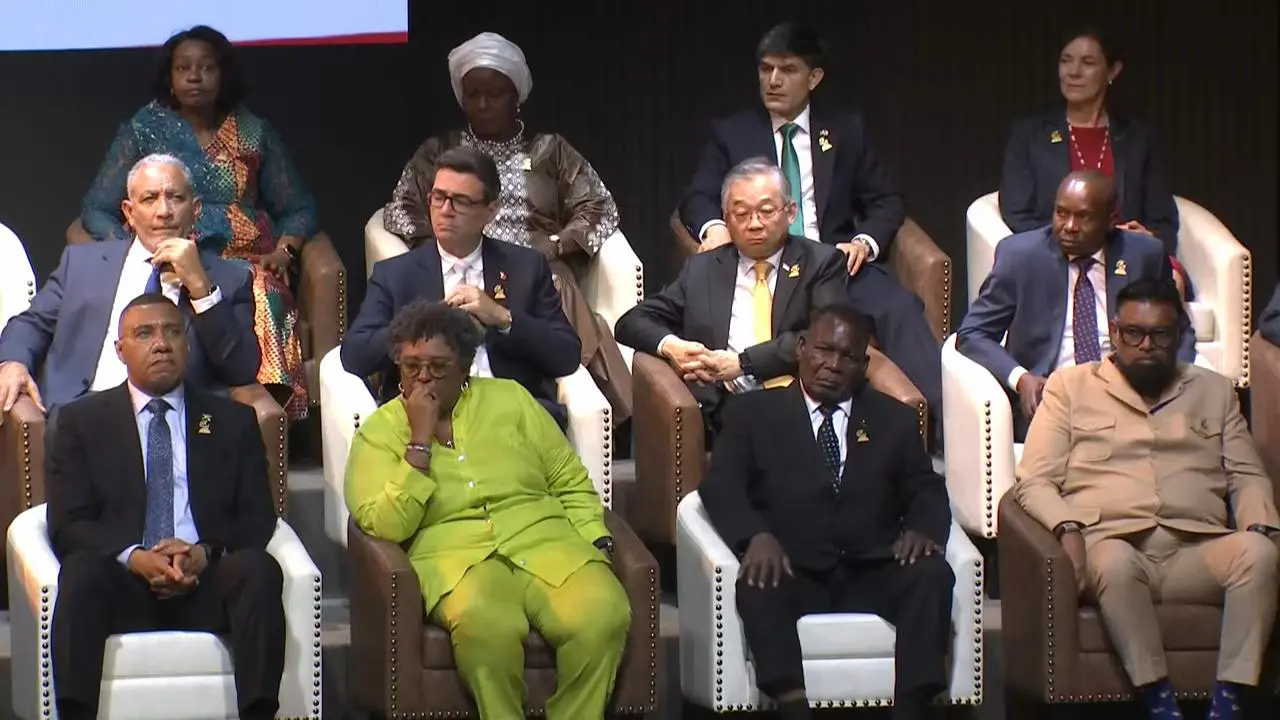
President Irfaan Ali (right in front row) and other heads of government during the King’s address.

The King also called for greater trade between Commonwealth countries, pointing to shared legal traditions, institutions, business networks and the English language.

Citing the Commonwealth Enterprise and Investment Council, he said doing business across the Commonwealth was 21 per cent cheaper.

He urged countries to make greater use of that advantage by reducing trade barriers, improving digital connections, helping small and medium-sized businesses reach new markets and encouraging investment across borders.

Opportunities extended beyond traditional goods to digital services, sustainable tourism, clean energy, creative industries, the blue economy and emerging technologies, he said.

The King, who attended with  Queen Camilla, thanked Antigua and Barbuda for its hospitality and acknowledged the country’s 45th independence anniversary.

He closed by urging leaders to make commitments that would improve lives, particularly in countries facing the greatest economic and environmental needs.

“I pray that over these coming days you will embrace this opportunity and commit yourselves to action,” he said.


Source: Kiskadee Watch

University of Guyana now accredits private companies to act as registrars of the .gy domain

0

Dear Editor,

On 21 August 2008, Stabroek News published a letter under the headline “Management of the .gy domain has fallen by the wayside.” The writer, who gave a name and address but asked that they be withheld, was an IT professional who had been urging clients to choose a .gy address over a .com, so that their businesses would read as Guyanese. The writer had paid the University of Guyana’s IT Centre for domain names almost two months earlier and had not received them. Emails to the administrator and the billing department went unanswered. The telephone numbers printed in the newspapers rang through to people who did not know where the registry staff were. Elsewhere in the world, the writer noted, a domain is issued within 24 hours. The letter ended with a question: what, exactly, was the oversight committee overseeing?

I found that letter last week while researching the history of our country’s domain. Stabroek News has since closed, and the journalists who kept its letters page running for decades now publish Kiskadee Watch. So I am answering here, eighteen years late, in the hope that it reaches the same readers and, with luck, the original writer.

The answer is that the problem the writer described has been solved, and not by a committee.

The University of Guyana remains the custodian of the .gy domain, as the Government entrusted it to be. What has changed is that the University now accredits private companies to act as registrars, in the same way that .com is sold by many companies rather than by one office. In April this year my company, Investigative Intelligence Solutions Inc., was accredited as a .gy registrar, and we launched Register.gy.

I built it because I had lived the 2008 letter myself. When my own firm needed the address iis.gy, the process took me about a week: a day to learn whether the name was free, a payment by MMG, a request for technical details I did not have to hand, and then two more days while someone entered them by hand. A week is better than two months. It is still a locked door for a shop owner who simply wants a website.

Today, on Register.gy, a Guyanese business searches for a name, pays by MMG in Guyana dollars or by card in US dollars, and the domain is registered at the registry within minutes. No one has to be chased. No form has to be carried anywhere. The system speaks directly to the registry, around the clock, including on weekends and holidays. Free DNS hosting and one-click email setup come with it, and there are people in Guyana who answer the phone and WhatsApp. The .gy, .com.gy, .co.gy, .net.gy and .org.gy extensions all cost the same, GYD 9,500 a year, and nearly a hundred businesses have registered in our first six months.

We have gone a step further than the writer could have imagined in 2008. Many Guyanese now build their websites by talking to artificial intelligence tools. Register.gy is built so that those same tools can connect a finished website to a .gy address on the customer’s behalf, with the changes shown first and applied only after the customer says yes. Any change can be undone for seven days.

I want to be careful about one thing. Register.gy is an accredited registrar. It is not the registry, and it is not the only accredited registrar. Any accredited registrar writes names into the same registry with the same rights. The credit for opening the door belongs to the University for choosing to accredit private registrars at all. What we did was walk through it and build the counter the 2008 writer was looking for.

The writer’s hope was that Guyanese businesses would carry a Guyanese address. In 2008 the entire .gy domain held a few thousand names. Last year more than 36,000 new business names were registered in this country. Most of them still live on a Facebook page. The door is open now. I would ask the writer, and every reader starting a business, to walk through it.

Yours faithfully,
Keron Bruce
Director, Investigative Intelligence Solutions Inc.


Source: Kiskadee Watch