Guyana is building the Sustainable Development Goals (SDGs) into its national development strategies, public policies and budgets, President Dr Mohamed Irfaan Ali told world leaders at the 81st session of the United Nations General Assembly (UNGA) on Wednesday.
He delivered a wide-ranging address on several global matters, including the SDG goals. He urged other nations to take lessons from Guyana, as progress on the 2030 targets falters worldwide.
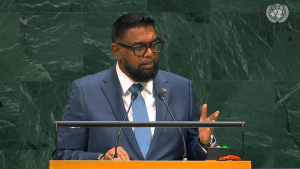
President Dr Mohamed Irfaan Ali
“One way to arrest the slippage is, as Guyana is doing, to mainstream the goals into our national development strategies, public policies, and budgets, so that they become embedded in the priorities we set and the resources we commit, rather than remaining aspirations,”he said.
According to the president, the goals are more than a reference point for good intentions. Instead, they must guide countries’ ambitions, their choices and “national priorities.”
Guyana’s own record was the evidence. Before the Assembly, President Ali pointed to several advances, including universal health care and free education, modern infrastructure, and faster access to affordable housing and opportunities for full employment.
He also highlighted financing for small and medium-sized enterprises and digitised public service delivery as further evidence.
“Development must not merely make our economies richer, it must make our societies better,” he went on to underscore.
With global momentum slipping, the president called for renewed commitment to the goals “not as an inventory of promises, but as a covenant with our peoples.”
That covenant, in his framing, means development that reaches every citizen, protects generations yet unborn and creates lasting, inclusive prosperity.
He applied the same test to the wave of new technologies, from artificial intelligence to biotechnology.
“Technology must not become the privilege of the few. It must become the servant of all humanity.”
On climate and nature, Guyana has already turned words into institutions.
“Two years ago, at this very podium, I committed Guyana to provide global leadership on biodiversity.”
That pledge produced the Global Biodiversity Alliance, established in July 2025 under Guyana’s leadership. In one year, its membership grew from 17 to 138. Members include governments, international organisations, the UN and development banks, indigenous peoples and local communities, scientists and universities, and importantly, the private sector.
The Alliance’s second conference, set for October 2026, will begin mobilising the resources and partnerships needed to deliver on its ambitions.
Alongside the Alliance, Guyana continues to advance its Low Carbon Development Strategy (LCDS) 2030. The strategy is focused on “turning forest stewardship and climate action into a new model for sustainable development.”
Delivering remarks on Tuesday during a High-Level Ministerial Dialogue at the United Nations Headquarters in New York, Senior Minister in the Office of the President with Responsibility for Finance, Dr. Ashni Singh reinforced the need for integrated and coordinated action across agrifood systems, and sustained investment to build and strengthen resilience as these are required to make healthy diets more affordable and accessible to all. The forum was held under the theme “From Leaving the Hunger Map to Sustaining Progress in Latin America and the Caribbean’. Minister Singh is currently in New York accompanying President Irfaan Ali who is leading a high-level delegation attending the 81st Session of the General Assembly of the United Nations.
Senior Minister in the Office of the President with Responsibility for Finance, Dr. Ashni Singh
Dr. Singh, while addressing the forum, used the opportunity to highlight the measures so far implemented by the Government of Guyana which has allowed the country to be recognised as one of the countries from Latin America and the Caribbean that has successfully reduced the prevalence of hunger and undernourishment to below 2.5 percent with Guyana noted for being ‘capable of self-sufficiently feeding its entire population across all seven essential food groups without foreign imports’. The Minister noted, however, that despite this, Guyana has still not escaped the impacts of severe weather and geopolitical disruptions.
“Guyana is proud to be one of those countries, and we congratulate all of the other countries in Latin America and the Caribbean – Brazil, Chile, and the Dominican Republic – who have achieved this major milestone”, he said but noted that ‘as we heard earlier, despite some reduction in food insecurity across the globe, progress remains uneven and vulnerable to multiple shocks. An estimated 520 million people could still face hunger in 2030, rendering us off track in achieving the SDG 2 target of zero hunger,” Guyana’s Finance Minister explained.
He added that ‘stark as they might appear, these projections may in fact understate the magnitude of the problem, given the potential impact of the currently ongoing El Niño conditions, and disruptions to agrifood systems resulting from geopolitical tension. Wheat prices, for example, have surged in recent weeks to levels not seen in years, growing 2.6 percent in August, and now 15 percent above a year ago, while fertiliser has also seen record growth, with average urea prices over the first eight months running 31.3 percent above the same period last year’.
Minister Singh also pointed to the price of diesel which he noted ‘is a critical input to agricultural production’ and which ‘is also currently trading at historically high prices, more than 60 percent higher than a year ago. These and other similar developments do not augur well for the global food security outlook in the near term’. It was here that the Minister urged the need for integrated and coordinated action across agrifood systems, and sustained investment to build and strengthen resilience.
The finance minister then zeroed in on the measures taken by Guyana thus far as a comprehensive approach to address the structural factors affecting access to healthy diets through the increase of supply via domestic production and trade, and prioritizing food affordability and nutrition, particularly for children.
“Some of our measures include: significant investments in growing and diversifying agriculture, expanding both production and exports, reducing production costs, and promoting economies of scale, including through investments in transport infrastructure to open more arable land and to improve farm to market connectivity as well as a regional food hub with cold storage capability to facilitate trade.
Minister Singh added that government has also been promoting the use of more data-driven, scientific, climate resilient methods in agriculture, including hydroponic and shade house technology; Incentivising private investment in agriculture and crowding in private capital to agribusiness, including by removing corporate taxes on income earned by companies from agricultural activity; Rolling out farmers markets nationwide as part of a broader effort to reduce inefficiency and improve competitiveness in the market for food items and ease food price pressures; Continuing Guyana’s National School Feeding Programme that supplies fortified daily hot meals to combat short-term hunger and reduce stunting and wasting and Implementing Comprehensive Child and Youth Health Programme and School Screening that is proactive and preventative, providing health screenings for nursery, primary and secondary school children.
The finance minister then highlighted the creation of new jobs in the country as he referenced the 156,000 new jobs created in the past five years as broadly, government has been ensuring broad-based job-intensive economic growth in order to improve livelihoods, increase disposable incomes, and raise household ability to meet basic nutritional necessities.
“These and other measures have helped to keep the incidence of hunger, undernourishment, and child malnutrition low over the last five years,” Dr. Singh posited.
He concluded that looking ahead, even as Guyana navigates volatile commodity prices, supply chain disruptions, imported inflation, and El Niño conditions, the country remains resolute with President Irfaan Ali’s leadership in continuing to spearhead the CARICOM “25 x 2025 + 5” Initiative, and in the pursuit of strengthening regional food security through increasing agricultural output and by ensuring more efficient intra-regional trade in agricultural output and food products, thereby reducing the region’s food import bill and improving the region’s food security outcomes in a lasting manner.
President Dr Mohamed Irfaan Ali has called on the international community to strengthen its capacity for peace and on the UN to take decisive diplomatic action to end suffering caused by conflicts, particularly the continuing crisis in the Middle East.
Addressing the 81st Session of the United Nations General Assembly on Thursday, President Ali said the international community must move beyond the instruments of war and strengthen its capacity for diplomacy and peace, as conflicts continue to consume lives and undermine global stability.
“In this regard, I reiterate Guyana’s call for a just and lasting solution to the crisis in the Middle East, one that brings an end to the suffering of innocent civilians and recognises the Palestinian people’s legitimate right to self-determination and to secure homeland of their own,” President Ali said.
President Dr Mohamed Irfaan Ali addressing the 81st Session of the United Nations General Assembly
He also reaffirmed Guyana’s support for a two-state solution, as he urged the international community to pursue diplomacy over destruction.
“The world does not need more sophisticated instruments of destruction. It needs a more sophisticated capacity for peace,” the president told the Assembly.
President Ali’s appeal extended beyond the Middle East, with Guyana calling for an end to the war between Russia and Ukraine, the conflict in Sudan, and other crises that continue to claim lives, displace families and undermine prospects for development.
“We call as well for an end to the Russian-Ukraine war and the war in Sudan and for peaceful resolution of all conflicts that continue to consume lives, uproot families, and extinguish the hopes of millions in other parts of our world,” President Ali declared.
The president also reiterated Guyana’s support for a peaceful, people-centred and development-focused solution for Cuba, noting that CARICOM remains prepared to play a meaningful role in advancing that objective.
On Haiti, President Ali stressed that sustained international support is necessary to address the country’s multidimensional challenges and advance democracy, stability, peace and prosperity.
However, he maintained that international assistance must support, rather than displace, Haitian leadership.
“Ultimately, the future of Haiti must be Haitian-led and Haitian-owned,” President Ali said.
The president’s call for peace formed part of a broader appeal for a stronger and more effective multilateral system capable of responding to the defining challenges facing humanity.
He pointed to the weakening of multilateralism alongside climate change, food insecurity, biodiversity loss, armed conflicts, geopolitical tensions, widening inequalities and the rising cost of living as challenges demanding collective action.
The head of state said history has demonstrated that even in periods of profound crisis, humanity possesses the capacity to overcome seemingly insurmountable challenges when nations choose cooperation over division.
Guyana’s intervention therefore placed diplomacy, peaceful conflict resolution and strengthened multilateral cooperation at the centre of its message to the international community, with President Ali urging nations to look beyond the crises of the present towards opportunities to build a more peaceful and secure future.
Last Updated on Thursday, 24 September 2026, 21:19 by Writer
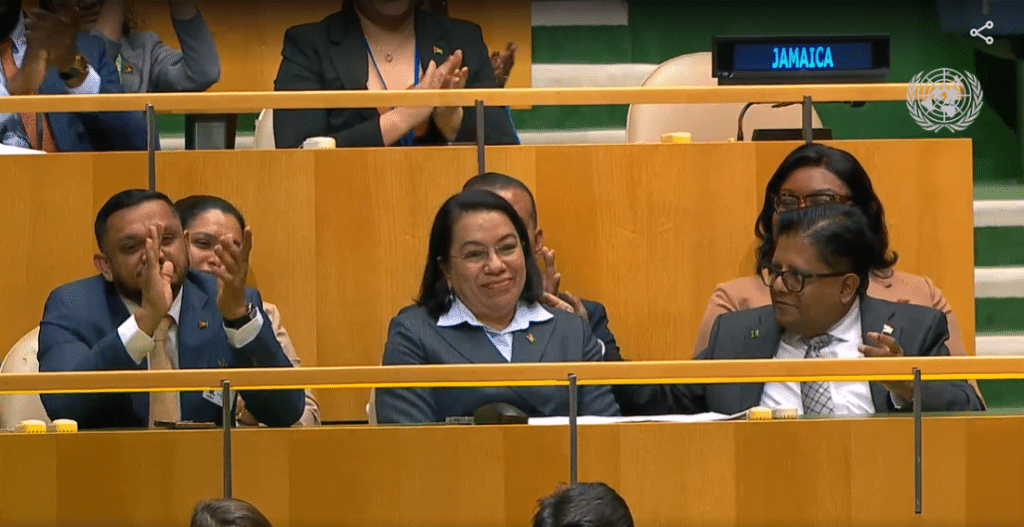
Guyana and CARICOM’s nominee for the post of UN Secretary General, Ambassador Carolyn Rodrigues-Birkett, flanked by natural resources minister Vickram Bharrat and finance minister Dr Ashni Singh
President Irfaan Ali on Thursday issued a stirring appeal to the Permanent Members of the United Nations (U.N.) Security Council and other member states of the U.N. to support Guyana’s nominee, Ambassador Carolyn Rodrigues-Birkett, to become the next Secretary General of the global body.
“Inthehumblestofways,IcallontheP5 (permanent members),theSecurityCouncil,andeverymember,andeverymemberhere,tolookbeyondthesmallcountrythatnominatedher,” he told the 81st session of the U.N. General Assembly.
The Guyanese leader made no reference to the United States’ reported veto of Ms Rodrigues-Birkett, currently Guyana’s Permanent Representative to the UN, because she described the situation in Palestine as “genocide”.
However, he appealed to the P5 — China, France, Russia, the United Kingdom and the United States — to support her to become the next UN chief.
“The responsibility for recommending the next Secretary General rests in the first instance with the Security Council, and we therefore, respectfully, place before its members the candidature of Carolyn Rodrigues-Birkett endorsed by the Caribbean Community. We invite all to consider her candidacy on its merits, and to judge whether her vision, experience, expertise, and record can help restore confidence in the United Nations at this critical moment,” he said.
Ms Rodrigues-Birkett was at the helm of Guyana’s delegation as a non-permanent member of the U.N. Security Council for the 2024–2025 term.
President Ali said the U.N. “needs leadership capable of restoring trust without compromising principles, of listening without surrendering conviction, of building bridges across the widening chasms between north and south, large states and small states, and the developed and developing world. We need a Secretary-General who will defend the (U.N.) Charter not only when it is politically convenient, but precisely when its principles are under pressure,” he said.
Touching on Palestine, he reiterated Guyana’s call for a just and lasting solution to the crisis in the Middle East, that brings an end to the suffering of innocent civilians and recognises the Palestinian people’s legitimate right to self-determination and to secure a homeland of their own.
“We reiterate our support for a two-state solution,” he said.
Departing from his prepared speech, Dr Ali said Ms Rordrigues-Birkett, who hails from an Indigenous community in Region One (Barima/Waini) and went on to become Amerindian affairs minister and later Guyana’s foreign minister, is guided by her upbringing, struggle, and accomplishments by breaking barriers.
“An Indigenous woman coming from a small indigenous village, defying the odds, the odds against indigenous persons, the odds against women, the odds against poverty, defining every challenge, and rising to the top amidst those challenges. Her character is built on struggle, sacrifice, commitment. Her accomplishments are crafted in her humanity,” he said.
Discover more from Demerara Waves Online News- Guyana
Subscribe to get the latest posts sent to your email.
Last Updated on Thursday, 24 September 2026, 20:58 by Writer
President Irfaan Ali addressing the 81st session of the United Nations General Assembly (UNGA) on Thursday.
President Irfaan Ali on Thursday urged Venezuela to accept the upcoming World Court decision on the validity of the 1899 Arbitral Award of the land boundary and set the stage for a “new era” of relations between the two South American nations.
“Now that we have both participated in the hearings, which were completed in May 2026, we urge Venezuela to abide by the forthcoming ruling, in accordance with their obligation under the UN Charter, as Guyana will do. We look forward to a new era of neighbourly relations in the interests of our peoples, the development of our countries, and the stability and prosperity of our region,” he told the United Nations General Assembly (UNGA).
Dr Ali’s call came less than one day after Venezuela’s acting President Delcy Rodrígues told the 81st session of the UNGA that her country wanted Guyana to come to the negotiating table as the only pathway to a long-lasting solution to the border controversy over the 160,000 square kilometre Essequibo Region.
“Here,IappealtotheCooperativeRepublicofGuyanatoresolvetheissueandtoreturntonegotiations,asstipulatedbytheGenevaAgreement.Agreementswhichlastthelongestarethosethatemergefrombilateralnegotiations.Theylastlongerandfunctionbetterthanthoseimposedbyexternalbodies,” she said.
While Venezuela said the 1966 Geneva Agreement stipulates that there must be a negotiated settlement and that the ICJ had no jurisdiction in the matter, that Spanish-speaking neighbour has participated in all the stages of the case that Guyana took before that judicial body after becoming fed up with 50 years of mediation through the UN Good Offices process.
The UN Secretary General had referred the border controversy to the ICJ in keeping with the Geneva Agreement, and the ICJ subsequently ruled that it had jurisdiction to hear Guyana’s case on the validity of the 1899 award.
Like in her remarks before the ICJ to wrap up Venezuela’s submissions, Ms Rodríguez did not criticise the United States or ExxonMobil as she had often done alongside Maduro.
Discover more from Demerara Waves Online News- Guyana
Subscribe to get the latest posts sent to your email.
Last Updated on Thursday, 24 September 2026, 20:51 by Writer
by GHK Lall
At last! At last, someone with the courage. To contemplate and question, even challenge, the mighty American Eagle. It plucks Guyana’s young in its talons. Who knows what next it will swoop to destroy? My thanks to Justice Courtney Abel, in his silver headed years, the head of the UG Department of Law spoke. He said what had to be said. Squeeze Justice Gino Persaud yesterday, there could be others today. Definitely some hesitancy tomorrow. Will this ruling please the president? How will the U.S. ambassador react to a judgment away from public sight? What will the U.S. State Dept do?
In my first writing in the immediate aftermath of the “visa review” development impacting Justice Persaud, I alluded to the chilling effect on the fraternity. Looking over its shoulder with tentativeness, in timidity. Second-guessing itself. Less for judicial sagacity and acumen, and more of where would the U.S. stand on this? Bluntly, Guyana’s judiciary now operates in fear. It may not be palpable; but it is audible. It is detectable. Fear has its own smell.
This is now less a matter of judicial independence, and more of this. What merit, what standing, national sovereignty? The U.S. barged into Caracas and took out a president. The U.S. put in its own president. In Guyana, the U.S. reached above and around Guyana’s president, Guyana’s Judicial Service Commission, and Guyana’s chancellor and effectively sidelined a sitting judge. Is Guyana still a country or is it the doormat and toilet of the U.S? If President Ali has any salt left in him, he should raise that question with Ambassador Nicole D. Theriot in their next face-to-face encounter. I would have grabbed the nearest phone and let her hear that in the sharpest terms. But the so-called special relationship reminds of the limitations to what he signed onto, his role. A bit player, a nobody, on the Great American chessboard.
Hon Attorney General Anil Nandlall faced the public from his cyberspace den and had his say. The PPP Govt is not pleased with Justice Persaud’s rulings. But the PPP Govt’s hands are clean. No involvement in U.S. “visa review”. Neither initiation tabled nor hint whispered off the record. What to make of the Hon Anil Nandlall’s representation in this instance? I struggle. For he is the same scholarly citizen, a creature of impeccable integrity, who has sold many (and himself) that Guyana is a country where the rule of law reigns, and respect for law and order is paramount. When I look at what Guyanese have for law, and how men feature dominantly in how that law is sometimes applied, sometimes weaponized, and oftentimes wielded, there is difficulty reconciling the PPP Govt being hands-off re visa review, despite its disagreement(s) with Justice Persaud.
Of greater concern to me is how the U.S. can swoop and savage a sitting Guyanese jurist. If there, then where else, and with what limit? Where is the Guyana Bar Assoc? Where is the Judicial Service Comm? Did the chancellor speak, and I didn’t read? I have read about cultural imperialism. Now I come across the blatant and arrogant projection of American imperialism into the very heart of the Guyana construct. The Ugly American is back. He is uglier than before. Go ahead! Mark me! Make my day!
What is Guyana and Guyanese today? Sitting ducks or turkeys in a barrel? A pack of bleating sheep just shorn of its wool, and left with only its meh? There is passive and there is docile. Good Lord! Does it have to be of the most obsequious and odious variety? The White man rules and Guyanese are only too delighted to roll in the mud and the filth and in utter self-disgrace. Pause and absorb this contrast. Americans can be attracted to and approve money launderers in Venezuela but is full of righteous wrath re Gino Persaud. There are White people I will always love. But how can I ever love hypocrisy, the bully, and the sneaky?
Whatever this “visa review” entails, it had better be good. Wherever other Guyanese are, there was Justice Courtney Abel. And next to him, little ole me.
Discover more from Demerara Waves Online News- Guyana
Subscribe to get the latest posts sent to your email.
Top officials of the International Criminal Police Organization (INTERPOL) say that more criminal syndicates in the Americas are turning to illegal gold mining to move and hide profits generated from the cocaine trade.
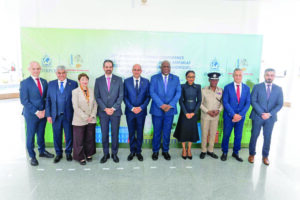
Prime Minister Brigadier (Ret’d) Mark Phillips, Home Affairs Minister Oneidge Walrond, Police Commissioner Clifton Hicken, INTERPOL President Lucas Philippe (fifth from left), INTERPOL Secretary General Valdecy Urquiza, and other officials at the opening of the 27th INTERPOL Americas Regional Conference being held in Georgetown
Over 80 senior law enforcement officials have gathered in Guyana for the 27th INTERPOL Americas Regional Conference to address some of the most pressing organised crime threats facing the region.
Held at the Arthur Chung Conference Centre (ACCC), the two-day event will examine emerging criminal trends, share operational experiences and identify practical solutions to tackle transnational crime affecting communities throughout the Americas.
Speaking at the opening ceremony on Wednesday, INTERPOL’s Secretary General (SG) Valdecy Urquiza revealed that one such trend that they are already following is the movement of drug profits through illegal gold mining activities in the region.
“Cocaine remains the financial lifeblood of groups across Central and South America. Yet, the very scale of these drug trade creates a massive problem for cartels – how to move, hide and clean illicit cash. A growing number of syndicates are solving this by moving their drug capitals straight into illegal gold mining,” Urquiza stated.
According to the INTERPOL SG, this practice led to the conduct of Operation Guiana Shield in December 2025 – the first ever transnational operation to combat illegal gold mining.
Involving Brazil, Guyana, French Guiana, and Suriname, this coordinated cross-border law enforcement crackdown targeted illegal gold mining, environmental crimes, and associated transnational organised crime.
President of INTERPOL, Lucas Philippe, dubbed the joint operation as highly successful.
“Not only did officers find gold, but they also seized firearms, cash, drugs, mercury and mining equipment, thus uncovering a much wider criminal eco-system. INTERPOL is adapting to this new normal,” the INTERPOL Chief declared during the conference opening on Wednesday.
Back in January, INTERPOL reported that Operation Guiana Shield saw over 24,500 checks on vehicles and individuals, leading to some 198 arrests.
As part of the exercise, Guyanese authorities detained three men on suspicion of gold smuggling and money laundering after discovering unprocessed gold and US$590,000 in cash.
INTERPOL had linked these suspects to a major organised crime group with possible connections to a leading Guyanese gold-exporting firm.
At the time, the INTERPOL SG had stated that the surge in international gold prices in recent years has resulted in increased illegal gold mining, thus making it the fastest-growing revenue stream for organised crime groups, including in Latin America.
Meanwhile, Prime Minister (PM) Brigadier (Ret’d) Mark Phillips noted that Operation Guiana Shield, as well as many other collaborative initiatives, shows that criminal activities spanning borders can be confronted when authorities act as one.
“These cases demonstrate the value of cooperation, but they also reveal where the system remains vulnerable. Intelligence cannot protect the public when it fails to reach the official required to act upon it. Nor can modern technology correct delays caused by uncertain authority or poor coordination. International information must, therefore, reach the frontline in time to influence an investigation subject to the laws and safeguards that preserve public confidence,” the PM noted.
Phillips, who is performing duties as acting President of Guyana, went on to outline efforts by the Government to build local capacity as it relates to intelligence-led policing. Similarly, he cited investments being made to enhance inter-agency communications among local law enforcement agencies.
These efforts, according to the Prime Minister, will be the foundation for regional collaboration and coordination.
“Guyana therefore approaches this conference with a practical purpose: We seek an intelligence system in which reliable information can be exchanged without unnecessary delay and converted into lawful operational action. We also seek continued access to the technology and expertise required to investigate crimes whose methods are changing rapidly,” he noted.
Noting that delays can shift the advantage to criminals and place justice further out of reach for law enforcers, the PM argued that cooperation must be as swift as the threat. INTERPOL, he noted, provides the tools through which such cooperation can be achieved.
Moreover, PM Phillips, a former army Chief in Guyana, further noted that any agreement arrived upon during the two-day conference in Georgetown must eventually lead to a timelier response when information is requested and a clear course of action when investigations cross a border.
“The professional relationships formed here should remain active after the conference, particularly when an urgent case requires assistance from another jurisdiction. This is especially important for the Caribbean, where our jurisdictions are comparatively small, but the criminal networks operating among them are well-financed and able to move quickly.”
“Closer coordination with INTERPOL would give border officials earlier warning of persons and activities of concern, while allowing investigators to recognise connections that may not be visible within a single country. Such cooperation would also narrow the space in which organised crime currently operates,” the PM stated.
With INTERPOL’s second Global Financial Fraud Assessment Report highlighting that between 2024 and 2025 fraud-related global alerts across the Americas and the Caribbean increased by 40 per cent, tackling financial crime is high on the agenda during the two-day conference in Georgetown.
Combating money laundering, the increasing misuse of cryptocurrencies by organised crime groups and experiences in tracking, tracing and recovering criminal assets will be key areas for discussion.
Discover more from Guyana Times
Subscribe to get the latest posts sent to your email.
Clinton Global Initiative: Partnerships key to powering scientific breakthroughs in small states – Pres Ali
President Dr Irfaan Ali has called for stronger international partnerships to help small developing countries overcome financial and human-resource constraints and use science and technology to address critical national challenges.
Ali made the call while delivering the feature address at the Clinton Global Initiative event, “Powering Scientific Breakthroughs”, at the Hilton Midtown Hotel in New York.
He said scientific advancement and technology are critical to achieving energy security, food security, affordable healthcare, climate and biodiversity services, equitable artificial intelligence and digitisation, pandemic preparedness, infrastructure development and human capital advancement.
According to Ali, small developing countries often have to navigate the same global systems as larger economies despite having less financial and human-resource capacity.
He said, however, that the size of a country should not determine its ability to contribute to global solutions.
“Guyana is indeed a small state, but we are learning that the power of a country is not measured only by size and population. Power can also be measured by the partnership a country builds,” the President said.
Ali said partnerships are particularly important for small states because they do not have the resources to independently finance every advanced laboratory, medical technology, innovation or agricultural research programme.
Sample environments for research
He said small states could instead serve as pilot or sample environments for research while leveraging international partnerships to access expertise, technology and financing.
“The question, therefore, is not whether a small state can do everything itself. The question is, can we build partnerships that allow us to do what we could never do alone?” he said.
The President pointed to healthcare as an area where Guyana is using partnerships and technology to address disparities in access to services.
“For too long, geography helped to determine the quality of health care a citizen could receive. If you live on the coastline, our options are different from those of citizens living in the hinterland. We are determined to change that,” Ali said.
He highlighted Guyana’s partnership with the Mount Sinai Health System and Hess Corporation, which he said has been extended for five years as part of efforts to transform the country’s public healthcare system by 2030.
The partnership, he said, focuses on strengthening systems, developing human capital, modernising care and bringing advanced expertise to Guyana.
Ali said technology is also being used through electronic health records, telemedicine, modern diagnostics and data-driven decision-making.
He cited a long-distance telemedicine robotic cardiac surgery between Guyana and India, which he described as an example of how technology could help overcome geographical barriers in healthcare.
The Head of State also said Guyana has established baseline medical data for children in primary schools through its partnership with Mount Sinai, with plans to extend the initiative to secondary school students.
He said the information would support public health decision-making and allow for health monitoring as children progress through the education system.
Ali also highlighted investments in health education and training, including programmes for nurses, patient care assistants, laboratory technicians and doctors.
He said Guyana is working with international universities, institutions and training programmes to develop the human resources and specialised skills needed to meet the country’s demands.
Additionally, he also outlined the Government’s efforts to expand digital access to public services.
“A citizen should not have to travel hundreds of miles or spend an entire day in a Government office simply to access a service that technology can put within reach,” he said.
Ali said Guyana is investing in a digital Government system and expects to complete its national payment platform by the end of this year.
He said Wi-Fi services are also being developed in hinterland communities.
According to Ali, technology and infrastructure investments have already contributed to a reduction of almost 95 per cent in the number of patients requiring medical evacuation from one of Guyana’s most distant hinterland locations to Georgetown in less than three years.
He attributed the reduction to the provision of services within the hinterland community.
The President said the Government is also working to consolidate Government services through the MyGuyana platform.
“By next year, you can open one app, MyGuyana, and every single service the Government offers will be on one platform rather than navigating 20 or 30 different websites,” he said.
He said Government service centres have also been established across the country, while digitisation has reduced transaction times in some instances from days to minutes.
Ali said these initiatives demonstrate how technology can reduce the cost of accessing services while improving efficiency.
He said Guyana’s experience shows that partnerships can allow small states to access technology, expertise, human resources and financing that may otherwise be beyond their individual capacity.
“It gives us the quickest pathway to technology, to people, to human assets, and, of course, to finances,” the President said.
Discover more from Guyana Times
Subscribe to get the latest posts sent to your email.
3rd country national deal: Guyana rejected a lot of persons – US Ambassador
…says US$7.8M allocated to aid foreign nationals accommodated locally
Even as Guyana agreed to accept third-country nationals from the United States, the Government has already rejected several persons from the first batch of migrants who arrived here earlier this month.
“A lot of people were rejected,” US Ambassador to Guyana Nicole Theriot told reporters during an interview on the side-lines of the INTERPOL Americas Regional Conference on Wednesday.
The migration cooperation framework allows for Guyana to receive a “limited, vetted” number of “skilled and non-criminal individuals” from the US through the International Organization for Migration (IOM) Assisted Voluntary Return Programme.
Already, at least six third-country nationals have arrived in Guyana and will remain here until their immigration status is determined by the US Government.
However, according to Ambassador Theriot, they were hoping to send more migrants on that first flight. “[On] the last manifest, you will know that only six people came, and the manifest was quite large. So, a lot of people were rejected,” the US diplomat noted, adding that she is unsure of how many more foreign nationals are expected to come before the end of the year.
“We do not send anyone that has not been approved by the Government, and so it’s really not possible for me to say [how many more will come]. Our plan was to hopefully send one flight a month with those who had been approved.”
“The Government here have said they will not take anyone with a criminal record, which is absolutely appropriate and within their rights. And they make the determination based on the information that we provide, but also the information that they [have]… So, they’re able to vet these people with their own intelligence, and so it’s a combination of ways that they look at every single person to make sure they are absolutely not letting anyone into Guyana that could cause harm,” she stated.
Funding for migrants
The Guyana Government has already made it clear that this is a temporary arrangement and that it has the final say in who it accepts coming into the country. Those foreign nationals coming here are being accommodated by IOM through its programme that is being funded by the US Government.
In fact, Ambassador Theriot told reporters on Wednesday that some US$7.8 million was given to the IOM, which is the United Nations (UN) Migration Agency, as part of a two-year contract.
“It covers IOM helping for those individuals to be resettled either permanently or until they can go back to their home country. It also provides for job skills training if that’s something that is needed. If the person doesn’t have the skills that are useful here in Guyana, it provides for that as well. So, it’s comprehensive. It’s all of their wellbeing. It’s health and medical. It is housing. It is food. It is communications. It is making sure they can communicate with their families. It is a comprehensive package. IOM does this all over the world, and they do it extremely well,” she asserted.
According to the US Ambassador, while the programme caters to permanent resettlement, this is entirely up to the individuals and Guyanese authorities.
“There are two different programmes. One is where they are just waiting here until they are returned to their home country, if they agree to that, or they can choose to resettle. It is up to them and the Government, of course,” Theriot stated.
Only last week, President Dr Irfaan Ali maintained that Guyana has retained full vetting sovereignty over and complete discretion to reject the foreign nationals proposed for relocation here.
Human rights credentials
In fact, during an interview with Al Jazeera while on a state visit in Qatar earlier this month, the Guyanese Head of State rejected the notion that this arrangement could set a precedent for the US to ‘dump’ foreign nationals here.
“We have exceptionally good human rights credentials… Of course, everything in life has an element of risk, but here is where we have the names before. We do our own vetting to our own satisfaction, and then we agree with the names. This is not a situation where the US turns up with a plane and just throws people off on your shores,” the President asserted.
Ali went on to dismiss human rights concerns, citing Guyana’s good track record and the fact that the country is already housing migrants from countries like Venezuela and Cuba who enjoy full and free access to social services.
On September 4, the first batch of foreign individuals – four from Cuba and two from Afghanistan – arrived in Guyana on a special US deportation flight. Their records, provided by the US, indicated that they had no criminal background, and the youngest is 20 years old, with the oldest being 36.
According to several international news agencies, Foreign Secretary Robert Persaud said these persons were accepted after being vetted by local authorities, adding that “the US has not made any further requests” for additional persons up to that time.
Discover more from Guyana Times
Subscribe to get the latest posts sent to your email.
Contractor shot, father-son duo chopped during backdam brawl
A contractor is now nursing a gunshot injury to his abdomen while two other men are suffering from chops to their bodies during an incident at Friendship, East Bank Demerara (EBD) on Monday.
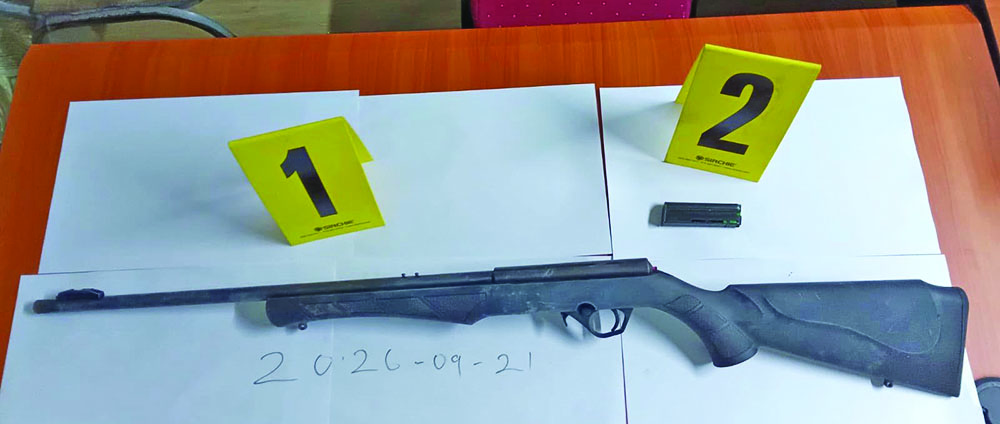
The bolt-action rifle found at Friendship Backdam
According to reports received, a 54-year-old farmer of Providence, EBD, along with his 26-year-old son, went to their farmland in the area with a tractor to clear and prepare the land for farming. However, while leaving, the father-son duo reportedly entered another person’s property with a rifle in search of iguanas.
A 33-year-old contractor of Friendship, EBD, along with five others who were fishing on the property, confronted the two farmers and warned them about discharging their firearm.
This reportedly led to an argument during which the 54-year-old farmer discharged the firearm in the direction of the men, resulting in the contractor being shot in his abdomen.
Upon seeing this, the other men reportedly demanded that the shooter hand over the firearm, but he refused, thus resulting in another confrontation. This time, the shooter and his son were allegedly chopped about their bodies, and their firearm was confiscated.
The three injured men were subsequently taken to the Diamond Regional Hospital. The contractor reportedly sustained a gunshot wound to his abdomen and underwent emergency surgery, but his condition is listed as critical.
On the other hand, the shooting sustained a chop wound to his left hand, while his son suffered chop wounds to his head, left eyebrow, left hand, and right elbow. Their injuries are not life-threatening. The police have since retrieved two live rounds and two spent shells.
Further, police ranks acted on information returned to the area where a bolt-action rifle along with a magazine was recovered. Investigations are ongoing.
Only a few days ago, 40-year-old Joy John, along with her husband, 38-year-old Amar Thomas, and 62-year-old Tony Williams, was found dead during an alleged brawl at Aranka Village, Baramita, North West District (NWD) Region One (Barima-Waini).
According to reports received, on the day in question, Williams visited John’s camp, and an argument erupted between them. Williams reportedly armed himself with a cutlass and dealt one blow to the woman’s neck.
Thomas, who was returning from his farm, subsequently confronted Williams, thus resulting in an altercation during which they both inflicted injuries on each other with sharp objects.
However, John was later found dead in her camp, while Thomas was found about 50 feet away. Williams was later found dead along a track about 100 feet from where the incident took place.
Discover more from Guyana Times
Subscribe to get the latest posts sent to your email.