https://kiskadeewatch.com/guyana/brought-not-bought/
‘Brought’ not ‘bought’
In yesterday’s edition of Kiskadee Watch, a news item on state land at Onderneeming incorrectly carried the word “bought” instead of “brought”. The incorrect word made it appear that the President who was responsible for bringing the land under the Land Registry Act had bought two parcels though any considered reading of the news item would have made clear what the transaction related to.
Kiskadee Watch regrets the error and apologizes for any inconvenience caused.
The error led to a statement from the Central Housing and Planning Authority (CH&PA) which itself rendered the name of Kiskadee Watch incorrectly.
The CH&PA statement did however provide further information on the two parcels which were the subject of an order published in the Official Gazette.
It said that Parcel 936, comprising approximately 26.8526 acres, is a regularised area occupied by informal settlers. Bringing this area under the Land Registration system will advance the process through which eligible residents can obtain Certificates of Title, thereby providing them with security of tenure and legal ownership of the lands they occupy.
It added that Parcel 1793, comprising approximately 155.126 acres and formerly identified as Block “CHPA 3”, is a new housing development. The land-registration process is therefore necessary to facilitate the eventual issuance of Certificates of Title to beneficiaries within that development.
Kiskadee Watch Editor-in-Chief Anand Persaud said it was gratifying that CH&PA was able to mobilize a statement on Sunday on what the President didn’t own. He said it would be equally satisfying if CH&PA and related agencies would also answer longstanding queries about transactions on lands that the President does have control of.







Source: Kiskadee Watch
Guyana moving toward specialised STEM School with Exxon partnership
Guyana moving toward specialised STEM School with Exxon partnership
Guyana is moving toward establishing a specialised Science, Technology, Engineering and Mathematics (STEM) school, with President Dr Mohammed Irfaan Ali pointing to a partnership with Exxon as part of efforts to strengthen the country’s capacity in specialised education.
President Ali made the disclosure during a sit-down interview with journalist Fareeza Haniff, as he outlined his vision for the next phase of Guyana’s development and the need to build the human resources required to sustain the country’s transformation.

He identified specialised STEM education as part of the broader investments needed to prepare Guyanese for emerging opportunities and ensure the country develops the technical capacity to support its expanding economy.
“Soon we’ll be thoroughly sought for the building of a STEM, specialised STEM school with Exxon. Only a few of those in the world,” President Ali said.
The proposed initiative forms part of a wider development agenda that he said must extend beyond physical infrastructure to include investments in people, skills and specialised capabilities.

President Ali said the next four years should focus on transformative projects capable of creating long-term opportunities, including positioning Guyana as a food hub and food capital, advancing biodiversity and climate services, strengthening the country’s role as an energy hub and delivering the highest level of skilled human-resource capacity.
He has also emphasised the importance of young people being proactive, researching beyond the obvious and advancing ideas that can contribute to national development.
“A very important key to success is advancing your ideas and being proactive,” he said, while urging young professionals not to be afraid of presenting new ideas and embracing opportunities to contribute.
The specialised STEM school, as referenced by the president is, therefore, being positioned within a broader effort to equip Guyanese with the specialised knowledge and skills needed to support the country’s next stage of economic and technological development.
As Guyana advances into that next phase, greater emphasis is being placed on building human capacity alongside infrastructure, with specialised education expected to play a key role in preparing the workforce for emerging areas of opportunity.
Amerindian Heritage Month celebrated through culture, tradition at Kuru Kururu
Amerindian Heritage Month celebrated through culture, tradition at Kuru Kururu
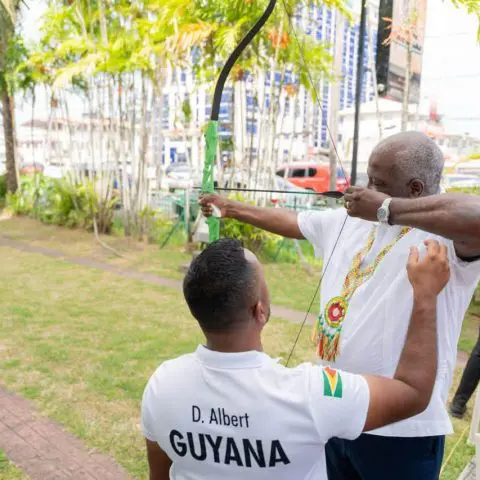
As the curtains closes on this year’s Heritage celebrations, His Excellency Dr Mohamed Irfaan Ali made an appearance on Sunday at the Drepaul’s Amerindian Heritage Day, at Kuru Kururu, Soesdyke/Linden Highway.
Celebrated under the theme, “observing our cultural heritage during our diamond jubilee: honouring our traditions, culture and contributions,” the vibrant sights, sounds and traditions of Guyana’s Indigenous peoples took centre stage at Kuru Kururu, as many gathered to celebrate Amerindian Heritage Month.


Member of Parliament, Alister Charlie was also in attendance.
President Ali used the opportunity to interact with then scores of Guyanese present for the celebrations.
The event brought together Indigenous leaders, residents, cultural practitioners, families and visitors for a showcase of the country’s rich Amerindian heritage, with traditional dances, music, craft, food and other cultural expressions forming part of the activities.
The event offered an opportunity for generations to connect with traditions that have been preserved and passed down over centuries, while highlighting the diversity of Guyana’s Indigenous communities.
The display of traditional crafts and Indigenous products provided a glimpse into the skills and creativity of local communities, while traditional foods offered visitors an opportunity to experience flavours rooted in Amerindian culture.
The celebration also underscored the importance of preserving Indigenous languages, customs, knowledge and practices, particularly among younger generations.
Amerindian Heritage Month is observed annually in September, providing a national platform to recognise the contributions of Guyana’s Indigenous peoples and celebrate their enduring cultural identity.
The Kuru Kururu activities are part of the wider month-long programme of events being held across the country.

Discussion