Guyana is positioning itself at the centre of global aviation safety discussions, as the country hosts the 3rd Global Forum for Aviation Safety for the first time.
The two-day forum officially opened on Tuesday at the Arthur Chung Conference Centre, bringing together aviation regulators, accident investigators, international organisations, technical experts and industry representatives from nearly 60 countries.
Civil aviation authorities from about 60 countries are attending
The forum, being held under the theme “Optimising Resources through Coordination and Cooperation,” is jointly organised by the International Civil Aviation Organisation (ICAO) and the European Union Aviation Safety Agency (EASA), and hosted by the Guyana Civil Aviation Authority.
Director General of the Guyana Civil Aviation Authority, Lieutenant Colonel (Ret’d) Egbert Field said that “the country depends on aviation to really move this economy, especially in the areas of mining, tourism and agriculture. Our commitment to aviation safety is equally as strong as our growth.”
Director General of the Guyana Civil Aviation Authority, Lieutenant Colonel (Ret’d) Egbert Field engaging at the conference
The forum provides a platform for countries to examine how regional cooperation can strengthen aviation safety oversight and accident and incident investigation, particularly by allowing states to pool technical expertise, human resources and other specialised capabilities.
For Guyana, however, the significance extends beyond hosting an international conference.
The event provides an opportunity for local aviation stakeholders to engage directly with some of the world’s leading aviation regulators and safety experts, while strengthening Guyana’s relationships with international aviation institutions and creating avenues for the exchange of knowledge and best practices.
Director of ICAO’s Air Navigation Bureau, Michele Merkle, underscored the importance of regional cooperation, noting that stronger collaboration among countries is essential to advancing aviation connectivity and safety.
“Regional cooperation goes well beyond sharing resources. It builds communities of expertise through which knowledge, experience and solutions can move more quickly through the global aviation network,” she noted.
Director of ICAO’s Air Navigation Bureau, Michele Merkle
The timing of the forum is significant, as Guyana’s aviation sector continues to expand.
Discussions at the forum are addressing issues including regional cooperation, the delegation of safety and investigative functions, aviation workforce development, sustainable financing, industry partnerships and the harmonisation of regulatory frameworks.
The forum concludes on Wednesday, September 30th.
The second day will also examine strategies for attracting and retaining aviation professionals, sustainable funding models and closer collaboration between regulators and the aviation industry.
For Guyana, hosting the global forum represents an opportunity not only to welcome international aviation leaders, but to deepen technical cooperation, expose local professionals to international expertise and strengthen the country’s participation in the global aviation community as its own aviation sector continues to grow.
Handwriting expert confirms Carol Joseph signature on March 13 fraudulent declaration, Lowenfield’s signature on reports with falsified votes submitted to GECOM
The prosecution in the 2020 election fraud trial on Tuesday turned to forensic handwriting evidence, with Detective Inspector Ameer Mohamed testifying that signatures attributed to former Chief Elections Officer Keith Lowenfield and APNU+AFC chief scrutineer Carol Smith-Joseph were written by the same persons who signed comparison documents.
Principal Magistrate Faith McGusty accepted Mohamed, of the Guyana Police Force’s Fingerprint and Handwriting Analysis Unit, as an expert in handwriting analysis. His evidence-in-chief remains unfinished and is expected to continue on Wednesday.
Lead Prosecutor Latchmie Rahamat said Mohamed conducted a microscopic comparison of the disputed and known signatures. In Lowenfield’s case, she said the expert compared signatures appearing on a passport replacement application and affidavit of lost passport with signatures on three election-related reports.
“He found similarities, and he said his opinion was that those signatures were authored by the same person,” Rahamat said.
Lead Prosecutor Latchmie Rahamat
The second analysis concerned the March 13, 2020 Region Four declaration, which was published on GECOM’s website and carried what appeared to be the signatures of former Region Four Returning Officer Clairmont Mingo and Smith-Joseph.
Rahamat said Mohamed compared the signature bearing Smith-Joseph’s name on that declaration with signatures on a passport application form and a police-station diary entry.
“Again, on the microscopic comparison that he did, he found that the signatures ‘Carol Smith Joseph’ were authored by the same person,” Rahamat said.
Rahamat said Mohamed prepared two analytical reports and tendered two comparison charts to the court. The charts, she said, enlarged the signatures and itemised the similarities he identified.
“It should also be noted that the expert has also presented to the court … two charts,” Rahamat said. “On the charts which he presented to the court, we could see him itemising the similarities that he observed in the signatures.”
Mohamed told the court that his analysis considered multiple individual writing characteristics, including letter formation, stroke direction, slant, spacing, proportions, line quality, writing speed, pen lifts, stops, and hesitations. This was the technical basis on which he reached his opinions on the common authorship of the signatures.
The nine accused are former GECOM Chief Elections Officer Keith Lowenfield; former Region Four Returning Officer Clairmont Mingo; former Deputy Chief Elections Officer Roxanne Myers; former Health Minister Volda Lawrence; APNU+AFC chief scrutineer Carol Smith-Joseph; and former GECOM employees Sheffern February, Enrique Livan, Michelle Miller and Denise Babb-Cummings. They have pleaded not guilty.
Wednesday’s proceedings are expected to include the continuation of Mohamed’s evidence, the return of witness Earl Cornelius, who dealt with the movement of documents sent for analysis, and the completion of evidence by an immigration official. Cross-examination of former Public Security Minister Robeson Benn is also expected.
Vigilance, ECD Access Road blocked with burning Debris
Missing Suriname Men
(Kaieteur News) – Reports are that the missing men were last seen alive leaving in a white car registered to Cromwell’s wife’s name.
On Tuesday investigators attempted to execute a search warrant at his home but were prevented from doing so.
Mark Cromwell
In some later developments persons blocked roads with burning debris. A truck was reportedly set on fire too. When law-enforcement officers attempted to put out the blaze which are threatening GPL light poles they were met with hostile reaction.
The Ministry of Natural Resources wishes to advise that three miners, including two non-nationals, have been detained in connection with illegal mining along the Siparuni riverbank.
The Guyana Geology and Mines Commission’s (GGMC) Enforcement Team found that machinery had been placed on the bank and a river dredge directed into it to extract minerals. The operation damaged the riverbank, and the team is assessing the extent of that damage.
The team seized the river dredge and associated equipment, including a motor vehicle. The matter has been handed over to the Guyana Police Force for further investigation.
The miner responsible for the operation will be required to account for the gold mined in the area as well as cover the reclamation costs for the damaged site.
The ministry reiterates that mining must be conducted in accordance with the required approvals and environmental safeguards. Operators will be held accountable for illegal activities and the rehabilitation of areas damaged by their operations.
Sept 29 (Reuters) – An informal poll by the United Nations Security Council on Tuesday placed former Costa Rican Vice President Rebeca Grynspan as the frontrunner in the contest to become the 10th UN secretary-general, sources close to the process said.
The fourth secret poll by the 15-member Security Council followed the gathering of world leaders at the General Assembly in New York last week. The first and third polls, held in July and September, also showed Grynspan narrowly ahead while an August poll placed Guyana’s U.N. Ambassador Carolyn Rodrigues-Birkett in the top spot.
After former Chilean President Michelle Bachelet dropped out of the race this month, seven candidates are vying to succeed Antonio Guterres. The former Portuguese prime minister steps down at the end of this year after two five-year terms. It is still possible for more candidates to enter the race.
Ultimately the five Security Council veto powers — the United States, China, Russia, France and Britain — need to agree on a candidate. When Guterres was chosen in 2016, it took six straw polls for the Security Council to reach agreement.
The UN Security Council will eventually formally recommend a candidate to the 193-member General Assembly for election. Approval by the assembly has long been seen as a rubber stamp.
The Commission of Inquiry into the capsizing of the M/V “BARIMA” informs the general public that all persons wishing to participate in the Inquiry may apply to the Commission for standing by contacting the Secretary of the Commission:
Mr. Javed Shaddick
Secretary
Commission of Inquiry into the Capsizing of the M/V “BARIMA”
Arthur Chung Conference Centre, 5-E ½ Orchid Drive, Liliendaal, East Coast, Demerara
The Commission will consider all applications and may grant standing if it is satisfied that an applicant:
• has played or may have played, a direct and significant role in relation to the subject matter of the Inquiry or has relevant evidence or information relating to the subject matter of the Inquiry;
• has a substantial, personal or direct interest in the subject-matter of the Inquiry whether as a witness, survivor, family member of a victim or otherwise;
• may be subject to explicit or significant criticism during the proceedings of the Inquiry or in the Report;
• should participate in the Inquiry as his or her participation may be helpful to the Commission in fulfilling the Terms of Reference.
Residents of the Lower Mazaruni are already seeing results from issues raised during President Dr Mohamed Irfaan Ali’s recent outreach to Region Seven.
Road upgrades, new heavy equipment, restored hospital power, and hundreds of new streetlights have followed in the weeks since.
Regional Executive Officer, Dr Josh Kanhai, in an interview posted on Monday evening, said the region moved quickly on the guidance of President Ali, given at community meetings in Bartica, Batavia and Karrau.
At Batavia, about two kilometres of road have been upgraded to an all-weather crusher-run surface.
Regional Executive Officer (REO) Dr Josh Kanhai accompanied President Dr Mohamed Irfaan Ali during the outreach to Region Seven in May
“His Excellency wants everyone to have comfort and accessibility. So, the mandate was to make sure that these roads are graded, they’re in a good state and that people can access their homes easily,” Dr Kanhai said.
The president saw a need for machinery during his Bartica visit. The region received an excavator, a grader and a roller three to four weeks later. The equipment is now upgrading dams to crusher-run and grading roads in villages including Dark Point, Karrau and Agatash.
Sea defence concerns raised at Batavia are being handled by the Sea Defence Board and the Ministry of Public Works, with works scheduled for this year. Similar projects in central Bartica are expected to go to tender.
At the Bartica Regional Hospital, power problems raised during the outreach have been resolved. The Ministry of Health sent in its electrical engineer and biomedical staff to do the repairs. A repaired x-ray machine is expected to be back in service shortly, and backup units remain available in the meantime.
The region has also received 350 streetlights so far, with more expected from the Ministry of Public Works. At Karrau, an assessment for new transmission lines has been completed.
“I can safely say that before this year ends, almost 98 per cent of Lower Mazaruni districts will have streetlights and lighting available in their communities,” the REO said.
The Ministry of Education also provided more than $200 million to repair gutters, trestles, water supply, security and lighting at schools before the new term began.
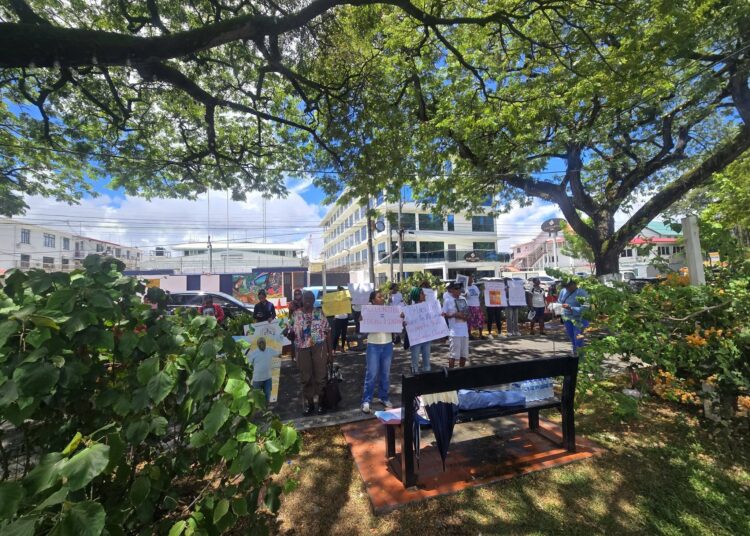
Families of people still missing following the MV Barima tragedy returned to the streets Tuesday morning, gathering outside the Main Street office of Minister of Public Utilities and Aviation Deodat Indar as another week passed without answers about their loved ones.
The protesters, joined by activists and supporters, held placards and directed a series of angry chants at government officials, including “Float the boat!”, Float the boat even if it is the bones to show!” “Bring up the evidence!” , “Edghill and Indar must go!” among other chants.
As a convoy carrying Prime Minister Brigadier (Ret’d) Mark Phillips approached the Prime Minister’s official residence on Main Street, families and supporters directed their chants toward the convoy as it entered the residence.
Among those continuing to demand answers is Royston Frank, whose son Rawle remains missing. Frank is seeking the recovery of his son’s remains, leaving the family unable to obtain the closure it has been seeking since the July 18 disaster.
The protest reflects mounting pressure from families who want the government to recover the sunken vessel, arguing that the MV Barima could contain both remains and physical evidence that may help establish what happened before the vessel capsized.
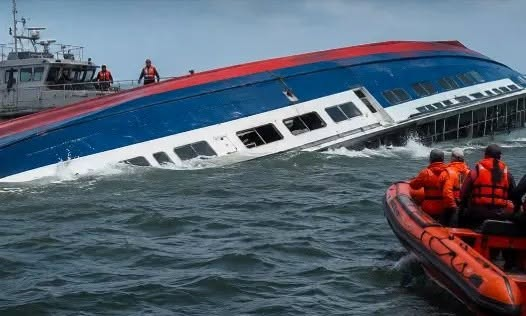
The vessel sank on July 18 while travelling from Georgetown to Port Kaituma. Government figures subsequently presented to the National Assembly indicated that 179 people were aboard. Seventy-six survived, 73 bodies were recovered and about 30 people remained unaccounted for.
MV Barima protest- September 29, 2026
The active search and recovery operation was later brought to an end, while questions continued over the fate of those who remained missing and the circumstances surrounding the disaster.
The demand to “Float the boat!” has since become a recurring feature of protests by relatives of victims. Families say recovering the wreck is important not only because additional remains could potentially be found, but because the vessel itself may provide evidence relevant to determining how and why the tragedy occurred.
The government has established a Commission of Inquiry into the disaster. Its terms include examining the circumstances surrounding the capsizing and sinking, the deaths, the government’s response, compliance with safety requirements and possible failures or shortcomings.
Tuesday’s protest, however, demonstrated that patience among some relatives is wearing thin.
The chant “Bring up the evidence!” underscored their demand that the investigation be supported by physical evidence from the wreck rather than relying solely on testimony and records.
The calls for Indar and Public Works Minister Juan Edghill to leave office also reflected the protesters’ dissatisfaction with the government’s handling of the tragedy.
For relatives such as Frank, however, the issue remains deeply personal. The demand to recover the vessel is tied directly to the search for loved ones who have not returned home.
As the protesters confronted another week of uncertainty, their message to government was unmistakable: “Float the boat” and bring back the evidence — and the missing.
Former government minister Annette Ferguson has rejected President Irfaan Ali’s references to “sleepless nights” over the MV Barima disaster, arguing that grieving families need action rather than assurances as questions mount over what authorities knew about the vessel before it sank.
“I personally do not care whether Ali sleeps comfortably or not,” Ferguson said in a social media post. “What I care about is that the MV Barima is raised, the remains of those who perished are recovered where possible, and families are given the opportunity to lay their loved ones to rest with dignity.”
“That tragedy continues to be a heavy weight. Still a lot of sleepless nights. It is something that I wish never happened. It was something I wish the families in our country would have never had to go through.”
He said the tragedy must produce a new culture of safety, infrastructure, leadership and responsibility.
Ferguson, who served as a minister in the A Partnership for National Unity and Alliance For Change (APNU+AFC) Government between 2015 and 2020, including as Minister within the Ministry of Public Infrastructure, has been among those repeatedly joining families and supporters demanding that the sunken vessel be raised. Parliament records confirm her ministerial role during the APNU+AFC administration.
Her intervention comes as a government paper trail highlighted in a September 28 Village Voice News investigation raises fresh questions about the condition of the 87-year-old vessel and the government’s own knowledge of its maintenance requirements.
The investigation found that the government had already launched a G$124.5 million docking and rehabilitation programme for the Barima months before the disaster. The National Procurement and Tender Administration documents put the engineering estimate at G$124,539,250, with five companies submitting bids ranging from approximately G$105 million to G$123.99 million.
Even more striking procurement records showed awards under the wider Transport and Harbours Department contract for the MV Ma Lisha, MV Barima and MB Hercules were dated July 17, 2026 — one day before the Barima sank.
The published procurement record does not clearly identify which company was assigned the Barima lot, meaning the complete procurement file would be required to establish that detail.
The timing raises a fundamental question. Why was a vessel already earmarked for more than G$124 million in docking and rehabilitation still carrying passengers the day before the disaster?
Capsized MV Barima Boat
Government Said There Was No Warning
Two days after the sinking, Public Works Minister Juan Edghill said there had been no indication that the vessel was unseaworthy.
“There was no report of any kind that suggested the vessel was unseaworthy. It was in line for dry docking in keeping with the schedule.”
The government has maintained that the Barima was last dry-docked in 2024 and that its next scheduled docking was due in the second half of 2026.
But subsequently reported internal maintenance records paint a more complicated picture.
However, maintenance logs, requisitions and technical reports contained repeated warnings about mechanical and safety problems. 20 engine-related complaints and eight generator-related failures, including concerns about heavily corroded main-engine fuel lines were highlighted
A January 2026 engineering report reportedly warned that the fuel lines were heavily corroded and could break while the vessel was operating.
Other reported problems included an inoperable VHF system, GPS failures, defective emergency equipment, generator failures, overheating machinery, exhaust leaking into the engine room and ventilation problems.
None of those records, standing alone, establishes that the Barima was legally unseaworthy or proves what caused the sinking. But they directly sharpen the question of what government officials knew, when they knew it and what they did with that information.
The issue is particularly significant because G$11.2 billion was budgeted for river transportation in 2026, including G$570 million for reconditioning ferry vessels.
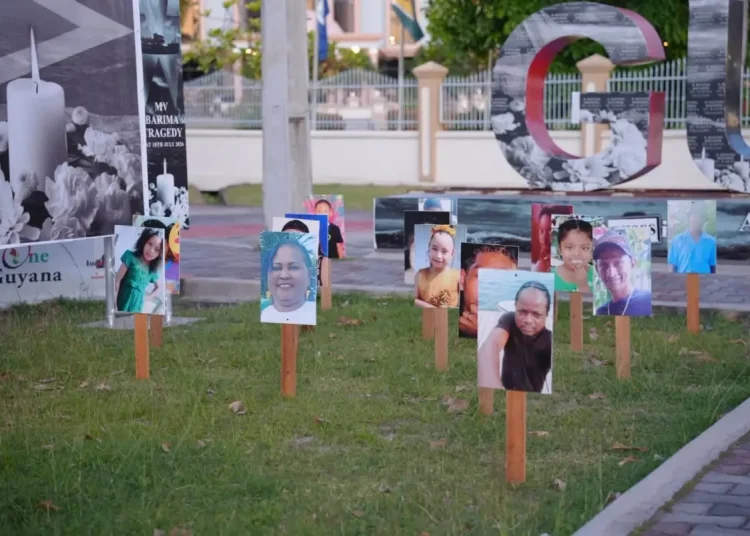
A photo of the victims of MV Barima
Ferguson Keeps Pressure on Government
Two months after the tragedy, Ferguson says the families’ demands have not changed.
“Two months after the MV Barima tragedy, the focus should not be on whether the President is losing sleep. The focus should be on the families who are still waiting for answers, the recovery of their loved ones, and the raising of the vessel.”
She has appeared at weekly demonstrations alongside relatives, opposition figures and other supporters, where the recurring demand has been “FLOAT THE BOAT” and “BRING THEM HOME.”
The Barima sank while travelling from Georgetown to Port Kaituma. Government figures subsequently presented to Parliament indicated that 179 people were aboard, 76 survived and 73 bodies were recovered, leaving about 30 people unaccounted for.
A Commission of Inquiry established by Ali is examining the disaster, including the vessel’s seaworthiness, maintenance history, maritime compliance and whether negligence, misconduct, dereliction of duty or institutional failures contributed to the loss of life.
Three crew members — Captain Kevin Price, Chief Mate Rondell Roberts and Goods Superintendent Delon Granderson — have been charged with murder. They remain presumed innocent.
But Ferguson’s demand goes beyond the criminal proceedings.
“Until there is meaningful action to recover the vessel and provide the families with closure, the pain of this tragedy will continue to haunt those left behind.”
Her message is blunt: condolences cannot recover the missing, and an inquiry cannot itself bring the wreck to the surface.
“The families deserve more than sad stories, they deserve answers and action.”
The growing paper trail now places a harder question before the authorities — if warnings and major rehabilitation plans existed before July 18, why was the Barima still in passenger service when it sank?
The Commission may ultimately provide the answer. Until then, Ferguson and the families continue to demand the same thing — raise the boat.
The People’s National Party joined Ghanaians and Pan-Africanists worldwide in honouring Kwame Nkrumah on the 117th anniversary of his birth — and traced a line from Marcus Garvey’s Jamaica straight to Ghana’s independence.
By Calvin G Brown (WiredJA) On Monday, September 21, as Ghana shut its offices, banks and schools to honour the man who led it out of colonial rule, a salute arrived from the other side of the Atlantic.
The People’s National Party (PNP) observed Kwame Nkrumah Day with a statement from its Old Hope Road headquarters, describing Ghana’s first president as a monumental visionary whose life and leadership transformed the course of African history and galvanised the global Pan-African movement.
The release, issued through the party’s Culture and Heritage Commission, chaired by I.B. Konteh, remembered Nkrumah as the architect of Ghana’s independence in 1957 and a founding figure of the Organisation of African Unity in 1963. It returned to one of his most famous lines, delivered on the night of independence: “Our independence is meaningless unless it is linked up with the total liberation of the African continent.”
From Garvey to Accra
The heart of the tribute was a claim Jamaicans can hold with pride: that Nkrumah’s vision was built directly on the teachings of Marcus Garvey. The PNP credited Garvey with igniting Pan-African consciousness and argued that Nkrumah turned the call for “Africa for the Africans, those at home and those abroad” into institutional reality.
History supports the claim. In his 1957 autobiography, Nkrumah wrote that of all the literature he studied as a student in the United States, Garvey’s Philosophy and Opinions inspired him most. Independent Ghana later named its national shipping line the Black Star Line, echoing Garvey’s own venture, and a black star still sits at the centre of the Ghanaian flag.
The party went further, formally endorsing Nkrumah’s declaration in Class Struggle in Africa (1970) that all people of African descent — whether in the Americas, the Caribbean or anywhere else — “are Africans and belong to the African nation.” It closed by pledging to help dismantle remaining structural barriers and to advance sovereignty, decolonisation and African dignity worldwide.
How Ghana Marked the Day
In Ghana, the day carried particular weight. The Ministry of the Interior, in a statement signed by Minister Muntaka Mohammed-Mubarak, declared September 21 a statutory public holiday, and government offices, financial institutions, businesses and schools across all 16 regions closed for the commemoration.
It was only the second observance since Parliament restored September 21 as Founder’s Day in June 2025, reversing a 2019 change under President Nana Akufo-Addo that had moved Founders’ Day to August 4 to honour the wider “Big Six” and renamed Nkrumah’s birthday a memorial day.
The Kwame Nkrumah Memorial Park in Accra, where Nkrumah is buried, has long been the focal point of wreath-laying ceremonies, lectures and cultural performances on the day. This year, Accra also hosted a Global Peace Cultural Festival on the holiday.
The sharpest reflection came from the academy. Professor Samuel Ntewusu, Director of African Studies at the University of Ghana, told the Ghana News Agency that “celebration is not an event.” The true measure of honouring Nkrumah, he argued, lay in studying and applying his ideas on economic independence, natural resources, education, agriculture and energy. He urged Ghanaians of every political persuasion to set partisanship aside and examine those policies critically.
A Legacy Still Contested
That appeal was pointed, because Nkrumah’s legacy remains a live political question in Ghana. The back-and-forth over the holiday’s date reflects a long rivalry between Nkrumah’s political heirs and those who argue independence was a collective achievement. Critics also point to the authoritarian turn of his later years, including a one-party state, before he was overthrown in a military coup in February 1966. He died in exile in Bucharest in 1972.
Yet even his detractors rarely dispute his place on the continental stage. In 2000, BBC World Service listeners voted him “African Man of the Millennium.”
Why It Matters Here
For the PNP, the tribute sits within a long tradition. The party of Norman and Michael Manley has consistently framed Jamaica’s story as part of a wider African and Global South narrative — a thread that runs through Jamaica’s Garvey heritage, its role in the anti-apartheid struggle and CARICOM’s ongoing campaign for reparatory justice.
The PNP’s statement said the day should serve as a reminder to Africans at home and abroad of their shared heritage and united power. Professor Ntewusu offered the test of that sentiment: whether Nkrumah’s ideas are studied and put to work, not merely saluted once a year.
On both sides of the Atlantic, the answer will be written long after the wreaths have wilted.