Home Blog Page 21

Guyana private sector wants us to swallow fairy tale that soaring GDP growth, oil revenues will trickle down to every household

0

Dear Editor,

Listen, I have to hand it to our local captains of industry and chamber of commerce luminaries. Every time they stand at a podium demanding that Guyana embrace a pure, unadulterated, American-style free market, free of pesky government interference, regulations, or pesky taxes, I get tears in my eyes. It is truly touching to watch millionaires lecture us on the beauty of rugged individualism while sitting atop an ocean of offshore oil.

Why bother with things like universal healthcare, affordable housing, or robust public education when we can just let Adam Smith’s invisible hand sort out who gets to eat and who gets to live in a shack? After all, just look at the United States, that shining beacon of pure, unfiltered capitalism where the government definitely doesn’t spend $2.5 trillion to $3 trillion a year babysitting its citizens.

Oh, wait. Never mind. It turns out that even in the global cathedral of laissez-faire, the American state quietly funnels over $1.6 trillion into healthcare programs like Medicare and Medicaid, nearly a trillion dollars into public education, and hundreds of billions more into food assistance and housing. It turns out that when the chips are down, even the capitalists love a good multi-trillion-dollar safety net, especially when it’s time to socialize corporate losses while privatizing the gains.

Yet, here in Guyana, especially our local business elite in Georgetown want us to believe that rugged capitalism means we should let the free market work its magic on the average Guyanese worker. They want us to swallow the fairy tale that soaring GDP growth and oil revenues will naturally trickle down to bless every household, as if wealth has ever spontaneously jumped out of a corporate ledger and built a primary school. They complain about the fiscal footprint of state spending on social programs, entirely forgetting that the healthy, educated workers keeping their businesses afloat didn’t drop out of a supply-side economics textbook. So let’s keep taking financial advice from folks who want all the rewards of an oil boom and none of the responsibility of building a nation. Let’s leave our healthcare and housing to the mercy of market forces so that a select few can add another zero to their bank accounts while the rest of us wonder how much a barrel of oil costs when you can’t afford to see a doctor.

In conclusion, if we are going to copy America, let’s at least be honest about the game: true capitalism is great for the people writing the checks, but for the rest of us, it’s a brilliant way to build a very rich market on top of a very broken country. 

Sincerely,

Keith Bernard


Source: Kiskadee Watch

Mohamed’s mother moves to High Court for his release on bail

0

The mother of Opposition Leader Azruddin Mohamed has moved to the High Court seeking her son’s release from prison on bail in the matter of surveillance footage which he is accused of obtaining by bribery.

In an urgent Fixed Date Application filed yesterday, Bonita Mohamed is asking the High Court to quash Magistrate Abigail Gibbs’ October 30 decision to remand her son to prison and grant him reasonable bail pending the determination of the criminal proceedings against him.

The application names the Director of Public Prosecutions, Magistrate Gibbs and the Attorney General as respondents.

Central to the challenge is an allegation of a connection between Magistrate Gibbs and the Deputy Superintendent of Police Jamine Bacon, who the applicant claims was involved in investigating the October 12 shooting incident outside the Kitty residence of Head of Special Branch, Senior Superintendent Prem Narine. The surveillance footage pertains to this incident.

According to the application, the connection was not disclosed during the bail proceedings, despite what Mohamed’s legal team contends was an apparent conflict of interest.

The applicant argues that the circumstances raise legitimate questions about whether Mohamed received a fair and impartial hearing when his application for bail was considered.

Mohamed and Police Constable Ryan Greene were jointly charged on Friday, October 30, with Unauthorised Giving of Electronic Data, contrary to the Cybercrime Act of 2018.

Both pleaded not guilty when they appeared before Magistrate Gibbs at the Sparendaam Magistrate’s Court, but were refused bail and remanded to prison until November 24.

The charges arose from an investigation into the alleged unauthorised obtaining and disclosure of surveillance footage relating to the October 12 shooting incident in Kitty, Georgetown, during which Narine fired shots in the direction of Mohamed.

Police have alleged that Greene, who was attached to the Police Command Centre, obtained the recordings without authorisation and supplied them to Mohamed in exchange for $800,000. Mohamed has disputed allegations that he paid for the footage.

The recordings were subsequently presented by Mohamed during an October 26 press conference, where he showed reporters several angles of the shooting incident and maintained that the footage supported his account of what transpired.

Kiskadee Watch previously reported that members of the media were prevented from entering the courtroom during the October 30 proceedings and were therefore unable to independently hear the submissions or the Magistrate’s reasons for refusing bail.

Following the hearing, Senior Counsel Roysdale Forde, who represented Mohamed, strongly criticised the refusal of bail and announced that the defence would approach the High Court.

“There is absolutely no basis for the refusal of bail,” Forde told reporters outside the courthouse.

According to Forde’s account of the ruling, the Magistrate expressed concern that Mohamed was allegedly committing further offences while already on bail.

However, the Senior Counsel challenged that reasoning, arguing that the existence of additional criminal charges could not be treated as proof that an accused person had committed an offence.

The High Court application now advances that challenge, with Mohamed’s legal team, including Forde and attorneys Siand Dhurjon and Damien Da Silva, questioning both the legal basis of the cybercrime charge and the circumstances surrounding the refusal of bail.

The applicant contends that Mohamed had lawful justification for receiving and disclosing the surveillance recordings because they were relevant to his defence against serious criminal allegations arising from the October 12 incident.

His attorneys further argue that the prosecution has failed to establish sufficient admissible evidence linking him to the alleged offence and question whether the provision of the Cybercrime Act relied upon by the prosecution applies to his alleged conduct.

The application also challenges the period of remand from October 30 to November 24, which the defence contends exceeds the statutory limit applicable under the Criminal Law Procedure (Paper Committals) Act 2024.

Additionally, the applicant argues that insufficient consideration was given to Mohamed’s previous compliance with bail conditions, his lack of criminal convictions, family responsibilities, established ties to Guyana and his constitutional responsibilities as the elected Leader of the Opposition.

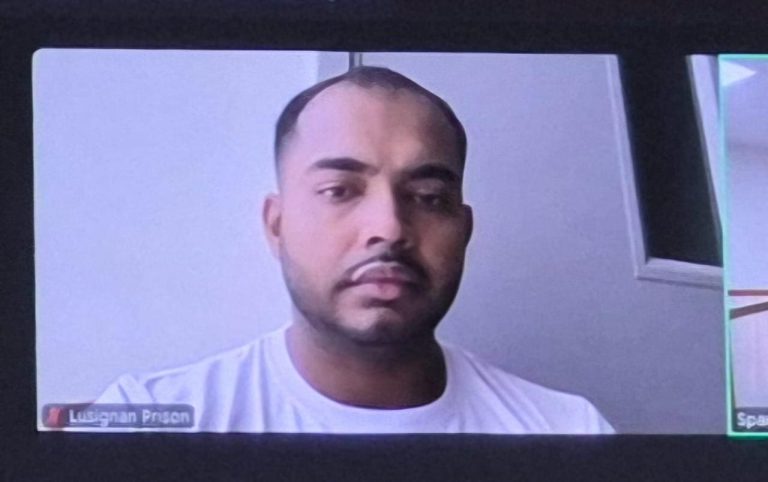
Beyond the refusal of bail, the application raises concerns about the conditions under which Mohamed is being held at the Lusignan Prison.

In her sworn affidavit, Bonita Mohamed alleges that her son is being kept in solitary confinement in a poorly ventilated cell, exposed to extreme heat and smoke and fumes from a nearby dumpsite, while facing severe restrictions on human interaction.

She contends that the conditions are cruel, inhumane and detrimental to his mental well-being.

The allegations follow concerns raised publicly over the weekend by Mohamed’s family.

Kiskadee Watch previously reported that his sister, Hana Khamelia, alleged that the Opposition Leader was being held in a windowless cell with a bright light operating continuously, affecting his ability to sleep.

His father, Nazar Mohamed, also alleged that his son was being confined to a small room, subjected to uncomfortable restraints and denied access to home-cooked meals.

The Guyana Prison Service has since denied allegations that Mohamed is being treated inhumanely, although questions surrounding the specific conditions of his confinement remain disputed.

The latest High Court challenge comes against the backdrop of several criminal and extradition proceedings involving Mohamed.

On October 16, Mohamed, his driver Eugene Thorne and videographer Mario Mohamed were granted bail of $750,000 each after pleading not guilty to firearm, ammunition and attempting to obstruct the course of justice charges arising from the October 12 incident.

The shooting incident has remained a subject of controversy, particularly after Mohamed publicly released surveillance recordings which he said supported his version of events.

Meanwhile, Police Constable Greene’s arrest had already been challenged before the High Court.

On October 29, Justice Christel Lambert ruled that police had reasonable grounds to suspect Greene’s involvement in the alleged unauthorised disclosure of the recordings and declined to order his release.

However, the Judge ordered the release of his mother, Nikita Greene, finding that the authorities had failed to establish reasonable grounds to suspect her of criminal wrongdoing merely because she had received money from her son.

That ruling concerned the legality of the arrests and detention, rather than whether the alleged offences had been committed.

Mohamed and his father are also facing separate extradition proceedings arising from a request by the United States.

Through the latest application, Bonita Mohamed is seeking High Court intervention to overturn the October 30 remand decision and secure her son’s release on reasonable bail while the cybercrime proceedings continue.


Source: Kiskadee Watch

BK says diver, 66,  suffered heart attack during MV Barima salvage operation

0

After days of silence, the BK Group says a contracted diver who died during salvage operations apparently had pre-existing medical conditions and suffered a heart attack, according to reports from a doctor aboard the operation.

The account was contained in a press release signed by Brian Tiwarie, Executive Chairman of the BK Group of Companies, following the death of Venezuelan diver Luis Martinez during work at the MV Barima wreck site.

The company said the licensed diver was contracted through Salvamentos del Caribe C.A. and that a resident, full-time doctor was aboard during the operations.

“According to reports from the Resident full-time doctor on board during the operations, the diver apparently had pre-existing medical issues and therefore suffered a heart attack,” the release stated.

The statement did not include a medical report or post-mortem findings supporting that account.

Questions will likely be raised as to what BK is doing with a billion-dollar salvaging contract when an apparently ill 66-year-old Venezuelan was diving in what are likely difficult conditions at sea.

BK said relatives had been notified and assistance would be provided to transport the body to the diver’s home in Venezuela.

The company also maintained that every aspect of the salvage operation was being conducted with strict adherence to the safety and well-being of all personnel involved.

Its release described the death as having occurred “over the weekend”. However, according to the police account previously reported by Kiskadee Watch, Martinez, 66, became unresponsive during diving operations on Wednesday, October 28, approximately 10 nautical miles off Anna Regina. Police publicly disclosed the incident on November 1.

Police said Martinez entered the water but had not resurfaced after approximately 20 minutes. Crew members pulled him up using a rope attached to his body and found him motionless and frothing at the mouth. He was transported to the Transport and Harbours Department wharf at Stabroek, Georgetown, where a doctor pronounced him dead at approximately 2.30 am on October 29. His body was taken to Memorial Gardens Funeral Home pending a post-mortem examination. 

The police statement did not identify his employer, detail the emergency assistance available at the diving site or explain what occurred between his retrieval from the water and arrival in Georgetown. BK’s release identifies the contracting company and says a doctor was aboard, but does not describe the treatment administered or the emergency evacuation arrangements. 

The PNCR/APNU had called for an independent investigation into Martinez’s death, questioning the emergency arrangements and the decision to transport him to Georgetown rather than seek medical assistance in Region Two. The party also sought disclosure of the contractors involved, safety requirements, operational plan and monitoring arrangements. 

This will be classed as another worksite death that the Ministry of Labour will have to investigate. The Labour Ministry has been largely silent on these cases and the Ministry has said nothing on this one. 

BK International was awarded a $1.034 billion contract on October 6 to salvage the MV Barima off Devonshire Castle Flats, Essequibo Coast, on a “no cure, no pay” basis. The published award record did not specify a mobilisation or recovery deadline, the approved salvage method or detailed conditions for determining successful completion.

The families of the victims of the MV Barima disaster have expressed outrage over the failure to refloat the vessel up to now and have expressed a lack of confidence in BK’s ability to do the job.


Source: Kiskadee Watch

Eight years and three governments later, the Whistleblower Act is still not operational

0

Dear Editor,

During Guyana’s review at the 140th Session of the UN Human Rights Committee (Covenant on Civil and Political Rights), which took place from March 18 to March 20, 2024, the Government was asked why the Protected Disclosures Act of 2018 was still not brought into operation by the Ministry of Legal Affairs. Their answer was that they had been unable to implement the Act due to “issues with the wording” [https://digitallibrary.un.org/record/4046144?v=pdf].

I was a member of Transparency Institute Guyana Inc (TIGI) at the time Parliament passed the Act and I remember that though the Bills being introduced had good intentions, our general concern was that they were accumulating too many discretionary powers to Ministers. Our submissions to the Ministry of Legal Affairs were routinely ignored.

Here is an extract from the official good intention of the Protected Disclosures Act of 2018. “An Act to combat corruption and other wrongdoings by encouraging and facilitating disclosures of improper conduct in the private and public sectors, to protect persons making those disclosures from detrimental action, …”.

Here are two examples of ministerial control. The first and most blatant is that there is no time limit to when the minister must bring the Act into operation. There is good reason for giving this responsibility to the minister, because the Protected Disclosures Commission has to be established and constituted. But no time limit is licence to get away with executive corruption and oppression of whistleblowers for as long as any government feels like.

The second is that although Section 4(4) of the Act states that the Commission shall not be subject to the direction and control of any other authority, S.4(5) makes the minister the exception. Eight years and three governments later, the Act is still not operational.

Despite acknowledging that the Act (commonly known as the Whistleblower Act) and the accompanying Witness Protection Act 2018 had not yet been formally operationalized, the 2024 government delegation asserted to the UN Human Rights Committee that even though the specific legislative framework was not fully functional, the Guyana Police Force provides direct protection to whistleblowers in practice!!!

Current police actions continue to expose this assertion as a lie. And the “wording” has little chance of being changed by a Parliament that hardly works, because its sittings are controlled by a partisan Speaker. Democracy requires integrity and dedicated, responsible work, but our ruling politicians have developed a scheme to live a cushy life supported by sycophants at the expense of ordinary hard-working people.

              Yours sincerely,

              Alfred Bhulai


Source: Kiskadee Watch

Home Affairs Ministry seeks surveillance safeguards review

0

-APNU demands independent oversight

The Ministry of Home Affairs has called for a comprehensive review of safeguards at the police Command Centre following the alleged unauthorised disclosure of surveillance footage, while the PNCR/APNU and parliamentarian Sherod Duncan say the controversy exposes wider failures in oversight and institutional management.

In a November 1 statement, the ministry described the alleged unauthorised access, extraction and disclosure of footage from the Liliendaal facility as a serious threat to the confidentiality and integrity of law-enforcement operations.

It said the police investigation must proceed on evidence and in accordance with the law.

“Political office does not confer immunity from investigation, just as political affiliation cannot be a basis for prosecution,” the ministry stated.

The PNCR/APNU, in a statement issued on November 2, acknowledged the seriousness of unauthorised disclosure but argued that accountability must extend beyond any individual accused of breaching procedures.

Duncan, in a separate response, said he had sought parliamentary scrutiny of surveillance safeguards for almost a year and had proposed an independent Office of the Surveillance Commissioner.

The ministry said the alleged conduct, if established, would constitute an abuse of entrusted access, potentially compromising sensitive investigations, undermining operational security and interfering with the administration of justice.

It also acknowledged that the matter raised questions about compliance with standard operating procedures and the adequacy of protections for sensitive information.

“Accordingly, the Ministry expects a comprehensive review of personnel, access controls, supervisory arrangements, and operational procedures at the Command Centre,” the release said.

The review would establish the extent of the alleged breach, identify failures of conduct or oversight and guide corrective action, including stronger controls, tighter supervision and enforcement of procedures. Its findings would also inform legislative reform.

The release did not identify who would conduct the review or give a timetable for its completion.

The PNCR/APNU questioned whether adequate safeguards, personnel vetting, access restrictions and supervisory mechanisms had been established before the surveillance system was put into operation.

“This is not simply a matter of one police constable or any individual who may have breached established procedures. It is a question of institutional responsibility,” the party stated.

It argued that internal misconduct, abuse of access privileges and unauthorised disclosure were foreseeable risks which should have been addressed through planning, monitoring and training.

The party called for an independent technical and operational assessment covering the system’s design, vulnerabilities, access arrangements and operating procedures.

It also proposed a review of Command Centre personnel, individual user authentication, audit trails, continuous monitoring, supervisory approval and clear responsibility for access to recordings.

Consultation with security specialists, professional bodies, civil society and the parliamentary opposition should precede changes with national-security and public-interest implications, the PNCR/APNU said.

It further called for specialist training in information security, confidentiality, evidence management and the legal responsibilities attached to handling surveillance material.

Independent oversight was necessary, the party argued, to protect citizens’ rights and guard against political manipulation of the system.

Duncan said the ministry’s proposed review addressed safeguards he had already raised through parliamentary questions and a motion.

According to him, a question submitted on November 19, 2025, sought information about the legal authority and safeguards governing police drone surveillance, including operating procedures, retention and deletion of footage, access controls and records identifying who viewed, copied or exported recordings.

He said he had also asked about facial recognition, automated licence-plate capture and other AI-assisted surveillance.

On May 9, 2026, Duncan said, he submitted a motion, seconded by MP Juretha Fernandes, proposing an independent Surveillance Commissioner and effective implementation of Guyana’s data-protection framework.

The proposed office would conduct audits and inspections, scrutinise data sharing and access controls, investigate complaints and report publicly to the National Assembly. The motion also addressed facial-recognition errors, algorithmic bias and the impact of surveillance on fundamental rights, he said.

Duncan said three further questions submitted on October 7 concerned public-security cameras and the Safe Country initiative. These sought details of who controlled recordings and facial-recognition data, whether material was stored locally or overseas, and which officers, contractors or foreign entities could access it.

Other questions concerned contracts, expenditure, retention procedures, audit findings, human verification before police action and the investigations, arrests, charges and convictions associated with the systems.

“Those questions remain unanswered, against a background of ad hoc parliamentary sittings and largely non-functioning oversight committees,” Duncan stated.

He called for relevant recordings, access logs and instructions to be preserved and for the investigation to be subject to credible independent scrutiny, including examination of the supervisory chain.


Source: Kiskadee Watch

Seeram set free with 13-month suspended sentence

0

-wife said he never once apologised, continues to suffer emotionally 

Thirty-six-year-old Farzana Hamid stood in the witness box yesterday at the Sparendaam Magistrate’s Court to deliver an impact statement detailing the physical and emotional abuse that she endured at the hands of her former husband Daniel Seeram and to persuade the court to deliver a sentence that matched the magnitude of his actions and their sore effects. 

She was not inclined to offer a comment to Kiskadee Watch after the hearing that essentially left Seeram a free man with a 13-month suspended sentence. This type of sentence means that Seeram will serve no time in prison; only if he commits an offence within the 13 months would he be required to begin serving the time. 

Magistrate Abigail Gibbs handed down the sentence for Seeram, 36, of Lot 8 Alexander Village, Georgetown having found “persuasive reasoning” that he was a suitable candidate for rehabilitation in the community and not in the prison.  

The starting point of the sentence was 24 months in prison, and she deducted 10 months for his previously good character and record of service and one more month for the time he had already spent in prison. This left a total of 13 months which she ordered to be non-custodial. 

Seeram, charged with assault causing actual bodily harm, was represented by Acquino Luke, Jeanique Williams and Tifaine Rutherford who appeared yesterday on behalf of Attorney-at-law Nigel Hughes. 

Prosecutor Ganesh Hira was not especially moved by Seeram’s statements in court yesterday which included an apology to Hamid and her parents. He said the manner in which the incident unfolded was “disgusting” and reminded the court that Hamid was asleep in their bedroom when she was awakened by punches to her head from Seeram. 

Hira said Hamid also sustained  quite a few injuries for which she has medical records and photos to prove. He reiterated his belief that Seeram was not remorseful and has tried to shift the responsibility for his actions. 

The prosecutor was responding to Seeram’s statements that he never envisioned the marriage to end in the manner it did, and that he was sincerely sorry to everyone, including  Hamid. He also said that the situation has left him depressed and wished Hamid well in her future, saying he hopes she is able to find someone with whom she is compatible and can lead a fulfilling life.

Meanwhile, Hamid related the lasting impact that Seeram’s abuse continues to have on her. “I cried and begged him to stop,” she shared, recalling how he destroyed her phone when she attempted to record the incident. 

She said the incident has affected her ability to move forward with her life and that she had to seek professional therapy. She continues to struggle with anxiety and the ability to trust others, she continued, noting that the situation has left her mentally and emotionally exhausted at times. While the guilty verdict has brought her some amount of validation, she said it does not erase the effects of what he did to her. 

Hamid said that Seeram has not once apologised to her and that there was an absence of remorse for which he should be held fully accountable. 

Senior Probation and Social Services Officer within the Ministry of Human Services and Social Security Orlena Forrester told the court that Seeram came from a loving, caring, and supportive family environment where each member of the family was treated with respect. 

The family went on mini vacations and did other things together like picnics and other family outings. They were deeply involved in their religious activities as staunch Hindus and his parents were strict, Forrester related. 

Providing some background information on Seeram, she shared that he attended Alexander Village Nursery School, West Ruimveldt Primary and then Queen’s College. He later enlisted in the Guyana Defence Force (GDF) and spent 12 years and then began pursing engineering studies. He is currently the Director of Border Patrol, having also served as the Regional Chairman for Region Four. 

Forrester described Seeram as having above average intellect and related how his parents and members of his community spoke well of his character. She said even Hamid, whom he married in June 2019, said he was a kind and loving individual. 

Some of the problems in the marriage were attributed to the constant meddling of Hamid’s parents, according to Forrester who further related Hamid’s account that Seeram became a different person when he drank alcohol; one who was emotionally distant and who hardly spoke to her during these times. 

Forrester, who called attention to Seeram’s stable and distinguished employment record, further shared that issues arose when Seeram stayed out late and nights and Hamid tried to question him about it when he returned home. 

Prosecutor Hira asked Forrester if Seeram had expressed remorse specifically about what he did to Hamid. Forrester responded that nothing was said specifically about Hamid and that Seeram expressed regret for what everyone involved had to go through because of the case.

Hira also disputed Forrester’s claims about how Hamid described Seeram as kind and loving, and pointed out how Seeram had sought professional help for his behaviour way before this incident occurred in 2023. 

Rutherford asked the court to grant a non-custodial or suspended sentence, noting that Seeram had already spent a month in prison. She said how Seeram has an unblemished character and that the parties had separated for over three years during which time Seeram never tried to contact her. 

The magistrate said the court took into consideration Seeram’s good character in the past, the favourable probation report and his service to the country as captain in the GDF. She said the court also took into account his apology to Hamid and her family. 

The magistrate stressed that Seeram’s previous good character and record of service carry weight and noted that the court also considered that Hamid’s injuries did not result in any permanent disability. 


Source: Kiskadee Watch

Magistrate refuses to revoke bail for Azruddin Mohamed in extradition case

0

Chief Magistrate Judy Latchman has declined to revoke the bail granted to Opposition Leader Azruddin Mohamed, ruling that pending criminal charges, without more, was insufficient to justify revoking his bail in the ongoing extradition proceedings.

The ruling was handed down yesterday morning following submissions by the defence, which argued that the prosecution could not rely solely on allegations or outstanding charges to establish that Mohamed had breached his bail conditions.

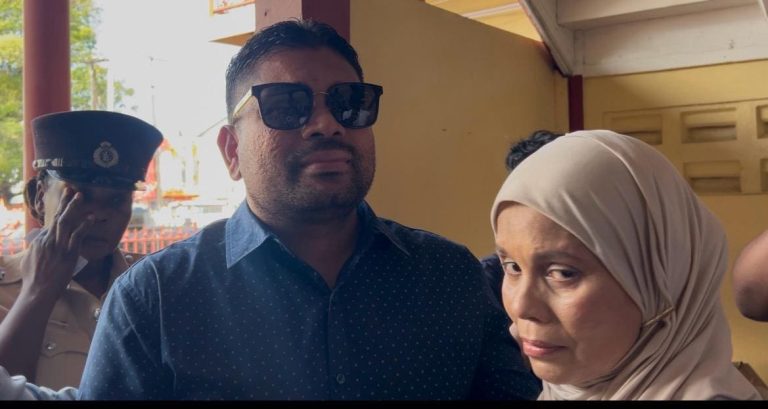
Earlier, the magistrate had ordered that Mohamed, who was on remand at the Lusignan Prison, appear before her for the extradition proceedings. When he appeared 30 minutes later he declared that the “demonic PPP government wants to kill me before the next elections”. He also said that he was in solitary confinement and suffering “maximum punishment”. He added that he had been on a lockdown for 23 hours and 50 minutes and the place was like a “furnace”.

In delivering her decision, Magistrate Latchman distinguished between pending criminal charges and conduct that could justify the revocation of bail, stating that the mere existence of charges did not automatically establish grounds for such an order.

She further said that if Mohamed were convicted of an offence while the extradition proceedings remained ongoing, that conviction could have a bearing on any subsequent application for revocation.

However, she did not consider the circumstances presently before the court sufficient to warrant revoking his bail.

The decision followed arguments challenging the prosecution’s reliance on separate criminal proceedings involving the Opposition Leader.

During submissions, defence counsel maintained that the court’s jurisdiction to revoke bail must be exercised within the statutory framework governing bail conditions and could not be extended merely because fresh allegations had been made against an accused person.

Counsel argued that the filing of charges was not equivalent to a finding of guilt and that the responsibility for determining whether those allegations were supported by sufficient evidence rested with the courts hearing the respective criminal matters.

The defence warned that allowing pending charges alone to justify revocation would create a situation in which allegations, regardless of their eventual outcome, could be used to interfere with an individual’s existing bail arrangements.

Counsel also referred to an earlier bail hearing on October 16, during which another Magistrate considered the circumstances surrounding the separate charges and granted bail after finding that special reasons existed.

The defence contended that the earlier decision was significant, particularly since the court had already considered the circumstances surrounding those allegations before allowing Mohamed’s release on bail.

It was further argued that the prosecution had failed to establish a meaningful basis for revoking bail and that the allegations should be tested in the criminal proceedings in which they were brought.

The defence maintained that the existence of separate charges did not, by itself, demonstrate that Mohamed had violated any condition imposed by the court in the extradition matter.

In her ruling, Magistrate Latchman declined the application for revocation, while leaving open the possibility that a subsequent conviction could be relevant to a future application.

The ruling means that Mohamed’s bail in the extradition proceedings remains in place, subject to the existing conditions.

Mohamed and his father, Nazar Mohamed, are facing extradition proceedings arising from a request by the United States.

The proceedings remain before Chief Magistrate Latchman at the Georgetown Magistrate’s Court.


Source: Kiskadee Watch

Special Branch Head admits no written record of surveillance operation targeting Mohameds

0

-unable to recall who instructed him to collect extradition documents

Senior Superintendent Prem Narine has admitted that he made no written record of telephone calls through which he received information about the whereabouts of Opposition Leader Azruddin Mohamed and his father, Nazar Mohamed, during a Special Branch surveillance operation on October 31, 2025.

The admission came during continued cross-examination by Senior Counsel Roysdale Forde in the extradition proceedings involving the two men, as the senior police officer was also unable to recall who instructed him to collect a package of extradition documents from the Ministry of Legal Affairs that same morning.

Narine, who heads the Guyana Police Force’s Special Branch, told the court that surveillance of the Mohameds began only after arrest warrants had been obtained on October 31, despite having received general permission from the Commissioner of Police to conduct surveillance operations when he assumed responsibility for Special Branch in July 2024.

Forde questioned when the surveillance was authorised, how the Mohameds were located and whether any records existed to independently establish the sequence of events leading up to their arrests.

Initially, Narine explained that when he assumed responsibility for Special Branch in July 2024, the Commissioner of Police had given him general directives concerning his responsibilities.

However, the Magistrate sought clarification on whether those directives amounted to permission to conduct surveillance specifically involving the Mohameds.

“Mr. Narine, I’m not trying to be difficult, but I’m trying to get some clarity,” the Magistrate remarked while pressing the witness on when permission had been obtained.

After further questioning, Narine confirmed that he received the general permission in July 2024.

He subsequently clarified that the Mohameds were not under continuous surveillance and that the operation targeting them commenced only after the arrest warrants were obtained on October 31, 2025.

“When I got the warrants, I sent out the surveillance team. They made checks. And then is when we knew where the Mohameds were,” Narine testified.

Asked whether the surveillance had begun before the warrants were issued, he answered in the negative.

Narine also confirmed that information about the Mohameds’ locations was communicated to him through telephone calls received on his personal cellular phone.

However, when Forde questioned whether he had documented the time of those calls or the information communicated, Narine acknowledged that he had not.

“I did not make any record,” he told the court.

He further admitted that he had not instructed any other officer to prepare a written record of the information received.

The questioning then shifted to Narine’s movements on October 31 and his collection of extradition documents from the Ministry of Legal Affairs.

Narine testified that he received instructions that morning to collect a package of documents relating to the extradition proceedings.

Although he knew the documents concerned the Mohameds, he said he did not know exactly which documents he would be collecting or how many were included in the package.

Narine was also unable to recall who had instructed him to collect the documents or whether those instructions had been communicated by telephone or email.

Forde pressed the witness on whether he had attempted to verify the instructions by examining his telephone or email records.

Narine acknowledged that he had not, despite confirming that he still possessed the same telephone number and email address used at the time.

Counsel subsequently requested that Narine check those records before the continuation of cross-examination to determine who had instructed him to visit the Ministry.

Further questions revealed uncertainty surrounding the documentation of the package’s collection.

Narine said he had identified himself to the person who handed over the documents but could not recall whether he had signed anything acknowledging their receipt. He also testified that he had not retained any receipt or document evidencing the collection.

When asked whether there was a record of his movements or the vehicle used that morning, Narine said he could not recall making such an entry or directing anyone else to do so.

He described the person who handed him the package as a woman approximately five feet five inches tall, of medium build and fair complexion, but said he could not provide further identifying details.

The exchanges were not without interruption, as the Magistrate repeatedly questioned the relevance of several questions concerning precisely where in the Ministry building the package was collected and how long Narine had waited to receive it.

Forde maintained that the questions were relevant to testing the witness’s recollection and the circumstances surrounding the collection of documents central to the extradition proceedings.

The Magistrate, however, ruled certain questions irrelevant and directed counsel to move on.

At one stage, Forde insisted that he was entitled to probe the evidence presented by Narine, particularly since he was representing Azruddin Mohamed and was not conceding the accuracy of the witness’s account.

The questioning later turned to the contents of the extradition package, including a Section 6 Certificate, an Authority to Proceed and a treaty between the United States and the United Kingdom relating to British Guiana.

Narine testified that he had read some of the documents before leaving the Ministry but had not examined the entire bundle in detail.

He identified the Section 6 Certificate and Authority to Proceed among the documents he reviewed, along with other materials that appeared to contain affidavits and details of indictments.

However, when Forde questioned him specifically about the extradition treaty, Narine acknowledged that he had only read its first page.

He admitted that he had not read any of the treaty’s articles, including Article 2.

This prompted a legal exchange between Forde and the prosecution over whether Narine could properly be questioned about the treaty’s applicability to Guyana.

The prosecution objected, arguing that the question concerned a matter of law rather than fact and that Narine was not a lawyer.

Forde disagreed, maintaining that he was not asking the witness to interpret the law but rather to explain the factual basis for his earlier testimony about the document.

The Senior Counsel argued that the defence was entitled to challenge the evidential foundation of documents tendered in support of the extradition proceedings.

When asked whether the first page of the treaty contained any reference to Guyana, Narine said he saw a reference to the United Kingdom and understood Guyana to have been a British colony at the relevant time.

Forde then attempted to question him about the date of Guyana’s independence.

That question drew another objection from the prosecution, which argued that the court was not conducting a history lesson and that the question was irrelevant.

Forde maintained that the issue was directly connected to the witness’s explanation of the treaty and the basis upon which he associated the United Kingdom with British Guiana.

The Magistrate ultimately ruled the question irrelevant.

In further submissions, Forde referred to the King extradition case, arguing that the circumstances in that matter differed from the present proceedings.

He contended that the defence was entitled to examine the documents and challenge the evidence supporting the Section 6 Certificate rather than simply accept the conclusions advanced through Narine’s testimony.

Forde also argued that the defence could not be placed in a position where the prosecution determined which witnesses would be called while restricting questions about documents introduced through the witnesses who did testify.

Before the afternoon’s proceedings concluded, Narine was asked whether he recalled seeing a declaration of succession concerning the treaty among the documents he collected.

He responded that he did not know what counsel would classify as such a declaration but had seen wording in the Section 6 Certificate, attached to the treaty, which he considered to constitute a declaration.

Cross-examination was subsequently deferred, with Narine remaining under oath for its continuation.

The extradition proceedings concern a request by the United States for the surrender of Azruddin Mohamed and his father, Nazar Mohamed. The defence’s questioning has focused, among other issues, on the police’s handling of the arrest process and the documents relied upon in the proceedings.


Source: Kiskadee Watch

Lindeners protest no water, no light

0

Last Updated on Monday, 2 November 2026, 21:11 by Writer

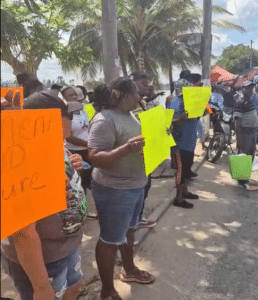
Residents of Linden on Monday took to the street of that once-thriving bauxite-producing town to vent their frustration at prolonged power outages and lack of water.

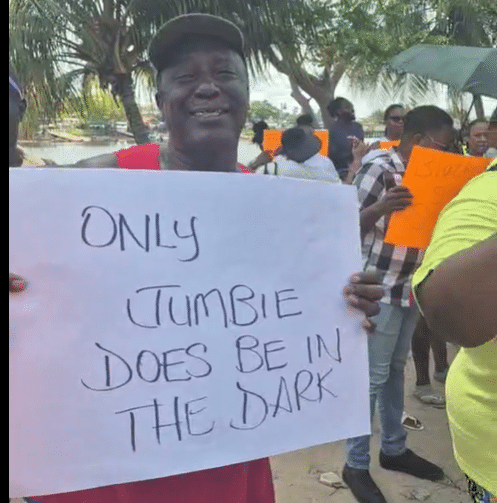
“No water, no light. All-you will get it right” they chanted on one of the main roadways.

Demerara Waves Online News was told that residents of the municipality were without electricity for more than 30 hours.

They also held placards that emphasised their plight as they stood outside the Linden Utility Services Co-operative Society Limited (LUSCL).

“No light, no school. Stop the blackout”, “Only jumbie does be in the dark”, “No light, no work”, “No more blackout, our children have to learn” and “Tired of spoil meat.”

People’s National Congress Reform (PNCR) member Sharma Solomon bemoaned that authorities were failing to upgrade the antiquated electricity transmission and distribution system and adding insufficient generating capacity.

“The problems are bigger than just the capacity, The problems include the ability of the system to move the power,” said Mr Solomon, a former mayor of Linden and former Region 10 (Upper Demerara-Upper Berbice) chairman.

He said the government over the years have been touting the 300 megawatt gas-to-energy plant but the situation in Linden is getting worse.

He later told Demerara Waves Online News that the government and the Chinese bauxite company, BOSAI Minerals, that is operating in Linden could reach a new power purchase agreement to increase electricity generation to guarantee “sufficient and adequate supply of electricity” as well as reserve and backup capacity to facilitate the expansion of residential and commercial activities.

Mr Sharma said given housing developments and the increasing infrastructural and commercial activities like the DDL cattle farm at Moblissa, that region wants the central government to provide at least 100 megawatts of power generation capacity.

He said the power grid in Linden alone was struggling to satisfy demand with 14.5 megawatts at a time when there are about 40 sawmills operating in the town.

“Industrialisation and the anticipation of both industrialisation and residential expansion needs better planning by government to get the technical input from LEI, LUSCL and even the municipality to say ‘here is how the community is expanding and how you, government, have to invest in power generation’,” he said.

Mr Solomon said sawmills were flocking the town to take advantage of the lower tariff of GY12 per kWh compared to those on the coastland that pay GY$65 per kWh but they were putting pressure on electricity generation.

He complained that for several months now residents had been suffering from unstable electricity and water utility services at a time when Guyana has the resources.

“It is important that we not only get answers. It’s important that we get long-term solutions,” said the A Partnership for National Unity (APNU) lawmaker.

He said once the electricity goes off, water supply stops.

Mr Solomon said small businesses like those in the markets were being badly affected.

He said household appliances were also being damaged.

He said each of Guyana’s 10 administrative regions should assess its ability to produce extra power that could be sold to the national grid.

The Guyana government had partly attributed Linden’s electricity woes to the extremely hot weather resulting in more persons switching on air condition units and the several sawmills that have mushroomed in the town in recent times, taking advantage of cheaper electricity rates.

The ministry of public utilities did not immediately comment.


Discover more from Demerara Waves Online News- Guyana

Subscribe to get the latest posts sent to your email.


Source: Demerara Waves

Man dies in Police lock-ups; OPR launches probe

0

The Office of Professional Responsibility (OPR) has launched an investigation following the death of 32-year-old Gavin Kennard Douglas after an incident at the Vreed-en-Hoop Police Station, West Coast Demerara on Saturday.

Douglas, of Crane Housing Scheme, West Coast Demerara, was arrested on Saturday in connection with an alleged armed robbery committed on Wednesday, October 28, at New Road, Vreed-en-Hoop.

He was escorted to the Vreed-en-Hoop Police Station at approximately 11:36 hrs. However, around 12:00 hrs, while being placed in the lockups, Douglas reportedly became aggressive and resisted police ranks, Police Headquarters reported.

He was subsequently restrained and placed in the lockups.

At approximately 12:45 hrs, police ranks conducting checks discovered Douglas frothing at the mouth.

He was immediately rushed to the West Demerara Regional Hospital, where he died while receiving medical attention.

The circumstances surrounding his death are now being investigated by the Office of Professional Responsibility.


Source: NEW ROOMS SITE