Investigators are probing the discovery of 7.370 kilograms (or 16 pounds) of suspected cannabis which was found in an abandoned building at Angoy’s Avenue, New Amsterdam, Berbice on Monday.
According to Police Headquarters, the suspected cannabis which was in a bulky salt bag and a bulky black plastic bag was found by ranks acting on information received.
The discovery was made at about 13:30 hrs.
In a report, Police Headquarters said ranks on mobile patrol proceeded the abandoned wooden building at Timmers Dam, where they conducted a search.
During the search, ranks found a suspected to be cannabis.
The suspected cannabis was taken to Central Police Station, where it was weighed and found to amount to 7.370 kilograms before being lodged.
No arrest was made and investigations are ongoing.
See below the full statement from the General Secretary of the People’s Progressive Party Civic, Dr. Bharrat Jagdeo:
October 5, 1992, remains one of the most consequential dates in Guyana’s political history. Through free and fair elections, Guyana reclaimed its democracy, as the victory of the People’s Progressive Party/Civic (PPP/C) ended 28 years of undemocratic retrograde rule by the People’s National Congress (PNC).
That victory represented more than a change of government. It paved the way for an independent judiciary, a stronger Parliament, a free press and a new Constitution that enshrined fundamental protections. Even with all of their imperfections, these institutions are hard-won gains and remain essential to a society where every citizen can live freely, pursue opportunity and shape their future.
Democracy also gave Guyana the opportunity to rebuild its economy and expand prosperity. Debt reduction, sound economic management and long-term planning helped create the foundation for growth and unprecedented advancements in health, education, housing and other social services.
But democracy must never be taken for granted. Not long ago, Guyanese saw political actors attempt to overturn the will of the people. The APNU+AFC’s efforts to rig the 2020 General and Regional Elections failed because the PPP/C stood in firm defence of our country and the right of our people to choose their government.
On the road ahead, we will remain vigilant in protecting our democratic freedoms. We will also ensure development reaches every family and every region. We will continue to prioritise job creation, housing, education, health and the wellbeing of our children, young people and the elderly.
This requires time for initiatives to be implemented, fiscal discipline and the transparent management of public resources. We will continue to deliver on our commitments and fight corruption in all of its manifestations.
Our promise is to build a Guyana where prosperity touches every community and every citizen regardless of race, religion or creed. That is what we fought for in 1992. It is what we will continue to deliver.
– from more than 900% of GDP when the PPP/C took office in 1992 to below 30% today
Successive PPP/C Governments tackled the inherited debt crisis through economic reforms, restructuring, international debt relief and sustained growth—moving Guyana from default and severe indebtedness to a fundamentally stronger economic position.
In fact, in 1988, Guyana could pay for less than a week of imports. It owed more than four times what its whole economy produced in a year, and it had stopped paying its creditors.
President Dr Mohamed Irfaan Ali went back to that point on Monday evening to explain how the country got there, and how it got out.
He called it an effort to bring “facts” to a public conversation he believes has been distorted.
President Dr Mohamed Irfaan Ali during his live statement on Monday evening
“Our creditworthiness was at its lowest. No one wanted to lend us money. We were defaulting on every payment,” the president said in a video statement posted on his official social media page before adding, “We did not have the revenue coming in to even match the minimum payment. That was a crisis.”
A crisis made by policy, not inherited
The president was clear that the debt did not come with independence. Guyana entered 1966 without the crushing burden it would carry two decades later, he said. That, in his view, makes it a story about choices.
“Governments are important. Leadership is important,”he said, stating that, “Because they pursue economic policies that can destroy us or take us forward.”
Between 1971 and 1976, the state nationalised bauxite, sugar and other major businesses. The public sector grew to about two-thirds of the economy.
“The difficulty was not nationalisation by itself,”President Ali said.
The problem was the combination of loss-making state enterprises, falling productivity and dependence on a handful of exports.
The country borrowed to keep those enterprises and imports going. As production fell and the Guyana dollar weakened, foreign debt swelled relative to the economy.
From 1976 to 1988 income per person fell by 31 per cent, inflation rose eightfold and government debt climbed from 31 per cent to 475 per cent of GDP.
By 1989, external debt alone stood at roughly 276 per cent of GDP.
Earning relief, not receiving it
The Desmond Hoyte Administration’s Economic Recovery Programme began repairing ties with the International Monetary Fund (IMF), World Bank and other lenders in 1989.
Still, when the People’s Progressive Party/Civic (PPP/C) Administration took office in 1992, total public debt sat at 623 per cent of GDP. Even after rescheduling, debt payments were taking about 42 per cent of government revenue in 1996.
Guyana then became an early entrant into the IMF–World Bank Heavily Indebted Poor Countries (HIPC) Initiative.
“This did not happen by accident,”the president said. He credited a government that convinced lenders it would spend prudently, invest in social services and open itself to international scrutiny.
In 1999, that earned Guyana about US$410 million in debt service relief. A further US$334.5 million in net present value terms followed in 2003, after a second HIPC round.
The relief came with conditions including an IMF-backed programme, a poverty reduction strategy, tax and procurement reform, tighter budget and debt management and measurable gains in health, education and governance
“This is long before oil”,President Ali stressed. He pointed out that the money freed from debt payments, about 3.5 per cent of GDP a year, went into schools, health and poverty programmes.
In 2006 and 2007, the IMF, World Bank and Inter-American Development Bank wrote off about US$611 million more, including US$470 million from the IDB.
Public debt, at around 186 per cent of GDP in 2003, fell to 65 per cent by 2009 and about 48 per cent by 2015.
What it bought
President Ali singled out 1999 to 2011, under then President Dr Bharrat Jagdeo, as the period of the PPP/C’s “greatest success.”
He noted the economy grew a cumulative 35.3 per cent over those years, with average growth near 4.4 per cent from 2006 to 2011.
He linked that stretch to the country’s steadiest political period.
The social results followed. Primary school enrolment stayed above 95 per cent and immunisation coverage passed 90 per cent.
Child mortality and malnutrition declined, and extreme poverty fell to 18.6 per cent by 2006.
HIV treatment also expanded during these years, he noted, at a time when the government had to find large resources to respond to the epidemic.
The oil era, and a warning
Oil has since pushed the numbers further. Public debt fell from 47.4 per cent of GDP in 2020 to 24.3 per cent in 2024.
The IMF’s 2025 assessment now rates Guyana at low risk of debt distress, improved from moderate in 2023.
It projects debt will level off near 25 per cent of GDP through 2034.
That standing, President Ali said, opens doors to financing from lenders such as US EXIM, UK Export Finance and Qatari investment funds.
But he closed with a caution.“We cannot be complacent,” President Ali said, explaining that, “The immediate threat is no longer insolvency.”
The challenge now, he said, is keeping fast-rising investment manageable and making sure Guyana’s productivity grows along with its wealth.
Minister of Home Affairs, Oneidge Walrond, has categorically rejected Red Thread’s claim that she ordered the complainant in the Deputy Commissioner Fizal Karimbaksh investigation to be confronted by the accused, branding the organisation’s account of her remarks false.
In a strongly worded statement on Monday, October 5, the minister said she gave no such instruction and stated that Red Thread is manufacturing a position to attack the government.
Minister of Home Affairs, Oneidge Walrond
“Red Thread’s attempt to convert my remarks into an instruction to violate the rights of a complainant is therefore false,” Minister Walrond declared.
She made it clear that she never mandated a confrontation, nor directed investigators to subject the complainant to any procedure contrary to the Sexual Offences Act. Her earlier comments, she said, simply relayed information provided to her on the investigative process.
“I neither design nor direct the day-to-day investigative procedures of the Guyana Police Force,” she stated.
The minister also took aim at what she called Red Thread’s selective outrage, saying the group is quick to emerge with sweeping condemnation of the PPP/C Government before establishing the facts, yet stays silent on other matters of national concern.
“Selective advocacy, however, does not entitle anyone to manufacture a position and then condemn the Government for holding it,” she said.
Minister Walrond noted that Red Thread conveniently ignored her public call for Karimbaksh to be sent on administrative leave pending the investigation, a position she said “could hardly be clearer.”
She was firm that both the complainant and the accused will have their legal rights protected, and that investigators are expected to uphold them.
“This government will not be lectured into abandoning either the rights of a complainant or the fundamental requirements of due process. No political organisation, advocacy group, commentator or public official gets to rewrite those legal protections“, the minister said.
Describing the matter as a serious criminal allegation against a senior member of the Guyana Police Force, the minister said it demands a serious investigation, “not political theatre, manufactured controversy or trial by public commentary.”
“Let the investigators investigate. Let the evidence determine the outcome. And let the law take its course,” she made clear.
Last Updated on Monday, 5 October 2026, 20:50 by Writer
The Guyana Development Bank (GDB) appears not to have a walk-in office for loan applicants, but on Monday — October 5 — began operations through an online portal.
The GDB online platform is accessible at www.gdb.gov.gy, the government’s Department of Public Information (DPI) reported.
The government also said that locations for physical help desks and the staff who will assist prospective applicants are expected to be announced later this week.
The DPI also reported that GDB help desks would be established at selected service centres and commercial banks, with staff available to assist persons with their applications.
A list of the locations and the staff assigned to the help desks is expected to be made public by the end of this week, the DPI also said.
Minister of Public Service, Government Efficiency and Implementation Zulfikar Ally encouraged persons interested in accessing financing to visit the bank’s online platform, sign up and provide their relevant information.
He explained that the application process has been designed to be simple and accessible, particularly for persons seeking loans between $50,000 and $300,000.
Applicants will be required to provide their name and eID or passport number.
Persons using their eID number will have several fields automatically populated, making the Know Your Customer (KYC) process easier.
Ministers of public service and government efficiency Zulfikar Ally, finance Dr Ashni Singh, and tourism industry and commerce Susan Rodrigues meeting with the board of the Guyana Development Bank.
For loans above $300,000 and up to $3 million, applicants will be required to provide more detailed information on how the financing will be used, including relevant business proposals and plans.
Minister Ally said the digital process is designed to accommodate persons regardless of their level of technological experience.
Physical assistance will also be available to persons who may require help.
Meanwhile, President Irfaan Ali was quoted in a separate press release as urging Guyanese to use the GDB to develop their entrepreneurial skills and proving to the commercial banking sector that they are the right persons with whom to do business.
“Commit to building yourself a credit rating that will take you to the next level. That will demonstrate to the financial system that you are ready. You are capable. And once given the opportunity, you are built for success,” he said.
“This is not a grant; this is your opportunity to earn, your opportunity to build your credit, and your pathway to participate in our national expansion. The Guyana Development Bank is about much more than providing loans. It is being designed as a complete support ecosystem that helps businesses start, grow, and succeed,” he also said.
The government said beyond financing, borrowers would have access to mentorship, training in financial stewardship and entrepreneurial skills, and extension services.
He called on interested persons to prepare their business plans, complete the application forms online and register for the training programme.
In Budget 2026, the government allocated an initial GY$20 billion for capital injection, representing the first tranche of the bank’s GY$40 billion of authorised share capital.
Police in Regional Division #6 (East Berbice-Corentyne) have discovered some 7.370 kilograms of cannabis on Monday, October 5, 2026, at Timmers Dam, Angoy’s Avenue, New Amsterdam.
Acting on the information received, ranks on a mobile patrol proceeded to an abandoned wooden building at Timmers Dam at about 13:30hrs and conducted a search at the premises.
During the search, ranks found a bulky salt bag and a bulky black plastic bag, both of which contained a quantity of leaves, seeds and stems suspected to be cannabis.
The suspected cannabis was taken to the Central Police Station, where it was weighed and amounted to 7.370 kilograms before being lodged.
Police in Regional Division #7 (Cuyuni-Mazaruni) have arrested a 33-year-old male miner of Durban Street, Lodge, Georgetown, following the discovery of a 9mm pistol and 11 matching live rounds of ammunition.
The discovery was made at around 16:45h on Sunday, October 4, 2026, during an operation conducted at the Pappy Show Police Station, Region Seven.
Preliminary investigations revealed that a motor vehicle with three occupants arrived at the Police Station while en route to Tamakay Landing, Mazaruni River.
The occupants were asked to exit the vehicle with their personal belongings, after which searches were conducted.
During a search of the vehicle, ranks found a 9mm pistol along with eleven matching live rounds of ammunition concealed beneath a floor mat in the front passenger area.
Upon the police’s discovery of the firearm and ammunition, the 33-year-old suspect fled into a nearby bush. However, the ranks immediately gave chase and subsequently apprehended him.
The 33-year-old, who is not the holder of a firearm licence, was arrested and escorted to the Enachu Police Station along with the firearm and ammunition, which were lodged as evidence.
The suspect remains in Police custody as investigations continue.
The newly operationalised Guyana Development Bank is being positioned as a catalyst for a new wave of entrepreneurial and productive activity, with more than G$20 billion budgeted for financing small businesses.
Speaking in an interview on Monday, Senior Minister in the Office of the President with Responsibility for Finance, Dr Ashni Singh, said the allocation is not simply an injection of capital, but is intended to stimulate sustainable businesses and livelihoods across the country.
enior Minister in the Office of the President with Responsibility for Finance, Dr Ashni Singh
Dr Singh said the funding available through the bank is intended to help establish and expand small businesses, while creating a pathway for entrepreneurs to build sustainable enterprises and eventually graduate into the traditional financial system.
“This initiative is intended to achieve a completely new wave of entrepreneurial and productive activity in Guyana. And this initiative is intended to stimulate sustained livelihoods, sustainable and sustained business ventures across the length and breadth of our country,” he said.
The minister stated that the Guyana Development Bank could also play a significant role in reshaping Guyana’s private sector, pointing to the fact that many established companies began as small enterprises.
“The overwhelming majority of medium and large businesses that we see across Guyana and indeed across the world started as a small business. Every small idea has the potential to grow and become a big idea. And so this has the potential to completely transform the private sector landscape,” he said.
Beyond financing, the bank will provide mentorship, training, coaching and capacity building to help entrepreneurs strengthen their businesses and become more competitive.
Minister Singh said the government’s support is intended to be a partnership, but ultimately, entrepreneurs must take responsibility for managing their businesses effectively.
“I want to say to them, you have a partner in this government. We’re going to provide you with all of the support that we can,” he noted.
The Guyana Development Bank is also making the financing accessible through an online application portal, allowing entrepreneurs to submit their applications, track their progress and manage their loan throughout its lifecycle from the comfort of their homes.
While applicants will also have the option of requesting face-to-face appointments, the online platform is intended to simplify the process and make access to financing easier for small businesses across the country.
Minister Singh further encouraged prospective borrowers to develop viable and innovative business ideas and use the financing to create sustainable enterprises capable of generating growth.
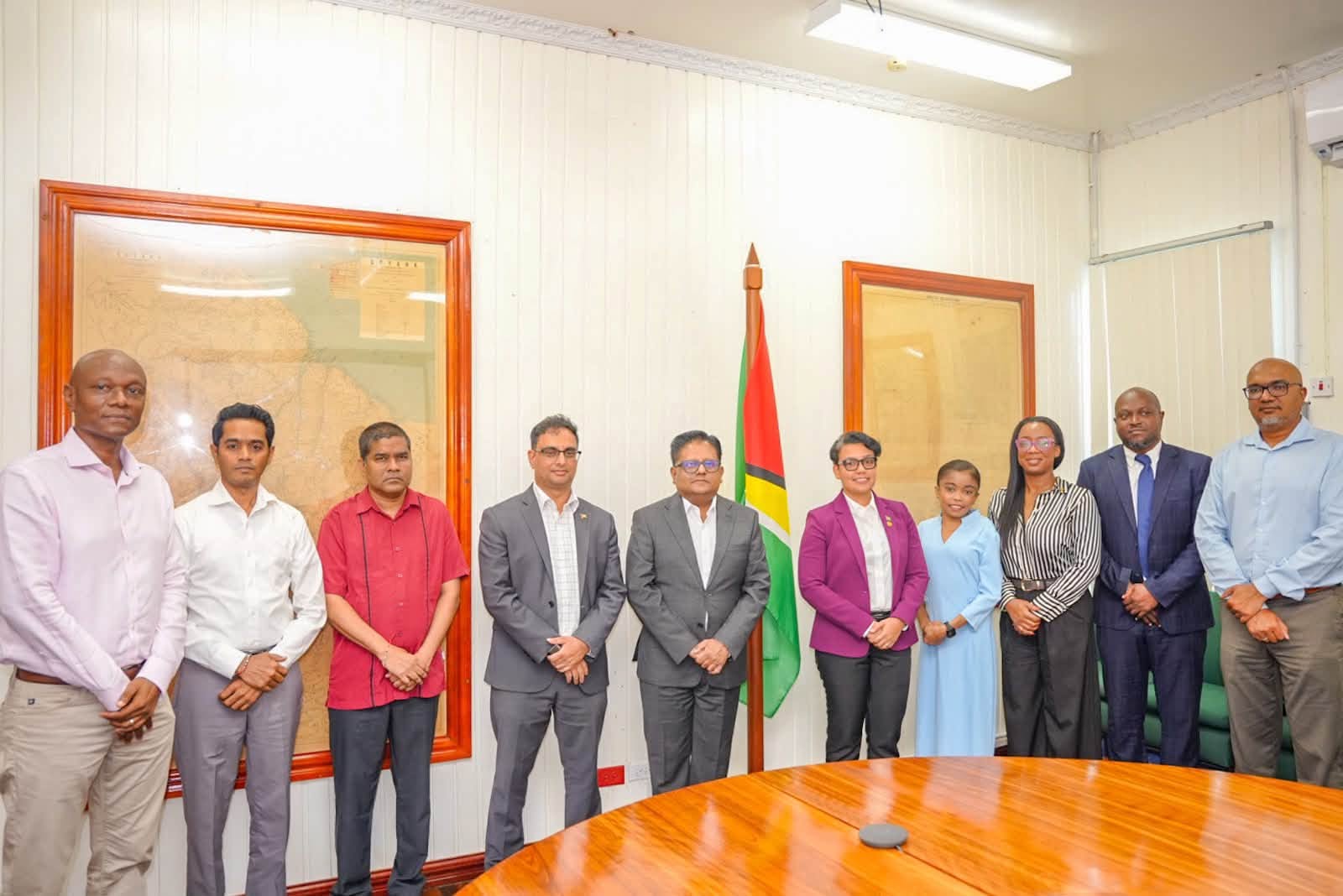
With the Guyana Development Bank launched today, symbolising fulfilment of another People’s Progressive Party/Civic 2025 Manifesto promise to the nation, Senior Minister in the Office of the President with Responsibility for Finance Dr. Ashni Singh today alongside Minister of Tourism, Industry and Commerce Susan Rodrigues and Minister of Public Service, Government Efficiency and Implementation Zulfikar Ally met with the new Board of Directors at the Ministry of Finance.
Minister Singh reiterated to the Board that the new Development Bank is one of the flagship commitments by government and it has the potential to unleash a wave of entrepreneurship unlike anything ever seen in this country’s history. He added that it also has the potential to allow thousands of businesses to be able to access capital to start up or grow and expand their small business in a manner that they were never previously able to do because they were required then to provide collateral as well as pay interest.
Senior Minister in the Office of the President with Responsibility for Finance Dr. Ashni Singh
“Because every single small business owner who is going to access a loan facility through the GDB, we would like to see every one of them invest the resources in a viable business idea and grow their business as well as manage their business responsibly so that their business grows not only to utilise the $3 million loan facility being provided by the GDB but so that they could graduate upwards into accessing loans from the formal financial system-the traditional commercial banks-and grow their business even more,” Dr. Singh re-emphasised during the meeting.
The finance minister explained that the initiative of the bank is intended to achieve a completely new wave of entrepreneurial and productive activity in Guyana as well as stimulate sustained livelihood and sustained business ventures across the length and breadth of the country. He noted that the amount of $20 billion is only an initial capital injection to stimulate either the establishment or expansion of a small business not as an end, but as a means to a much bigger end.
He therefore expressed enthusiasm that entrepreneurs countrywide or persons interested in setting up small businesses will use this period of the country’s development in which there are endless opportunities in a number of sectors, to participate in establishing and growing their businesses in order to boost their livelihoods as well as simultaneously contribute to the country’s continued economic development-especially in the non-oil sector that has seen consecutive years of growth Only recently, Guyana’s Mid-Year Report for 2026 highlighted that the country’s non-oil economy grew by 10.1 percent and has been growing at exceptional rates over the last five years.
Addressing the meeting, Minister of Tourism, Industry and Commerce Susan Rodrigues, under whose portfolio the bank falls, while congratulating the new board members, said in terms of access to financing the Bank can help to develop other traditional and new and emerging sectors of the economy.
“We may see new scenarios and people coming up with new proposals that they won’t ordinarily take to a commercial bank but there is great value in that idea,” Minister Rodrigues said as she urged the bank to be innovative as well in consideration of prospective applicants who may have proposals outside of the norm.
Minister of Public Service and Government Efficiency, Zulfikar Ally in addressing the new board members said government‘s aim is to allow for more people across the country who have brilliant ideas to be able to start small businesses within their communities
“My Ministry will always be there to ensure efficiency in implementation,” Minister Ally said as he referenced government’s digitisation policy and the fact that the new bank includes the active website that allows persons to submit their applications and proposals.
The new Board of Directors of the Bank appointed by the Senior Minister are Chairperson Abu Zaman, Deputy Chairperson Kathy Smith and Directors James Bond, Sukrishnalall Pasha, Dion Inniss, Nalinie Singh and Praem Rambharak.
Government is urging budding entrepreneurs residing in Guyana, as well as those looking to expand their businesses to take full advantage of the opportunity provided and ensure that they submit their applications and proposals to start their businesses through the website established and available online at https://gdb.gov.gy/.
It can be recalled that in its 2025 Manifesto, launched on August 18, 2025 the PPP/C had committed to establishing the Guyana Development Bank (GDB) Following this, in the 2026 Budget presentation on January 26, the finance minister announced a provision of just over $20 billion for the bank. Following passage of the Budget on February 14, the GDB Bill 2026 was drafted and published in the Official Gazette on June 4, 2026. Dr. Singh on June 5, 2026, presented the Bill to Parliament and the Bill was passed on July 27 of this year. It was then assented to by President Ali on July 30 and the Act published in the Official Gazette on the same day. On September 16, 2026, Minister Singh signed the Commencement Order and this was published in the Official Gazette the same day, designating October 5, 2026 as the day on which the Act shall come into operation.
Construction of 110 three-bedroom young professional homes at Palmyra in Region Six is now approximately 60 per cent complete. The first set of houses is expected to be completed this month.
Minister of Housing Collin Croal engages contractors
Speaking with the Department of Public Information (DPI) last Friday, Minister of Housing Collin Croal disclosed that the homes are at varying stages of construction. All 110 units are expected to be completed before the end of the year.
“At Palmyra, we have two sets of houses…We have the three-bedroom normal bungalow [and the] three-bedroom type houses for young professionals,” Minister Croal said.
The project represents an investment of more than $2.1 billion.
Minister Croal said the Palmyra development is among the projects being advanced to ensure communities throughout Guyana benefit from the national housing programme.
The young professional units are being constructed at an approximate cost of $19.5 million each and are intended to provide modern three-bedroom housing for eligible beneficiaries.


 The Guyana Development Bank (GDB) appears not to have a walk-in office for loan applicants, but on Monday — October 5 — began operations through an online portal.