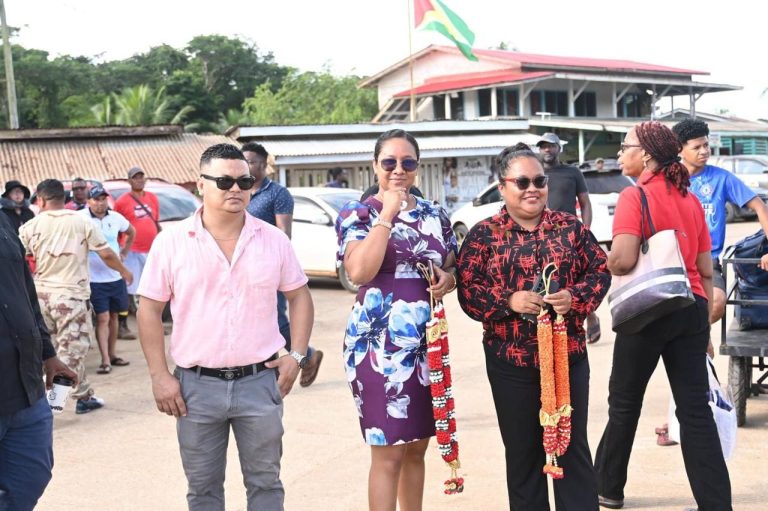
Housing Minister Collin Croal and Minister of Public Service, Government Efficiency and Implementation Zulfikar Ally are in Port Kaituma, Region One, for a session to inform residents about financing through the Guyana Development Bank.
They are accompanied by former government minister and now Director of Government Efficiency Nigel Dharamlall.
According to the announcement, the session will explain the bank’s interest-free, collateral-free loans of up to $3 million for eligible small businesses and persons seeking to establish or expand enterprises.
Croal was welcomed at the Port Kaituma airstrip by Region One Vice-Chairman Paul Pierre, Regional Executive Officer Dr Steven Cheefoon, District Development Officer Orlando Thorne, Community Development Officer Annmarie Robinson and Assistant Regional Executive Officer Jason Ramjohn.
The outreach comes after President Irfaan Ali said an estimated 15,000 to 20,000 persons had applied to the bank following its October 5 launch. Kiskadee Watch reported on October 21 that applications were being evaluated and grouped according to the sectors applicants intended to enter. The figures were estimates, and the report did not state how many loans had been approved or disbursed.
The government announced an initial injection of US$100 million, approximately $20 billion, representing half of the institution’s authorised capital of $40 billion.
Coaching and mentorship would be compulsory and that submitting an application would not automatically qualify a person for the maximum loan. Specialists were expected to assess proposals, help applicants refine their ideas and connect them with technical support.
The bank’s proposed arrangements include service desks in commercial banks and an electronic platform intended to reach applicants, including those in hinterland and riverine communities.
Camex Restaurants Inc yesterday announced the appointment of Christine Bennett-Blair, FCCA, MCSI, MBA as its new Chief Executive Officer (CEO).
Camex operates quick-service restaurant brands, including Church’s Chicken, Dairy Queen and Mario’s Pizza.
A Camex release said that Bennett-Blair is no stranger to Camex having served the organization from 2006 to 2025, during which time she held key leadership positions including Chief Financial Officer (CFO) and Deputy Chief Executive Officer (DCEO).
It added that she has a profound understanding of the company’s operations, culture and strategy and is well positioned to guide Camex into the next phase of its development.
Bennett-Blair is a Chartered Accountant with more than 20 years experience in finance, auditing, corporate governance and executive leadership in the private and public sectors, the release said.
“Christine brings an exceptional combination of institutional knowledge, financial discipline and executive leadership to Camex,” said Thomas Monaco, Board Member of Camex Restaurants Inc. and President of Small Enterprise Assistance Funds (SEAF). “Having played an important role in the company’s development over nearly two decades, she understands the business, its people and the opportunities ahead. We are delighted to welcome her back and are confident in her ability to lead Camex into its next chapter”, he added.
As Chief Executive Officer, Bennett-Blair will work with the Board of Directors and Management Team on the company’s strategic priorities, enhancing business performance and further elevating the customer experience, the release said.
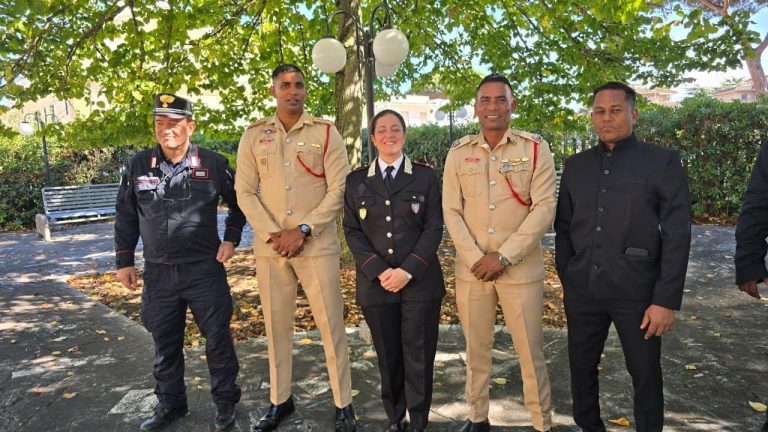
Two Guyana Fire Service (GSF) officers have completed specialised training in forest fire and crime scene investigation in Italy.
Acting Divisional Officer Suresh Persaud and Station Officer Javid Mohamed attended the Basic and Advanced Course in Forest Fire and Crime Scene Investigation at the Carabinieri Forestry School CoEEP in Sabaudia from October 4 to 16, according to the Fire Service.
The programme examined how vegetation, available fuel, wind, temperature, humidity and terrain influence the development and spread of forest fires. Investigators use these factors to interpret conditions at a scene and identify possible points of origin.
Training also covered systematic scene examinations, including observation, documentation and assessment of physical evidence to determine whether fires may have resulted from accidental ignition, negligence or deliberate action.
Participants were instructed in securing scenes, recognising potential evidence and maintaining its integrity during collection and handling. The course emphasised minimising disturbance, particularly where criminal activity is suspected.
Another component addressed the preparation of factual investigative reports, distinguishing observations, witness accounts and technical interpretations from conclusions supported by evidence.
The Fire Service said the training was relevant to investigations involving forests, grasslands, agricultural lands and other areas with substantial vegetation. The knowledge gained could also help identify recurring causes and guide fire prevention campaigns.
Persaud and Mohamed attended alongside Guyana Forestry Commission Deputy Commissioner Tasreef Khan. The programme highlighted cooperation among fire services, forestry authorities, police investigators and environmental agencies.
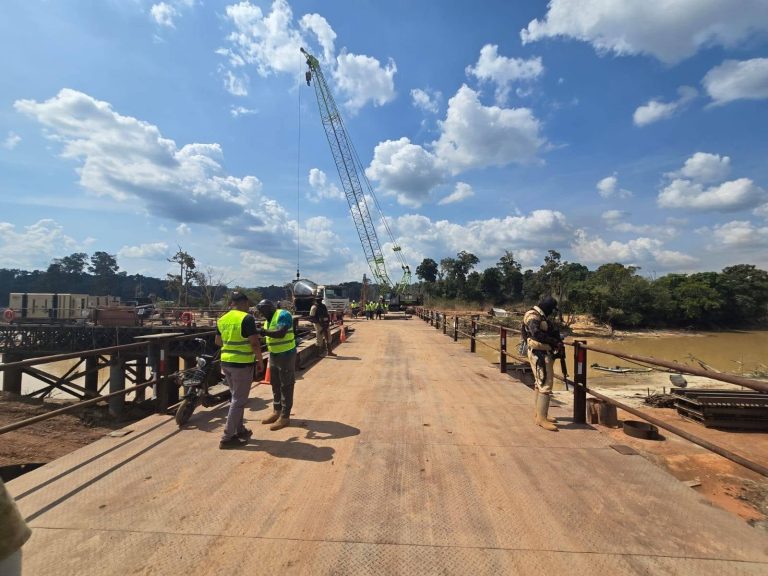
Minister of Natural Resources, Vickram Bharrat, yesterday joined Minister of Public Works, Juan Edghill, for a site and project inspection of the Puruni Bridge which is currently being built in Region 7.
The project which was recently undertaken by Canadian company Aris Mining will see a 109-metre steel bridge replace the pontoon system, enhancing the lives and connectivity of miners and residents of Puruni and surrounding communities.
A release from the ministry said that the project is facilitated by the Government of Guyana, through the Ministry of Natural Resources and “demonstrates the Government’s commitment to developing Guyana’s interior infrastructure, inclusive of the mining and forestry sectors”.
Aris Mining is pursuing gold exploration at Toroparu in Region Seven. A release from the Ministry of Natural Resources on September 5, 2026 said that the project further demonstrates the Government’s commitment to strengthening infrastructure for Guyana’s mining and forestry sectors. It made no mention of Aris Mining’s involvement in the Toroparu project.
In October 2025, Aris Mining published results of its Preliminary Economic Assessment (PEA) confirming Toroparu as a “large-scale, long-life open pit gold project with robust economics”.
Its website says that after the GCM Mining and Aris Gold merger and the arrival of its management team in September 2022, the company paused the Project’s previous construction plans to reassess the Project on a first-principles basis, which included completing a new geological interpretation, updating the mineral resource estimate, and executing optimization studies. “The result is a robust PEA that outlines a major new growth and diversification opportunity for Aris Mining”, the website said.
It says that a Prefeasibility Study is in progress and a construction decision is expected in early 2027.
Last Updated on Wednesday, 4 November 2026, 0:03 by Writer
The 750 kVa generator being offloaded in Linden
Linden now has a 750-kVA (kilovolt-amperes) back-up generator to guarantee water supply during power outages, the ministry of public utilities said Tuesday night.
The ministry said the backup generator replaced the existing generator at the West Watooka Water Treatment Plant and strengthens the facility’s capability to maintain operations during electricity disruptions.
The government said the decision followed Tuesday’s engagement with regional officials and electricity service providers in Linden.
Public utilities minister Deodat Indar reportedly instructed his director-general Alfonso De Armas to oversee arrangements for the deployment of the standby generator.
The Guyana Water Incorporated’s (GWI) executive director of projects, Marlon Daniels, and the director of operations, Jawaharlal Ramjug, were also on the ground overseeing arrangements for the generator replacement and coordinating the necessary technical support, the ministry said.
The director general also coordinated with the ministry’s agency, GWI, to advance Mr Indar’s directive to ensure that all water treatment plants across Linden be equipped with backup power systems, strengthening their resilience and reducing the impact of electricity interruptions on water production and distribution, the ministry added.
The public utilities ministry also said the engagement was attended by the Region 10 regional executive officer (REO), Dr Gregory Harris, along with management and technical teams from the Linden Electricity Company Incorporated (LECI), which serves Mackenzie, and the Linden Utility Services Co-operative Society Limited (LUSCSL), which serves Wismar.
“The Ministry’s priority remained clear — to safeguard essential water services for Linden residents through coordinated interventions, while the respective electricity service providers addressed the ongoing power supply challenges.”
The replacement generator was delivered one day after Lindeners protested the frequent and prolonged blackouts that also disrupt potable water supply.
A Partnership for National Unity (APNU) parliamentarian Sharma Solomon called for a long-term solution to the electricity crisis.
He said it was time the government invest in a 100-megawatt generation system and upgrade the aged transmission and distribution system.
He said that capacity would cater for housing, infrastructural and commercial activities.
Discover more from Demerara Waves Online News- Guyana
Subscribe to get the latest posts sent to your email.
Hours after Port of Spain trumpeted a “proactive foreign policy agenda” for CHOGM 2026, the Prime Minister pulled out — and the explanation arrived by WhatsApp.
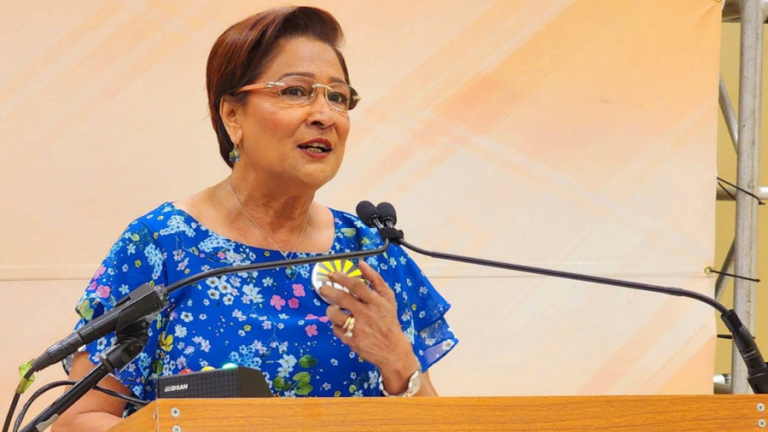
By Calvin G Brown (WiredJA) — It took less than a working day for Trinidad and Tobago’s “proactive foreign policy agenda” to shrink to an empty chair.
On Monday morning the Ministry of Foreign and CARICOM Affairs issued a glowing release confirming that Prime Minister Kamla Persad-Bissessar would depart that evening to lead the national delegation to the Commonwealth Heads of Government Meeting in St John’s, Antigua.
The itinerary was a diplomat’s dream: a reception and dinner hosted by King Charles III, the Commonwealth Business Forum, the Heads of Government Retreat, a CARICOM-Canada session hosted by Prime Minister Mark Carney, and bilateral talks with the leaders of the United Kingdom and Australia.
By Monday afternoon the Office of the Prime Minister had issued a second release. The Prime Minister “will not be attending the Commonwealth Heads of Government Meeting as previously announced.” Foreign Minister Sean Sobers would represent the country. Persad-Bissessar “reverts to her existing OPM schedule.”
That was it. No reason. No apology to the host. No acknowledgement that the Government had, in the space of a few hours, contradicted itself in writing.
The reason arrived by text message
The explanation, when it came, did not come from either ministry. It came in a WhatsApp message to Guardian Media. “Came down with bad case of flu,” the Prime Minister wrote. The Trinidad Express separately reported that she had been nursing a persistent cough and did not want it to disrupt meetings with world leaders.
Nobody begrudges a sick woman her bed. A head of government hacking through a dinner with the King is in no one’s interest, least of all her own. But the illness is not the story. The story is a government communications machine that managed to issue two official statements on the same day, on the same subject, and explain nothing in either of them — leaving the Prime Minister herself to fill the vacuum by text message to a reporter.
For an administration that has staked its reputation on being “influential” in global affairs, this was an own goal scored in slow motion.
Why this summit mattered
CHOGM 2026 is not a routine gathering. It is the first Commonwealth summit held in the Caribbean in 17 years — and the last one was in Port of Spain, in 2009, and Persad-Bissessar herself went on to hold the Commonwealth chair until 2011, the first woman to do so. The Ministry’s own release leaned heavily on that history.
Antigua and Barbuda, the smallest nation ever to host, has spent a year and a fortune preparing. King Charles is in the room. Reparations, climate finance and small-island debt are on the table.
Trinidad and Tobago, one of the region’s heavyweight economies and its loudest recent critic of CARICOM governance, will be represented at head-of-government level by nobody. The Retreat, where the real business is done, is strictly for Heads. Minister Sobers, however able, cannot sit in that room.
The Ministry’s Monday-morning release had insisted that “effective foreign diplomacy must extend beyond ceremonial engagements.” It is a line Port of Spain may now wish it had held back.
The pattern her critics are pointing to
Former foreign minister Dr Amery Browne wasted no time. He described the Prime Minister as having “a very low attendance record at important meetings and summits,” and reminded citizens of her early departure from the CARICOM Heads Retreat in Nevis in February — the episode that ended with Sobers reportedly citing seasickness as a reason he might not take the boat to the venue, and with Trinidad and Tobago absent from the meeting where Secretary-General Carla Barnett’s reappointment was settled.
Persad-Bissessar has disputed that account vigorously, insisting Sobers was effectively disinvited by a Heads-only message and that the reappointment process was “surreptitious.” Fair enough. But the political damage of the Nevis saga was never about who was right. It was about optics: a Prime Minister who leaves, a minister who cannot follow, and a region that moves on without them.
Antigua now hands the opposition a sequel. Two absences from the year’s two most consequential regional gatherings — one unexplained for days, the other unexplained for hours — are enough to turn an unfortunate coincidence into a narrative.
The case for the defence
In fairness, foreign ministers stand in for Prime Ministers at summits all the time. Sobers and his team were already on the ground on Sunday, and the trade and investment forums that matter most to ordinary Trinidadians will carry on without a prime ministerial handshake. The flu is real; coughing on a monarch is not statesmanship. Browne, for his part, is an opposition politician doing what opposition politicians do.
All true. None of it answers the question of why a government with a full press apparatus at its disposal could not manage one honest sentence: the Prime Minister is unwell and sends her regrets.
The lesson from Port of Spain
Diplomacy runs on presence. A bilateral with Carney, a word with Albanese, a quiet exchange with Gaston Browne at the Retreat — these are the moments where a small state punches above its weight, and they are not transferable by press release. Trinidad and Tobago has spent 2026 arguing that CARICOM lacks transparency. It has now shown the Commonwealth, on Caribbean soil, that it struggles with the same thing on a Monday afternoon.
The flu will pass. The question Port of Spain must answer is whether the pattern will.
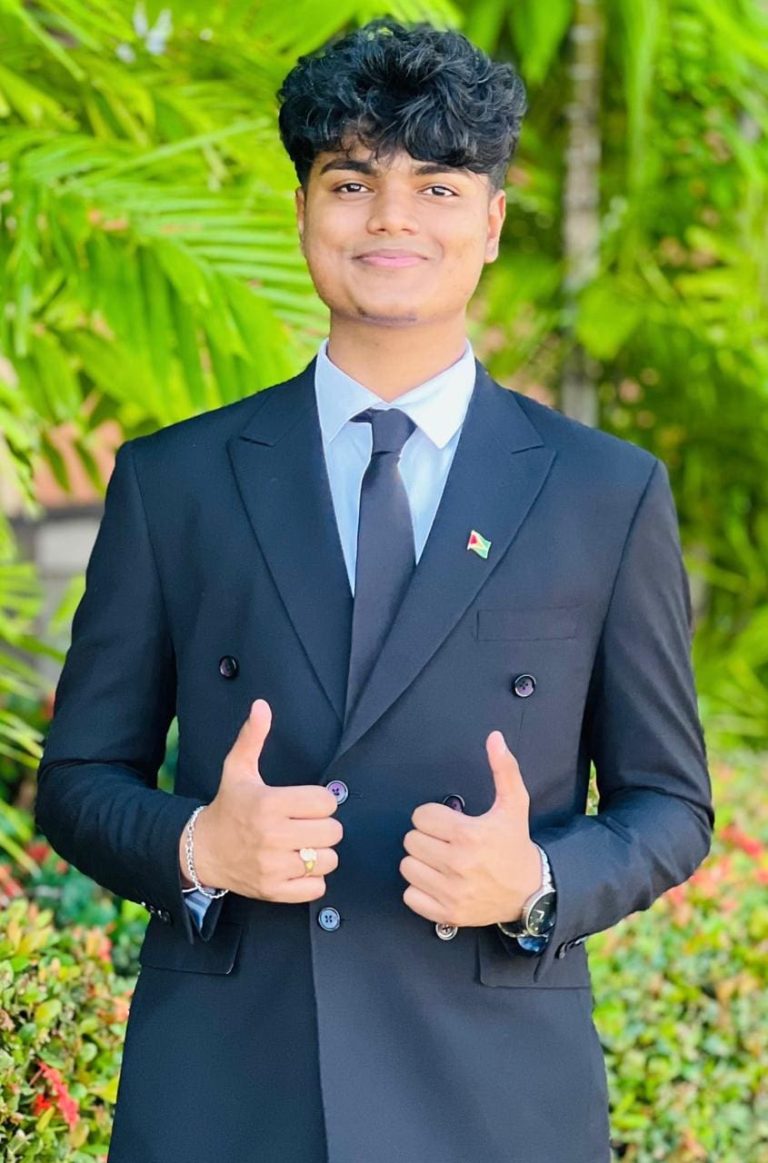
Financial constraints prevented Naresh Jagnanan from taking up a place at one of Georgetown’s leading secondary schools. Years later, the former Essequibo Islands Secondary School student has graduated from the University of the West Indies (UWI), St Augustine, with first-class honours and as a valedictorian of its Faculty of Social Sciences.
For the 21-year-old from Belle Plaine, Wakenaam, the journey is one he attributes to “divine intervention”.
Jagnanan earned a bachelor’s degree in economics and political science. He said he was nominated for valedictorian by the departments of economics and political science and the Guild of Students, in recognition of both his academic performance and his contribution to student life.
Reflecting on his upbringing in the farming community and the opportunities that followed, he told Kiskadee Watch that the experience was difficult to describe.
“What are the chances of a student from a C grade school with parents from a struggling humble background being chosen from among thousands of Caribbean students, to be honoured by the university? 0.001 per cent probably. It has to be God’s divine intervention. That’s the only way I see it,” he said.
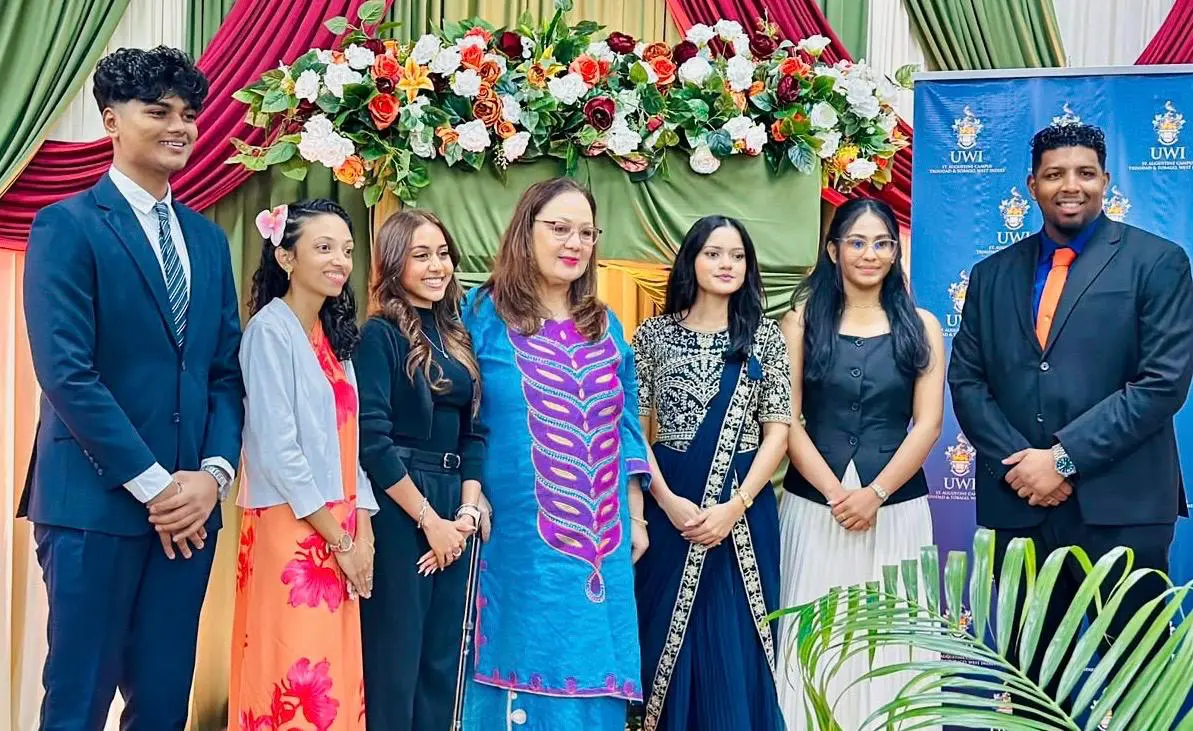
Naresh Jagnanan (left) with UWI St Augustine Campus Principal Professor Rose-Marie Belle Antoine and fellow 2026 UWI valedictorians.
Jagnanan attended San Souci Primary School and topped Wakenaam at the National Grade Six Assessment, earning a place at a leading Georgetown secondary school. His parents, however, could not afford to send their then 11-year-old son to the city, where he had no family member with whom to stay.
He instead attended Essequibo Islands Secondary School in San Souci. As the island’s top NGSA pupil, he received a bicycle, which he used to travel to school.
“The majority of students rode bicycles to school. In the mornings we ganged up and rode to school and in the afternoons, we returned home together.”
He went on to secure Grade One passes in all 11 subjects he wrote at the Caribbean Secondary Education Certificate (CSEC) examinations, a first for the school. The Caribbean Examinations Council (CXC) also named him the region’s most outstanding CSEC student in business studies that year.
“It was the first time in its 58 years of existence that a student of EISC got that award,” he said.
His performance earned him a CXC/UWI scholarship covering tuition, accommodation and a stipend at a UWI campus of his choice. He had to qualify for admission through the Caribbean Advanced Proficiency Examination (CAPE) and take up the scholarship within three years.
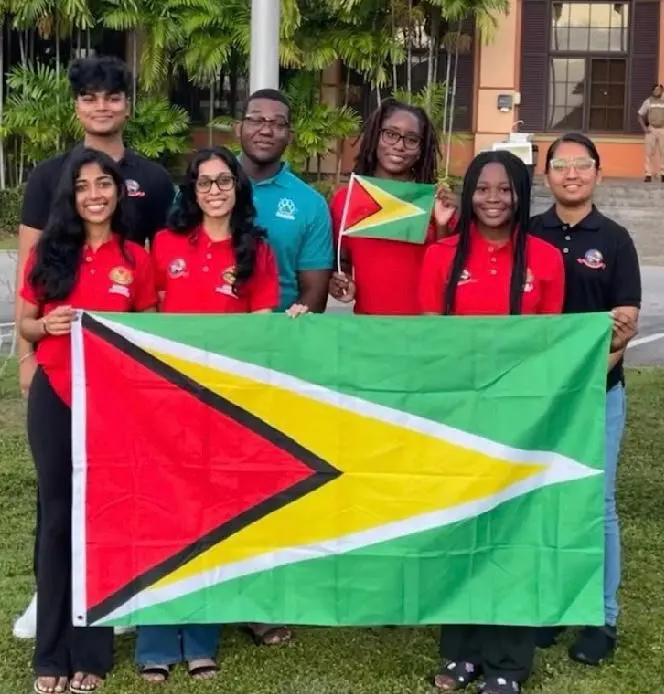
Naresh Jagnanan (left, back row) with fellow Guyanese students.
By the time the scholarship was announced in February 2022, admissions deadlines at schools offering CAPE had passed. Jagnanan said he gained entry to Queen’s College through the intervention of then Education Minister Priya Manickchand.
“So, from February I prepared to write five Unit 1 subjects for my first year of CAPE. I had very limited time to prepare for the exams. The exams were written in May 2022.”
At 16, he also had to adjust to life in Georgetown, where he stayed with a relative. He secured Grade One passes in all five units.
“I even made the merit lists,” he said, laughing.
With only a few months to prepare, he knew he could not afford to lose focus.
“There was no way I could have slacked off. It was rigorous but it taught me a lot of time management skills.”
Encouraged by those results, he took on ten units in his second year, earning nine Grade Ones and a Grade Two. He was named Guyana’s top CAPE student in August 2023, having completed 15 units over the two years.
At its 2023 awards ceremony, CXC recognised him as the Caribbean’s most outstanding CAPE student and its most outstanding CAPE student in business studies. He also received an ACCA award, while Queen’s College received the School of the Year Award for its CAPE performance.
Jagnanan said he was subsequently awarded a Presidential Scholarship. By the time it was announced, however, he was writing his first-year final examinations at UWI and chose to remain there.
“I had already made friends, and I was settled into university life, and boy I did not regret that decision to stay at UWI for a single moment,” he said.
In his valedictory address, he urged students not to allow their backgrounds or financial circumstances to limit their ambitions.
“There is no greater betrayal to yourself than abandoning your own becoming,” he said.
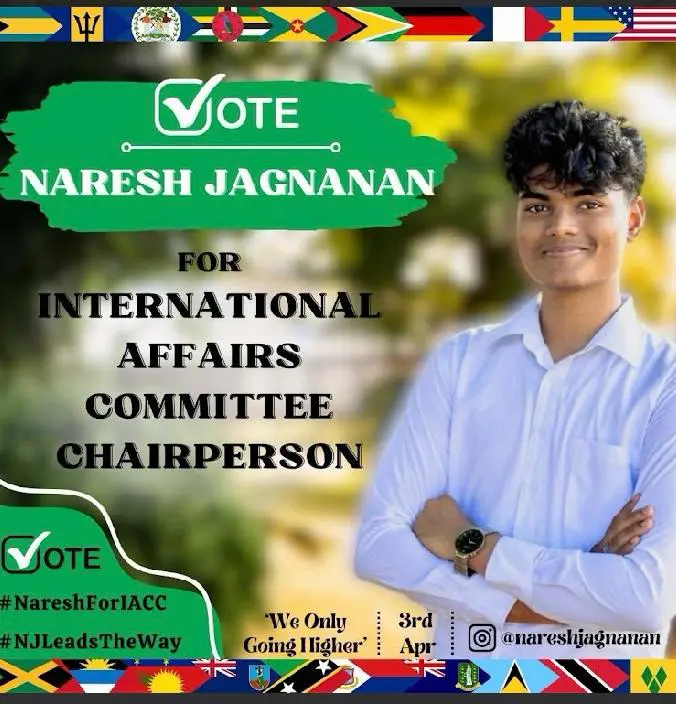
Naresh Jagnanan campaigning for the chairmanship of the Guild of Students’ International Affairs Committee.
His parents’ experiences helped shape that determination. His father is a potter who also works as a security guard, while his mother is a domestic worker. Neither completed secondary school. Jagnanan said they had been taken out of school to help with farming or household work, a practice he described as common in Wakenaam at the time.
“My mom really pushed us. She said she did not want her children to experience the same life she had,” he said.
He recalled his mother mopping and cleaning to support the family, and her wish that her children would not face the same struggle to make ends meet.
His two sisters now teach at Essequibo Islands Secondary School. His older sister, he said, faced the greatest difficulties during her school years.
“We studied late into the night with kerosene lamps. Kerosene lamps were mainly used in Wakenaam at the time because we had no electricity. We finished homework some nights using candles and even torchlights.”
He benefited from textbooks passed down by his siblings and was able to read them before reaching the classes for which they were intended. With electricity now available, he believes children on the island have an easier time studying.
University life
At UWI, Jagnanan lived at Canada Hall, sharing accommodation with students from across the Caribbean. He said he concentrated on academics in his first year and made the Dean’s List every semester throughout his studies.
“We lived in a shared space that we called home. We got to know about community,” he said.
In his second year, he became vice-president of the Guyana Students’ Association of Trinidad and Tobago (GUYSATT). He helped organise activities involving Guyanese students at UWI and other institutions, including the Hugh Wooding Law School, the University of Trinidad and Tobago and the University of the Southern Caribbean.
The association held cultural events, pop-ups, Amerindian Heritage Month activities and a Guyana Culture Night, both on and off campus.
“We really showcased our ‘Little Guyana’ in Trinidad,” he said.
Working with other national student associations also strengthened his interest in Caribbean cooperation.
“If we can bring together associations like this in one space, what can we not do as a region?” he asked.
In his third and final year, he contested the chairmanship of the Guild of Students’ International Affairs Committee (IAC). He said he received the highest number of votes across the guild’s committees.
“That moment was a reminder that I was there for service. I was there because people believed in me and I was there because I believed that change must happen. That was the pivot that really shaped my thinking.”
The role involved representing about 1,500 regional and international students and ensuring their concerns were heard by the university administration.
Under his chairmanship, the committee organised a Caribbean Integration Season, bringing together the various national student associations. Among its activities was the transformation of the JFK Quadrangle into an airport-inspired cultural hub featuring food, storytelling, drumming, dancing and singing.
“It wasn’t just Trini or Guyanese cultures. It was the bringing together of different accents, different histories and traditions like jab jab, masquerades.”
He also led the IAC’s Hurricane Melissa relief drive, which he described as the largest organised at the St Augustine campus.
When the hurricane struck Jamaica in late October, he said, Jamaican students were preparing for examinations while worrying about their families and whether financial support from home would continue. Tuition deadlines and daily living expenses added to their concerns.
“We had to step in. I mobilised campus and university officials early and I got them to create a plan before the hurricane evolved to category five,” he said.
The response included an extension of the tuition payment deadline and university bursaries for some affected students. The committee also approached sponsors in Trinidad for assistance with food and other necessities.
Jagnanan said more than 1,000 students became involved in the three-week relief drive. The campus has 90 clubs, and he recalled participation from clubs he had not previously known about, alongside representatives of nine university departments and two Trinidadian non-governmental organisations.
The university donated 100 cartons of relief supplies for Jamaica and 100 grocery packages for Jamaican students, he said.
“That was when I saw what people can do when we come together. That was a very defining moment in my journey at UWI. It puts into perspective just how much impact we can make if we all come together.”
For his work in 2025/2026, Jagnanan was recognised as the guild’s most outstanding councillor, best team player and most outstanding committee chairperson.
He said student advocacy had changed his own outlook as much as it had helped others.
“I have seen how much advocacy can do especially in rooms with university and campus officials and how much that could literally influence and change people’s lives.”
After his final examinations in May, he returned to Guyana and is now a financial analyst at the Ministry of Finance.
He has applied to universities to pursue a master’s degree in economics and said he had been accepted by all those to which he applied. Among the institutions he is considering are the University of Oxford, the London School of Economics and Political Science, and Imperial College London.
“I’m keeping my fingers crossed that I do get through with a scholarship,” he said.
Asked where he saw himself in ten years, he said: “I’m not sure where and who I will be, but I know that I would be serving people. I am not interested in filling the pockets of corporate business.”
He chose the Ministry of Finance because he believes it can help address prices and protect vulnerable people.
“Regardless of what fancy term I’m given or fancy title I get, my mentality of helping people or serving people will remain in the front of whatever I do.”
He traces that outlook to Wakenaam and the support he received from relatives, teachers, neighbours and small shopkeepers. Teachers helped pay for his CSEC examinations, while others contributed towards his university studies or offered encouragement.
“We may not all be connected by blood, but we are connected by relationships. That is our way of life in Wakenaam.
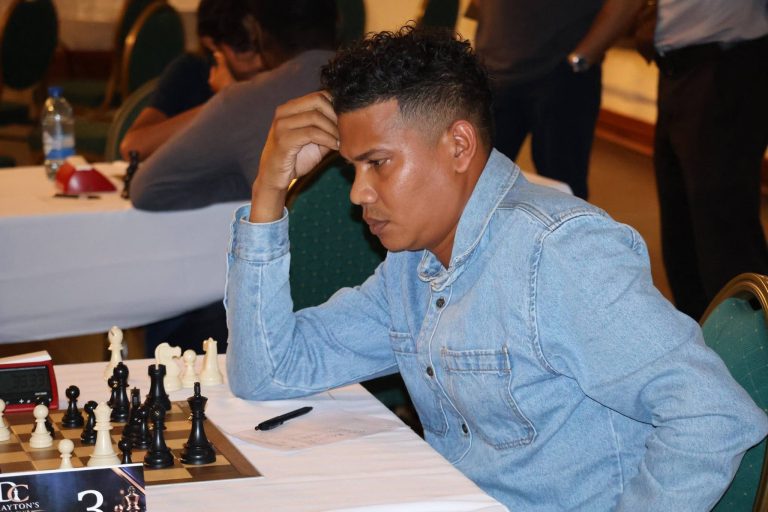
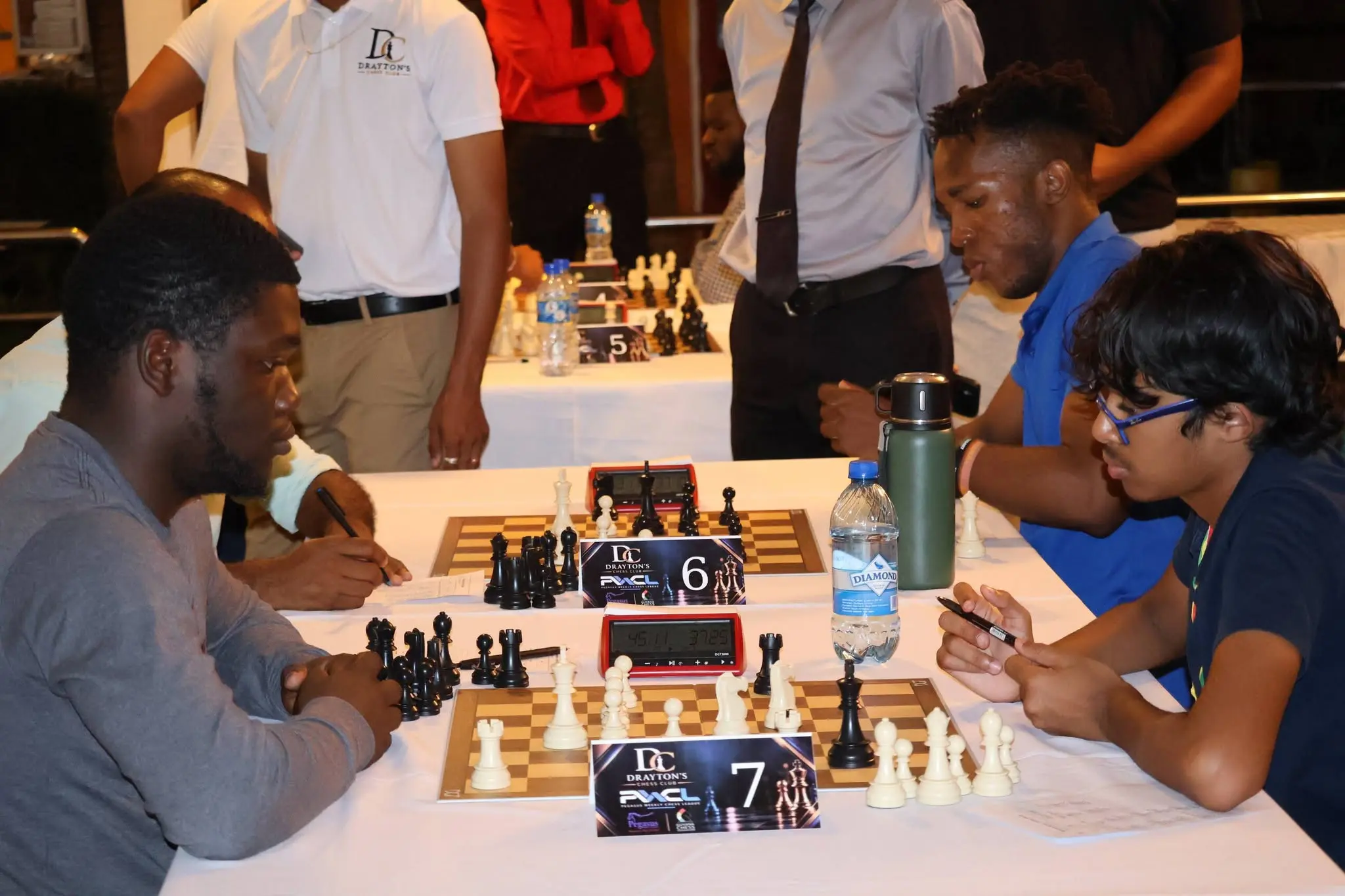
Eight players made winning starts last night, moving off the second season of the Pegasus Weekly Chess League, with six opening-round games settled over the board and two decided by forfeits.
Oluwadare Oyeyipo, Martin Poon, Odinnie Reece, Gilbert Williams, Gaven Houston and Jevaughn Grant earned victories over their opponents, while Keron Sandiford and Joshua Gopaul collected points by forfeit.
Poon defeated Ryan McKay with the black pieces, while Oyeyipo also won with black against Ephraim Blair.
Reece continued that trend by overcoming Jessica Callender, and Grant defeated Raymond Sookdeo to complete four victories for players using the black pieces.
Eight players made winning starts to the second season of the Pegasus Weekly Chess League
Williams and Houston were the two players to win over the board with white. Williams beat Jaden Taylor, while Houston secured his opening point against Sachin Beharry.
Sandiford received a forfeit victory against Seth Hugh, while Gopaul’s point came by the same route against Owen Mickle.
The results left all eight winners on one point apiece in the 16-player competition, with no draws recorded in the opening round.
Meanwhile, league administrator Anthony Drayton has launched his website draytonchessclub.com.
Michael Oie Jr scored in either half as Western Tigers beat Anns Grove United 3–0 in the Guyana Football Federation Elite League at the National Training Centre, Providence, on Sunday night.
Kevon Woodley also found the net for the Tigers, while Santos claimed a 3–1 victory over Monedderlust in the night’s other fixture.
Oie opened his account in the 22nd minute to give Western Tigers the lead. Woodley then struck a minute before the end of regulation time in the first half, extending the advantage to 2–0.
The Tigers increased their lead after the restart when Oie scored again in the 59th minute. His second goal completed the scoring as Western Tigers finished with three goals and a clean sheet.
Part of the action between Santos (white) and Monedderlust (red). (Elite League photo)
Santos’ victory followed a similar start, with two first-half goals putting them ahead before Monedderlust pulled one back.
Ezekiel Frank-David struck after seven minutes, and Candel Hazel made it 2–0 in the 20th minute.
Paul McDonald gave Monedderlust hope with a goal in the 48th minute, cutting Santos’ lead to one. The score remained 2–1 until Kymani Sealey found the net in the 78th minute to secure the victory.
Avinash Persaud and Christine Sukhram each captured their 15th Guyana Open title as the 2026 Brava Guyana Open concluded on Sunday, November 1, at the Lusignan Golf Club.
Persaud returned a combined gross score of 156 to win the men’s championship, while Sukhram secured the ladies’ crown with 173 over the two-day tournament, which began on October 31.
Consistency carried Persaud to victory, with rounds of 78 on both days earning him the daily best gross honours in the 0–9 Flight. Marlon Abena finished second overall on 160, with Jalan Raman placing third on the same score. Mohanlal Dinanath claimed the men’s Overall Best Net title with 145.
Sukhram led the ladies’ gross competition with rounds of 83 and 90, taking the daily best gross awards on both occasions. Joaan Deo finished second overall with 188, followed by Princessa Wilkie on 204.
Wilkie won the ladies’ Overall Best Net title with 144 after recording the best net score on each day, returning 70 on Saturday and 74 on Sunday. Sukhram placed second in the net standings with 151, while Sabi Dhori was third on 153.
In the handicap divisions, Jim Peck won the 10–18 Flight with a net score of 135, ahead of Subhas Chandar on 137 and Arnold Deo on 139. Peck also claimed the division’s best gross award with 161.
Jermaine Pillay took both leading honours in the 19–28 Flight, winning with a net 133 and recording the best gross score of 177. Hilton Wong finished second on net 138, while Chet Bowling placed third with 141.
Nigel Smith topped the Senior Flight with a net score of 132. Kishan Bacchus followed on 138, with Carlos Adams completing the top three on 145.
The daily competitions produced several other award-winning performances. In the 0–9 Flight, Dinanath recorded Saturday’s best net score of 71, while Rakesh Harry took Sunday’s award with 72.
Chandar claimed both the best net and best gross honours in the 10–18 Flight on the opening day, scoring 64 and 79 respectively. Peck’s 66 earned him Sunday’s best net award, while Seepaul Sooknanan recorded the day’s best gross score of 79.
Wong returned the opening day’s best net score of 68 in the 19–28 Flight, while Bowling claimed best gross with 88. Pillay secured both awards on Sunday with a net 63 and gross 85.
In the Senior Flight, Smith recorded Saturday’s best net score of 65, with Adams matching that score to take Sunday’s award.
Myung Ja-Kim won the ladies’ nearest-the-pin prize on the first day. Deo claimed Saturday’s longest-drive award, while Wilkie earned that honour on Sunday.
Persaud added both men’s longest-drive awards to his championship success, while Danny Aldebotoe won the opening day’s nearest-the-pin prize. Value4U sponsored the men’s special awards.
Brava Solutions supported the championship as title sponsor for a fifth consecutive year. Other sponsors were SLB, Umami, Baker Hughes, Kris Persaud of Tristar, Value4U, Feroze Barakat of Odyssey Tours, Ready Mix, GYSBI, Gulf Engineering and GBTI.
The Lusignan Golf Club thanked the sponsors, golfers, officials, volunteers and spectators for their contributions to the tournament, which brought players and supporters together for two days of competition and highlighted the continued development of golf in Guyana.