© Cricbuzz
Source: Village Voice News
© Cricbuzz
Source: Village Voice News
Cage fish farming, once doubted as unworkable in Guyana, is now in 43 communities. Most of them are in the hinterland, and residents are earning more and eating more fresh protein.
Minister of Agriculture Zulfikar Mustapha gave the update in an interview with the Department of Public Information (DPI) on Thursday.
He said the programme has grown well beyond its pilot sites at Mainstay, Mashabo and Lake Capoey in Region Two.

“I can remember vividly two, three years ago when the president mentioned about cage fishing, people were laughing, saying that that kind of activity cannot be done in this part of the world… But we have proved them wrong,” Minister Mustapha said.
Cages are now in place at Rockstone, Shulinab, Nappi, Orealla, Siparuta and St Cuthbert’s Mission, among other communities.
The minister said the programme is helping villages “tremendously in supplementing their income and at the same time providing necessary proteins for the community.”

The programme has grown steadily this year. Minister Mustapha told DPI earlier this year that close to 53 cages were operating across the country, most of them in Indigenous and hinterland communities.
He said then that one cage can make about $8 million in a production cycle. A village with three or four cages could add between $24 million and $25 million to its local economy.
Under the programme, the government gives communities cages, fingerlings and feed, along with technical support and training from the Fisheries Department.


“I don’t want the communities, these indigenous communities to be dependent anymore, that you must go and give them things. I want this community to be a producer of commodities,” he said.
He noted that hinterland villages now run 13 agro-processing facilities, which package their own products and sell commercial quantities on the coast. Peanut butter made at St Ignatius in Region Nine is now on supermarket shelves in Georgetown.
The government’s support also extends to finding buyers. The New Guyana Marketing Corporation (New GMC) links producers with buyers, so communities are not left on their own once they start producing.
“We are not just doing these things and leave the people by themselves. We are working with them from production right on to marketing,” the minister said.
Minister Mustapha said he is impressed by how organised the communities are and how eager residents are to get into commercial activity.
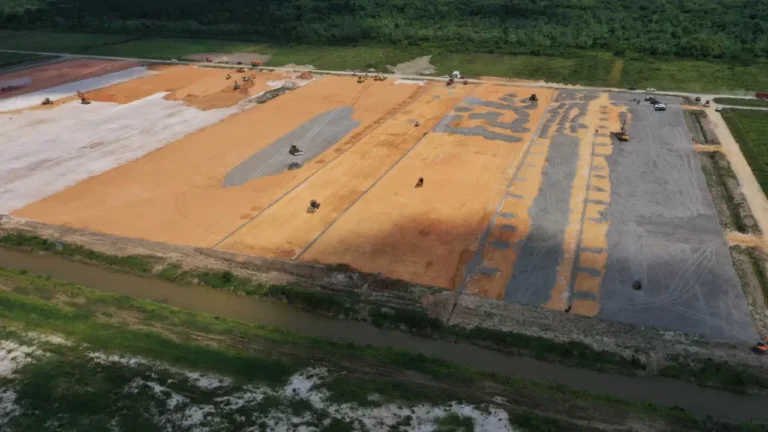
The truck parking facility at Hermitage, Wales, West Bank Demerara, is approximately 75 per cent complete and a management committee will be set up to oversee the management of these facilities.
Minister of Housing Collin Croal made the announcement on Friday during a visit to the 24-acre development, where six contractors are currently working to complete the facility.
The facility is one of several being constructed across the country. It is intended to provide truck operators with a designated area to park their vehicles and carry out routine maintenance, including oil changes and repairs in an organised setting.
Other such developments being pursued in areas such as Golden Grove and Enmore.
According to Croal, works are being done at the Wales facility in various lots which are currently at different stages of completion. Four of the six lots are expected to be completed within a month and the remaining two before the end of the year.
“So I can safely say before this period, 2026, finishes, the operation for this truck parking facility at Wales will be operational,” Croal said.

As construction progresses, attention is also being turned to establishing the management arrangements that will guide the facility’s operations, including its fee structure and the responsibilities of those overseeing the compound.
“We have a management committee that we will be setting up, and we will announce the fee structure,” Croal said, adding that further details on how the facility will operate are expected to be announced in the coming days.
He noted that lighting will also be installed on the tarmac to allow operators to work at different hours, making the facility more convenient for persons who depend on their vehicles for their livelihood.
The management arrangements will also include security and maintenance, with Croal noting that workers will be needed to protect the compound, oversee payments and ensure the area is properly maintained.
“There will be opportunities for employment to manage the facility,” he said.
Source: News Room Guyana
West Indies stunned India in the second T20I of the five-match series at the JSKA International Stadium in Ranchi. The evening started with Sanju Samson’s onslaught, which was followed by Tilak Varma and Shreyas Iyer’s stupendous cameos that helped the hosts post 249 runs on the board in the first innings.
At the halfway mark, things were looking comfortable for India in the middle, but the equation quickly changed in the second innings. Captain Shai Hope once again stole the show with his phenomenal knock of unbeaten 102 runs off 45 balls. Sherfane Rutherford produced a stunning show too, scoring 84 runs off just 37 balls. They stitched a partnership of 120 runs and that was arguably what pushed India out of the contest.
Towards the fag end, Romario Shepherd joined the party and played a perfect cameo to get the job done, which looked impossible at one stage. Especially after the powerplay. India were off to a cracking start with the ball, with Mayank Yadav picking up two wickets of Kamil Pooran and Shimron Hetmyer in the first over itself. In the final over of the powerplay, Rovman Powell was sent packing for 24 runs as India looked to be in control.
However, Hope and Rutherford’s partnership proved deadly as West Indies registered the second-highest chase in T20I cricket history. South Africa’s 259 run case against West Indies is at the top of the list. (India TV News Network)
Source: INews Guyana
Four CARICOM assessment teams are to meet between October 12 and 27, 2026 to examine whether the Region can meet its own demand for paints, hydraulic cement, glass bottles and bitumen. Their reports will be critical inputs that regional trade ministers will consider in deciding on future tariff treatment for the products.
The groups were established by the Council for Trade and Economic Development (COTED) at its Sixty-second Regular Meeting in June this year.
“The Council has directed the assessment teams to be rigorous in examining the regional supply and demand for products and give careful consideration to the sensitivities of all stakeholders and consumers who rely on a stable and predictable supply of the products being assessed,” Assistant Secretary-General, CARICOM Single Market and Trade, Ambassador Wayne McCook stated.
The teams, which are coordinated by the CARICOM Secretariat, comprise technical representatives from several Member States. The Organisation of Eastern Caribbean States Commission and the CARICOM Private Sector Organization have been invited to participate in the meetings.
The groups will examine the competitiveness of intra-regional trade against extra-regional imports, including the effect of the Common External Tariff, non-tariff barriers and logistics costs, and review how the Community’s Rules of Origin criteria apply to the products. They are expected to enlist support and input from stakeholders in the public and private sectors, consumers and civil society as they prepare for their meetings.
The Assessment Teams:
Petroleum bitumen: Barbados, Grenada, Guyana, Jamaica, Suriname and Trinidad and Tobago.
Other Hydraulic Cement: Antigua and Barbuda, Barbados, Guyana, Jamaica and Trinidad and Tobago.
Glass bottles: Barbados, Grenada, Guyana, Jamaica, Suriname and Trinidad and Tobago.
Paints and varnishes: Antigua and Barbuda, Barbados, Dominica, Grenada, Guyana, Jamaica and Trinidad and Tobago, the Organisation of Eastern Caribbean States Commission.
COTED is the CARICOM organ responsible for trade and economic development, and comprises ministers responsible for trade in the Community’s fifteen Member States. (CARICOM)
Source: INews Guyana
The Small Business Bureau (SBB) will channel contributions from over 20 small businesses towards breast cancer awareness and research when its third annual Shop for a Cause Walk & Expo returns to the Kingston Seawall Esplanade on October 10 and 11, 2026.
Held under the theme “Walk with Purpose. Shop with Impact.”, the two-day initiative will combine entrepreneurship with community support, encouraging the public to shop with local businesses while contributing to efforts to advance breast cancer awareness and research.

Each participating SBB-supported business will contribute a minimum of $10,000 or 10 per cent of its expo sales, while additional contributions will be collected from SBB staff, participants in the walk and members of the public, with all donations benefiting the Cancer Institute of Guyana.
Chief Executive Officer of the Small Business Bureau, Mohamed Ibrahim, said the initiative demonstrates how small businesses can contribute to causes affecting families across the country.
“Shop for a Cause allows our small-business community to contribute to an issue that affects families across Guyana while showcasing the talent and resilience of local entrepreneurs. Every purchase made at the expo and every step taken during the walk will help to advance breast cancer awareness and research,” he said.

The expo will run from 4:00 p.m. to 11:00 p.m. on both days, featuring locally produced goods and services from the participating businesses. Health-awareness booths and government agencies will also be present to provide information and support to members of the public.
The awareness walk will take place on Sunday, October 11, beginning at 6:00 am and led by breast cancer survivors.
The initiative also seeks to recognise breast cancer survivors, remember those who have lost their lives to the disease and encourage greater awareness of prevention, early detection and available treatment services.
Members of the public, government agencies, private-sector organisations, small-business owners and community groups are encouraged to participate in the walk and support the expo.
The Ministry of Agriculture’s weekly farmers’ market at the Sophia Exhibition Centre in Greater Georgetown is bringing fresh produce to consumers and also giving small local manufacturers a new way to reach buyers.
Among the vendors this week was Elizabeth Nandesar of Nandesar Manufacturing Enterprise, a local agro-processing business that makes pepper sauces, seasonings, curry mixes, marinades, dips and pickles, including mango achar. The company already supplies supermarkets, but its representative said the market has opened up new customers.

“This has really boosted our market, not only at the supermarkets that we supply, but many places from different entities have come out,” she said.
Minister of Agriculture, Zulfikar Mustapha said more small businesses are asking to take part. He has told organisers to make room for producers who turn up on market day without registering beforehand.


“If they don’t have any contact, they can turn up on the day of the market… so that we can keep expanding the market,” the minister said.
The minister said the market is part of the government’s efforts to ease the cost of living by connecting farmers and producers directly with consumers, instead of through middlemen.
“People are just inflating the price in the middlemen. So, we have to try as much as possible to get rid of that… so that they can have directly from the farm to the people,” he said.
The market runs every Wednesday in October from 3 p.m. The minister said a similar market will be held at least once a month in Regions Two, Three, Five and Six.

Small businesses and farmers who want to take part can contact the Ministry of Agriculture through its Facebook page or phone line or contact the Guyana Marketing Corporation (GMC).
Source: Department of Public Information (DPI)
Minister of Human Services and Social Security Dr Vindhya Persaud said governments must remain accessible, accountable and connected to the people.
She was addressing parliamentarians at the 153rd Inter- Parliamentary Union (IPU) Assembly in Arusha, Tanzania.

The assembly, held from October 5 to 9, brought together parliamentarians under the theme “Enhancing good governance and empowering communities through inclusivity, trust and opportunities for all”.
“We believe that our government must remain accessible, responsible and connected to the people.”
Dr Persaud outlined Guyana’s approach to engaging citizens, including direct interactions with the president and cabinet in coastal, indigenous and riverine communities.
She said digital platforms also allow citizens to raise concerns and provide feedback, helping the government address everyday frustrations and strengthen accountability.
These engagements support wider participation by young people, women, persons with disabilities, businesses, civil society and faith-based organisations.
She highlighted the annual National Toshaos Council conference as a forum where indigenous leaders discuss their communities’ priorities with the president and cabinet.

Dr Persaud also pointed to the allocation of 15 per cent of revenue from Guyana’s carbon credit sales to indigenous communities, supporting development projects determined at the village level.
Turning to public services, she cited housing provision for 53,000 families, free university education, technical and vocational training, and scholarships among the government’s measures to widen opportunity.
She further highlighted expanded support for senior citizens and persons with disabilities, alongside investments in healthcare, digital connectivity and roads to improve access to services and markets.
Dr Persaud said parliament plays a central role in translating citizens’ concerns into legislation and holding government accountable.
“Guyana’s parliament is pivotal to our governance framework. Where diverse voices contribute to legislation representing our population’s perspective,” she said.
Against the backdrop of geopolitical tensions and climate uncertainty, the minister said people need to understand how decisions made in parliamentary chambers will affect their lives.
Thus, she called for stronger international cooperation to share effective approaches to inclusive governance, while safeguarding privacy and maintaining public trust.
Source: Department of Public Information (DPI)

Guyanese archers made a strong impression in the inaugural Caribbean Premier Archery League (CPAL), copping seven individual medals in the competition, which was held remotely.
The 17-member Guyana team won three gold, two silver and two bronze medals.
The gold medallists were Shianne Affonso-Simon in the Senior Women (Barebow), Lucas Chung in the Under-21 Men (Recurve) and Brandon Cummings in the Under-18 Men (Recurve)
The silver medallists were Jo-Lee Zammet in the Senior Women (Barebow) and Fatima Gani in the Under-18 Women (Recurve), while the bronze medallists were Melesa Ramnaraine in the Senior Women (Barebow) and Saifullah Gani in the Under-18 Men (Recurve).
Particularly impressive was Guyana making a clean sweep of the top three podium spots in the Senior Women (Barebow) with Affonso-Simon (gold), Zammet (silver) and Ramnaraine (bronze).
“The results represent a significant achievement for Guyanese archery and demonstrate the growing depth of talent across the country’s senior and youth divisions,” Archery Guyana said in a press release.
The CPAL is a new permanent annual competition platform sanctioned by World Archery Americas (WAA).
CPAL was specifically developed for the Caribbean, providing archers across the region with an opportunity to compete at a high, internationally recognised standard without the prohibitive cost associated with frequent cross-border travel.
The league combines standardised World Archery competition formats, modern digital submission of results and certified national-level officiating, creating a verifiable and competitive league environment operating to the standards required for a WAA-sanctioned event.
For developing Caribbean archers, the league therefore provides an important pathway to gain meaningful competitive experience, measure their performances against athletes from across the region and prepare for larger regional and international competitions.
According to the President of Archery Guyana Vidushi Persaud-McKinnon, “The participation of 17 athletes across multiple clubs in our beautiful country reflects the breadth of Guyana’s developing competitive archery programme.”
She added: “The results also provide further encouragement as Guyana prepares to welcome athletes from across the Caribbean and Americas for the inaugural Caribbean Archery Championships and the eighth Caribbean Developmental Championships, to be hosted at the Guyana National Stadium, Providence, from October 22-25, 2026.”
Meanwhile, the Board of Directors of Archery Guyana has congratulated the archers, the seven medallists, their coaches, clubs, families and supporters on their achievements and encouraged the development of archery at every level in Guyana.
Source: News Room Guyana

The International Monetary Fund (IMF) has lauded many of the government policies implemented to strengthen institutions and promote economic growth, even as it stressed that existing gaps must be addressed.
In a report issued following its 2026 Article IV Consultation with Guyana, the IMF noted concerted efforts to enhance human capital, from free university education, which has contributed to a 45% increase in enrolment, to local content measures that create opportunities specifically for Guyanese in the oil sector.
It also said strides have been made in raising agricultural production and diversifying Guyana’s energy mix, away from its current reliance on imported fossil fuels.
The IMF said the government’s focus on digitisation is also helping to strengthen public sector transparency and service delivery.
“The authorities are advancing digitalization, with an initial phase of comprehensive restructuring across healthcare, education, revenue administration, human and social services, and security. Once individual services are digitalized, they plan to develop interoperability across various management information systems to help coordinate services and improve efficiency,” the IMF said.
The IMF said public procurement is benefiting from digitisation, but added that it should be further strengthened.
“Steps taken include the launch of a centralized digital platform for government procurement opportunities in early 2026 and its expanded use to provide digital public access to project bids, alongside improved procurement staff training (with IDB support),” it noted.
“The government has also introduced a small business procurement program that mandates that at least 20 percent of government procurement be sourced from small businesses. Efforts should focus on consistent enforcement of transparent procurement rules and strengthened oversight.”
The Fund also said data collection, analysis, and publication should be improved to allow for adequate assessment of the country’s situation.
IMF staff usually visit each member country once a year for what is known as an Article IV Consultation. They meet government and central bank officials, as well as other groups such as business, labour, and civil society, to discuss the economy, including monetary and fiscal policy, the exchange rate, and structural reforms. Topics can also include climate change and digitisation.
After the visit, the staff write a report for the IMF’s Executive Board to discuss. The Board’s views are then shared with the country’s authorities, which completes the consultation.
Source: News Room Guyana