St. Joseph Mercy Hospital Provides Free Surgeries To 27 Needy Guyanese Patients
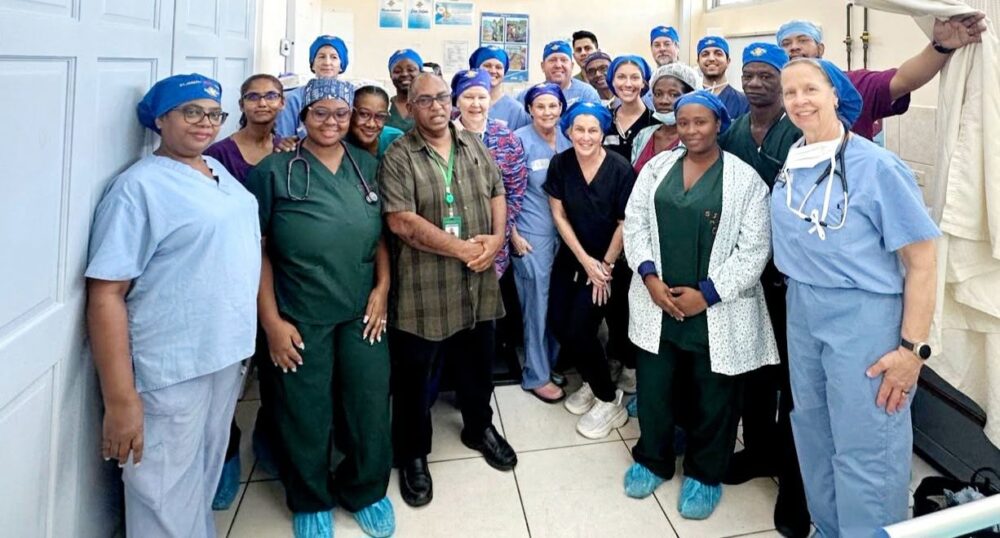
By Mark DaCosta- The hospital with deep Catholic roots has delivered free surgery to 27 Guyanese patients, a reminder of how far charitable medicine still stretches in our country. In a statement dated November 13, St. Joseph Mercy Hospital announced that it had hosted its eighth medical mission outreach, working alongside a visiting surgical team from the United States. The hospital described the exercise as a success and a continuation of its pledge to reach “less fortunate of our communities.”
The visiting contingent comprised general surgeons, urologists, anaesthesiologists and seasoned nurses. They worked beside local colleagues, among them Dr. Tyrell, Dr. Rangel, Dr. Erik and Dr. Menendez, as well as other staff. The procedures ranged widely: hernia repairs, hydrocele operations, circumcisions, hysterectomies, myomectomies and lumpectomies. These are operations that can be financially punishing for low-income households, particularly when they are not urgent enough to be treated as emergencies but are painful, disabling or worrying enough to disrupt livelihoods. The hospital said patients were treated “free of cost” and expressed gratitude to both teams.
The hospital framed the mission as an expression of its founding purpose, offering “quality service to all, particularly the poor.” That purpose is woven into its history. The institution grew out of a lay Catholic initiative in December 1943, when doctors, lawyers and businessmen resolved to build a hospital open to all regardless of race or creed. The Sisters of Mercy agreed to administer it in 1944, and it opened its doors in 1945 with 64 beds. It remains the only not-for-profit Catholic general hospital in the CARICOM region.
The outreach also says something about how healthcare is sustained in Guyana. Partnerships with overseas medical volunteers supplement local capacity, bringing specialist skills to people who might otherwise wait or go without. Yet 27 patients, however welcome their relief, is a small number against the national need. Such missions are valuable, but they are periodic, and the hospital’s statement does not say how patients were selected or whether follow-up care is arranged. Those questions matter if charitable surgery is to complement, rather than substitute for, dependable public provision.
The hospital is well placed to carry such work. It has weathered a devastating fire that destroyed its heritage wing in May 2010, rebuilt from 2014, and earned ISO 9001:2015 certification. It now offers accident and emergency services, laparoscopic surgery, neurosurgery, orthopaedics, dialysis and occupational medicine for the growing oil and gas sector. It also trains nurses through its own school. Jerri Dias took over as chief executive in September 2026, so this mission falls early in a new chapter of leadership.
The hospital describes itself as guided by “compassion, commitment, and professionalism,” values it has invoked since 1945. It operates three campuses: the Parade Street hospital, Mercy Resident Care Demerara and the School of Nursing on Pere Street. As Guyana’s economy expands, the test for institutions like Mercy will be whether prosperity translates into surgical care that reaches ordinary citizens year-round, not only when a visiting team arrives. Meanwhile, institutions such as this must be commended for their contributions to Guyana’s less fortunate.
Source: Village Voice News